Pro-Ject MaiA DS3 black


Buy as a bundle and save
- Pro-Ject MaiA DS3 black
- Davis Acoustics Krypton 6 technik (black) × 2
Specifications and features


Pro-Ject MaiA DS3: integrated amplifier, DAC and phono in a compact enclosure
Four devices in a 20 cm-wide box: that is the challenge taken on by the MaiA DS3, which combines a preamp, power stage, phono preamp and digital-to-analog converter behind a single aluminum front panel. This new version succeeds the MaiA DS2 with increased power (2 x 140 W into 4 ohms), a new Texas Instruments PCM1795 DAC and Bluetooth 5.0 compatible with aptX HD. Design and assembly remain European, by hand.
Four devices in a solid aluminum chassis
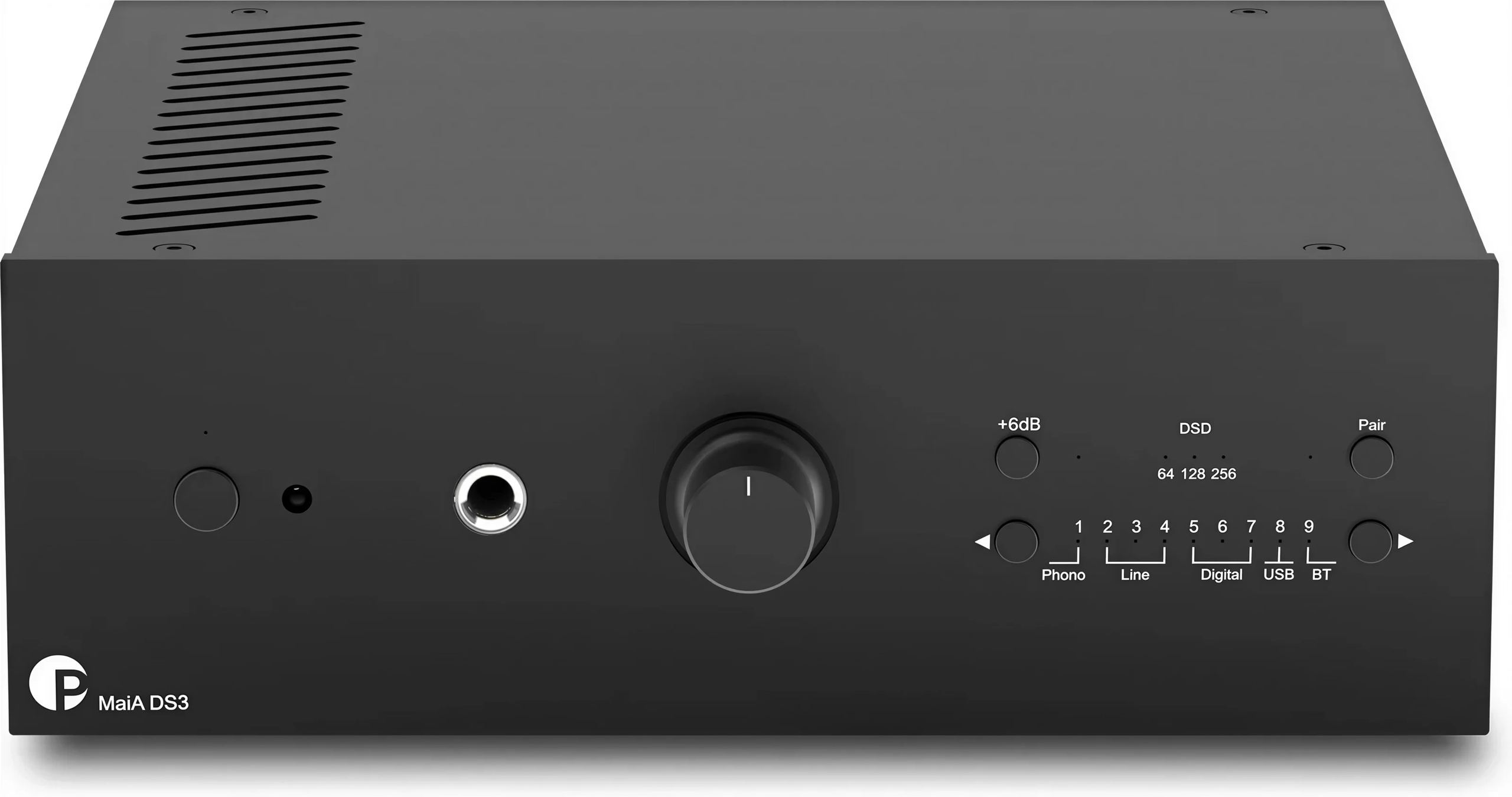
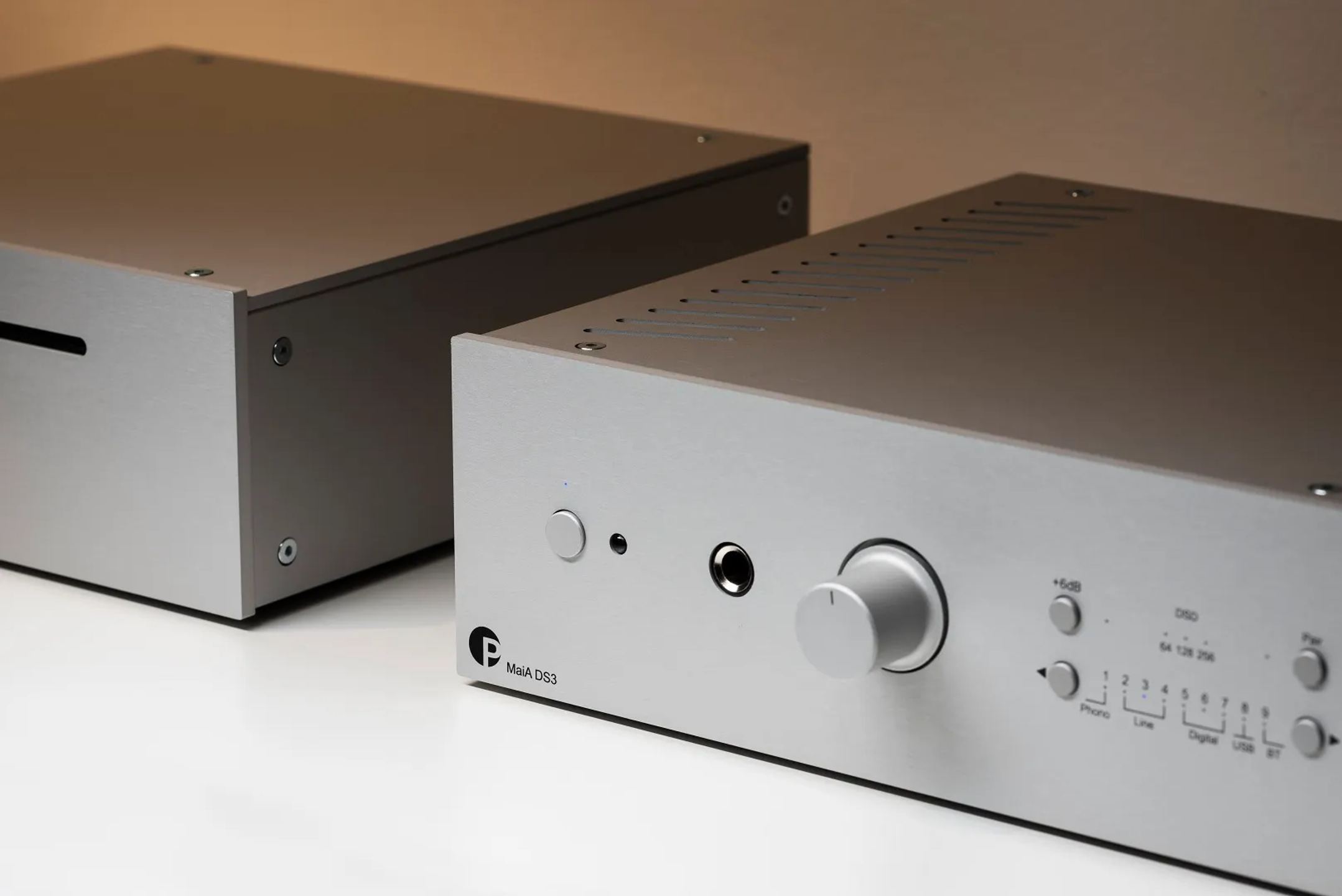
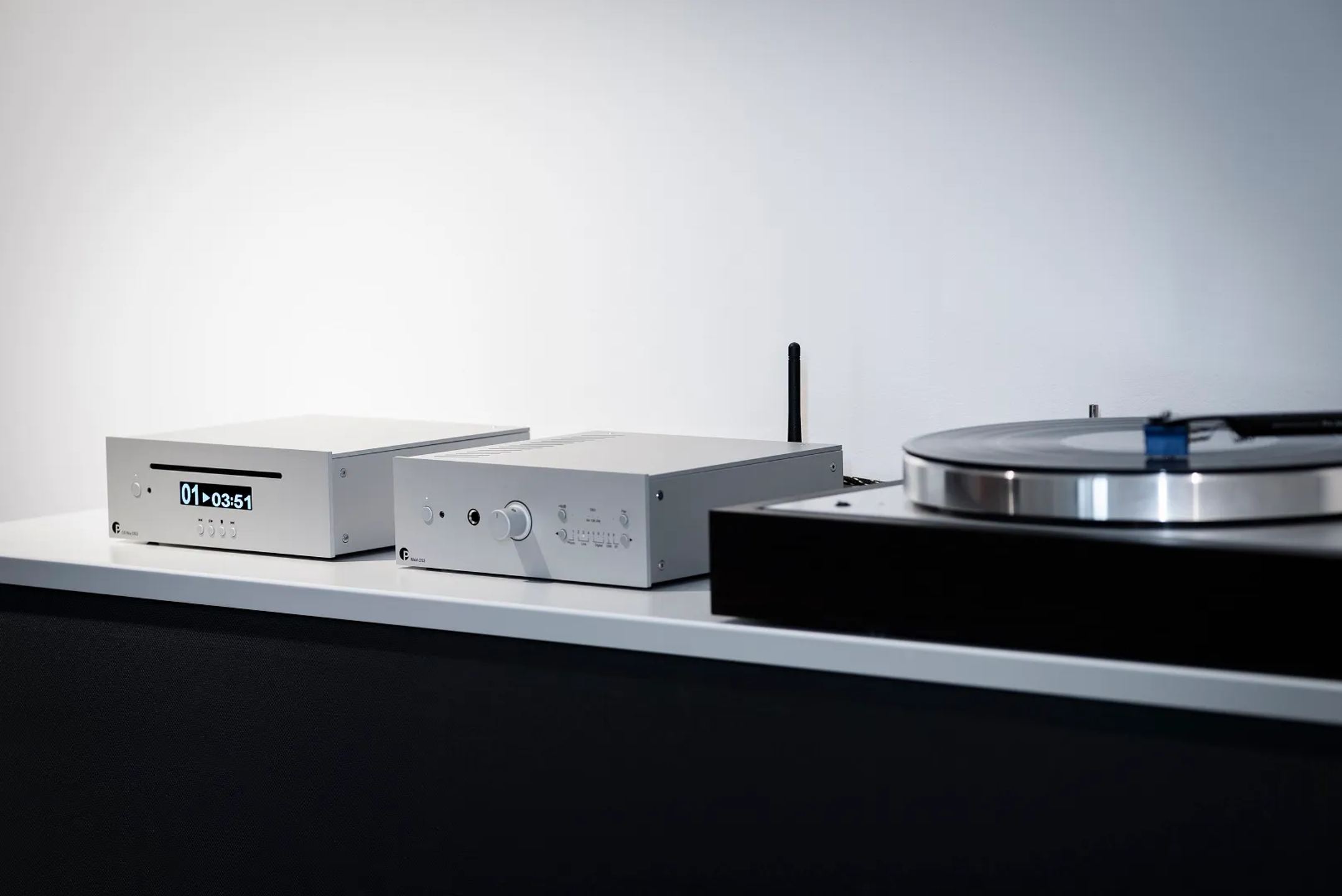
Preamp, power stage, MM/MI/MC-compatible phono preamp and digital-to-analog converter: the MaiA DS3 brings together these four functions in a machined aluminum enclosure measuring 206 x 71 x 240 mm (252 mm with connectors), for 1.85 kg without its external power supply. The front panel remains minimalist, dominated by a large motorized volume knob. No screen, no showmanship: the solid aluminum also acts as shielding against electromagnetic interference.
Two finishes are available, silver or black. Pro-Ject also offers the option of dressing the sides with magnet-mounted wood panels, sold separately, which noticeably change the look of the enclosure. The included remote controls input selection and volume, which remains analog thanks to the motorized potentiometer on the front panel.
Class D with 2 x 140 W in a 20 cm enclosure
Pro-Ject specifies 2 x 80 W into 8 ohms and 2 x 140 W into 4 ohms at 1% distortion. The design is dual mono, with two independent channels to limit crosstalk between channels. The amplification operates in Class D, which partly explains the compact chassis and its high efficiency.
At 10 W into 8 ohms, total harmonic distortion remains below 0.01%. The signal-to-noise ratio reaches 97 dB (105 dB A-weighted) at 1 kHz and the frequency response varies by less than ± 0.3 dB up to 20 kHz. In practice, these power reserves are enough to drive bookshelf speakers without difficulty, and several energy-efficient floorstanding models are also well within the DS3’s capabilities.
A PCM1795 DAC and DSD256 support
The DAC is based on the Texas Instruments PCM1795 chip, a 32-bit / 192 kHz Delta-Sigma converter. On the PCM side, files are supported up to 24-bit / 192 kHz. On the DSD side, the DS3 reads DSD64, DSD128 and DSD256 streams, covering virtually the entire high-resolution audiophile catalog.
The USB input relies on an asynchronous XMOS interface in USB Audio Class 2, which separates the DAC clock from that of the source computer to limit jitter. On Mac and Linux, the DS3 is recognized directly as an audio device. Under Windows, installation of the driver supplied by Pro-Ject is required to take advantage of high-resolution PCM and DSD.
Nine inputs for every source, wired or wireless
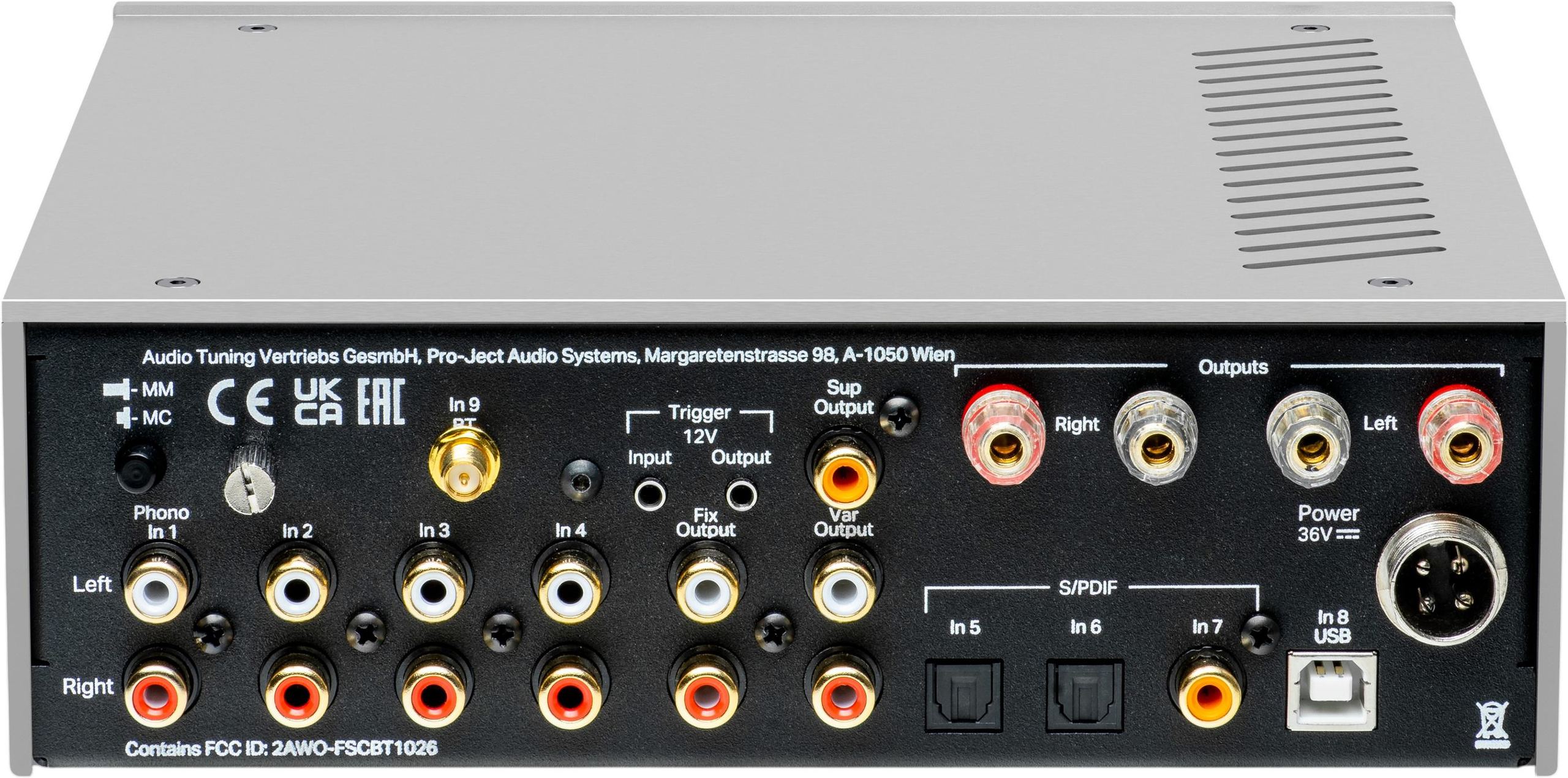
The DS3 offers nine inputs on its rear panel. On the analog side, there is one phono RCA input (compatible with MM, MI and MC) and three line-level RCA inputs with 860 mV sensitivity for connecting a CD player, tuner or external preamp. On the digital side, two optical S/PDIF inputs, one coaxial S/PDIF input and one USB input sit alongside a Bluetooth 5.0 receiver compatible with aptX and aptX HD, A2DP profile.
This combination covers most home setups, from turntable to TV to smartphone. Wireless playback remains limited to Bluetooth, with no network player or built-in Wi-Fi: an external streamer will therefore be required for Spotify Connect, Tidal Connect or file playback from a NAS.
A phono section compatible with MM, MI and MC
The phono stage accepts moving magnet (MM), moving iron (MI) and moving coil (MC) cartridges. In MM, load impedance is 47 kΩ for 40 dB gain. In MC, impedance drops to 100 Ω and gain rises to 60 dB. The absence of finer impedance and capacitance adjustments may limit optimization with some very low-output MC cartridges, but most high-output MCs and all MM/MI cartridges work with the DS3 without difficulty.
Outputs for subwoofer, power amplifier and headphones
The gold-plated speaker terminals accept 4 mm banana plugs, spades or bare wire. A variable RCA output accommodates a subwoofer or an additional power amp; this is a standard preamp output with no built-in active filtering, so the subwoofer will need to handle its own low-pass filtering. A second RCA output, fixed this time, is not affected by the volume setting and is suitable for a recorder or a second listening zone.
The headphone output delivers 2 x 430 mW into 32 Ω at 1% distortion. Enough to comfortably drive common dynamic headphones; very current-hungry planar-magnetic models may reach the limits of the stage. Finally, 12 V trigger input and output allow automatic power-on of another system component.
Designed and hand-assembled in Europe
The DS3 is designed and hand-assembled in Europe, in line with Pro-Ject’s Box Design products. The power supply is external, in the form of a 36 V / 5.5 A DC block: this choice keeps the transformer away from the conversion and amplification stages, but requires extra space behind the cabinet. Standby power consumption remains below 0.5 W.
With its 1,850 g on the scale and 206 x 240 mm footprint, the MaiA DS3 fits on a desk, sideboard or bookshelf, next to a turntable or a TV.
Documentation
Technical specifications
Amplification
- Output power: 2 x 80 W into 8 ohms / 2 x 140 W into 4 ohms (1% THD)
- Dual mono design
- Frequency response (20 Hz - 20 kHz): < +/- 0.3 dB at 20 kHz
- Signal-to-noise ratio: 97 dB (105 dB A-weighted) at 1 kHz
- Total harmonic distortion: < 0.01% at 10 W into 8 ohms
Digital-to-analog converter
- DAC Delta-Sigma PCM 1795DB 32-bit / 192 kHz
- PCM sampling frequencies: up to 192 kHz / 24-bit
- DSD support: DSD64, DSD128, DSD256
Analog inputs
- 1 pair of RCA Phono inputs (compatible with MM, MI and MC cartridges)
- MM sensitivity: 47 kohms
- MC sensitivity: 100 ohms
- MM gain: 40 dB
- MC gain: 60 dB
- 3 pairs of line-level RCA inputs (CD player, tuner, etc.)
- Sensitivity: 860 mV
Digital inputs
- 2 optical S / PDIF inputs
- 1 coaxial S / PDIF input
- 1 USB input
- Asynchronous XMOS USB Audio Class 2 24-bit / 192 kHz
- Requires USB 2.0 or higher
- 1 Bluetooth 5.0 input
- aptX, aptX HD codecs
- A2DP profile
Outputs
- Gold-plated speaker outputs, compatible with 4 mm banana plugs, spades or bare wires
- Variable RCA output for subwoofer or additional power amplifier
- Fixed RCA output unaffected by volume (for audio recorder, etc.)
- Headphone output: 2 x 430 mW into 32 ohms (1% THD)
- Trigger input and output: 12 V on / off detector
Power supply and consumption
- External power supply: 36 V / 5.5 A DC
- Standby power consumption: < 0.5 W
Design and manufacturing
- Machined solid aluminum chassis protecting against external interference
- Magnetic side panels available separately
- Available finishes: silver or black
- Designed and handcrafted in Europe
Included accessories
- Remote control (2 AAA 1.5 V batteries) allowing analog volume control via motorized potentiometer and input selection
Dimensions and weight
- Dimensions: 206 x 71 x 240 mm (252 mm with connectors)
- Weight: 1850 g without power supply unit
Frequently asked questions
What are the differences versus the MaiA S3?
The S3 range targets an even smaller format and simplified electronics: 2 x 40 W into 4 Ω, Cirrus Logic CS4344 DAC, no native DSD support, no MC phono preamp. The DS3 steps up with its PCM1795 DAC, 2 x 140 W into 4 Ω, DSD compatibility up to DSD256, MM/MI/MC phono preamp and asynchronous XMOS USB input.
Do you need to install a driver to use the USB input?
On Mac and Linux, the DS3 is recognized directly as a USB Audio Class 2 device without installation. Under Windows, a driver supplied by Pro-Ject must be installed for high-resolution PCM and DSD streams. The USB input requires a USB 2.0 or higher port on the computer side.
Can the MaiA DS3 drive floorstanding speakers?
With 140 W per channel into 4 Ω, the amplification handles most bookshelf speakers and energy-efficient floorstanding speakers. For complex loads, or low-sensitivity speakers (below 86 dB) in a large listening space, a more powerful power amp will be more comfortable.
Does the subwoofer output provide filtering?
No. The variable output is a full-band preamp output, with no high-pass filter on the main speakers or low-pass filter on the sub output. Filtering and crossover frequency adjustment must be handled by the subwoofer itself.
Which headphones can be connected to the headphone output?
With 2 x 430 mW into 32 Ω, the headphone stage properly drives common dynamic models (Sennheiser HD 600/650, AKG K7XX, Beyerdynamic DT 880, etc.). Very insensitive planar-magnetic headphones or very high-impedance models may require a dedicated amplifier to express their full dynamics.
Does the DS3 support Wi-Fi streaming?
No. The only integrated wireless mode is Bluetooth 5.0 (aptX, aptX HD, A2DP). To access Wi-Fi streaming services (Spotify Connect, Tidal Connect, AirPlay, Roon, etc.), you need to add an external network player connected to one of the line-level RCA, S/PDIF or USB inputs.
What are the wood side panels worth?
They are sold separately and attach magnetically to the sides of the DS3. Several wood species are offered in the Pro-Ject catalog, including shades matched to the brand’s turntables. Their role remains purely aesthetic, with no particular acoustic function.
- Eco-contribution of €2.58 included in the sale price.
- GTIN / EAN: 9120122290330