

Pro-Ject Head Box DS3 B black


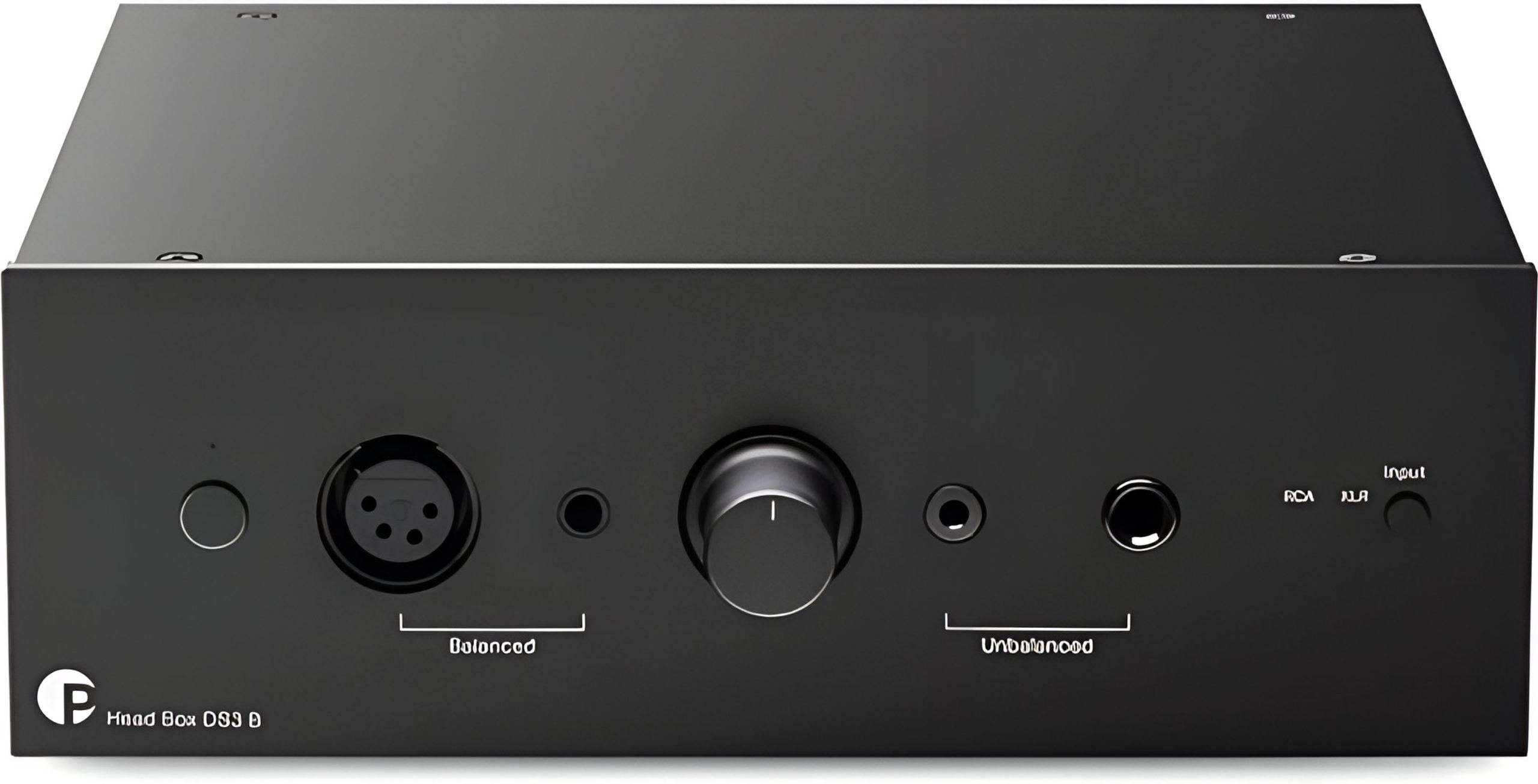
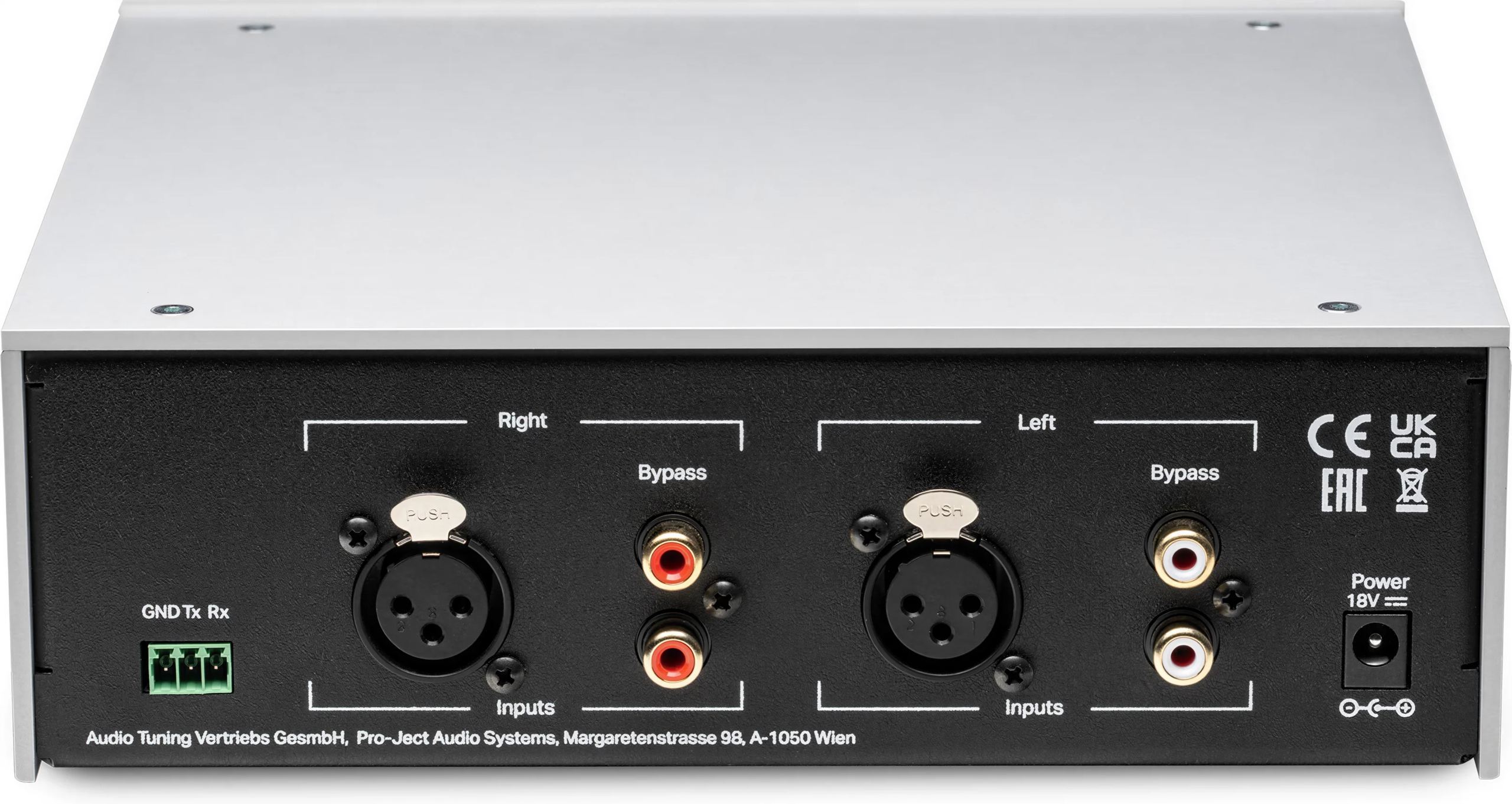
Pro-Ject Head Box DS3 B: fully balanced headphone amplifier
Properly powering high-end headphones requires amplification capable of delivering voltage and current without coloring the signal or clipping on dynamic peaks. With this first model in a new generation of the Box Design range, Pro-Ject applies the balanced principle from one end of the chain to the other, from the XLR or RCA inputs to the balanced headphone outputs. The fully aluminum enclosure and European manufacturing complete a specification focused on performance.

A fully balanced signal chain from end to end
Balanced amplification is regularly advertised by manufacturers, but often limited to the output connector. Pro-Ject says it wanted to avoid this shortcut on the DS3 B: both inputs (RCA and XLR) feed a fully balanced chain all the way to the corresponding headphone outputs. The amplifier design is fully discrete, with no integrated operational amplifier in the audio path.
As for the measurements published by the manufacturer, the signal-to-noise ratio exceeds 118 dB A-weighted at 1 kHz, total harmonic distortion remains below 0.002% (at 1 kHz for 500 mV input), and crosstalk is specified below -83 dB at 10 kHz. The frequency response does not deviate by more than 0.2 dB between 20 Hz and 20 kHz.
Power reserve for demanding headphones
The output stage delivers up to 1500 mW into 32 Ω in balanced mode. Into 8 Ω, it delivers 510 mW; into 16 Ω, 900 mW; into 300 Ω, 560 mW. This distribution covers both low-sensitivity planar magnetic headphones (often current-hungry) and high-impedance dynamic models from the studio world (which require voltage). The minimum supported headphone impedance goes down to 8 Ω, which opens the door to certain low-impedance in-ear monitors without compromising amplifier stability.
Gain differs depending on the input: 12 dB from the RCA input, 6 dB from the XLR input. This asymmetry reflects the fact that a balanced source generally delivers twice the level of its unbalanced counterpart; the gain difference compensates to maintain comparable volume from one source to the other.
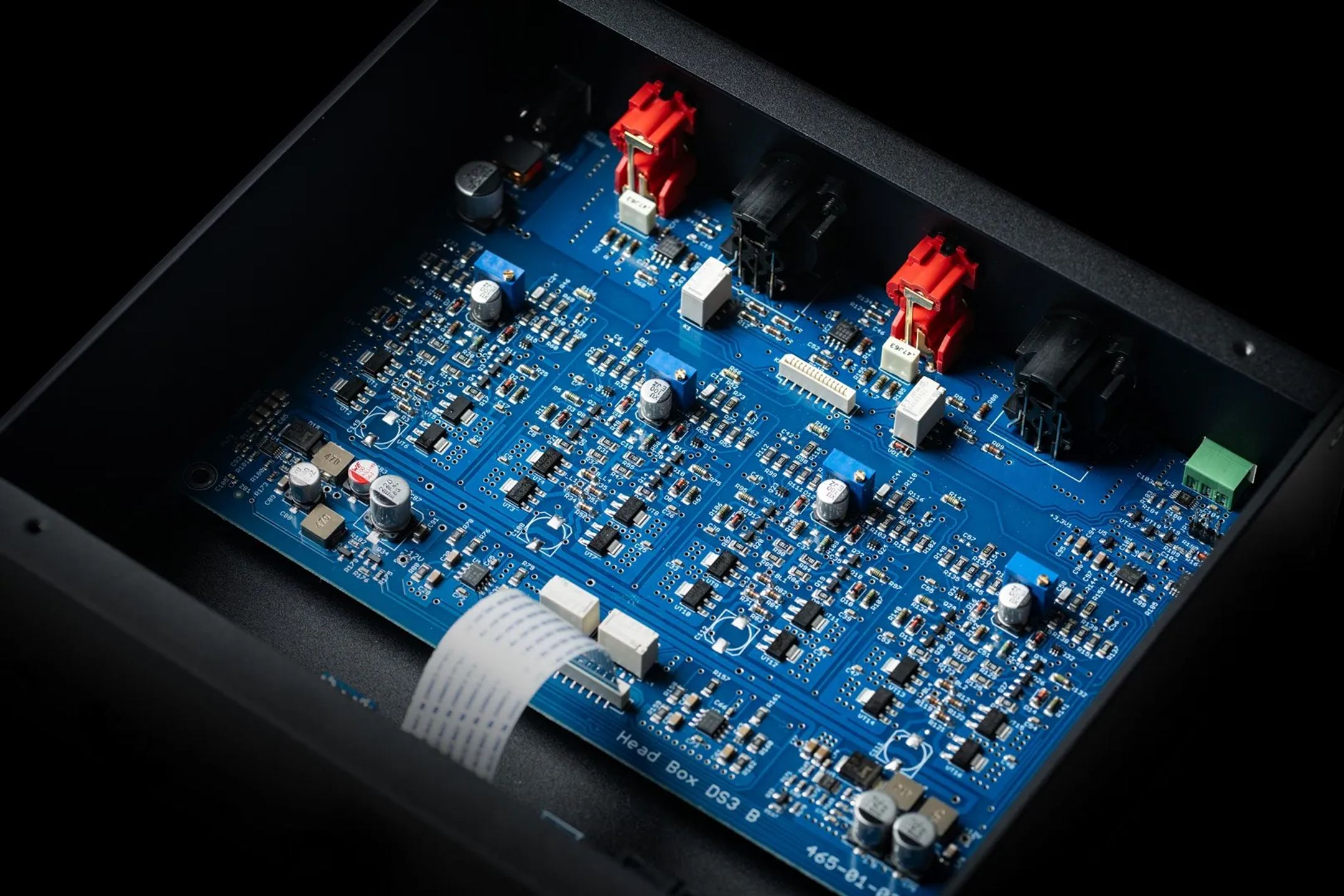
Four headphone outputs and two source inputs
Four headphone outputs are wired on the front panel. Balanced: one 4.4 mm Pentaconn connector and one 4-pin XLR socket. Unbalanced: one 3.5 mm jack and one 6.3 mm jack. This combination covers the terminations supplied with most current headphones, from the classic studio jack to Pentaconn, now common on recent high-end models.
On the rear, one pair of RCA inputs and one pair of XLR inputs allow two sources to be connected simultaneously, switched via a selector on the front panel. An RCA loop output carries the RCA input signal without amplification, making it possible to share the same source with an integrated amplifier or active speakers.
Aluminum chassis and external power supply
The enclosure is made entirely of aluminum, including the buttons and knob. This construction serves two purposes: electromagnetic shielding for the low-voltage stages (which are sensitive to radiated interference) and a weight of 1430 g excluding the power supply, which limits vibrations transmitted to the components. Dimensions of 206 × 70 × 194 mm (218 mm with rear connectors) make integration on a desk or in a compact hi-fi rack easier.
The power supply is external, provided as an 18 V / 1 A DC adapter, compatible with 110-240 V at 50 or 60 Hz. Separating the transformer from the audio circuits prevents radiation from the power block from polluting sensitive stages; standby power consumption remains below 0.5 W. Manufacturing takes place in Europe, in keeping with the rest of the Box Design range. Two finishes are available: silver or black.
Integration into a hi-fi setup
The DS3 B connects to the output of a DAC, a preamplifier, or directly to a source with line output (network player, variable output of a converter, CD player). The two parallel inputs make it easier to use several sources together, and the RCA loop output allows simultaneous connection to a speaker system without having to reconnect the DAC every time you listen. On a desk, the compact format and front-panel connectors make daily use convenient; in a hi-fi rack, the DS3 B fits alongside a preamplifier or DAC from the same range.
Documentation
Technical specifications
Architecture and design
- Fully symmetrical and discrete topology, a benchmark in its category
- Discrete amplifier design for maximum performance
- Masterfully refined symmetrical architecture
- Fully symmetrical signal path for RCA and XLR inputs
Audio performance
- Maximum output power
- 510 mW into 8 Ω
- 900 mW into 16 Ω
- 1500 mW into 32 Ω
- 560 mW into 300 Ω
- Signal-to-noise ratio: > 118 dB A-weighted at 1 kHz
- Total harmonic distortion (THD): < 0.002% at 1 kHz for a 500 mV input
- Crosstalk: < -83 dB at 10 kHz
- Gain: 12 dB / 6 dB (RCA input / XLR input)
- Frequency response: < -0.2 dB from 20 Hz to 20 kHz
Connectivity
- Analog inputs: 1 RCA / Cinch pair, 1 XLR pair
- Analog loop outputs: 1 RCA pair (passthrough output for additional amplifier)
- Balanced headphone outputs: 4.4 mm Pentaconn, 4-pin XLR
- Unbalanced headphone outputs: 3.5 mm, 6.3 mm
- Headphone impedance: minimum 8 Ω
Power supply
- Power supply: 18 V / 1 A DC, 110-240 V, 50 / 60 Hz
- Standby power consumption: < 0.5 W
Chassis and finish
- All-aluminum chassis providing robust mechanical protection and effective shielding against electromagnetic interference
- High-quality aluminum controls and buttons
- Available finishes: silver, black
Dimensions and weight
- Dimensions (w × h × d): 206 × 70 × 194 (218) mm
- Weight: 1430 g without power supply
Frequently Asked Questions
Which headphones can be connected to the Head Box DS3 B?
The DS3 B accepts headphones equipped with 3.5 mm jack, 6.3 mm jack, balanced 4.4 mm Pentaconn, or balanced 4-pin XLR. The minimum supported impedance is 8 Ω, which covers a large majority of in-ear monitors in addition to over-ear headphones. To take advantage of the balanced signal chain, you need a balanced headphone cable terminated in 4.4 mm Pentaconn or 4-pin XLR.
What does the “B” in Head Box DS3 B mean?
The “B” indicates support for fully balanced operation (balanced in English). Pro-Ject uses this suffix on several models in its Box Design range that maintain a balanced signal chain from beginning to end, not only at the output connector level.
Do you need a DAC with balanced output to take advantage of the device?
No. The Head Box DS3 B accepts an unbalanced RCA source on the corresponding input, and the internal chain converts the signal to balanced to take advantage of the rest of the circuit. An XLR source still provides balanced transmission up to the input, with better noise immunity over long cable runs.
Can the RCA loop output be used to connect active speakers?
The loop output carries the input signal without amplification or volume control. It is suitable for feeding an integrated amplifier or a preamplifier, which will handle level adjustment. For active speakers without volume remote control, it is better to use a preamplifier upstream or the variable output of a DAC.
Can the external power supply be replaced with a linear power supply?
The supplied adapter is an 18 V / 1 A DC unit. A linear power supply compatible with these specifications and fitted with an identical connector can be substituted to reduce residual mains noise. Pro-Ject offers linear power supplies in its Power Box catalog intended for the Box Design range; voltage and current should be checked before purchase.
- Eco-contribution of €0.12 included in the sale price.
- GTIN / EAN: 9120137901276




