Pro-Ject Amp Box S3 black


Overview
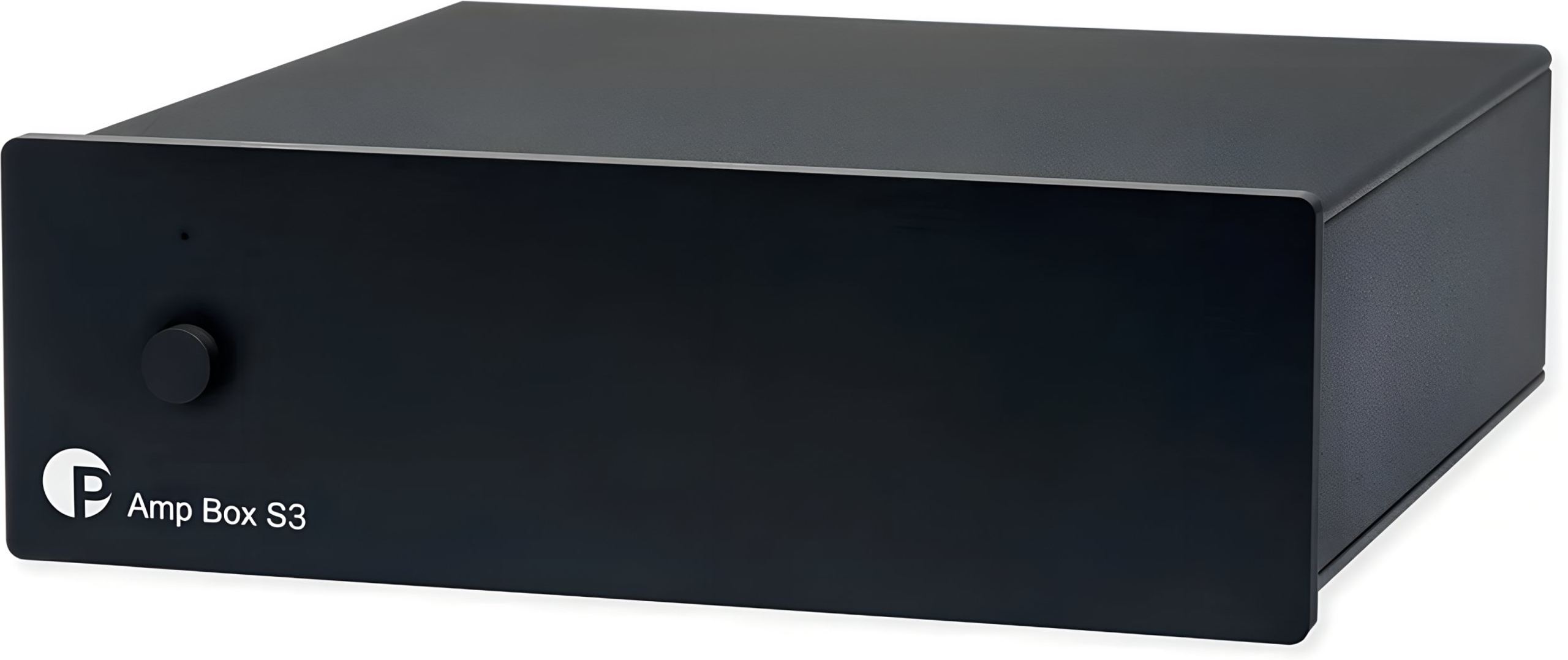
Holding a stereo power amplifier in the palm of your hand remains an uncommon exercise in hi-fi. With the Amp Box S3, Pro-Ject delivers the third generation of its miniature block series, based on a new amplification chip and a completely redesigned printed circuit board. The format remains that of a pocketbook, but the ambition does not: to reproduce the sonic characteristics of a tube amplifier in a fraction of their usual bulk.
A format that fits in the palm of your hand
The chassis measures 103 x 36 x 118 mm and weighs 385 grams excluding the power supply. The construction uses solid aluminum, chosen by Pro-Ject for its dual function: protection against mechanical vibrations and electromagnetic shielding. The finish remains understated, with a single switch on the front panel and a status light. Two matte finishes are available, silver or black, equally suited to a hi-fi cabinet or an office shelf.
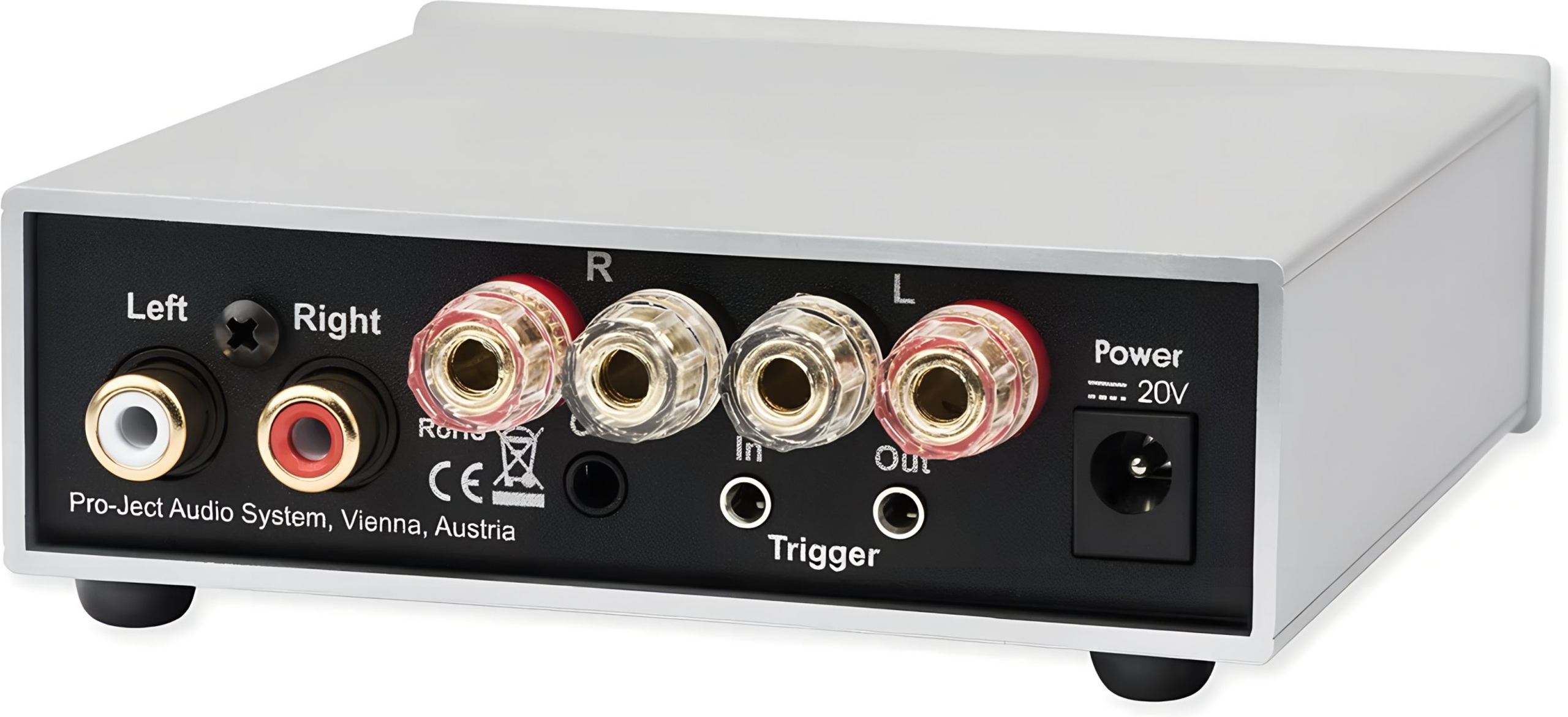
On the rear are a pair of RCA sockets for the stereo input, two pairs of insulated speaker terminals (compatible with Ø 4 mm banana plugs, spades, pins, or bare wire), a trigger input and output on 2.5 mm jack, and the power connector. The external 20 V / 3 A power supply remains universal and moves voltage conversion away from the audio circuit to limit interference nearby.
A new chip, a completely revised circuit
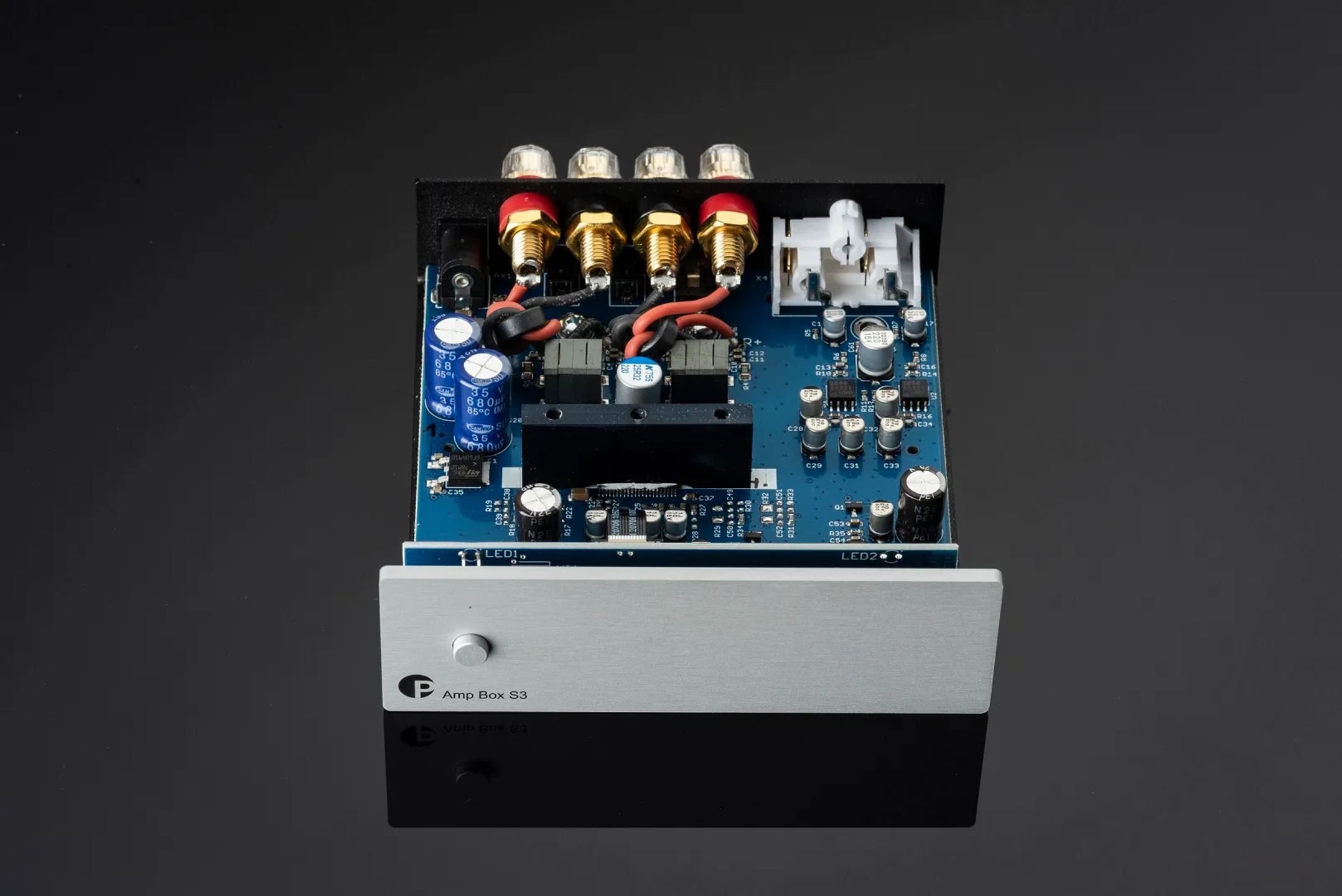
Pro-Ject has renewed the technical foundation between the Amp Box S2 and this third generation. The amplification chip has changed from the Renesas R2A15108SP to the Texas Instruments TPA3221, whose stated efficiency exceeds 90%. This efficiency eliminates the need for heat dissipation fins: a single-piece molded aluminum profile provides passive cooling.
The printed circuit board has also been revised, with a four-layer topology instead of two in the previous version. Pro-Ject states that this redesign is intended to reduce crosstalk, noise, and interference, and improves filtering of the voltage coming from the power supply. The figures have changed: total harmonic distortion plus noise is said to be ten times lower than that of the Amp Box S2 according to the manufacturer, and the response at 20 kHz improves by 1.2 dB. The stated total distortion falls below 0.02% at 10 W into 4 ohms, and the signal-to-noise ratio reaches 87 dBV (100 dBV A-weighted) into 4 ohms.
A deliberately warm signature
Pro-Ject’s design brief is explicit: to approach the sonic characteristics of a tube amplifier, in class D. This is more an exercise in tuning than chemistry, consisting of favoring smoothness in the midrange and slight roundness in the lower end of the spectrum, rather than the analytical transparency sometimes associated with pure class D. Pro-Ject claims a spacious soundstage, especially appreciable in nearfield listening setups.
The available power (2 x 23 W into 8 ohms, 2 x 40 W into 4 ohms, with peaks of 50 W into 4 ohms) remains tailored to speakers of متوسط to high sensitivity in moderately sized rooms. In larger spaces, the dynamic reserve will begin to become limited on demanding passages.
A single RCA input, several usage scenarios
The Amp Box S3 is a pure power amplifier: it has neither a volume control nor a source selector. A controllable line-level source must therefore be present upstream, whether that is a preamplifier, a streamer with volume control, or a DAC with variable output. The single stereo RCA input reflects this specialization logic.
The 12 V DC trigger terminals, one input and one output, open up several scenarios. The output allows a second Amp Box S3 to be daisy-chained, for example in a bi-amplification setup (one block per pair of terminals on a speaker) or in tri-amplification in more demanding installations. The trigger input allows automatic power-on from a compatible preamplifier or processor.
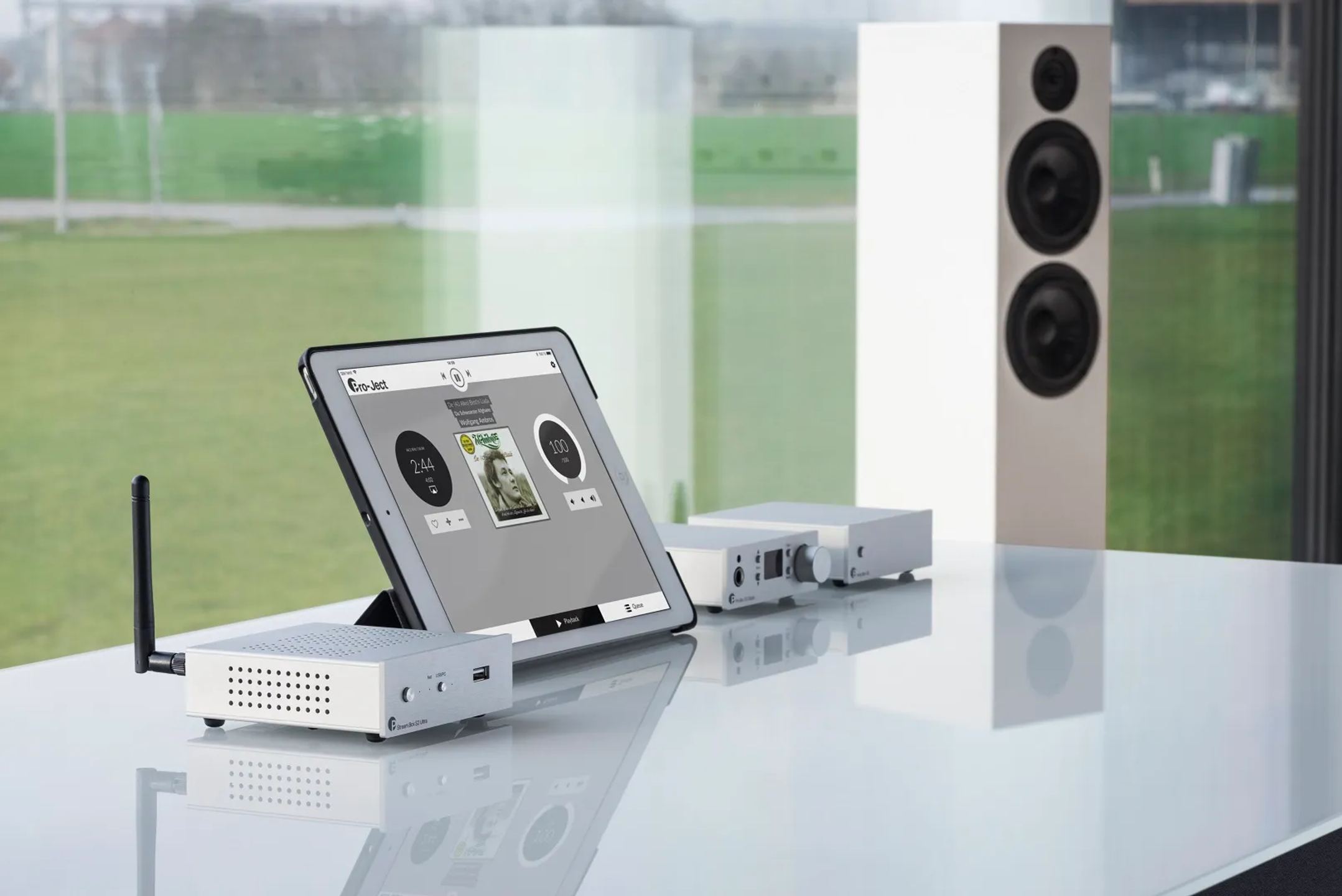
In terms of use, the format opens possibilities that traditional blocks do not cover: amplifying a nearfield speaker system on a desk, upgrading the amplification section of a compact streamer, powering in-wall or in-ceiling speakers, or adding amplification for the secondary channels of a home theater. For conventional living room use, Pro-Ject recommends rooms of 10 to 15 m². Silent operation, with no fan, allows installation in close proximity to the listening position.
Documentation
Technical Specifications
Overview
- Audiophile stereo power micro amplifier
- New PCB concept and sophisticated topology
- Reduced distortion and improved signal-to-noise ratio
- Ultra-compact format and audiophile quality
- Advanced amplification module
- Designed to reproduce as closely as possible the sonic characteristics of a tube amplifier, with a rich, musical sound and analog warmth
Audio performance
- Output power: 2 x 23 W into 8 ohms, 2 x 40 W into 4 ohms
- Peak power: 2 x 50 W into 4 ohms
- Frequency response: 20 Hz – 20 kHz (-0.7 dB into 4 ohms)
- Channel separation: > -68 dB at 20 kHz
- Signal-to-noise ratio: 87 dBV (100 dBV A-weighted) into 4 ohms
- Total harmonic distortion (THD): < 0.02% at 10 W into 4 ohms
- Gain: 31 dB
Connectivity
- Input: 1 pair of RCA sockets (stereo)
- Input impedance: 25 kohms
- Insulated speaker terminals, compatible with: Ø 4 mm banana plugs, spades, pins, or bare wire
- 12 V DC trigger input: 2-pole Ø 2.5 mm jack socket
- 12 V DC trigger output: 2-pole Ø 2.5 mm jack socket, for connecting another Amp Box S3
- Front-panel power switch
Power supply
- Power supply: 20 V / 3 A DC
- Universal power supply included
Design and manufacturing
- Aluminum metal enclosure protecting against vibrations and interference
- Clean, refined finish that blends into any HiFi setup
- Compact format allowing easy concealment
- Available colors: silver, black
- Designed and manufactured in Europe
Dimensions and weight
- Dimensions (w x h x d): 103 x 36 x 118 mm
- Weight: 385 g without the power supply
Applications
- HiFi amplifier for rooms from 10 to 15 m²
- Audiophile amplifier for nearfield speakers on a desk
- Upgrade for the amplification section of a streamer
- Multiroom amplification solution
- Upgrade for the amplification of a home theater system
- Amplification for in-wall or in-ceiling speakers
- Bi-amping or tri-amping configurations via the trigger output
Frequently asked questions
Does the Amp Box S3 operate in class D?
Yes. The amplification module is based on the Texas Instruments TPA3221 chip, a class D circuit with efficiency above 90% according to Pro-Ject documentation. It is precisely this efficiency that makes the miniature format possible, without resorting to a finned heat dissipation device.
What is the main difference with the Amp Box S2?
Three major changes separate the two generations: the amplification chip (TPA3221 versus Renesas R2A15108SP), a four-layer printed circuit board instead of two, and a revised power supply filtering section. Pro-Ject announces harmonic distortion plus noise ten times lower and better behavior at 20 kHz.
Is a preamplifier required upstream?
Yes. The Amp Box S3 does not have volume adjustment. A controllable line-level source is required, whether that is a dedicated preamplifier, a DAC with variable output, or a streamer equipped with quality digital volume control.
Which speakers should be chosen in view of the available power?
Pro-Ject recommends rooms of 10 to 15 m². At this power level, speakers of medium to high sensitivity will deliver the most balanced result. Low-sensitivity models or very large floorstanding speakers may feel constrained on dynamic passages.
- Eco-contribution included in the sale price.
- GTIN / EAN: 9120097829092