Canton Vento 91 black (pack of 2)



Overview
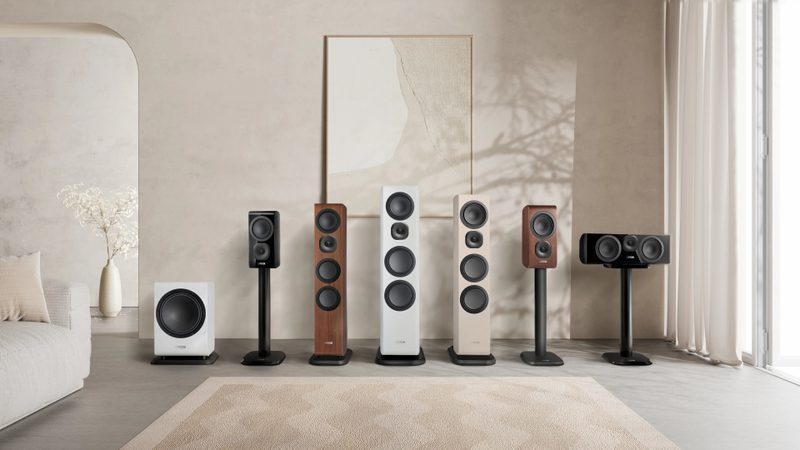
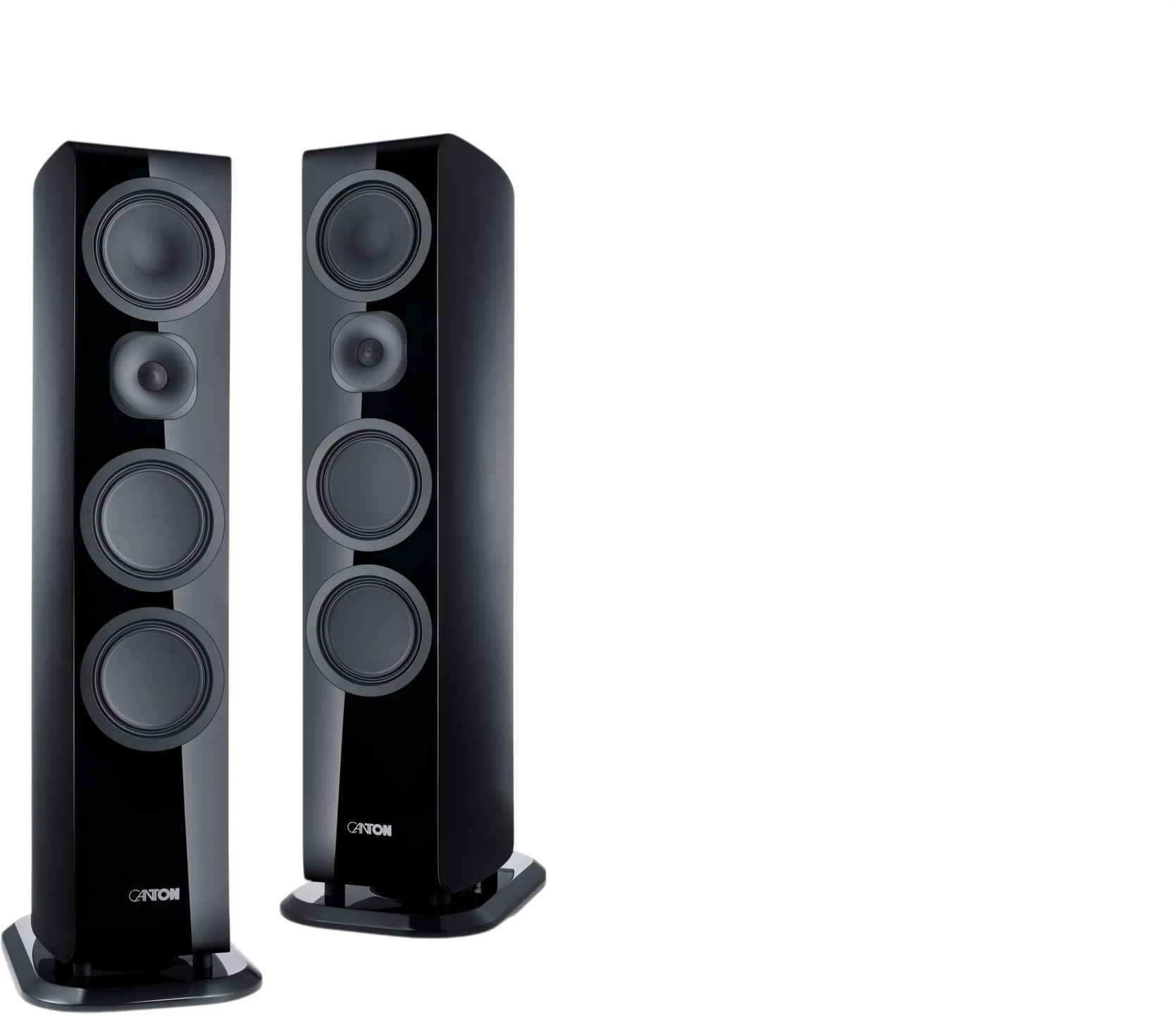
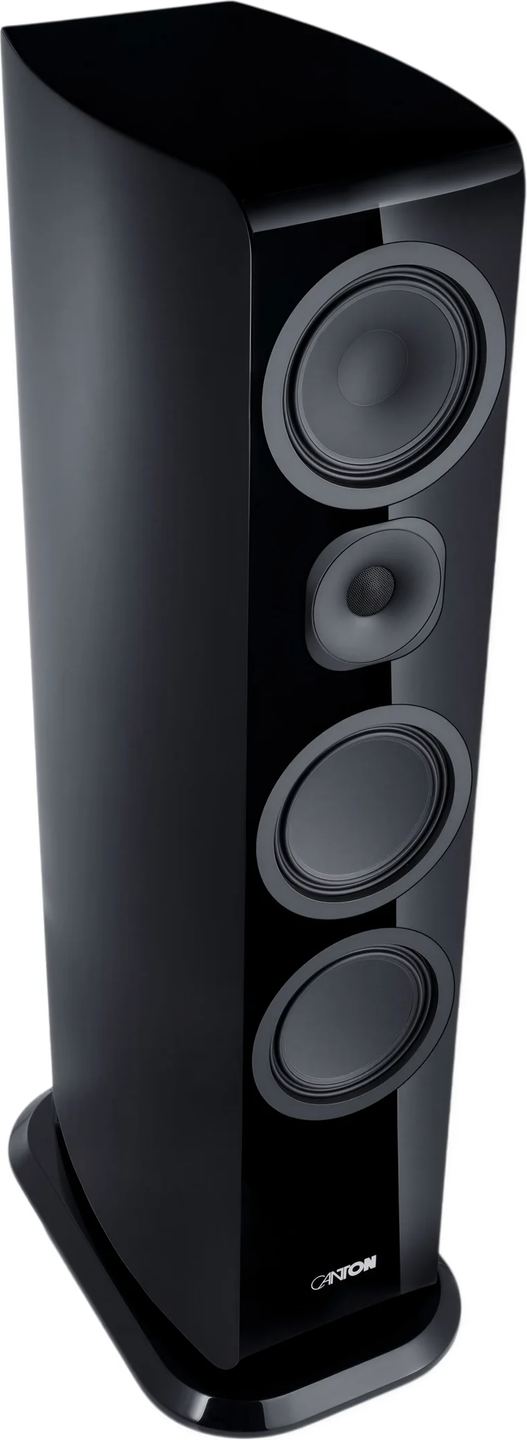
Seventh generation of a range that has accompanied Canton for more than twenty years, the Vento 91 takes over from the Vento 90 with a completely redesigned cabinet, a high-frequency section borrowed from the Reference series, and handcrafted manufacturing maintained at the Weilrod factory in the Taunus. The speaker sits in second place in the Vento 2026 family, between the Vento 81 and the flagship Vento 101, in a format that remains compatible with most living spaces.
A cabinet with redesigned curves
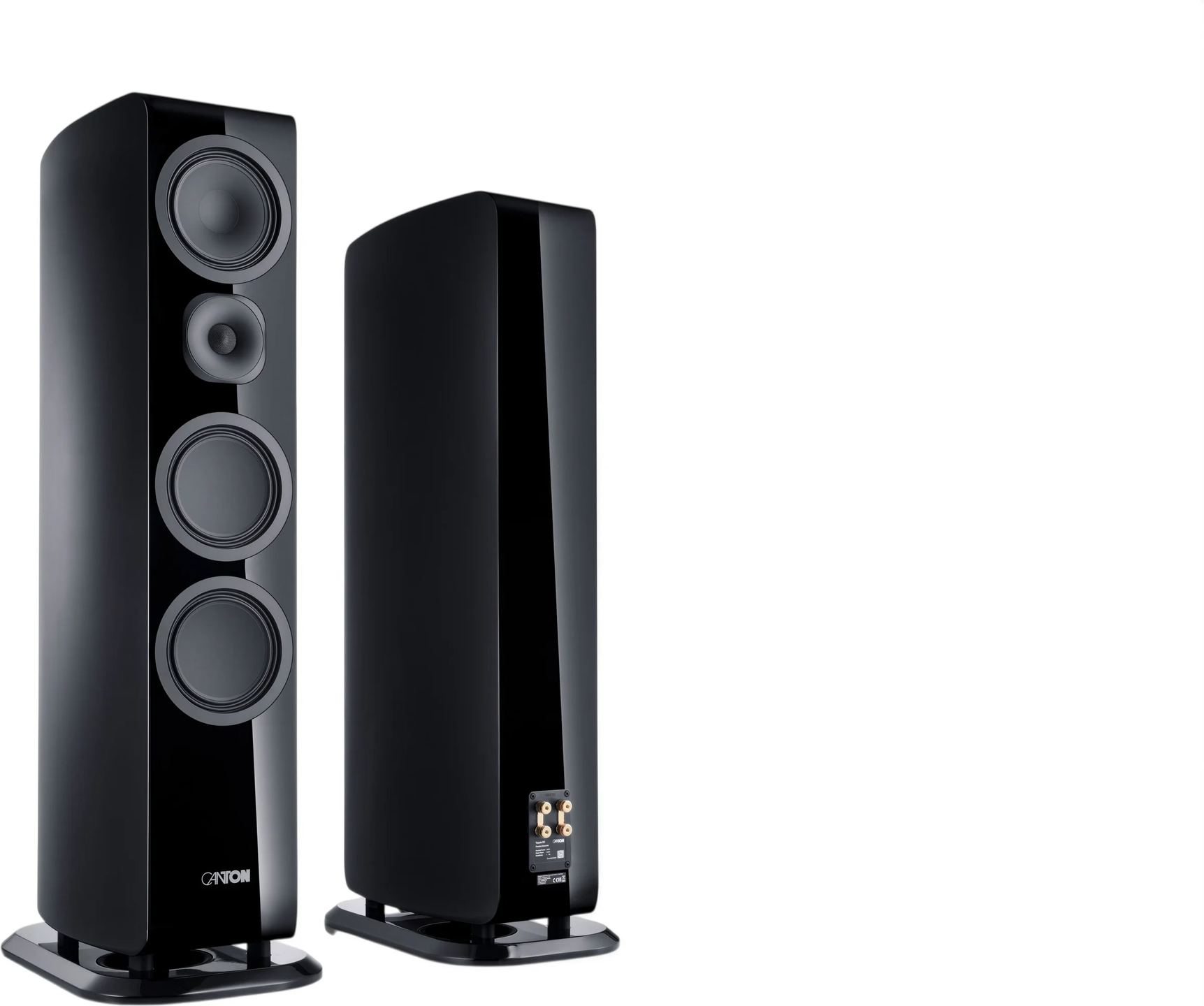
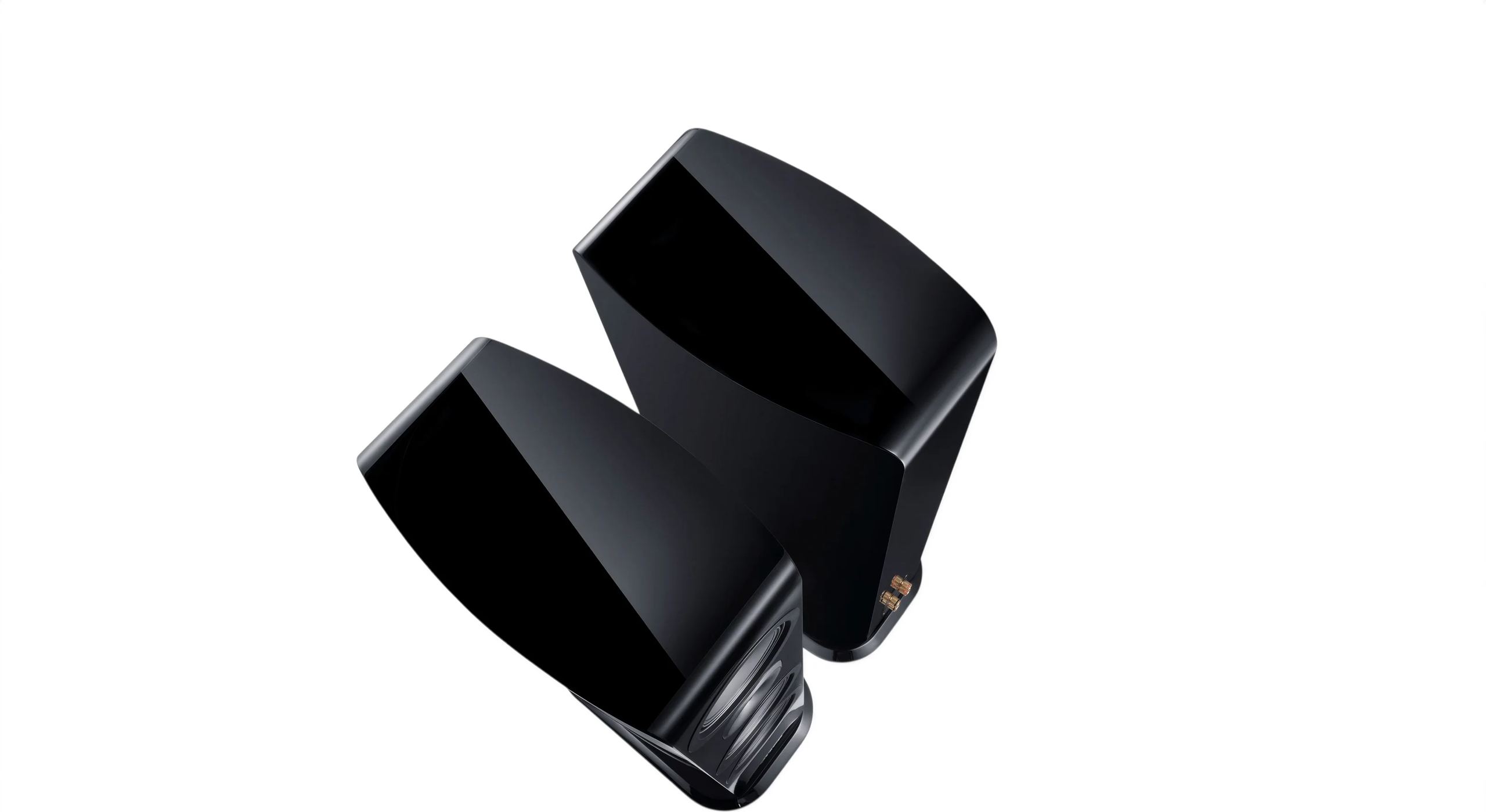
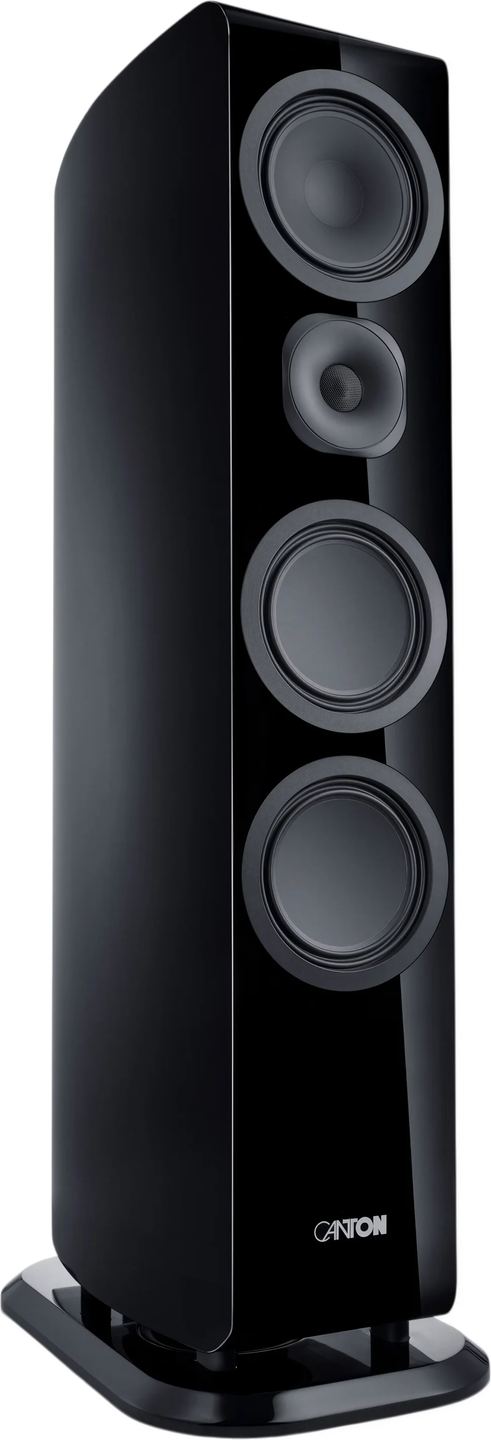
The silhouette of the Vento 91 breaks with previous generations. The front baffle and rear panel are slightly rounded, the edges softened, the sides curved: the multilayer MDF cabinet adopts a so-called “bow-shaped” form that Canton has refined to reduce diffraction at the edges of the speaker. This surface treatment is not just aesthetic. By eliminating sharp angles, the design limits stray reflections that disrupt the dispersion of midrange and high frequencies.
Inside, the volume is divided into separate chambers. Each speaker section has its own space, isolated by internal bracing that stiffens the structure and limits vibrations between frequency ranges. The cabinet weighs 32 kg empty, a weight that reflects the density of the construction.
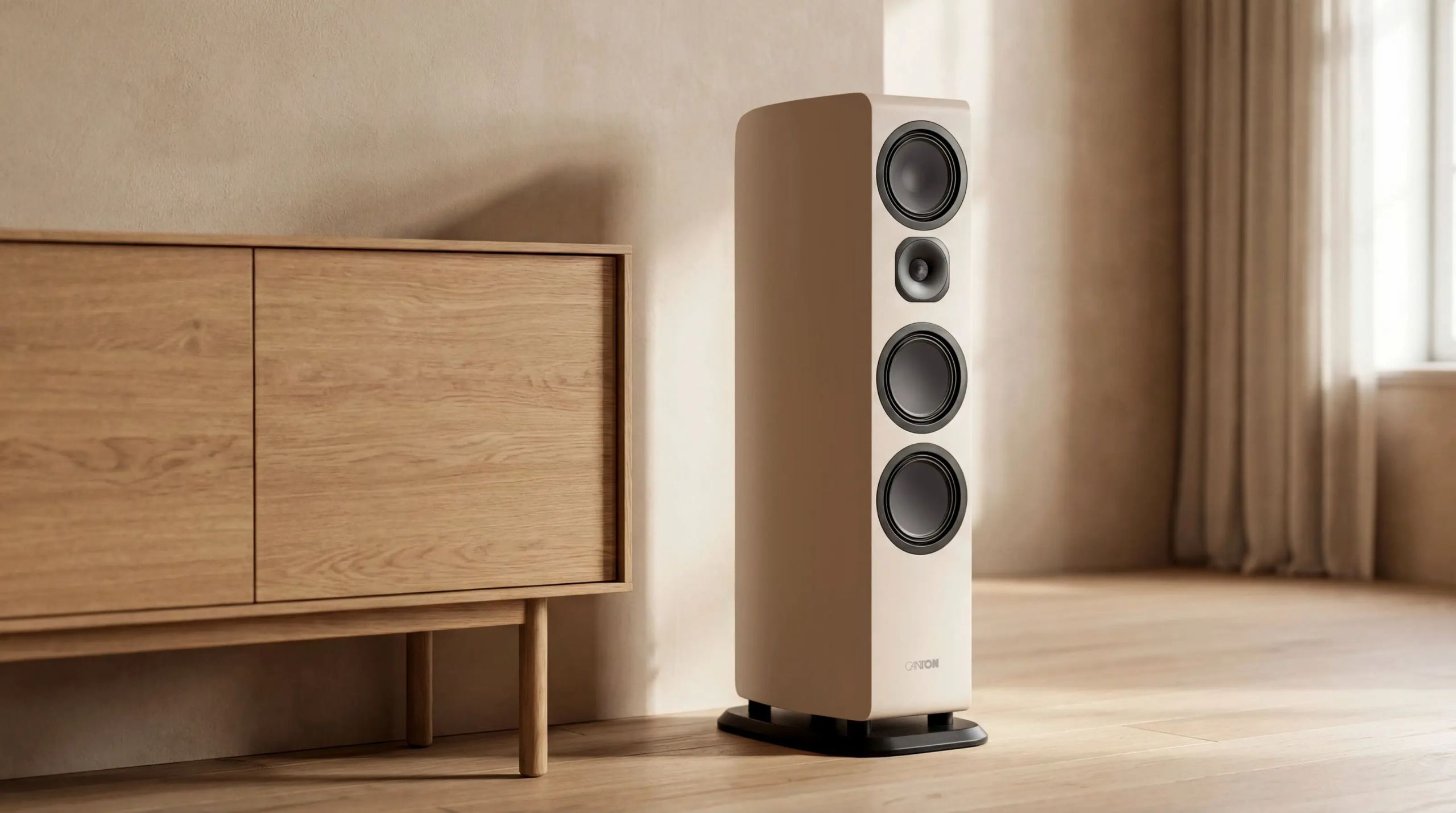
The base has also changed. The metal cones are now offset toward the rear and inward, giving the speaker a visually suspended effect: the floorstander seems to float slightly above the ground. This arrangement has a practical advantage: it reduces sensitivity to room placement and makes positioning easier. The bass-reflex port vents beneath the cabinet (“Downfire” configuration), directed toward the base, which takes advantage of the floor’s proximity for more even diffusion of low frequencies.
The BC tweeter and its square waveguide
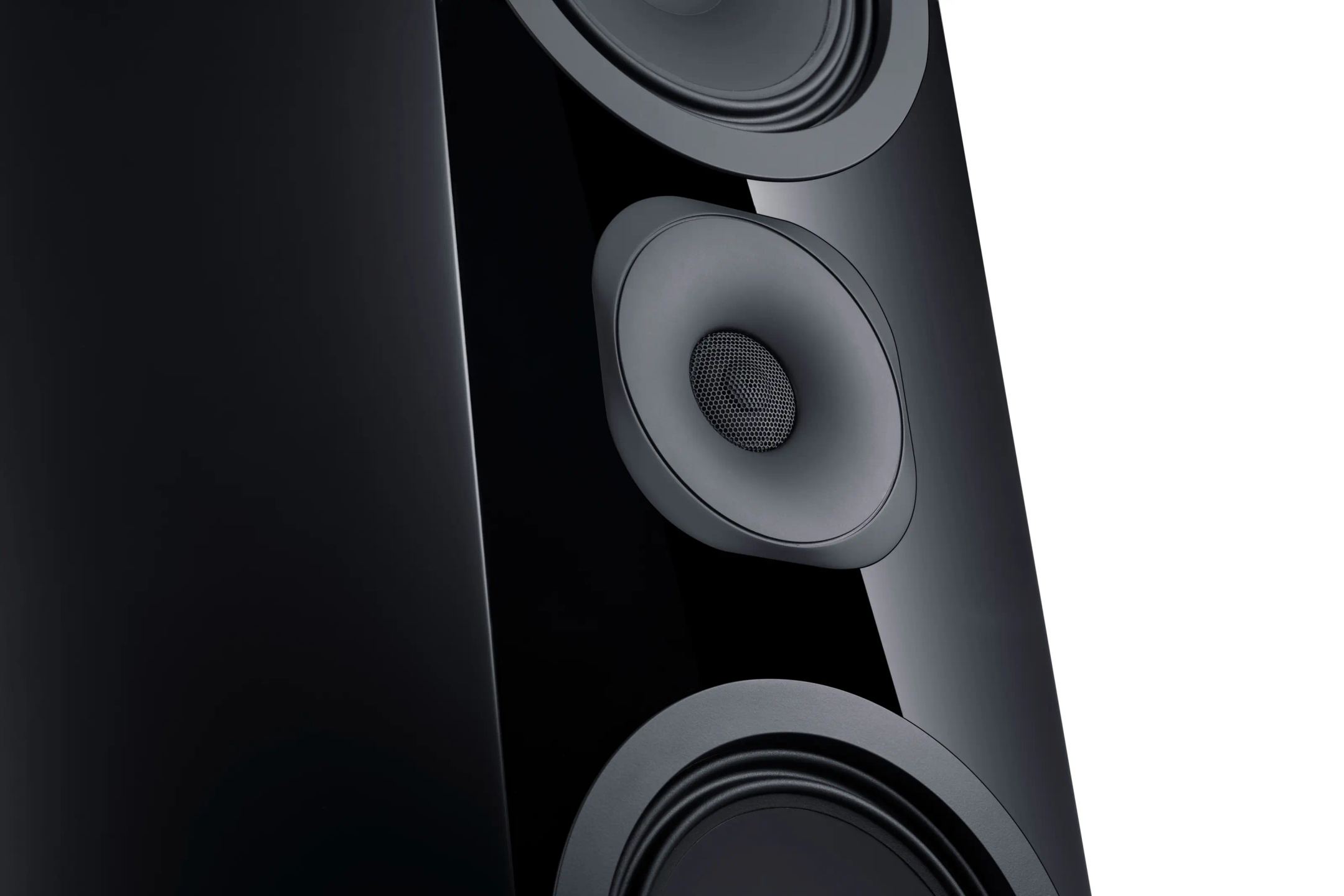
The most visible part of this new generation is the Transmission Front Plate, a square-shaped front plate with rounded edges that frames the 25 mm dome tweeter. This waveguide, developed for the Vento 2026 series, adapts the tweeter’s directivity to that of the midrange driver in order to ensure a coherent transition between the two ranges. Canton states that this device improves the efficiency of the treble section by nearly 3 dB across the entire range.
The dome itself uses BC (Black Ceramic) technology, a blackened aluminum oxide dome also found in the Reference series. This material combines lightness and rigidity, two qualities that allow the tweeter to reach up to 40,000 Hz without any notable break in behavior. The fact that Canton has integrated this component into the Vento brings the two ranges noticeably closer in terms of treble performance.
According to Canton, the outer shape of the Transmission Front Plate was inspired by watchmaking mechanics (the square dial of a sports watch is mentioned). The result is a distinctive visual element that gives the entire Vento 2026 series its immediate identity.
Midrange and bass: ATB diaphragms and Wave surrounds
The 174 mm midrange driver and the two 192 mm woofers use Aluminium Titanium Black (ATB) diaphragms, a material derived from the titanium cones of previous Vento models. The matte and slightly glossy surface of the ATB diaphragms is the result of a chemical treatment that modifies the mechanical properties of titanium to increase damping while maintaining high rigidity. The drivers integrate into the front baffle without visible screws.
On the Vento 91 (as on the 101), Canton uses the Triple Curved Cone construction for the bass and the Double Cone design for the midrange. These terms refer to diaphragm profiles with multiple curvatures that increase the cone’s structural rigidity without adding mass. The expected result is better control of diaphragm movement at high excursion, which translates into tighter bass and less coloration at high volume.
The peripheral surrounds (“Wave Sicke” in Canton terminology) allow long excursions while maintaining linear movement. This wave-shaped surround is a recurring element of Canton’s expertise: it makes it possible to achieve proper deep-bass efficiency despite a moderate driver diameter.
The crossover frequencies are set at 200 Hz and 3,000 Hz, a classic scheme for a three-way speaker of this size. The crossover incorporates Canton DC (Displacement Control) technology, a circuit designed to attenuate infrasonic distortion that can overload the bass drivers below their useful band.
Amplification and connection
With a nominal impedance of 4 to 8 ohms and a sensitivity of 87.9 dB (1 W / 1 m), the Vento 91 is not a high-sensitivity speaker. It requires an amplifier capable of delivering current stably into moderately low loads. The nominal power handling of 180 W and music power of 340 W provide comfortable headroom for transients, but the speaker will deliver its best results with a quality amplifier rather than with an entry-level receiver pushed to its limits.
The rear terminal panel is equipped with gold-plated connectors compatible with bi-wiring and bi-amping. The screw terminals accept cable cross-sections up to 10 mm² and are compatible with banana plugs and spade connectors. For single-wiring use, jumpers connect the two pairs of terminals.
A floorstander designed for stereo listening as well as multichannel
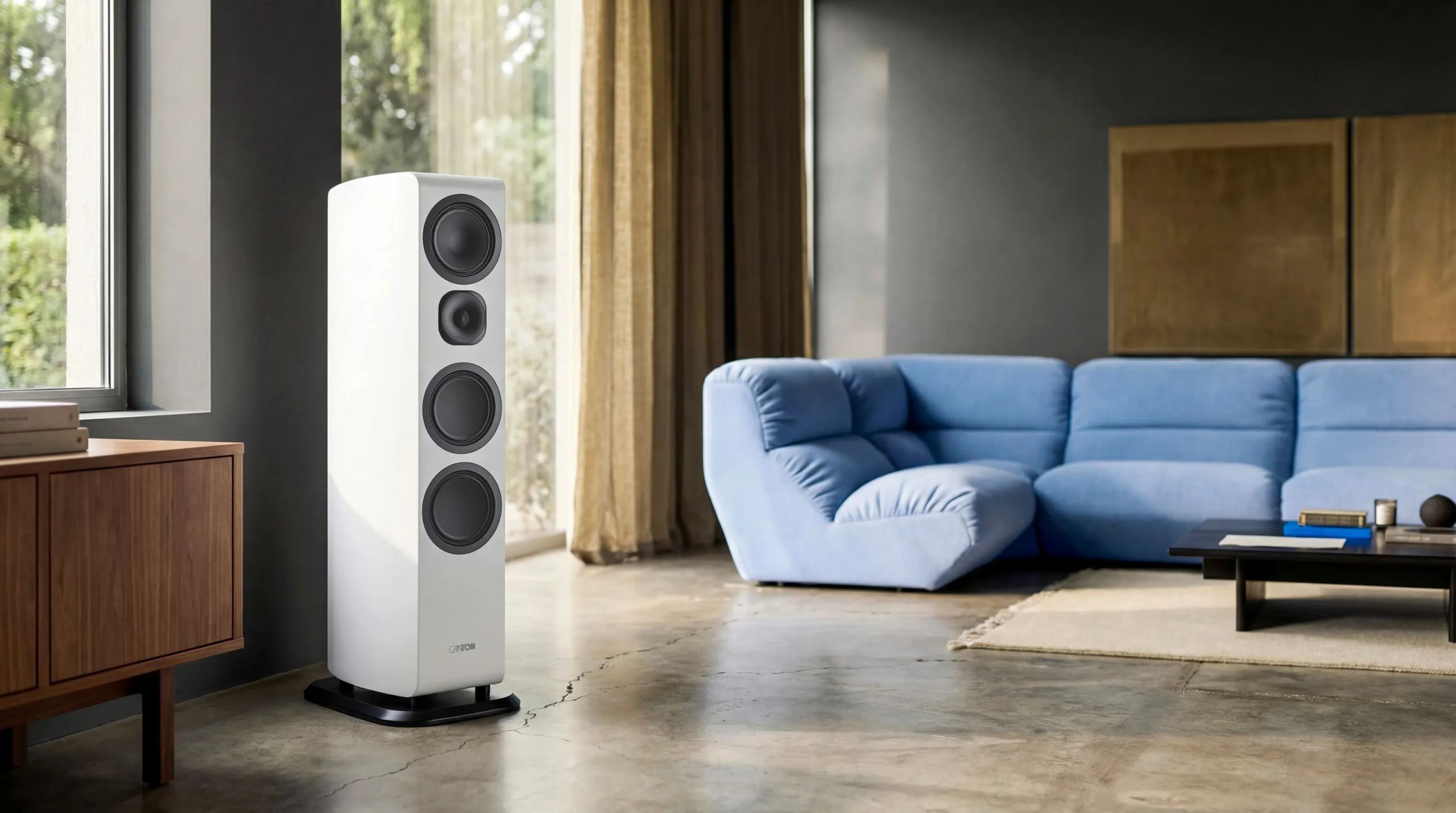
The Vento 91 works in two distinct contexts. In a stereo configuration, the pair of speakers forms a complete system for music listening in medium to large rooms, with the stated frequency response of 20 Hz to 40 kHz covering most of the audible spectrum (and beyond) without an additional subwoofer.
In a home theater configuration, the Vento 91 can serve as the front speaker in a multichannel system complemented by the Vento 51 center speaker, the Vento 21 or Vento 11 surrounds, the Vento AR 1 Dolby Atmos module, and the Vento Sub 1 subwoofer. All models in the Vento 2026 series share the same sound signature and the same speaker technologies, which ensures tonal consistency between channels, a point often overlooked when assembling a system from different ranges.
Manufacturing and finishes
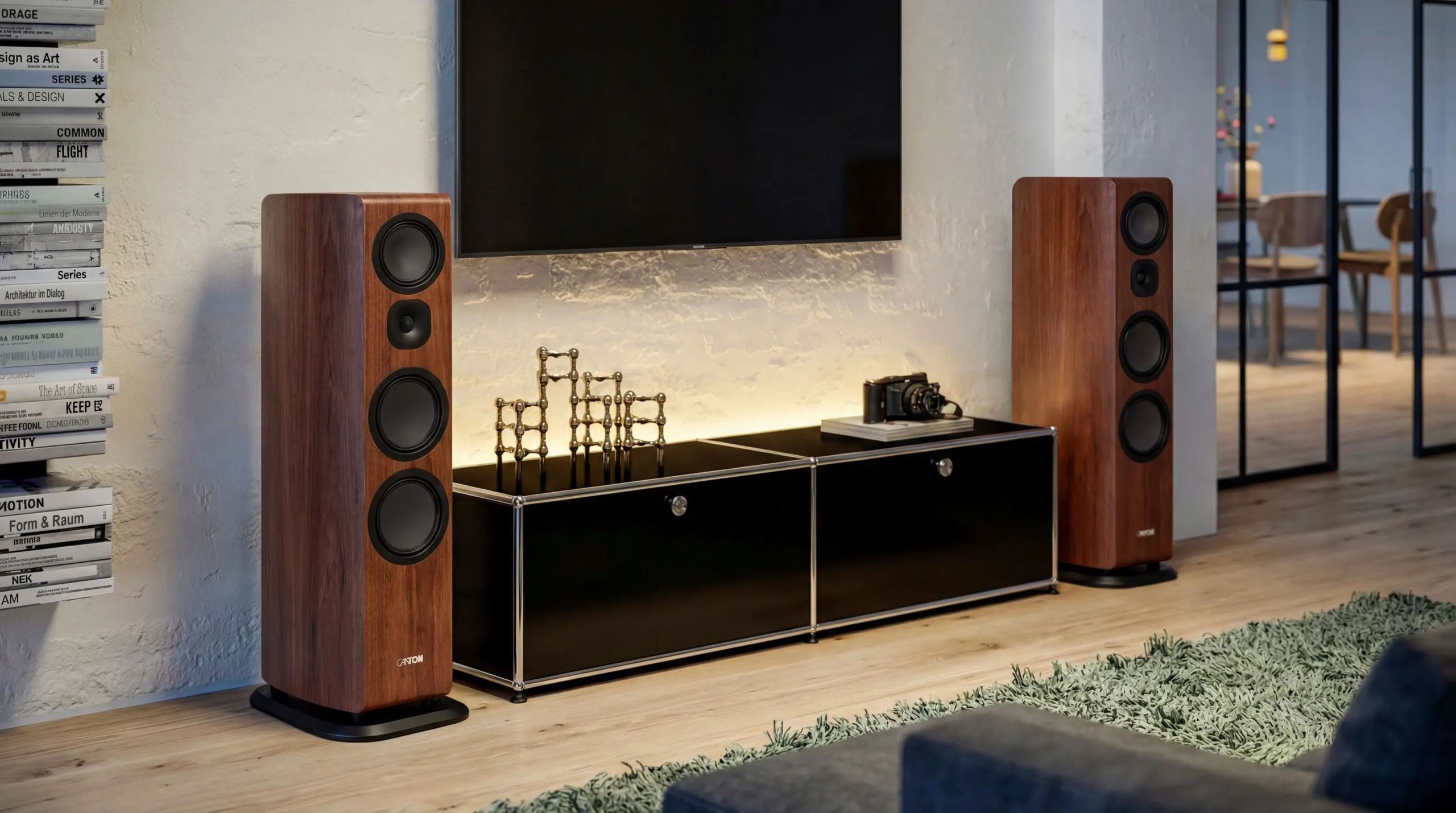
All Canton production remains located in Weilrod, Germany. The curved cabinets of the Vento 91 are hand-assembled from MDF panels laminated in several layers, a process that allows curved shapes while reinforcing rigidity. The lacquered finishes (gloss black, matte white) go through a multi-stage process of sanding, lacquering, and sealing. The walnut version receives a selected veneer.
Quality control takes place at every stage of assembly: driver fitting, internal wiring, crossover verification, final acoustic testing. This level of manual manufacturing is unusual in this price range and remains one of Canton’s most concrete arguments against the competition.
Documentation
Technical specifications
Type and design
- 3-way bass-reflex floorstanding speaker
- Downfire port oriented toward the floor
- High-fidelity design for stereo and home theater systems
Drivers
- Tweeter
- 1 ceramic dome tweeter
- Diameter: 25 mm
- Optimized waveguide for controlled dispersion
- Midrange
- 1 Titanium-Graphite midrange driver
- Diameter: 174 mm
- Bass
- 2 Titanium-Graphite woofers
- Diameter: 192 mm each
Audio performance
- Nominal power: 180 W
- Music power: 340 W
- Frequency response: 20 Hz – 40 kHz
- Crossover frequencies: 170 Hz / 3000 Hz
- Impedance: 4 – 8 ohms
Technologies
- ATB (Aluminium Titanium Black) technology
- Canton DC filter for reducing infrasonic distortion
- Low-resonance curved multilayer MDF cabinet
- Compartmentalized internal structure for better separation of frequency ranges
- Downfire bass-reflex system for uniform diffusion of low frequencies
Construction and design
- High-rigidity curved cabinet
- Premium high-quality finish
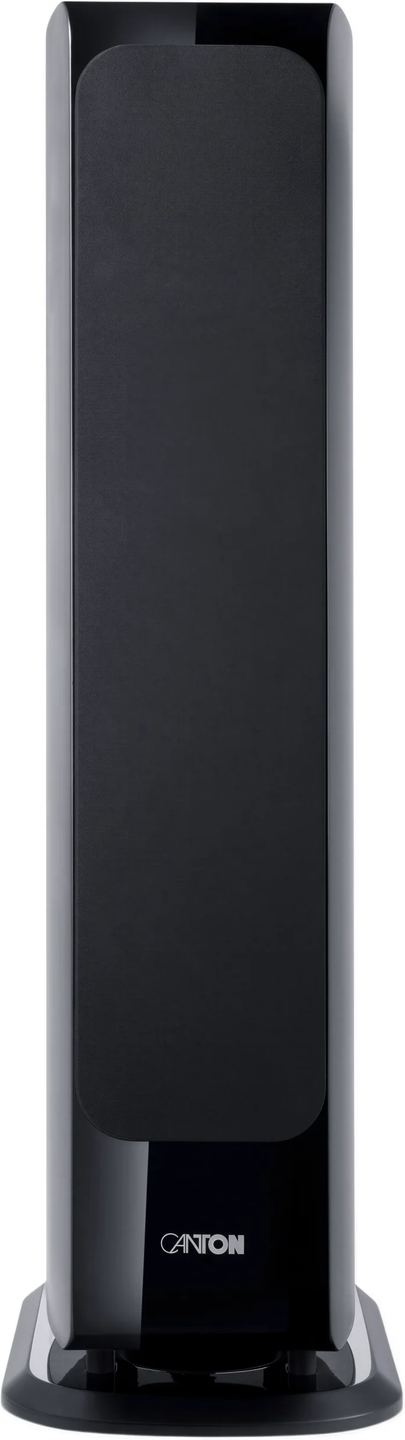
- Acoustically transparent grille with magnetic attachment
- Gold-plated bi-wiring / bi-amplification terminal
Dimensions and weight
- Speaker dimensions with base (W x H x D): 30 × 104 × 48 cm
- Manufacturer dimensions (W x H x D): 28.7 × 110 × 38 cm
- Weight: 32 kg
Box contents
- Canton Vento 91
- Black protective grille
- User manual
Frequently Asked Questions
Does the Vento 91 replace the Vento 90?
Yes. The Vento 91 is the seventh generation of the Vento range and directly succeeds the Vento 90. The cabinet has been redesigned, the drivers use new ATB diaphragms, and the treble section incorporates the Transmission Front Plate with the BC tweeter from the Reference series.
What type of amplifier is needed to power the Vento 91?
The 4 to 8 ohm impedance and 87.9 dB sensitivity require an amplifier that is stable into low loads. A well-built integrated amplifier delivering at least 80 to 100 W into 4 ohms will be suitable in most cases. Mid-range AV receivers and above can also do the job, provided their power supply is sufficiently robust.
Does the Vento 91 require a subwoofer?
The stated frequency response extends down to 20 Hz, which covers almost the entire bass spectrum for music listening. For home theater use with soundtracks that are very demanding in infrabass (LFE effects), adding a subwoofer such as the Vento Sub 1 can provide a useful complement below 30 Hz.
Is the Vento 91 compatible with Canton Dolby Atmos modules?
Yes. The Vento AR 1 module, designed for Dolby Atmos height channels, is placed directly on top of the speaker. The entire Vento 2026 series was developed as a coherent family for multichannel installations.
- Eco-contribution included in the sale price.
- Manufacturer reference: 04576
- GTIN / EAN: 4010243045764