

T+A DAC 200 silver


Specifications and features


Overview
The T+A DAC 200 combines a quadruple differential conversion architecture with remarkable versatility, capable of handling both the finest stereo signals and multichannel home theater streams. With native DSD support up to DSD1024 and multiple selectable processing algorithms, it caters to demanding audiophiles as well as home theater enthusiasts seeking reference sound quality.
Advanced Conversion Architecture
At the heart of the DAC 200 lies a quadruple differential conversion architecture per channel, a technical approach rarely seen in the audio industry. Each stereo channel benefits from four 32-bit Sigma-Delta converters working in parallel, drastically reducing noise and significantly improving dynamics. This calculated redundancy ensures exceptional conversion precision, especially noticeable in complex musical passages where the finest details are preserved.
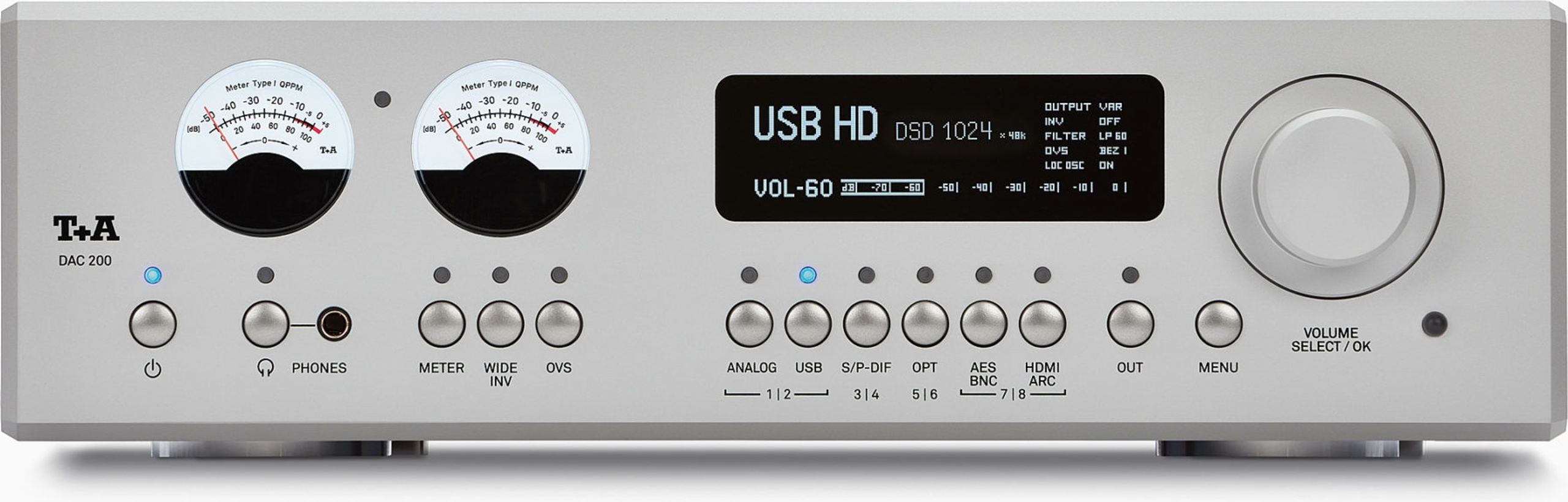
The DSD conversion section deserves special attention with its True 1-bit native architecture developed by T+A. Unlike conventional solutions that convert DSD to PCM, this system processes the DSD signal directly in its original format, thus preserving the sonic integrity sought by fans of this format. Compatibility extends up to DSD1024, or a sampling rate of 49.2 MHz, placing this converter among the highest-performing on the market.
Connectivity and Usage Flexibility
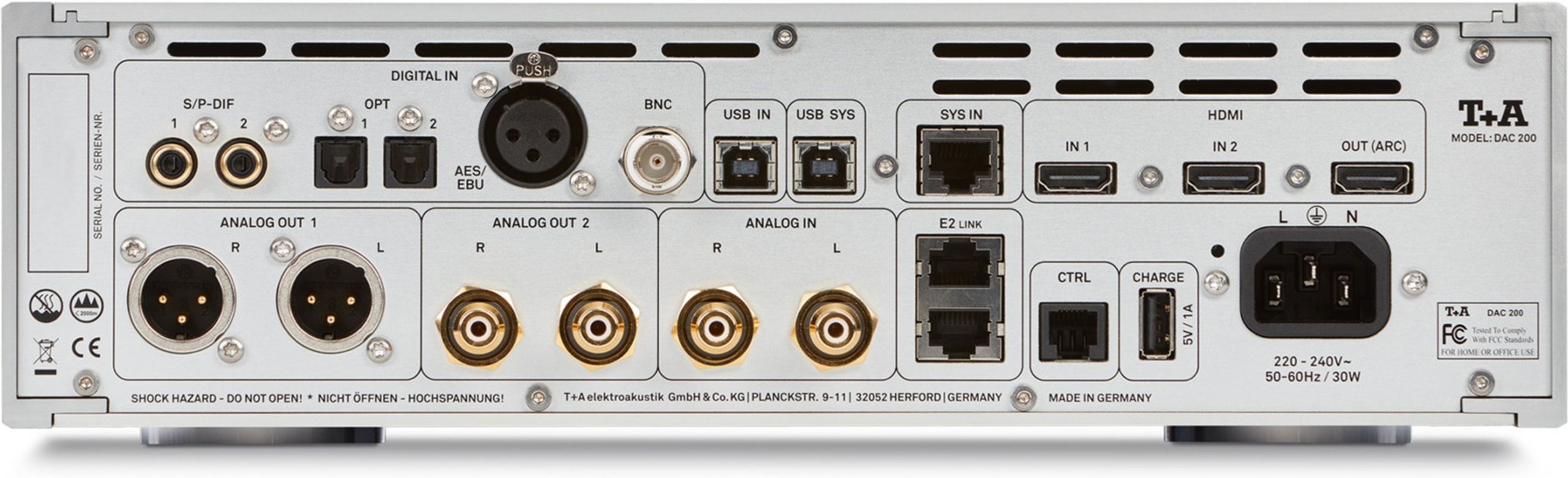
The DAC 200’s wealth of connections illustrates its versatility. On the digital side, two USB DAC inputs allow direct connection to computer sources, supporting PCM up to 768 kHz and DSD up to DSD1024. Traditional connections are not overlooked, with AES-EBU, coaxial and optical S/P-DIF inputs, plus a BNC input for professional setups.
Home theater integration benefits from two HDMI inputs and one HDMI output with ARC option, allowing direct connection to modern TVs and media players. This hybrid approach enables the DAC 200 to serve as the central hub of an audio-video system, while maintaining audiophile quality for stereo music listening.
The analog outputs offer remarkable flexibility with RCA and XLR connections available in both fixed and variable versions. The gold-contact relay volume control, adjustable in 1 dB steps, allows direct use with a power amplifier, eliminating the need for a separate preamplifier in certain configurations.
Sound Quality and Proprietary Technologies
The DAC 200’s analog output stages adopt a class A-HV (high voltage) topology designed in dual mono. This architecture ensures perfect separation of the left and right channels, eliminating crosstalk and preserving the stereo image. Class A guarantees exemplary linearity across the entire dynamic range, while the high-voltage power supply optimizes power handling and dynamics.
Analog filtering uses a third-order phase-linear Bessel filter, renowned for preserving the temporal coherence of signals. The switchable cutoff frequency between 60 and 120 kHz allows you to tailor the frequency response to your listening preferences and the characteristics of your downstream audio system.
Optimized Home Theater Integration
Although primarily designed for stereo listening, the DAC 200 excels in home theater integration thanks to its HDMI connections. Multichannel signal processing preserves spatialization and sound effects, while audiophile-grade conversion enhances the listening experience of musical soundtracks. The ARC option on the HDMI output simplifies connections with modern TVs, allowing unified volume control from the TV remote.
This versatility allows the DAC 200 to serve as the main converter in a hybrid music-cinema system, avoiding the usual compromises between stereo quality and multimedia features.
High-Performance Headphone Output
The DAC 200’s 4.4mm Pentaconn headphone output deserves special mention. This format, developed by Pentaconn, offers perfect channel separation and optimized contact resistance compared to traditional connectors. The dedicated class A output stage can deliver up to 200 mA, allowing the use of high-impedance headphones without compromising dynamics.
The 6-ohm output impedance ensures optimal compatibility with most headphones on the market, from sensitive models to high-impedance studio references. This technical approach avoids the matching issues often encountered with general-purpose headphone amplifiers.
Customizable Audio Processing
The DAC 200 offers five selectable oversampling algorithms: short FIR, long FIR, Bezier, IIR, and pure Bezier. Each algorithm has distinct sonic characteristics, allowing you to tailor the sound to your personal preferences and the type of music you listen to. FIR filters favor temporal precision, while Bezier and IIR algorithms offer a more musical approach with subtle coloration.
The NOS (No Over Sampling) mode completely disables oversampling, preserving the native sampling rate of recordings. This option appeals to purists seeking a “natural” sound without additional digital processing, especially appreciated on vintage recordings and acoustic productions.
Everyday Ease of Use
Despite its technical sophistication, the DAC 200 remains accessible thanks to its dedicated FM200 remote control and intuitive user interface. Default settings are optimized for immediate use, while advanced options remain easily accessible for users wishing to customize their listening experience.
The USB connection requires no specific driver for standard resolutions, ensuring plug-and-play compatibility with most systems. Only DSD512 and DSD1024 resolutions require a dedicated driver under Windows, a technical limitation understandable for these cutting-edge formats.
Documentation
Technical Specifications
Analog Section
- Frequency response: 0.1 Hz to 200 kHz (±0 / –3 dB)
- Signal-to-noise ratio: 110 / 114 dB
- Distortion (THD / intermodulation): < 0.001%
- Channel separation: > 108 dB
- Discretely designed Class A-HV output stages, dual mono circuit
Outputs and Controls
- Preamplifier outputs
- Variable
- RCA: 0…2.5 Vrms / 22 Ohms
- XLR: 0…5.0 Vrms / 22 Ohms
- Fixed
- RCA: 2.5 Vrms / 22 Ohms
- XLR: 5.0 Vrms / 22 Ohms
- Variable
- Volume control: gold-contact relays, 1 dB step adjustment (from -90 to 0 dB)
- Headphone output
- 4.4 mm Pentaconn format
- High-performance Class A output stage (up to 200 mA)
- Output impedance: 6 Ohms
Audio Inputs
- Analog inputs
- High-level RCA: 250 mVrms to 4.5 Vrms / 10 kOhms
- Digital inputs
- 1 x AES-EBU: 32 to 192 kHz / 16–24 bits
- S / P-DIF
- 2 x coaxial
- 2 x TOS-Link optical
- 32 to 192 kHz / 16–24 bits
- DoP DSD64
- 1 x BNC: 32 to 192 kHz / 16–24 bits
- 2 x USB DAC
- Device mode
- PCM up to 768 kHz
- DSD up to DSD1024
- DSD512 and 1024 only with dedicated Windows driver or Linux Kernel ≥ 4.4
- DoP up to DSD256
- 2 x HDMI IN, 1 x HDMI OUT (with optional ARC)
Digital-to-Analog Conversion
- PCM
- Quad differential converter per channel
- 4 x 32-bit Sigma-Delta DACs
- Up to 705.6 / 768 kSps
- DSD
- T+A True 1-bit native converter
- Up to DSD1024 (49.2 MHz)
- Oversampling
- T+A processor
- 4 selectable algorithms: Short FIR / Long FIR, Bezier / IIR / Pure Bezier
- NOS mode (no oversampling)
- Analog filter
- 3rd order linear-phase Bessel filter
- Switchable cutoff: 60 or 120 kHz
General Specifications
- Power supply: 200–240 V / 50–60 Hz, 30 W
- Standby: < 0.5 W
- Dimensions (H × W × D): 10 × 32 × 34 cm
- Weight: 6.2 kg
- Supplied accessories: FM200 remote control, power cable, USB cable
Frequently Asked Questions
What is the difference between the available oversampling algorithms?
The FIR filters (short and long) favor temporal precision with controlled impulse response, ideal for classical and acoustic music. The Bezier and IIR algorithms provide a more musical coloration, particularly appreciated for rock and pop. The pure Bezier mode offers a compromise between precision and musicality. The choice depends on your personal preferences and the type of music you listen to.
Should I use the fixed or variable outputs?
Fixed outputs deliver a constant optimal level for connection to a preamplifier or integrated amplifier with volume control. Variable outputs allow direct volume control, ideal for direct connection to a power amplifier. This configuration eliminates a preamplification stage, which can be beneficial for sound purity.
Which high-resolution audio formats can I use without a specific driver?
The DAC 200 natively supports PCM up to 384 kHz and DSD up to DSD256 in DoP mode without a specific driver. DSD512 and DSD1024 resolutions require T+A’s dedicated Windows driver or a Linux system with kernel 4.4 or higher. This technical limitation is common to most converters supporting these extreme resolutions.
- Eco-contribution included in the sale price.




