

SPL Crossover Mk2 black



SPL Crossover Mk2: fully analog active filtering
Integrating a subwoofer into an entirely analog high-end system presents a practical problem: almost all filters on the market require digital conversion. Returning to digital within an analog system means sacrificing part of what one was trying to preserve. SPL takes the opposite approach with a two-way stereo active crossover that separates frequencies without ever entering the digital domain, and whose scope extends far beyond bass reinforcement.
Separating frequencies without going digital
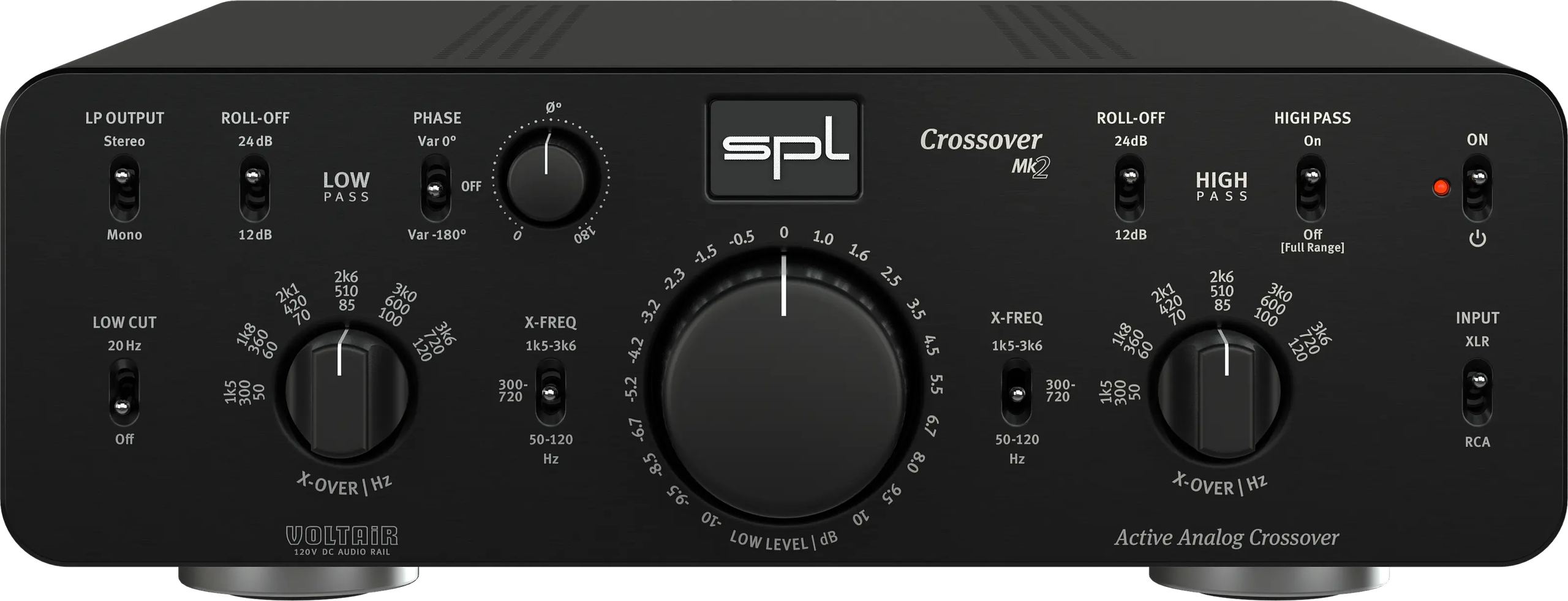
An active crossover operates before the power amplifiers: it splits the line-level signal into two bands and sends each one to its amplification stage. The Crossover Mk2 is organized into two independent sections. The low-pass section feeds the subwoofer(s), while the high-pass section feeds the main speakers. Each has its own crossover frequency, adjustable independently between 20 Hz and 3.6 kHz.
The benefit of keeping everything analog follows simple reasoning. In a high-end system, the signal travels without conversion from beginning to end. Inserting a digital filter means adding analog-to-digital and then digital-to-analog conversion where precisely this type of stage had been excluded. The Crossover Mk2 processes the signal as voltage, without a clock or converter, and keeps the signal chain analog from end to end. This approach requires an insertion point between the preamplifier and power amplifier, or a preamplified output.
VOLTAiR technology and its 120 volts
The VOLTAiR designation refers to the shared electronic foundation of SPL’s Professional Fidelity range. The principle is to operate the audio circuits at a 120-volt supply voltage, split into ±60 V, whereas conventional operational amplifiers operate at around ±15 V. This voltage quadruples the available headroom before clipping. SPL claims approximately 12 dB of additional dynamic headroom compared with a ±15 V design.
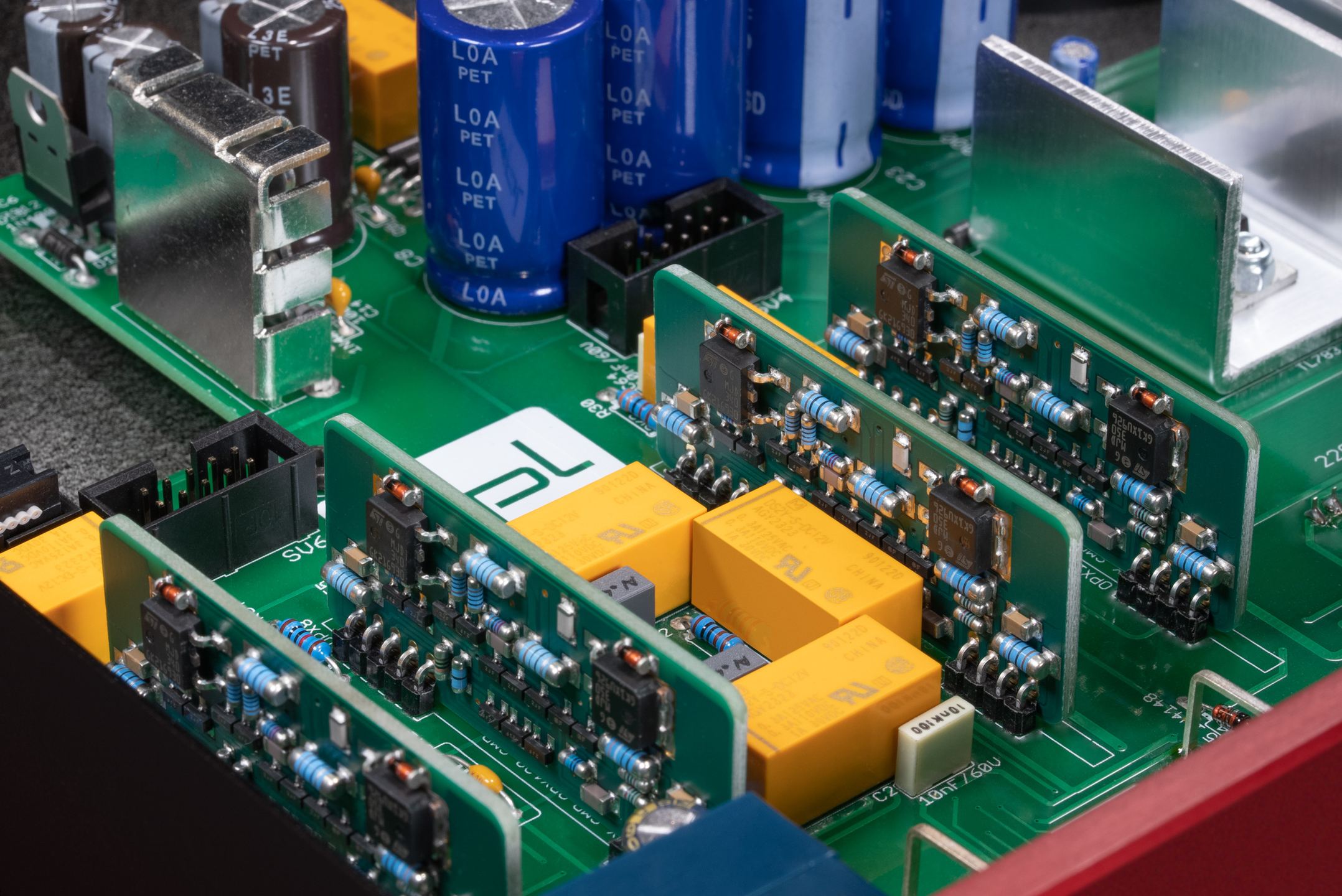
Such voltage would destroy standard components. SPL therefore developed its own operational amplifiers, the 120V SUPRA, capable of handling these ±60 V. The result is evident in the specifications: 0.0008% harmonic distortion on the high-pass output, 138 dB dynamic range, and frequency response from 10 Hz to 100 kHz at -3 dB. The designation can sometimes be misleading: these 120 volts have nothing to do with mains voltage; they apply solely to internal signal processing.
Eighteen crossover frequencies and two slopes
Frequency adjustment is handled by two selectors. The first, X-FREQ, selects one of three operating ranges: 50 to 120 Hz, 300 to 720 Hz, or 1.5 to 3.6 kHz. The second, X-OVER, selects one of six values within the chosen range. The combination provides eighteen crossover points, adjustable independently for low-pass and high-pass operation.
These values are stepped rather than continuous: you choose from a grid rather than freely turning a potentiometer. In return, each position can be reproduced exactly from one session to the next. The slope can be switched between 12 and 24 dB per octave on each of the two sections. A gentle slope (12 dB) allows greater overlap between the two paths and softens the transition; a steep slope (24 dB) separates the bass more clearly from the rest, at the expense of more pronounced phase rotation around the crossover point.
A fixed 20 Hz high-pass filter completes the package. It removes inaudible frequencies below this threshold from both paths, preventing the amplifier from wasting power on unwanted infrasonic frequencies and relieving the speakers.
Aligning bass with the main speakers
Making a subwoofer and main speakers work together requires their signals to arrive in phase at the ear. The Crossover Mk2 offers continuously variable phase adjustment covering 360°. A three-position switch sets the direction of rotation: from 0° to 180° in one case, from 0° to -180° in the other; the potentiometer then sets the exact value. The third position is off, completely removing the phase circuit from the signal path.
Bass level is adjustable from -10 to +10 dB via an Alps RK27 potentiometer. This control is primarily used to match the subwoofer to the speakers, but nothing prevents using it to add body to a bass-light recording.
The low-pass output operates in mono or stereo. In mono, the filter sums both channels and feeds a single subwoofer; in stereo, it drives two separate subwoofers, one per channel. And if you prefer to let the main speakers run full range, the high-pass filter can be disabled, restoring the entire spectrum to the main channels.
Mk2 improvements over the original version
The first version of the SPL crossover was limited to the 50-120 Hz range, with six positions and a fixed 24 dB-per-octave low-pass slope. Its use was limited to integrating a subwoofer with full-range speakers. The Mk2 extends the crossover point to 3.6 kHz and increases the number of frequencies from six to eighteen.
This expanded range changes the purpose of the Crossover Mk2. Reaching up to 3.6 kHz makes it possible to separate bass from midrange and treble, making speaker bi-amplification possible rather than simply adding a subwoofer to an existing system. Both slopes become switchable on each section, and the phase control gains its three-position switch. However, the Mk2 does away with the two mechanical VU meters found on the original version: the choice favors adjustment range over visual level monitoring.
Balanced connections and German manufacturing
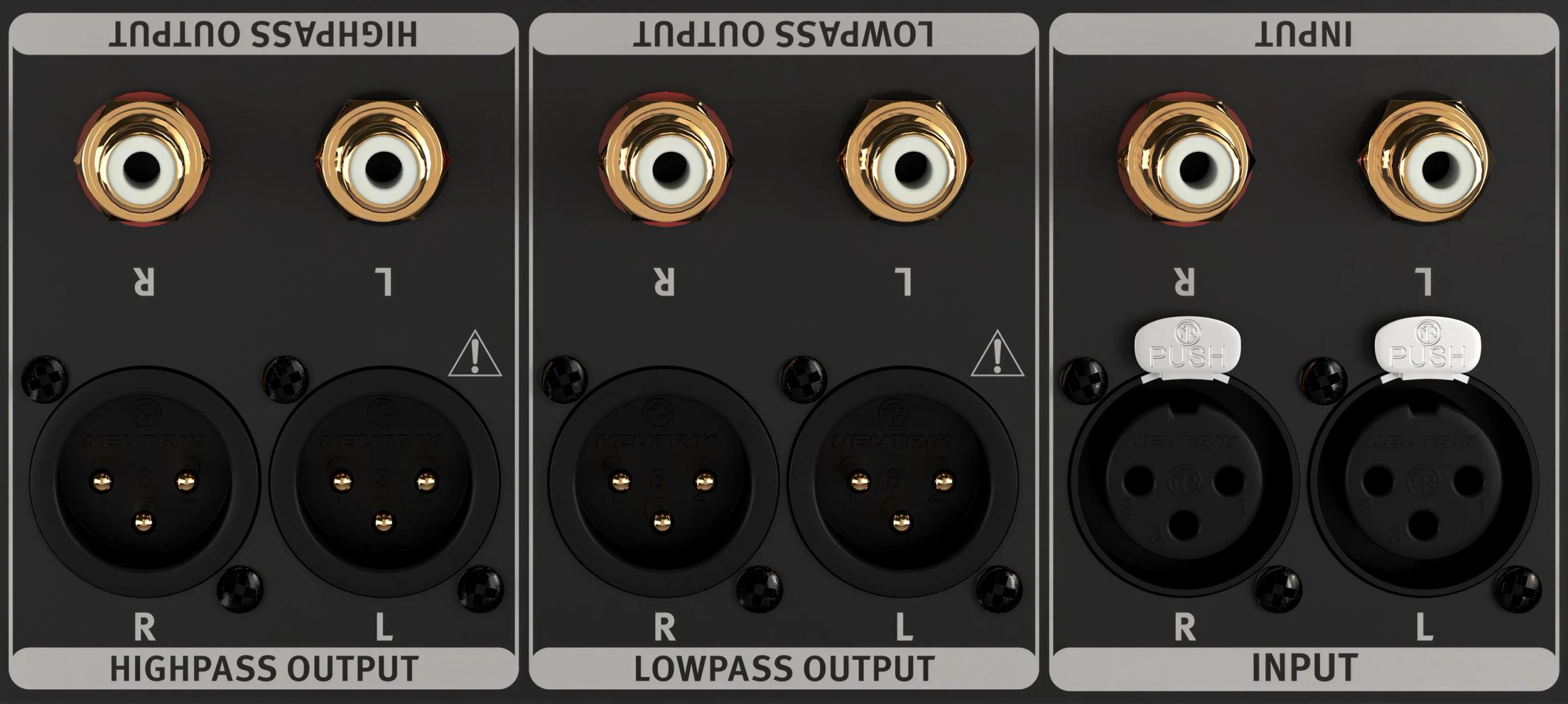
Each input and output is available in two formats: balanced XLR and unbalanced RCA, all gold-plated. A selector chooses the active input, XLR or RCA, while the outputs deliver the signal simultaneously through both connectors, eliminating the need for adapters regardless of the rest of the installation. The balanced connection offers 82 dB common-mode rejection, useful with long cable runs or in electrically noisy environments.
The AMP CTL connector handles 12 V triggering. It puts up to four compatible devices into standby or wakes them at the same time as the Crossover Mk2, and the crossover itself can be controlled by an SPL preamplifier such as the Director Mk2, the Elector, or the Phonitor x. In standby, power consumption remains below 0.3 W.
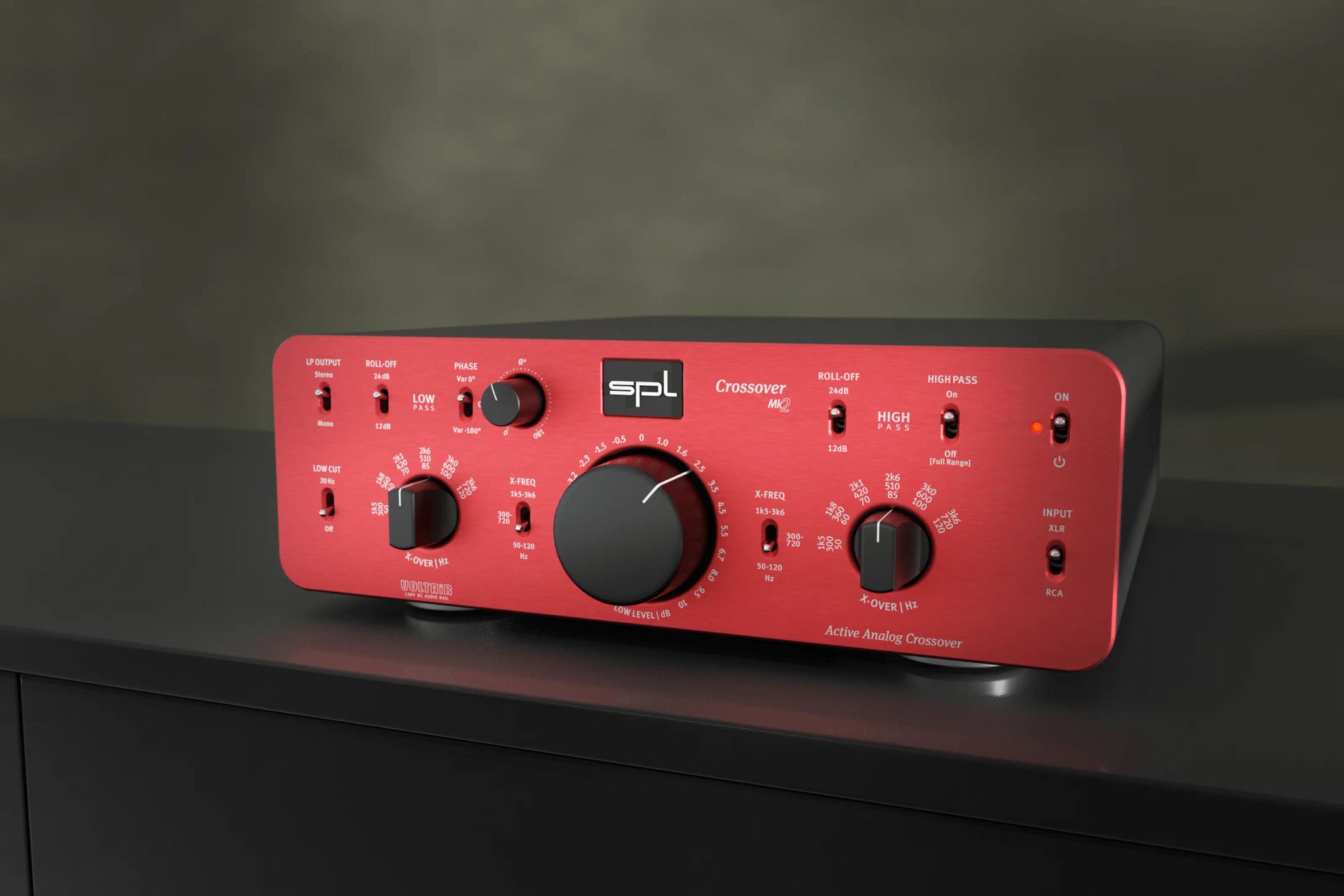
As for manufacturing, SPL assembles the Crossover Mk2 at its German factory in Niederkrüchten. Sensitive components are through-hole mounted, soldered through the printed circuit board rather than surface-mounted, a choice that allows each part to be selected by ear. The power supply is linear, with a shielded toroidal transformer. The chassis measures 278 × 100 × 300 mm and weighs 4.6 kg, and is available in black, red, or silver.
Documentation
Technical specifications
Overview
- Stereo 2-way analog active crossover
- Second generation of the SPL Crossover
- Designed for integrating subwoofers and multi-amplified systems
- Proprietary SPL VOLTAiR 120 V technology
- Made in Germany
Key features
- High-fidelity analog filtering without digital conversion
- Independent crossover frequencies for the Low Pass and High Pass sections
- 18 selectable crossover frequencies
- Switchable filter slope: 12 or 24 dB / octave
- 20 Hz low-cut filter (Low Cut)
- Variable 360° phase adjustment
- Low Pass operation in mono or stereo
- High Pass filter can be disabled
- Subwoofer level adjustment from -10 to +10 dB
- Balanced XLR and unbalanced RCA inputs and outputs
- RCA and XLR outputs active simultaneously
- 12 V Trigger management (AMP CTL)
Crossover frequencies
- Independent adjustment for Low Pass and High Pass
- 18 available frequencies:
- 50 / 60 / 70 / 85 / 100 / 120 Hz
- 300 / 360 / 420 / 510 / 600 / 720 Hz
- 1.5 / 1.8 / 2.1 / 2.6 / 3 / 3.6 kHz
- 3-position X-FREQ range selector
- 6-position X-OVER selector
Settings
- Filter slope:
- 12 dB / octave
- 24 dB / octave
- Low-cut filter (Low Cut): 20 Hz
- Phase adjustment:
- Variable from 0° to 180°
- Variable from 0° to -180°
- Phase circuit can be disabled
- Low Pass output:
- Mono
- Stereo
- High Pass filter can be enabled or disabled
- Bass level adjustment: -10 dB to +10 dB
Audio performance
- Maximum input / output gain: 32.5 dB
- Frequency response (-3 dB): 10 Hz – 100 kHz
- Harmonic distortion:
- 0.0008 % (0 dBu, 1 kHz, High Pass)
- 0.0009 % (0 dBu, 30 Hz, Low Pass)
- Crosstalk (1 kHz): -70 dB
- Signal-to-noise ratio (A-weighted):
- -106 dBu (High Pass)
- -105 dBu (Low Pass)
- Dynamic range:
- 138 dB (High Pass)
- 137 dB (Low Pass)
- Common-mode rejection (XLR): 82 dB
- Output impedance: 75 Ω
Connectivity
- Inputs:
- 1 balanced XLR pair
- 1 unbalanced RCA pair
- Outputs:
- High Pass XLR
- High Pass RCA
- Low Pass XLR
- Low Pass RCA
- XLR / RCA input selector
- AMP CTL In Trigger input (12 V)
- AMP CTL Out Trigger output (12 V)
Power supply
- Linear power supply with shielded toroidal transformer
- Analog voltage: ±60 V
- Relay and LED power supply: +12 V
- Mains power:
- 230 V AC / 50 Hz
- 115 V AC / 60 Hz
- 230 V fuse: T 0.5 A
- 115 V fuse: T 1 A
- Maximum power consumption: 50 VA
- Standby power consumption: < 0.3 W
Dimensions and weight
- Dimensions (W × H × D): 278 × 100 × 300 mm
- Net weight: 4.6 kg
- Weight with packaging: 5.85 kg
Frequently asked questions
Where does the Crossover Mk2 fit into a setup?
It is connected between the preamplifier and the power amplifiers, at line level. You therefore need a preamplified output on one side and separate amplifiers on the other, or an insert point on a preamp/power amp combination. An integrated amplifier without a preamp output and power amp input does not allow it to be inserted.
Is it suitable only for connecting a subwoofer, or also for bi-amping speakers?
Both. As long as the crossover point remains within the available range, up to 3.6 kHz, it can separate the bass from the midrange/treble of a speaker and feed two separate amplifiers. This is what distinguishes it from a simple subwoofer filter: it can also handle a two-way crossover higher up in the spectrum.
Don't the eighteen fixed frequencies lack precision compared to a digital filter?
A digital filter theoretically allows any value down to the nearest Hz, whereas the Crossover Mk2 uses an eighteen-point grid. In practice, the difference between two adjacent values remains small, and the detented positions are reproduced identically from one session to the next. The trade-off is between the absolute precision of digital and a 100% analog signal path.
Should you choose a slope of 12 or 24 dB per octave?
It depends on the desired overlap between the channels. A 12 dB slope lets the two speakers overlap over a wider range, which smooths the transition and is more forgiving of a slightly misaligned subwoofer. A 24 dB slope separates each channel more distinctly, at the cost of phase being more difficult to align around the crossover point. Listening and in-room measurements decide on a case-by-case basis.
Does the 12 V trigger work with a preamp from another brand?
Yes. The AMP CTL input and output follow the 12 V trigger standard, widely used by most manufacturers. An SPL preamplifier from the range connects directly to it, but any device equipped with a 12 V trigger output can control the filter’s standby mode, and vice versa.
Can two subwoofers be controlled in stereo?
Yes, via the switchable stereo low-pass output: the filter keeps the left and right channels separate and feeds one subwoofer per channel. In mono mode, it sums both channels to a single subwoofer, which is sufficient in most rooms since deep bass is not very directional.
Does bass level adjustment correct the room acoustics?
It adjusts the subwoofer’s overall level from -10 to +10 dB, to balance it with the speakers or boost a recording lacking in bass. It does not replace acoustic treatment: room resonances and placement-related dips require other tools, panels, or a dedicated correction system.
- Eco-contribution included in the sale price.
- Manufacturer reference: LCRO2430
- GTIN / EAN: 4260149320315