Fyne Audio Vintage Five (pack of 2)


Awards

What Hi-Fi? 5 stars
A global reference, What Hifi? is one of the most comprehensive magazines covering Home Cinema and Hifi. The "5 stars" award distinguishes the highest quality products, according to this British magazine.
Fyne Audio Vintage Five, a compact speaker with retro aesthetics
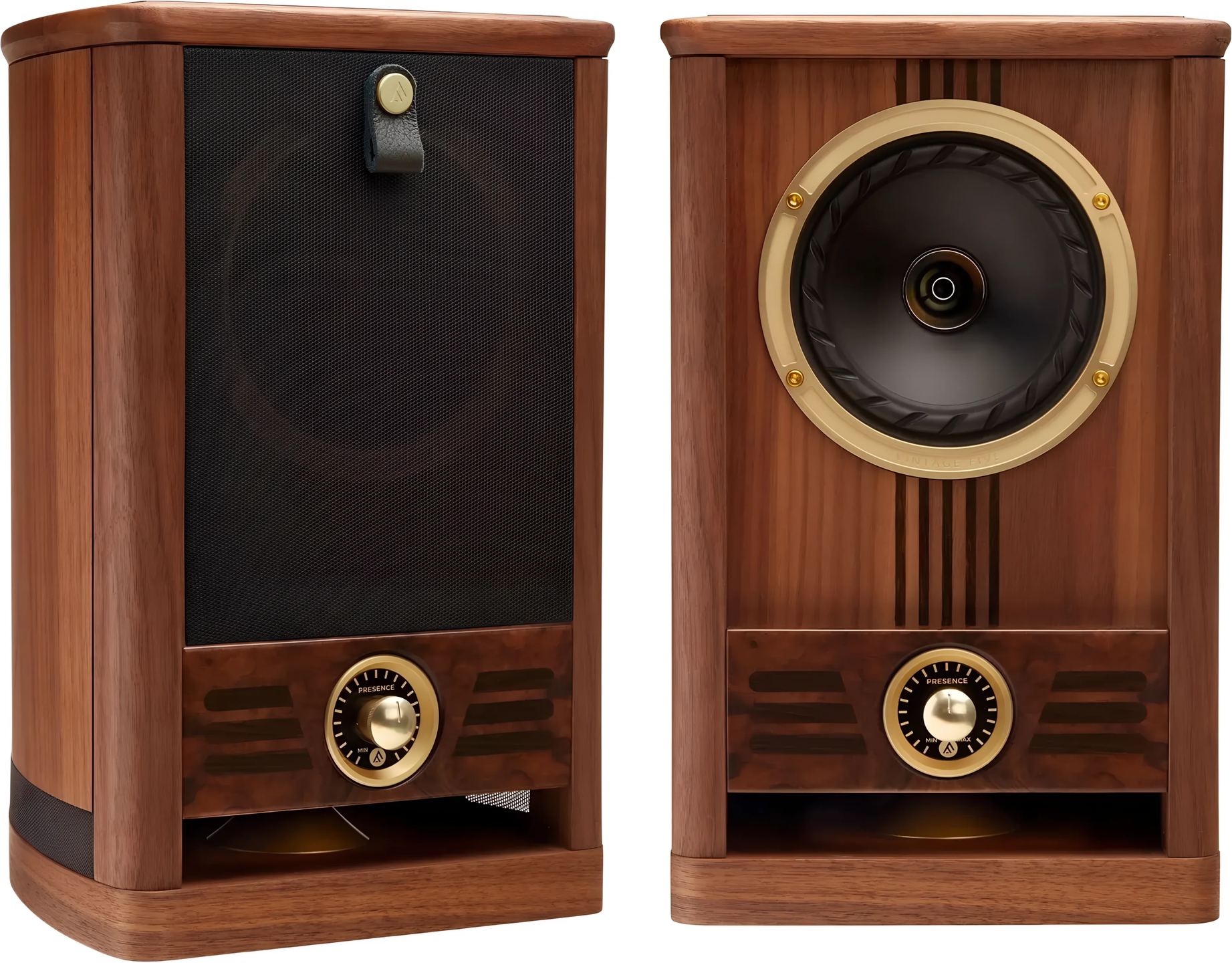
Bringing the engineering of Fyne Audio’s large Vintage floorstanders into a cabinet that sits on a stand or shelf: that’s the ambition of this British two-way speaker. Beneath its 1970s speaker looks, it houses a coaxial driver, a downward-firing port, and a cryogenically treated crossover. A format that fits into small and medium-sized rooms, with the same technical solutions as the larger models.
A walnut-veneered birch cabinet
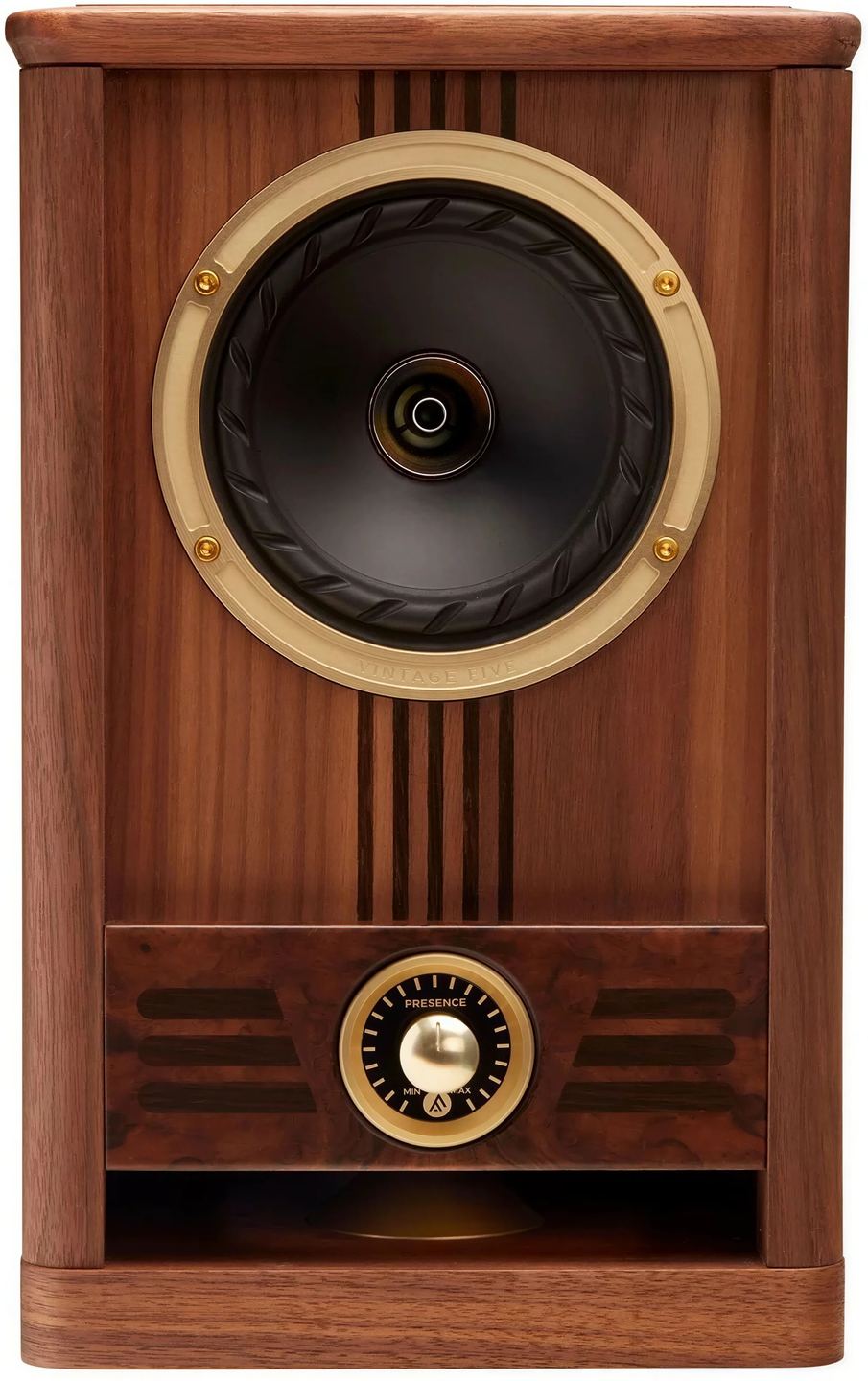
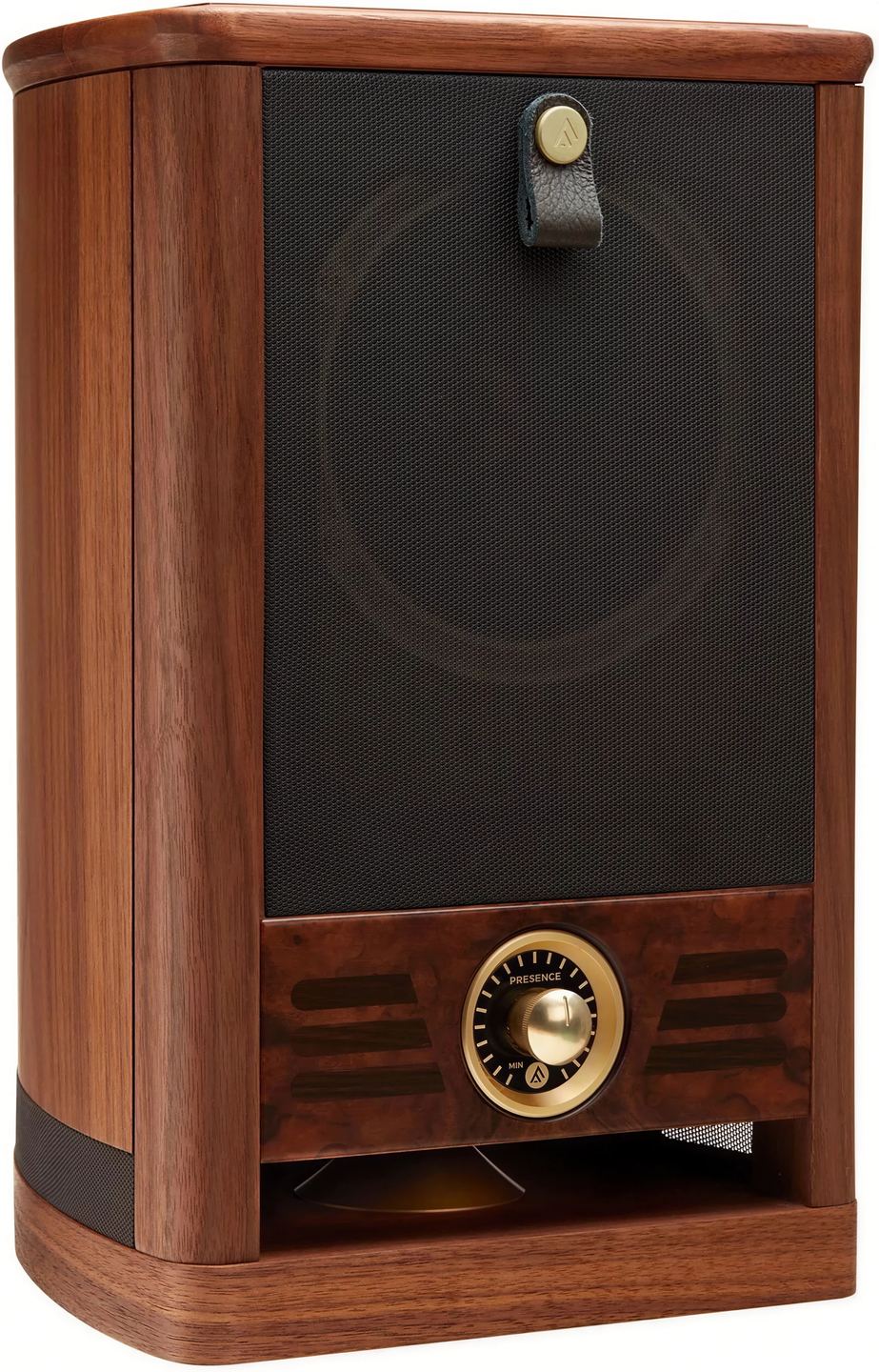
The look leans firmly into retro: walnut veneer, walnut burl inlays, gold metallic trim, and grille cloth stretched over a wooden frame. The top panel is reminiscent of a plinth, a nod to the high-end speakers of decades past.
Beneath the veneer, the cabinet is made from high-density pressed birch plywood, with sides curved in variable-radius curves. This shape reduces internal standing waves — those resonances that colour the sound when they build up between two parallel walls. Fyne Audio assembles and finishes these speakers by hand in the United Kingdom. It measures 350 mm tall by 219 mm wide and 260 mm deep, and weighs 6.2 kg per speaker, making it easy to place on a low piece of furniture or a dedicated stand without taking up too much space.
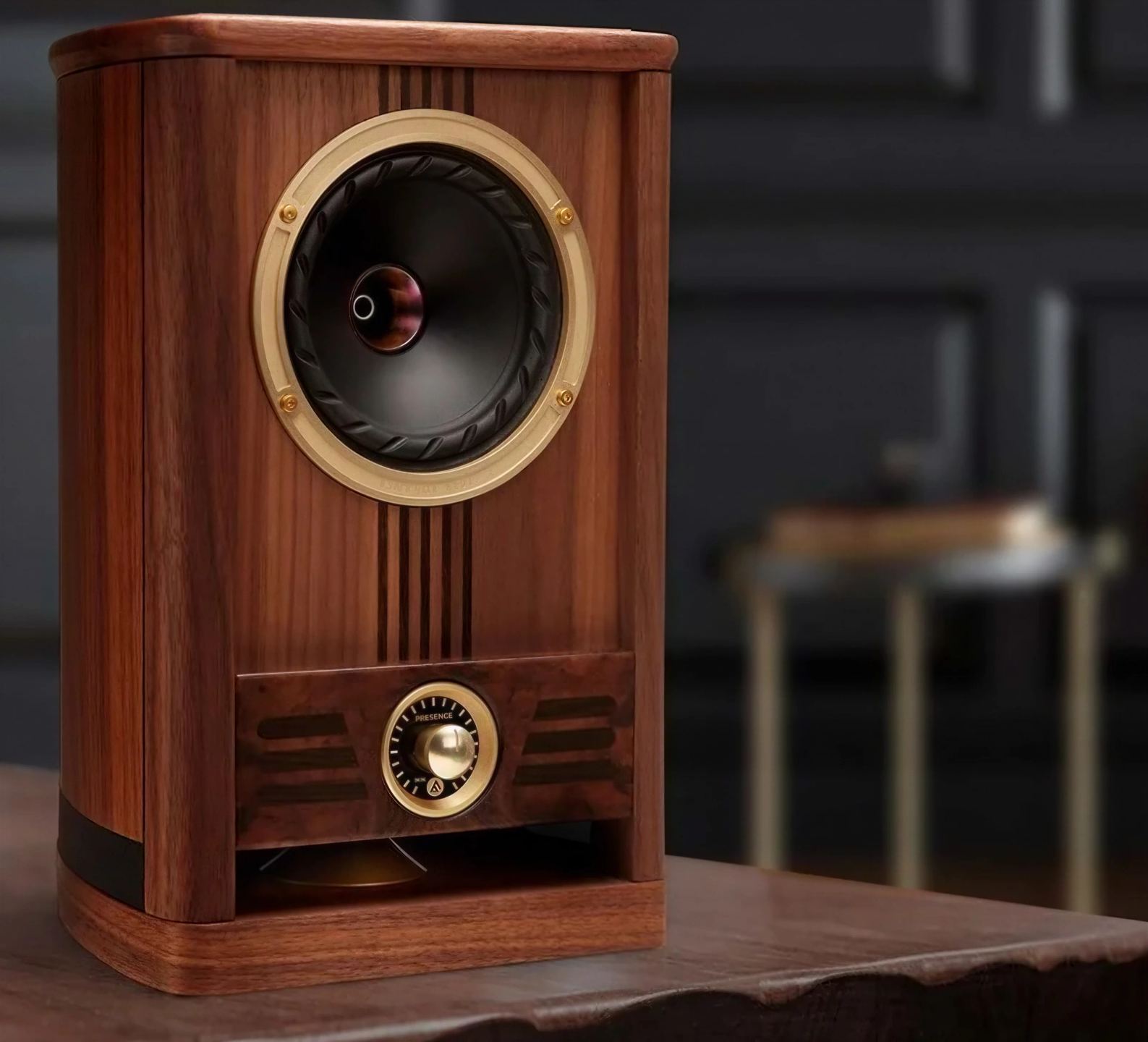
The IsoFlare coaxial driver, a single point source
The principle of a coaxial driver is to house the tweeter at the centre of the mid-bass driver, on the same axis. Both drivers radiate from the same point, as if all the music were coming from a single source. In practice, the stereo image remains coherent even when you’re not listening directly on-axis, and the soundstage doesn’t collapse the moment you shift by a seat.
Here, a 125 mm multi-fibre cone handles the bass and midrange. At its centre, a 19 mm magnesium dome compression tweeter takes care of the highs, driven by a neodymium magnet. Magnesium, light and rigid, helps the dome stay accurate right up to the top of the frequency range, where the response extends to 38 kHz.
The surround connecting the cone to the chassis, called FyneFlute, is not smooth but moulded with variable-geometry fluting. Its role: to absorb the energy that reaches the edge of the cone rather than reflecting it back towards the centre — a reflection that would otherwise add colouration to the midrange.
A downward-firing port
Rather than opening the port at the rear or front, Fyne Audio routes it beneath the speaker, towards the floor. Below the opening, a Tractrix-profile diffuser — a geometry borrowed from acoustic horns of the 1920s — spreads the expelled air into a 360-degree spherical wave. Bass is distributed evenly throughout the room, regardless of which direction the speaker is facing.
The practical result: the Vintage Five is less sensitive to its position in the room than many rear-ported speakers. It tolerates placement against a wall or on a shelf without the bass becoming muddy, although it still benefits from a little breathing room.
A passive crossover treated at extreme cold
The split between mid-bass and treble occurs at 1.9 kHz, via a low-loss passive crossover with simple wiring: second-order filtering on the mid-bass, first-order on the treble. In other words, few components in the signal path, to preserve its finesse.
Once assembled, each crossover undergoes deep cryogenic treatment — a process involving exposure to very low temperatures followed by slow rewarming. The process relieves internal micro-stresses in the components, wires, and solder joints, improving signal transfer and making the sound a little more transparent.
Adjusting presence to suit the room
On each speaker, an analogue dial controls presence: plus or minus 3 dB over the 2.5 to 5 kHz band. This is the range where vocal attack and the bite of brass or strings reside. A heavily furnished room with curtains and rugs tends to muffle this upper midrange: turn the dial up. A bare, reverberant room, on the other hand, benefits from turning it down. The adjustment is lossless and does not degrade the signal.
Amplification and placement
Sensitivity is rated at 87 dB, an average figure for a compact speaker, with a nominal impedance of 8 ohms that remains easy to drive. Fyne Audio recommends an amplifier of 30 to 100 watts RMS; the speaker handles 50 watts continuous and peaks of 200 watts. A well-chosen integrated amplifier in this range will bring out its dynamics without strain.
Placed on stands at the right height, with the tweeter at ear level, it delivers the best of its stereo image. It is most at home in a small or medium-sized room, in a two-channel system, for both streaming and vinyl. There is nothing to stop it being used as a front channel in a home cinema setup, but it is in stereo that it most clearly expresses what the Vintage series aims for: a clean, grounded sound — old-school in style, contemporary in engineering.
Technical specifications
System design
- System type: 2-way, downward-firing port, with BassTrax Tractrix diffuser
- Cabinet construction: high-density pressed birch plywood
- Finish: walnut
Drive units
- Configuration: 1 125 mm IsoFlare point-source driver
- Multi-fibre bass / midrange cone
- FyneFlute surround
- 19 mm magnesium dome compression tweeter
- Neodymium magnet system
Acoustic performance
- Frequency response (-6 dB typical in-room): 46 Hz - 38 kHz
- Sensitivity (2.83 V at 1 m): 87 dB
- Nominal impedance: 8 ohms
Power
- Recommended amplifier power: 30 - 100 W RMS
- Continuous power handling: 50 W RMS
- Peak power handling: 200 W
Crossover
- Crossover frequency: 1.9 kHz
- Filter type: low-loss passive, simple wiring, 2nd-order low-pass, 1st-order high-pass, deep cryogenically treated
System adjustments
- Presence (2.5 kHz - 5.0 kHz): ± 3 dB
Dimensions and weight
- Dimensions (H × W × D): 350 × 219 × 260 mm
- Net weight (per speaker): 6.2 kg
- S-Trax position (from the front edge of the cabinet): 53 mm
Frequently Asked Questions
Does the Vintage Five need feet, and at what height?
Ideally, yes. It performs at its best when the tweeter, located at the center of the speaker, is at ear level when seated. On 60 to 70 cm stands, depending on your sofa, the stereo image stabilizes and the bass separates from the furniture. Placed too low, it loses precision and openness.
Can it be placed on a shelf despite its downward-facing port?
Yes. The port opens underneath the cabinet, onto a diffuser integrated into the base of the speaker: bass is redirected into the room without the opening needing space in front of it. A shelf is therefore suitable, provided the speaker is not wedged against the back or surrounded by books that would muffle the sound. An unobstructed edge and a little clearance are sufficient.
Can it be bi-wired or bi-amplified?
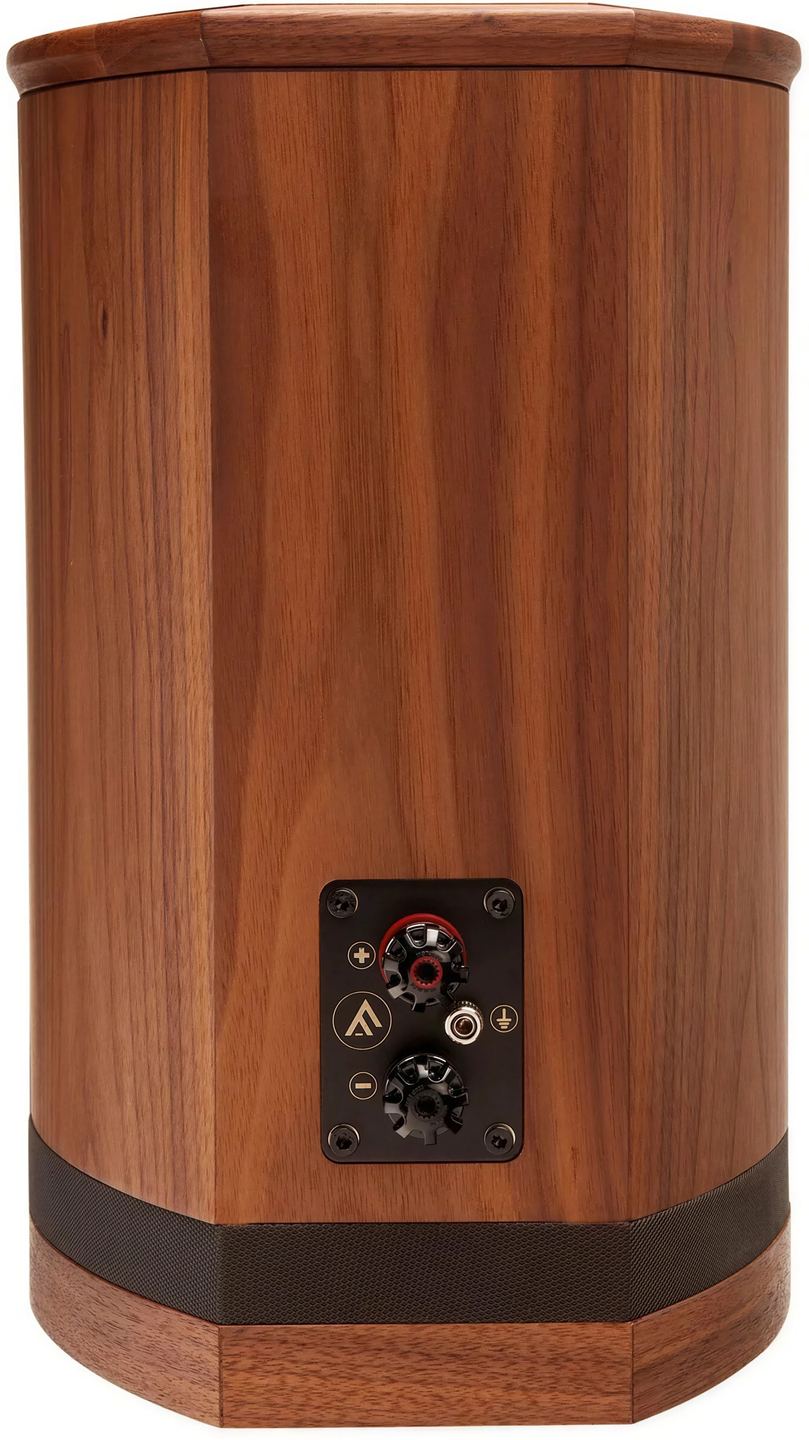
No. The crossover uses single wiring, with only one pair of terminals per speaker. Bi-wiring and bi-amping are not supported: a good speaker cable connected to this pair of terminals does the job.
Is it available in finishes other than walnut?
The Vintage Five is available in walnut, with wood veneer and walnut burl inlays. This is the only finish available for this model.
Does it need a subwoofer?
Not necessarily. The bass extends down to around 46 Hz in-room, covering the vast majority of music, including a good portion of the lower register of electric bass guitars and organs. For movie infrabass or very low electronic music, a subwoofer takes over at the bottom of the spectrum and relieves the speaker.
Where does the Vintage Five fit into the Vintage series?
It is the only compact bookshelf model in the series. The others, Vintage Ten, Twelve and Fifteen, are increasingly substantial floorstanding speakers. The Vintage Five applies the same technical principles in a smaller cabinet, designed for more modest listening spaces.
- Eco-contribution included in the sale price.
- GTIN / EAN: 5060546834106