

Stream Box E and Wireless Box E: Pro-Ject goes wireless multiroom
May 07, 2026
Contents
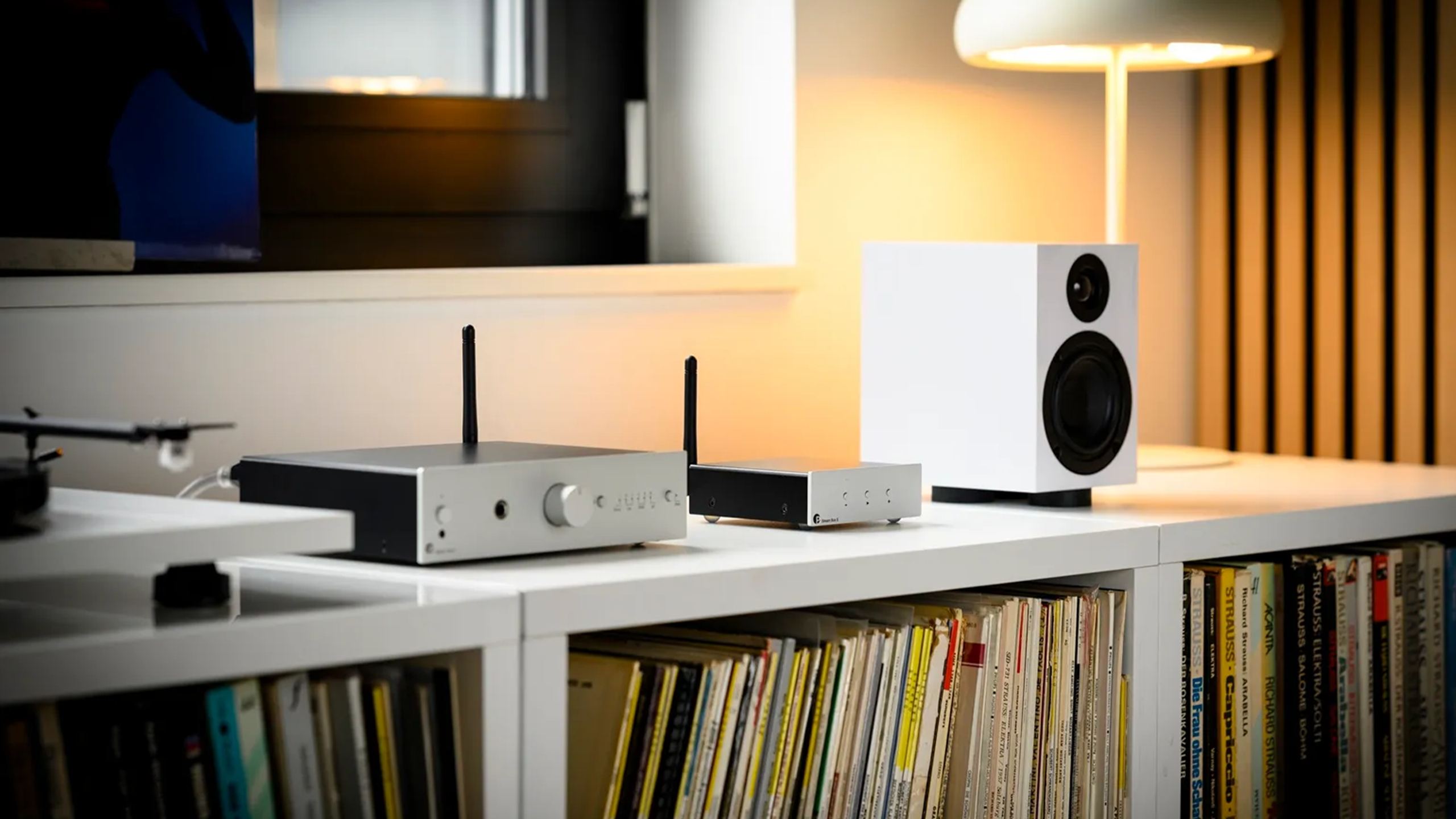
Pro-Ject continues to build out its streaming catalog. The Austrian manufacturer, long confined in the collective imagination to the turntable section, announced on April 28 two new compact units that share the same software platform (WiiM OS) but address two very distinct uses. The Stream Box E plays the expected role of a streamer DAC to connect to an existing amplifier. The Wireless Box E, meanwhile, offers something more unusual: a small amplified module that clips directly onto the back of a passive speaker and removes the speaker cable from the equation.
→ Discover all Pro-Ject products
The Stream Box E, an unsurprising but well-positioned streamer DAC
The Stream Box E is the more conventional of the two. In terms of connectivity, it features a stereo RCA analog output, an optical S/PDIF digital output (Toslink), an RCA analog input for connecting a line-level source (typically a turntable via a phono preamp), and a 5 V / 1 A DC power supply. The unit accesses the main services in native mode: Spotify Connect, Tidal Connect, Qobuz Connect, and Amazon Music, the latter integrated into the in-house Pro-Ject Home app.
In terms of measurements, Pro-Ject announces a signal-to-noise ratio greater than 102 dB on the line output, harmonic distortion below 0.009%, and channel separation greater than 106 dB at 10 kHz, for a frequency response of 20 Hz to 20 kHz at -1.5 dB. The nominal output level is 3 Vrms. These are respectable figures for a device at this price point. The DAC chip used, however, is not specified.
Wi-Fi is dual-band (802.11 a/b/g/n/ac, 2.4 and 5 GHz), and Bluetooth 5.0 supports only the SBC and AAC codecs. No aptX HD, no LDAC. A strange omission for a brand that already has a BT Box E HD with aptX HD in its catalog.
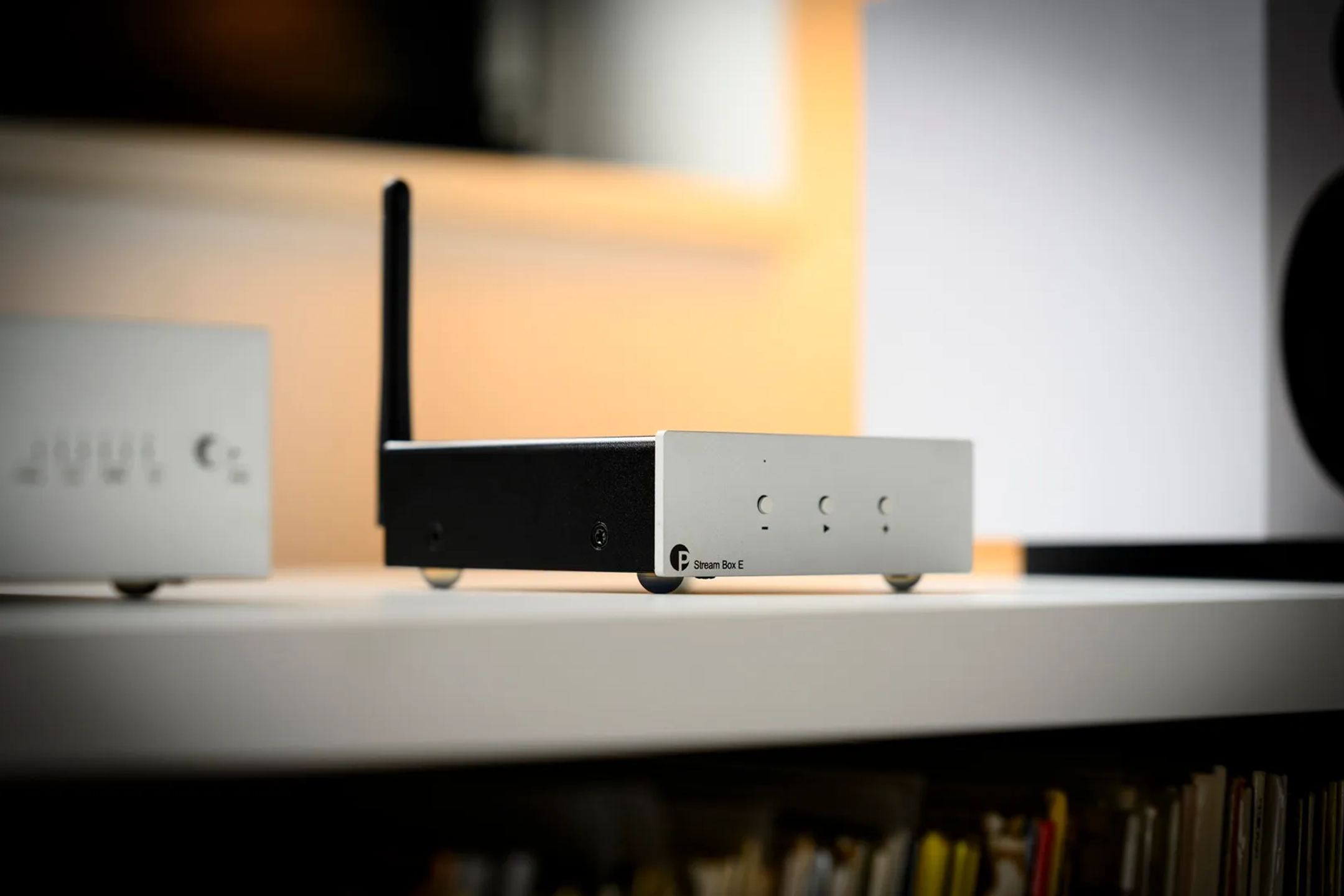
The metal chassis with aluminum front panel gets a special mention: Pro-Ject indicates that the electromagnetic shielding allows the unit to be placed directly next to an amplifier, or even stacked on top of it, without degrading audio performance. A practical argument for neat integration into an existing system.
Three use cases are highlighted: adding streaming to a system already equipped with an integrated amplifier, serving as a digital preamplifier in combination with a power amplifier and a pair of passive speakers, or directly feeding a pair of active speakers. The built-in volume control does indeed allow for this last scenario.
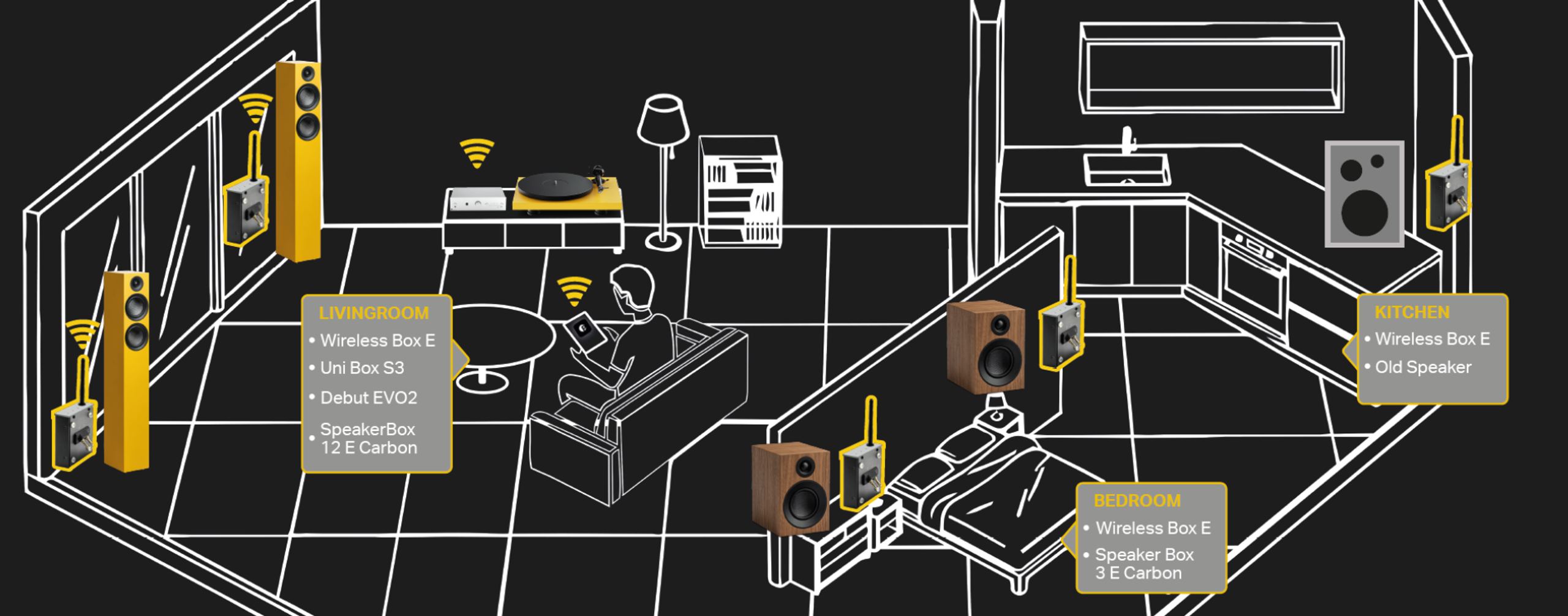
The RCA analog input deserves a closer look. Pro-Ject calls it “True Wireless Sending”: the signal from a turntable or any other line-level device connected to the Stream Box E can be broadcast to other compatible devices on the network (Uni Box S3, Wireless Box E, other new-generation Pro-Ject streamers) and to WiiM products. Connecting a turntable to the Stream Box E in the living room and listening to the LP in the kitchen without rewiring anything is an argument that sets this range apart from purely digital solutions such as Sonos. The Stream Box E is available immediately for €179, in black or silver finish.
The Wireless Box E, or the (almost) end of the speaker cable
This is the product that draws attention. Rather than offering yet another connected amplifier to stack in the rack, Pro-Ject flips the logic: each Wireless Box E is a mono amplified module that connects directly to the terminals of a passive speaker via 4 mm banana plugs. A stereo pair therefore requires two units, one per speaker, for a total of €458 for a complete system (the module is announced at €229 each, in black or silver, with availability scheduled for late May 2026).
The stated amplification delivers 25 W into 8 ohms or 50 W into 4 ohms (at 1% THD), which is sufficient for bookshelf speakers in a modest-sized room. The signal-to-noise ratio is 96 dB (100 dB A-weighted) into 4 ohms, distortion is less than 0.12% at 5 W into 4 ohms, and channel separation is -67 dB at 10 kHz. Modest figures, but consistent with the compact format and the price. The amplification class is not specified. Each unit receives audio over dual-band Wi-Fi and includes the same WiiM OS as its bigger sibling, again with Bluetooth 5.0 limited to the SBC and AAC codecs.
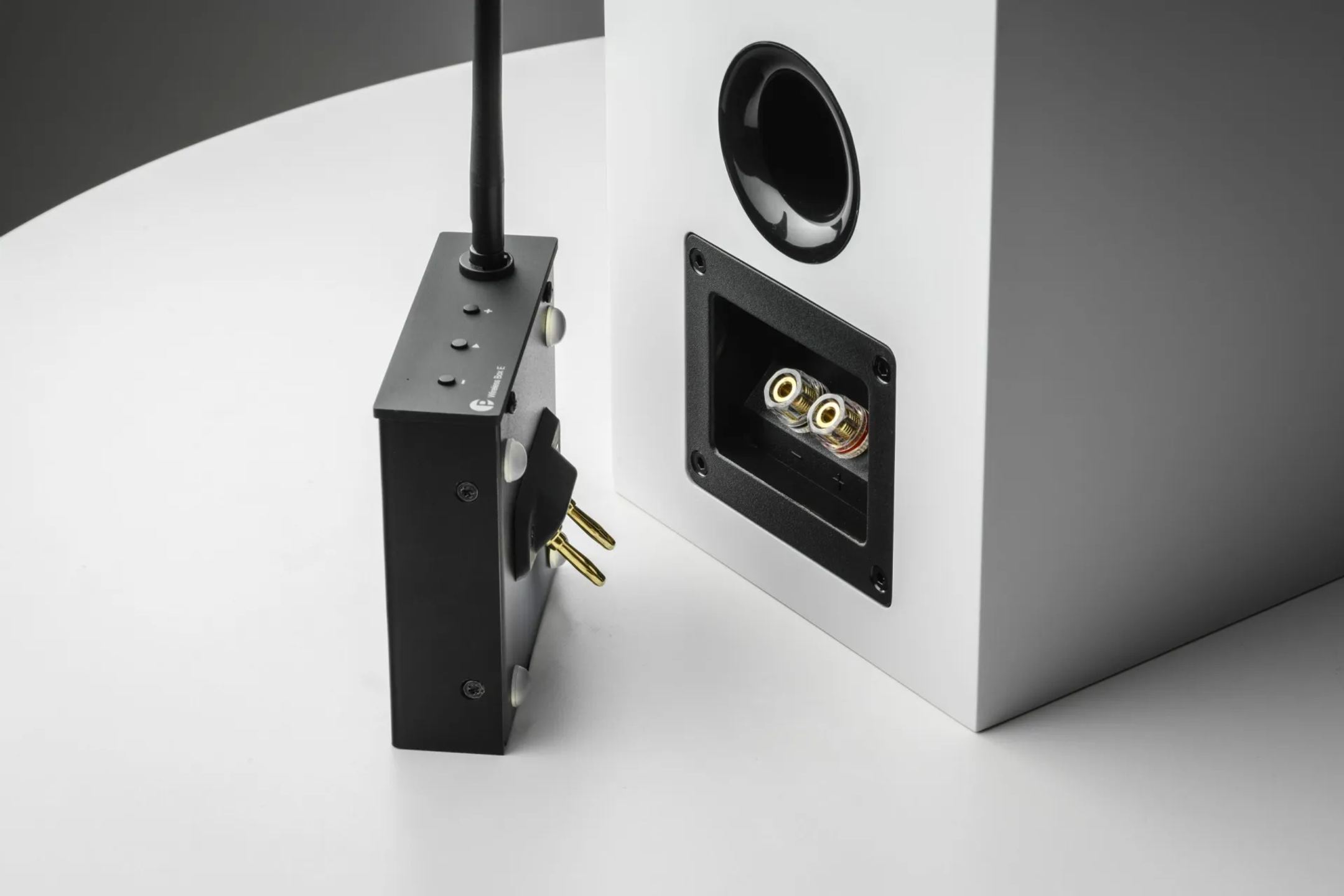
Pro-Ject has calibrated the module primarily for its own speakers, whose rear layout allows direct attachment. For other brands, a 30 cm Connect it LS-E Flex extension cable, sold for €29.90 per pair, takes over when the geometry of the rear panel prevents direct connection.
One detail remains that slightly tempers the “wireless” promise: each Wireless Box E requires its own 22 V / 1 A power supply. The speaker cable is eliminated, but the problem is shifted to a nearby power outlet for each speaker. A clear advantage in installations where the outlet is easier to access than routing speaker cable, much less so in rooms where the outlet is far from the listening positions. Standby power consumption remains low at less than 0.5 W.
Pro-Ject True Wireless Receiving: the overall logic
Both units are based on the same software architecture, controlled via the Pro-Ject Home app, and it is this shared platform that gives the range its coherence. The Wireless Box E can directly receive the audio stream from the Stream Box E, from the Uni Box S3 launched last summer, and from the Wi-Fi T2 W turntable that broadcasts vinyl wirelessly. It is also compatible with WiiM devices themselves, which expands the integration scope beyond the Pro-Ject catalog alone.
The most convincing usage scenario combines the two new products. A Stream Box E centralizes the sources (streaming and analog input for the turntable), and several pairs of Wireless Box E units power passive speakers placed in different rooms. The result is a multiroom system capable of playing vinyl throughout the house, without investing in a Sonos infrastructure. The entry ticket for a complete stereo system without speaker cable comes to around €640 (one Stream Box E at €179 plus one pair of Wireless Box E units at €458), excluding speakers and excluding the extension cable. That is significantly less than a pair of connected active speakers from a comparable brand, but with a dependence on the WiiM/Pro-Ject ecosystem that must be accepted.
The downside: no AirPlay 2, no Roon Ready
Pro-Ject supports neither AirPlay 2 nor Roon Ready certification on these two units. That is a choice with major consequences. Apple Music has no native “Connect” mode on the WiiM platform, and without AirPlay 2, it becomes impossible to play the Apple Music library in lossless from an iPhone to these devices. Roon subscribers, meanwhile, will have to look elsewhere.
The DAC chip in the Stream Box E is no better documented. At this price level the omission is understandable, but it makes direct comparison with a WiiM Pro Plus, for example, more difficult, since that model lists its specifications.
For Tidal, Qobuz, or Spotify subscribers, none of this is a problem: the Connect modes work flawlessly. Apple users, on the other hand, will have to look to Sonos or another AirPlay 2-compatible manufacturer.
You may also like to read
 Turntable and speaker package: our best combinations under €1,000Comparisons and buying guides
 Which turntable to start with without making a mistakeComparisons and buying guides
 Beginner’s Vinyl Guide: How to Get Properly Equipped in 2026Tutorials and practical guides
 Pro-Ject unveils a Scorpions turntable inspired by the Blackout albumHi-fi and home cinema news
 How to Digitize Your Vinyl Records into High-Quality Audio FilesTutorials and practical guides
 Debut Reference 10: Pro-Ject rethinks its entry-level turntable with a 10-inch tonearmHi-fi and home cinema news




