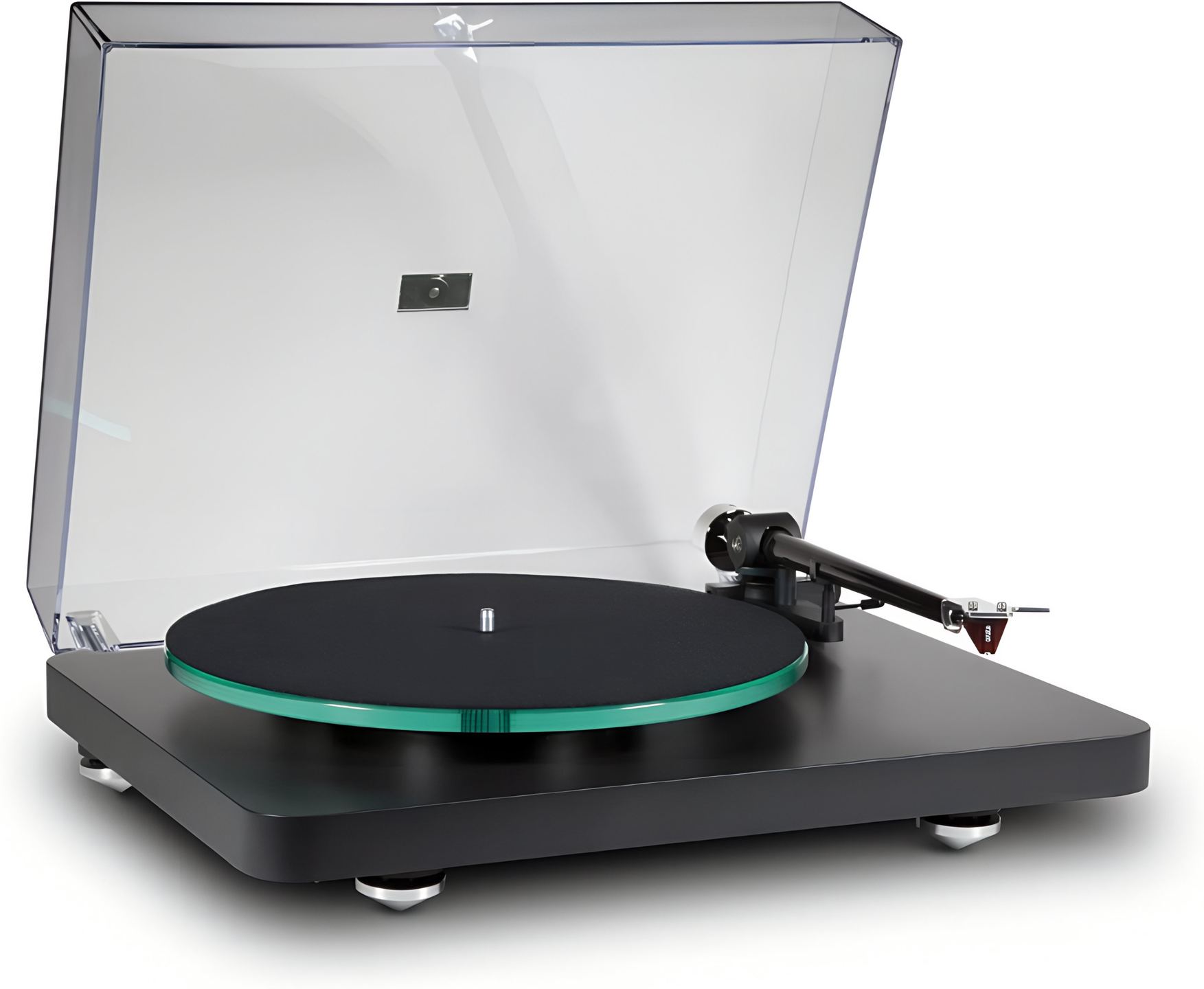
The NAD C588 is a manual, belt-drive turntable developed in collaboration with Pro-Ject. It continues NAD’s tradition since 1972 of focusing on sound quality over aesthetics. This model combines Pro-Ject’s manufacturing expertise with the acoustic specifications defined by NAD.
A Design Focused on Stability and Isolation
The NAD C588 is built on a remarkably dense MDF plinth, weighing nearly 9.2 kilograms. This substantial mass is no accident: it serves as the first line of defense against unwanted vibrations. The four conical metal feet, equipped with a tuned isolation system, create a mechanical interface between the turntable and its support. These feet, ending in sharp spikes, require the use of the supplied protective discs to preserve wooden furniture—a detail that reflects the attention given to every aspect of the design.
The 10-millimeter-thick glass platter, surrounded by a distinctive translucent green edge, rests on a sub-platter made of machined aluminum alloy with particularly tight tolerances. This combination ensures exceptionally consistent rotation, helping to keep wow and flutter below 0.01%. The included felt mat plays a crucial role in damping potential glass resonances—a material chosen for its inertia but requiring this specific acoustic treatment.
The protective dust cover, thick and designed to minimize resonance, is hinged at the rear of the plinth. Unlike some competing models, it can remain open at any angle, offering appreciable flexibility in use. NAD even provides a pair of white cotton gloves for handling the platter without leaving fingerprints, reflecting an almost ceremonial approach to setup.
The Tonearm: Fusion of Composite Materials and Mechanical Precision
The 9-inch (230 mm) tonearm is the C588’s major differentiator compared to lower models in the range. Built around a carbon fiber tube—prized for its rigidity and resonance-damping ability—it ends in a fixed metal headshell. This hybrid design leverages the complementary properties of both materials: the lightness and damping of carbon, the rigidity and precise mounting of metal.
The decoupled counterweight, with an effective mass of 9.5 grams, incorporates an internal suspension system that acts as a dynamic vibration damper. This feature, unusual at this price point, effectively reduces unwanted resonances that can affect playback. Tracking force adjustment, calibrated from 0 to 30 millinewtons, is done manually by moving the counterweight along the arm—a process requiring patience and precision with the supplied gauge, whose markings are admittedly rather broad.
Magnetic anti-skating compensation, preferable to spring or thread systems, ensures a constant and predictable force without adding mechanical friction. Even more remarkable, the C588 offers adjustment options rarely seen at this price: both azimuth (to ensure the stylus is perfectly perpendicular in the groove) and vertical tracking angle (VTA) are adjustable. A screw near the bearing allows the arm to rotate for azimuth adjustment, while two screws at the rear allow the arm height to be changed to optimize VTA according to record thickness or cartridge type.
Motorization and Electronic Control: The Pursuit of Perfect Speed
The C588’s drive system illustrates NAD’s approach to speed control. The synchronous AC motor, powered by a proprietary circuit, benefits from sophisticated electrical isolation. The external 15V DC power supply is first converted to clean DC voltage, then reconverted to stable 50Hz AC. This double conversion, also used in much more expensive turntables, eliminates mains fluctuations that could affect rotational consistency.
The drive belt, described by NAD’s technical director Greg Stidsen as “specially formulated” with precise mechanical and dimensional characteristics, plays a crucial role in isolating motor vibrations. Made from synthetic rubber to strict specifications, it must transmit torque while filtering micro-vibrations and maintain these properties over time.
Speed change between 33⅓ and 45 rpm remains manual—you need to lift the platter and move the belt to the appropriate step on the two-stage pulley. This approach, which may seem anachronistic in the all-electronic era, has the advantage of maintaining a simple, direct mechanical link, without additional electronic circuits that could introduce noise or instability. NAD even mentions the possibility of using a special pulley for 78 rpm playback, thus appealing to shellac collectors.
The Ortofon 2M Red Cartridge: A Calculated Choice
The Ortofon 2M Red cartridge, pre-installed and factory-set, is a judicious choice for this turntable. With its 5.5 mV output and frequency response from 20 Hz to 22 kHz, it delivers solid performance without requiring a phono preamp with exceptional specs. The elliptical stylus ensures precise tracking of groove modulations, while the relatively light cartridge body matches well with the arm’s effective mass.
Factory installation guarantees optimal alignment according to Baerwald geometry, with an 18 mm overhang precisely set. NAD nevertheless provides an alignment template for those wishing to install a different cartridge, thus acknowledging the turntable’s upgrade potential. The recommended tracking force of 18 mN (1.8 grams) for the 2M Red is in the optimal range to minimize record wear while maintaining stable groove contact.
A Systematic Approach to Vibration Management
NAD’s philosophy regarding vibration control is evident in every aspect of the design. Vibration transmission follows what engineers describe as a “triangle”: from the record to the platter, through the spindle and bearing to the plinth, up through the arm support to the pivot, then down the arm to the cartridge. Each interface along this path represents an opportunity to lose musical energy or introduce coloration.
Strict machining tolerances applied to the sub-platter and spindle minimize mechanical play, thus preserving the music’s micro-dynamics. The bearing, with its stainless steel spindle rotating in a precision sleeve, receives special treatment to reduce friction while maintaining dimensional stability over time.
Isolation from external vibrations coming from speakers or transmitted through the floor relies on several layers of protection: the mass of the plinth, the specific tuning of the isolating feet, and the mechanical decoupling between different elements. This multi-layered approach proves particularly effective in preserving clarity and definition in complex musical passages.
Sound Performance and Positioning in the Range
Sonically, the C588 stands out for its particularly successful tonal balance. Unlike some turntables in this price range that favor either treble or bass, the NAD maintains remarkable coherence across the entire spectrum. Bass frequencies are solidly grounded without excessive heaviness, the midrange is full of detail without harshness, and the treble brings transparency and air without metallic hardness.
The soundstage unfolds with precision, offering clear instrument separation and appreciable depth. This spatialization never becomes artificially projected, maintaining a coherence that respects the intent of the recordings. The turntable excels especially in reproducing instrumental timbres, preserving the harmonic richness that makes vinyl so charming.