Ortofon Diamond Concorde MKII MIX

Overview
On a DJ turntable, the stylus takes a beating: cueing back to line up a track, the back-and-forth of scratching, long hours of playback at a party. This is the replacement stylus for the Concorde MKII MIX cartridge by Ortofon, the all-round model in the series. It clips onto the front of the cartridge body and restores its original performance when a worn tip starts to dull the sound.
A spherical tip that stays in the groove
The stylus ends in a spherical tip with an 18 µm radius. This rounded shape maintains consistent contact with the groove walls regardless of the direction the record turns, allowing it to handle vigorous back-cueing and scratching without skipping. Ortofon uses this profile for intensive handling, reserving the elliptical profile for gentler use where playback detail matters more than tracking stability. The trade-off is familiar: a spherical tip reads high frequencies a little less precisely, especially toward the center of the record, where the groove gets tighter. The frequency response spans 20 Hz to 20 kHz at -3 dB, enough to reproduce the full audible range of house, hip-hop or rock, whether played in a club or at home.
A 6 mV output and solid bass tracking
At 6 mV at 1 kHz (measured at the standard velocity of 5 cm/s), the signal sent to the mixer’s phono input is strong: it stands out clearly from background noise and leaves headroom on the gain control. Tracking ability reaches 100 µm at 315 Hz at the recommended tracking force. This figure describes the modulation amplitude the tip can follow without skipping, and it matters most in the bass, where the grooves have the widest undulations. The lateral dynamic compliance of 14 µm/mN, which measures the flexibility of the stylus suspension, remains moderate and suits the fairly high-mass tonearms of DJ turntables.
Channel separation (20 dB at 1 kHz, 15 dB at 15 kHz) and left-right balance of ± 1.5 dB fall within a reasonable range for this type of cartridge. Groove stability and robustness take priority over stereo imaging precision.
A wider MKII stylus assembly that’s easier to grip
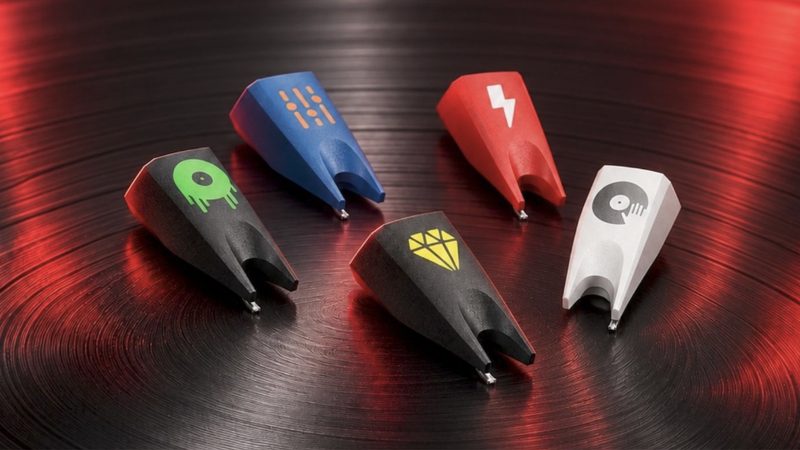
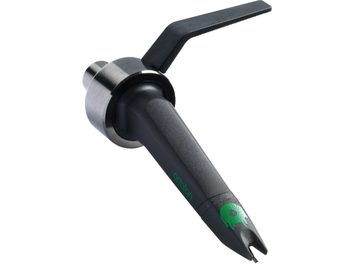
The MKII generation has a redesigned stylus assembly: wider and sturdier, it is easier to grip between your fingers, even in a dim DJ booth. A metal spring holds it in the cartridge, and a soft click confirms that it is seated properly. A cutout at the front leaves the tip visible, making it easier to place the stylus precisely at the start of a track. The assembly is black and green, matching the Concorde MKII MIX, and weighs just one gram.
Replacement requires no tools. With the cartridge removed from the tonearm, pull the worn stylus assembly straight forward, then insert the new one along the same axis, holding it from above and without forcing it, until it clicks.
Set the turntable to around 3 grams of tracking force
The recommended tracking force is 3 g, within a usable range of 2 to 4 g. Going outside this range risks skipping, degraded sound and unnecessary record wear. On a Technics SL-1200 or SL-1210, the small additional counterweight screwed onto the back of the tonearm limits Concorde cartridges to around 2 g: it must be removed to reach the recommended value.
For DJ use with back-cueing, set anti-skating to zero so the tip follows the groove in either direction of rotation. Some DJs prefer half the tracking force, a setting to fine-tune by ear. For straightforward listening, set anti-skating to the same value as the tracking force. Adjust the tonearm height so it is parallel to the record during playback. A new stylus reaches its best performance after a break-in period of around twenty hours of normal playback, avoiding extended time spinning in the run-out groove.
A stylus for the Concorde MKII MIX body only
Each stylus in the series is matched to the magnet and coils of its own cartridge body, and this one is intended exclusively for the Concorde MKII MIX. Other Concorde MKII styli (DJ, Club, Scratch, Digital, Elite) physically fit the same body, but Ortofon does not support these combinations: they may alter the output level or upset channel balance. First-generation Concorde styli do not fit MKII cartridges at all.
Technical Specifications
General Information
- Diamond for Concorde MKII MIX
- Color: black and green
- Recommended exclusively for Concorde MKII MIX
Audio Performance
- Output voltage: 6 mV (1,000 Hz, 5 cm/s)
- Channel balance: ± 1.5 dB at 1 kHz
- Channel separation:
- At 1 kHz: 20 dB
- At 15 kHz: 15 dB
- Frequency response: 20-20,000 Hz (-3 dB)
Physical Characteristics
- Tracking ability at 315 Hz: 100 μm (at recommended tracking force)
- Lateral dynamic compliance: 14 μm/mN
- Stylus type: spherical R 18 μm
Tracking Force
- Possible tracking force: 2-4 g
- Recommended tracking force: 3 g
Frequently Asked Questions
How do I know when it’s time to replace the stylus?
You can hear when a stylus is worn: the highs become dull, sibilants turn raspy, distortion increases toward the end of a record side, and skips become more frequent even though the settings haven’t changed. A damaged stylus can also wear down the groove walls, damaging the records themselves. Regular inspection with a magnifying glass helps you spot a worn or dirty diamond tip before it gets to that point.
Should you check the tracking force after replacing the stylus?
Yes. Replacing it does not change the counterweight setting, but checking with a tracking force gauge confirms that the stylus is tracking at 3 g. It is also a good opportunity to check the anti-skating and tonearm height.
Does the stylus work with a straight-arm turntable?
Yes, a spherical stylus profile is precisely what suits this type of tonearm, as an elliptical profile may not sit properly in the groove. A short straight tonearm does, however, increase harmonic distortion regardless of the cartridge fitted, in exchange for better tracking during scratching.
Can it be used with timecode vinyl?
The stylus reads a timecode vinyl record like any other record. For dedicated use with digital vinyl mixing software, Ortofon offers the Concorde MKII Digital: its 10 mV output improves the signal-to-noise ratio of the signal sent to the software, while its reduced response at the frequencies where vinyl crackle occurs limits tracking errors and reduces wear on records.
Is it useful to rotate the cartridge to mimic a straight tonearm?
This practice, which involves turning the cartridge about 23° inward, sometimes improves tracking in the groove but causes premature wear to both the stylus and the records and degrades the sound, because the stylus tip no longer meets the groove at the correct angle. Ortofon advises against it.
How do I care for the stylus and cartridge?
Clean the stylus with a fine antistatic brush, always brushing from the back of the cartridge toward the front, never back and forth or sideways, as this could bend the cantilever. Brushing records with a carbon-fiber brush before and after each play helps prevent buildup. Once a year, a little contact cleaner on the cartridge pins and in the tonearm socket prevents oxidation and channel dropouts.
Can the stylus be used on a hi-fi turntable?
The turntable just needs to accommodate the Concorde MKII MIX cartridge body—that is, its tonearm must have a connector for a removable headshell, as on most DJ turntables. The 6 mV output is suitable for a standard MM phono input. For listening only, the spherical stylus prioritizes durability over playback detail, and the anti-skating should be set to the same value as the tracking force.
- Eco-contribution included in the sale price.
- GTIN / EAN: 5705796141009