

Oehlbach Bi-Tech 4.4 L (2 x 3m)
Overview
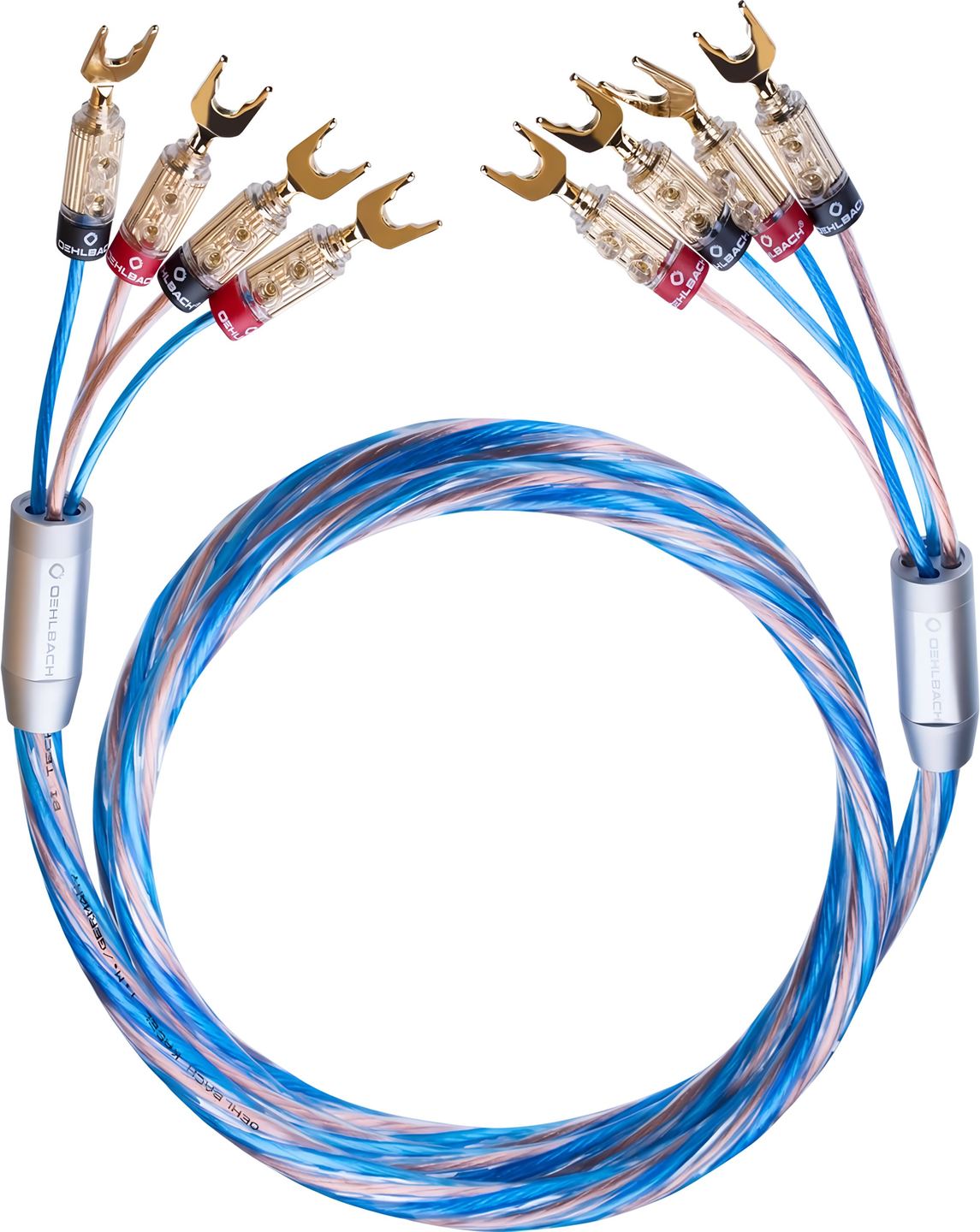
Powering a speaker with two amplification channels, one for bass and the other for midrange and treble, requires four conductors per side instead of two. Oehlbach supplies this connection ready to plug in, with conductors of different materials and cross-sectional areas according to the part of the spectrum they carry, and factory-fitted spade connectors at both ends. All that remains is to choose the right length and tighten the binding posts.
Two copper cross-sections according to the frequency band
Each cable in the pair actually combines two independent connections. Bass travels through two 4 mm² oxygen-free copper (OFC) conductors, a generous cross-section with good reason: the bass driver draws most of the current supplied by the amplifier. Over 5 m, the resistance of such a connection remains just a few hundredths of an ohm, including the outgoing and return paths, well below a speaker’s impedance (4 to 8 Ω), and this margin is particularly beneficial for longer runs and low-impedance speakers. Midrange and treble travel through two 2.5 mm² silver-plated oxygen-free copper (SPC) conductors, a surface treatment Oehlbach reserves for this part of the spectrum because high frequencies flow more near the conductor’s surface, a phenomenon known as the skin effect. At audible frequencies, this effect remains modest in fine strands, and the difference between silver and copper is slight. The principle of separation, however, is sound: each signal path has its own pair of conductors, with no shared return path. The flexible plastic insulation, blue against a copper-coloured background, keeps the cable flexible despite its overall cross-section.
Connecting a speaker for bi-amplification
The Bi-Tech 4.4 L is used with a speaker equipped with two pairs of binding posts, one pair for bass and one for midrange and treble. These two pairs are connected as standard by jumpers (strips or short cables), which must be removed before connecting the four spade connectors; otherwise, the two amplifier outputs would be connected to each other. At the electronics end, the four conductors connect to two separate pairs of speaker outputs: two stereo amplifiers, one per frequency band or one per speaker, or a home cinema amplifier capable of reassigning some of its channels to bi-amplification. The speaker’s passive crossover continues to distribute frequencies between the drivers; each amplification channel simply works with a smaller load, with bass no longer modulating the power supply of the channel handling midrange and treble. The audible benefit depends on the speaker and amplifiers used, and is more noticeable with current-demanding speakers than with easy-to-drive models. Oehlbach specifies a recommended amplifier power of up to 400 W.
Fusion spade connectors with gold-plated contacts
Each cable ends in four Fusion spade connectors at each end, with 24-carat gold-plated contacts. The spade slides under the tightening collar of a screw-type binding post and provides a broad contact area once tightened, making it a connection that remains stable over time. Gold is not there to improve conductivity: it protects the contact from oxidation, whereas bare wire eventually darkens and loses connection quality. Factory assembly also prevents stray strands from protruding from the binding post and potentially touching the neighbouring terminal. The spade has one limitation: it is not suitable for the spring terminals found on some entry-level speakers and electronics. The cable is made in Germany and covered by a 30-year manufacturer’s warranty.
Choose the length before ordering
The Bi-Tech 4.4 L is available in 2, 3, 4 and 5 m lengths, referring to the length of each cable in the pair. As the connectors are factory-fitted, the cable cannot be shortened without losing the spade connectors: it is best to measure the actual route, along the skirting boards and around the furniture, then add a little slack so the speakers can be moved a few centimetres during adjustment. Keeping the same length on both sides simplifies installation, even though the sound response does not depend on it over these distances. Any excess should be stored in wide loops behind the furniture rather than tightly coiled.
Documentation
French
Technical Specifications
Construction and Design
- Optimized hybrid design
- 2 x 2.5 mm² silver-plated oxygen-free copper (SPC) for midrange and treble
- 2 x 4 mm² oxygen-free copper (OFC) for bass
- Premium insulation
- Highly flexible for easy installation
- Durable protection against wear
- Effective interference suppression
Electrical Specifications
- Signal type: analog audio
- Signal direction: input / output
- Maximum supported power: up to 400 W (350 W according to another source, to be confirmed with final specification)
- Bi-amped design for demanding high-fidelity systems
Physical Characteristics
- Cable geometry: round
- Total cross-section: 2 x 2.5 mm² (SPC) + 2 x 4 mm² (OFC)
- Insulation material: flexible plastic
- Color: blue / copper
Connectors
- 4 x Fusion Oehlbach cable lugs per pair
- 24-carat gold-plated contacts
- Reliable, lossless transmission
- Robust and durable contacts
Package Contents
- 1 pair of pre-assembled cables
- 4 x cable lugs already mounted on each end (total: 8 lugs)
General Information
- Lossless transmission of low frequencies
- Excellent detail reproduction in midrange and treble
- Highly flexible and easy to install
- Manufacturer warranty: 30 years
Frequently asked questions
Can it be used for bi-wiring with a single amplifier?
Yes, provided the amplifier allows it. Some screw terminals accept two spade connectors stacked on the same terminal; other amplifiers have two pairs of outputs, A and B, which, when operated simultaneously, feed the two pairs of conductors in parallel. This is called bi-wiring, not bi-amping, since the same channel drives both the bass and treble. The speaker jumpers must also be removed in this case.
Is there any benefit to using this cable with a speaker that has a single set of terminals?
No. With only one pair of terminals, the conductors would have to be joined in pairs, and separating the channels would be pointless. A standard two-conductor speaker cable is the right choice in this case.
What's the difference compared to the Bi-Tech 4.4 B?
The conductors, cross-sectional areas and insulation are identical. The 4.4 B is terminated with Fusion banana plugs, which are quicker to connect and disconnect, while the 4.4 L comes with spade terminals, recommended when the binding posts do not accept banana plugs or when screw fastening is preferred.
Does the connection direction matter?
The cable has no required orientation at the amplifier or speaker end. However, each pair must be connected to the correct terminals: the 4 mm² conductors to the bass terminals, the 2.5 mm² conductors to the midrange/treble terminals, with correct polarity, red to red and black to black, at both ends. Reversing the polarity on just one section causes a dip at the crossover between bass and treble.
Can a home theater amplifier handle bi-amping?
Many home theater amplifiers with seven or more channels offer an option in their speaker assignment menu that dedicates the surround back channels to bi-amping the front speakers. These channels are then no longer available for surround speakers, and the setup is limited to 5.1 or an equivalent configuration. The device’s manual specifies which outputs to use.
Do spade connectors require maintenance?
Very little. Tightening the binding posts from time to time is enough, as heating cycles and vibrations can slightly loosen a screw over the months. To clean the contacts, a dry cloth or one lightly moistened with alcohol is suitable; an abrasive product would wear away the gold plating.
- Eco-contribution included in the sale price.
- Manufacturer reference: D1C10833
- GTIN / EAN: 4003635108338








