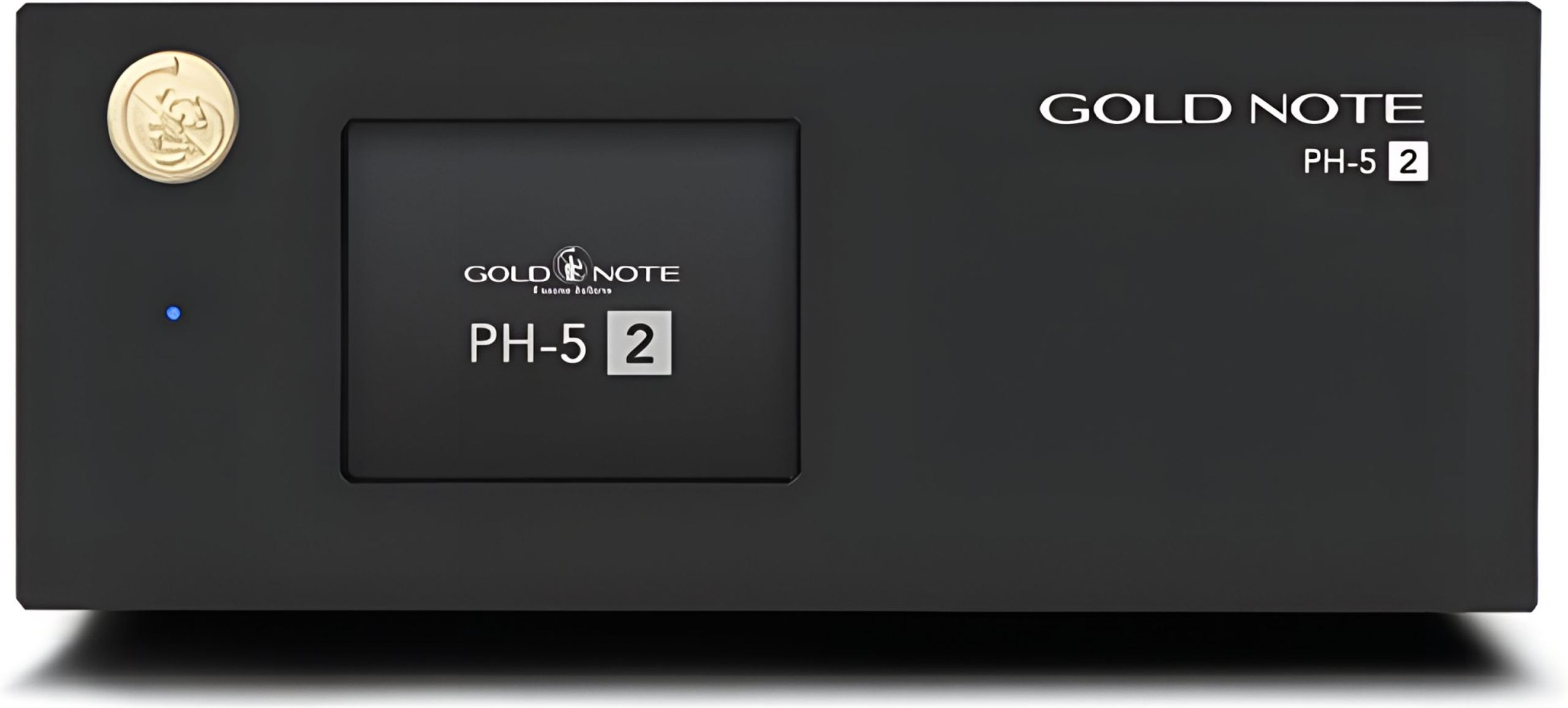
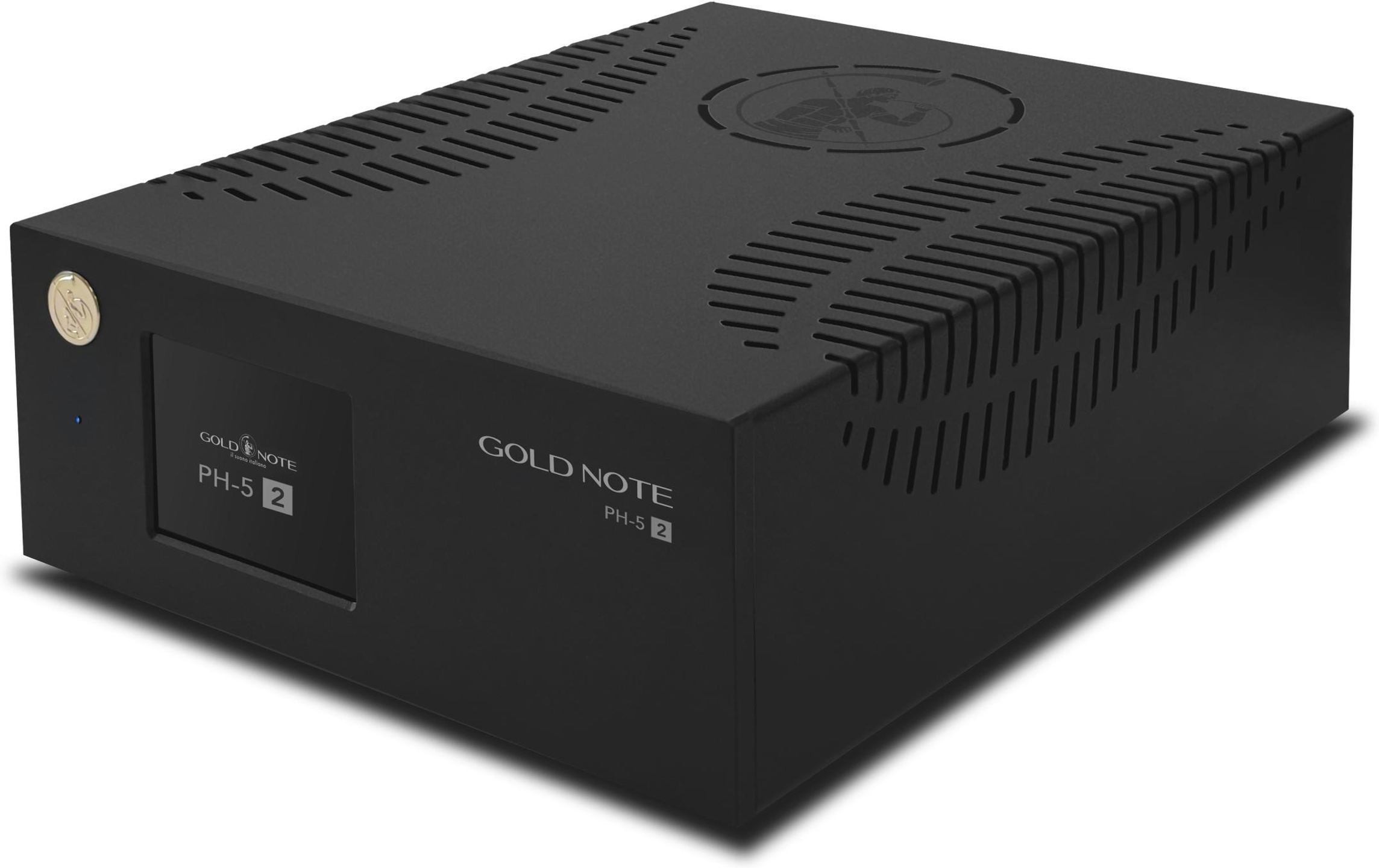
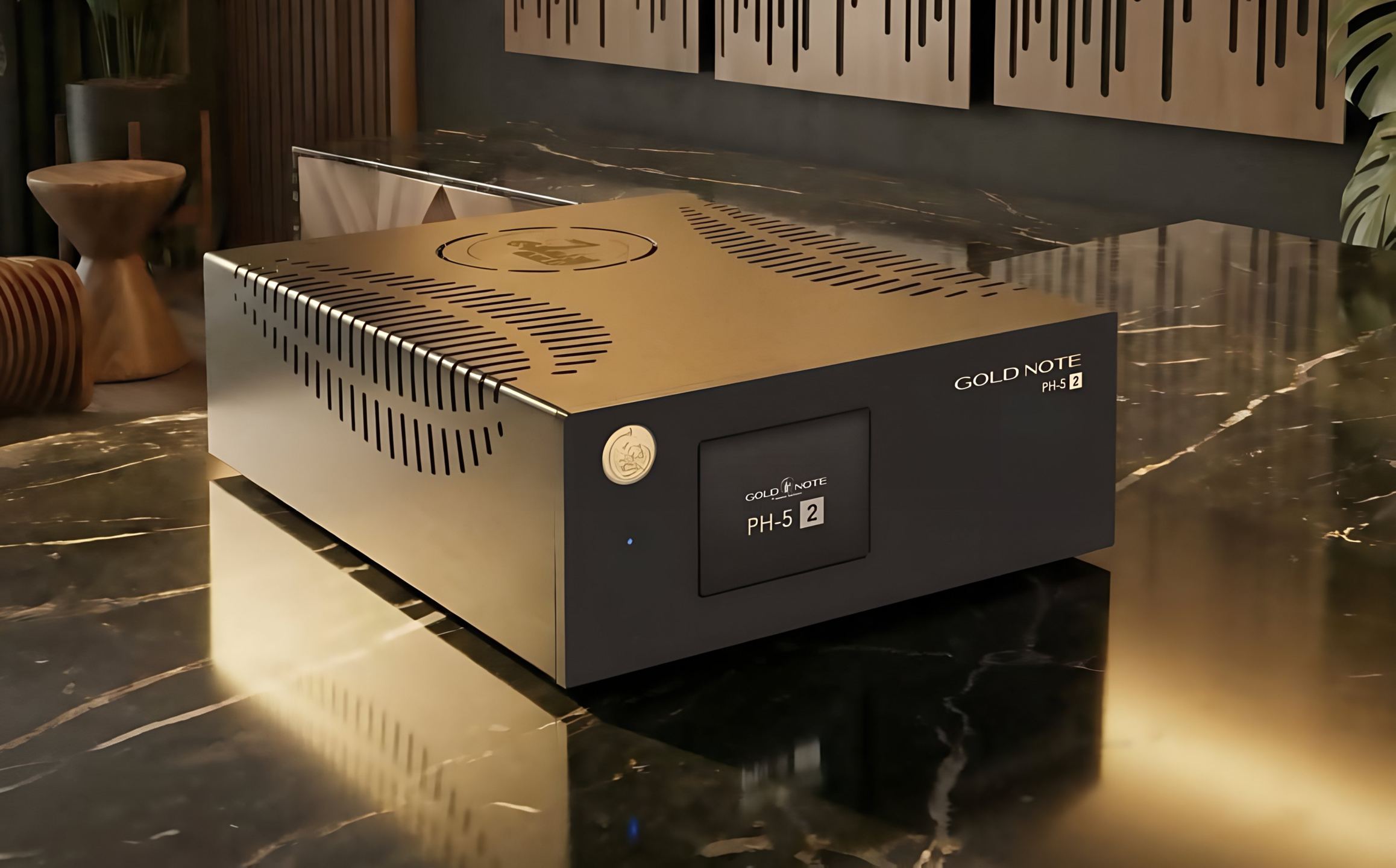
Gold Note PH-5.2, phono preamp with variable equalization
Records cut before the mid-1950s did not all follow the now-standard RIAA curve, and most turntables play them today with the wrong equalization. That is the playground of this phono preamp: a fully analog signal path, three equalization curves to choose from according to the record, and fine gain and loading adjustments to get the best from any cartridge.
Finding the right curve for each record
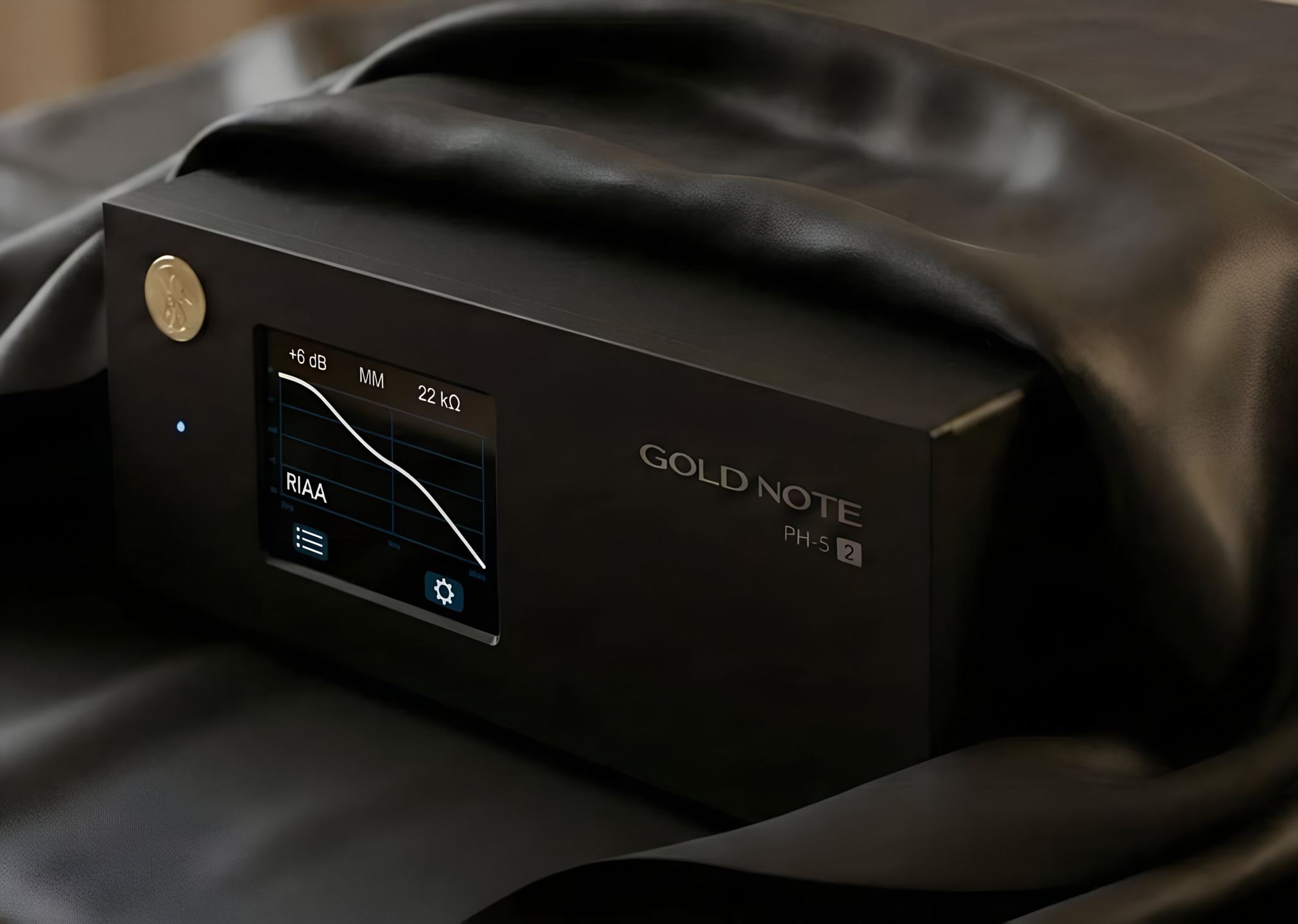
The RIAA standard was only adopted in the mid-1950s. Earlier records, along with part of the catalog from labels such as Decca or Columbia, relied on other equalization curves. Applying the RIAA curve to these records upsets their tonal balance. The PH-5.2 offers three selectable curves, directly from the display: RIAA, Decca London and American Columbia. Each is also available in an Extended version, which extends the frequency response to 50 kHz instead of 20 kHz, with an accuracy of ±0.3 dB. The aim is not to color the sound, but to restore the balance intended when the record was cut. An infrasonic filter (10 Hz, 36 dB per octave) completes the package: it eliminates the very low frequencies generated by a warped record or resonances from the turntable, without affecting the audible range.
An analog core controlled from the display
Control is handled via a color touchscreen, clearer and more direct than on the PH-5. It lets you adjust the equalization curve, gain and loading, and switch between profiles during listening without interrupting playback. The digital section stops at the display, however. The audio signal remains entirely analog, on a discrete-component circuit whose layout has been shortened to limit interference. Every setting selected on the display acts on the signal through high-quality relays, without ever sending the music through a digital stage. This separation makes it possible to combine the convenience of a modern interface with the purity of an analog chain.
Precise matching with every cartridge
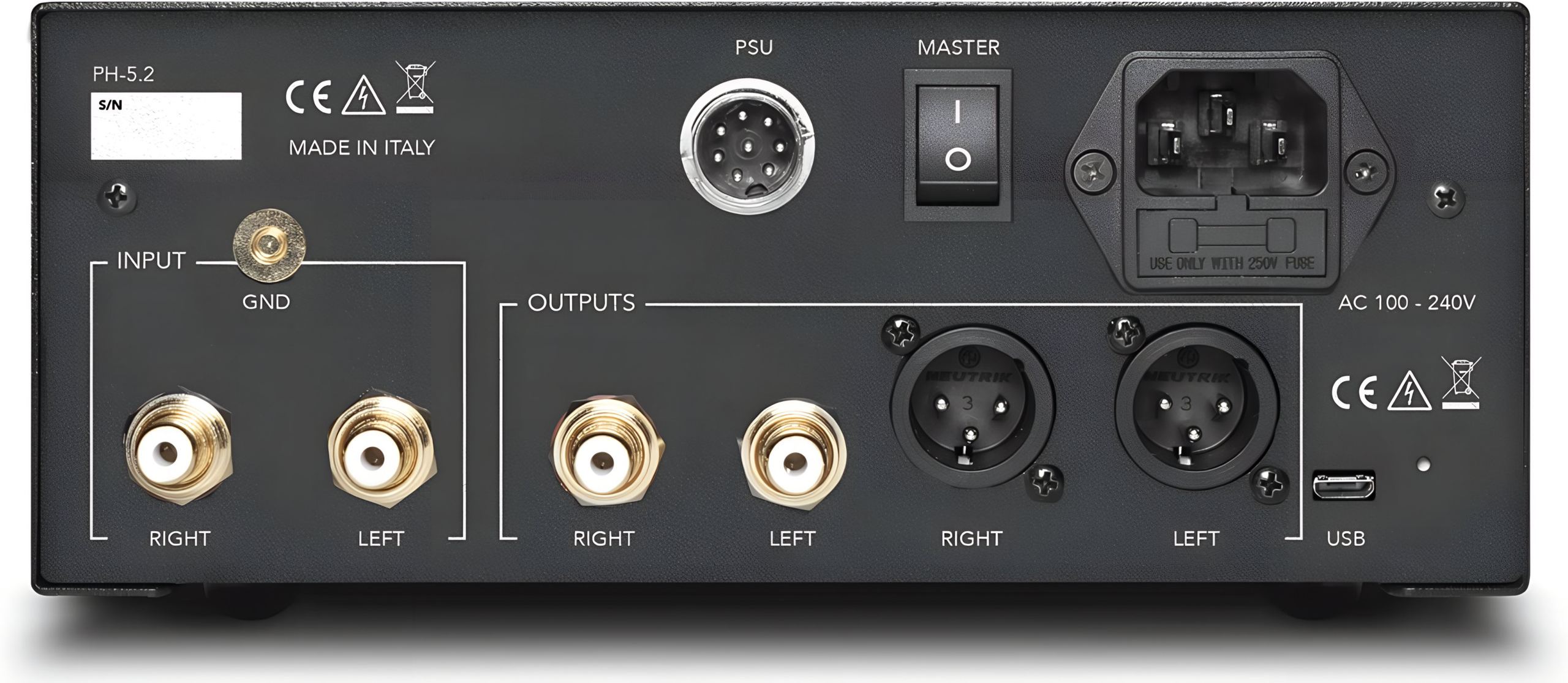
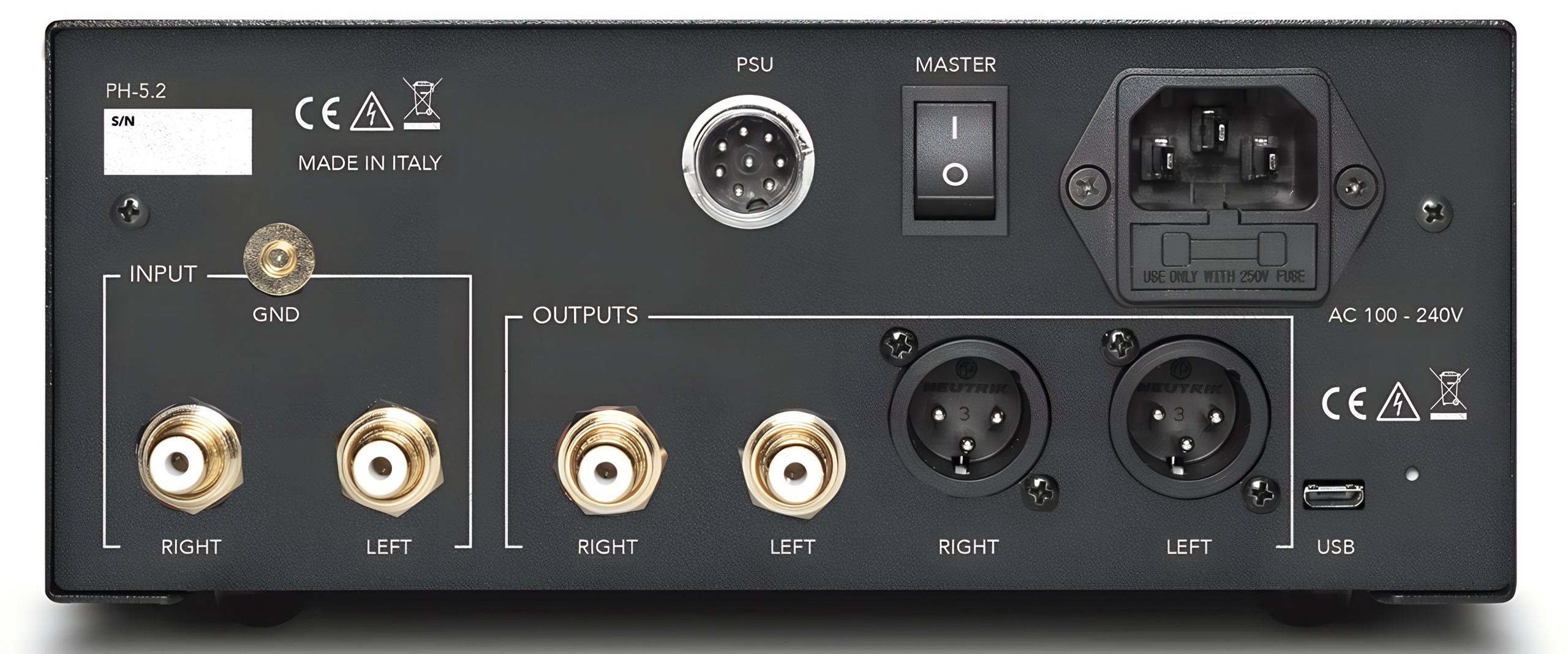
A phono cartridge delivers a very low signal, a few millivolts for a moving-magnet model, often less than 1 mV for a low-output moving-coil model. The PH-5.2 accepts 0.1 mV to 10 mV at its input, covering virtually everything that can be fitted to a tonearm. The single RCA input accepts either a moving-magnet (MM) cartridge or a moving-coil (MC) cartridge. Gain is set around 40 dB in MM and 60 dB in MC, with adjustment steps (0, +3 and ±6 dB) to match the cartridge’s output level. On the loading side, nine impedance values range from 10 Ω to 47 kΩ, complemented by 220 pF capacitance in MM. New compared with the PH-5: the PH-5.2 stores two configurations, one MM and one MC, which can be recalled with a simple selection in the menu. Handy when two turntables share the system, or when alternating between two cartridges on the same tonearm.
Aluminum chassis and revised power supply
The most noticeable change compared with the PH-5 lies in the chassis. Sandblasted and black-anodized aluminum interacts very little with magnetic fields, which cleans up the circuit’s electrical and mechanical environment and lowers the noise floor. Micro-details, those that give air and substance to a recording, come through more clearly. The format remains that of a compact half-width enclosure (200 × 80 × 260 mm, 1.2 kg), easy to place near the turntable to shorten cables. The power supply has also been reworked, with greater stability and better current reserves. In practice, bass gains more foundation and treble becomes smoother: the circuit operates more calmly during demanding passages. Power consumption remains modest, around 10 W in operation and less than 0.5 W in standby.
RCA and balanced XLR outputs
Connection is made via two outputs, one unbalanced RCA and one balanced XLR, with an output impedance of 50 Ω. Having a balanced connection at this price level is far from common: it rejects interference more effectively over cable runs and matches amplifiers equipped with XLR inputs. The PH-5.2 fits between the turntable and any line input, on an integrated amplifier, a preamplifier or a connected amplifier. The measurements support the claim: distortion below 0.05% at 1 kHz, a signal-to-noise ratio of 89 dB and 105 dB of dynamic range, enough to let low-level details emerge from silence.
In the lineage of the PH-10 and PH-1000
The PH-5.2 inaugurates the 5.2 series from Gold Note and its new aesthetic language, while opening the Florentine manufacturer’s range of phono preamps. It directly descends from the PH-10 and PH-1000, whose guiding principles it adopts (neutrality, control, faithfulness to the record) in a more compact and more affordable format. To take performance further without replacing the PH-5.2, the optional external PSX-5.2 power supply supports the mains section and raises performance to a higher level. One caveat, however: the PH-5.2 only reveals its potential with a turntable and cartridge worthy of it. Paired with an entry-level source, it will be satisfying without revealing everything it can do.
Faithful to the record’s true sound, without coloration or artificial enhancement
Principle inspired by reference models PH-1000 and PH-10
Total fidelity to the recording
Evolution of the PH5.5 Compared with the PH-5 Model
Chassis: sandblasted, black-anodized aluminum with minimal interaction with magnetic fields
Power supply: optimized with increased stability and better current capacity
Display and ergonomics: new interface with faster, clearer, and more intuitive settings
Mains Power
Power consumption: 10 W
Standby consumption: < 0.5 W
Mains voltage: 100–120 V or 220–240 V, 50 / 60 Hz
Fuse: 2 A T
Dimensions and Weight
Dimensions
Unit only: 200 × 80 × 260 mm (W × H × D)
Packaged: 290 × 180 × 390 mm (W × H × D)
Weight
Unit only: 1.2 kg
Packaged: 2.2 kg
Frequently asked questions
What is the difference between a separate phono preamp and one built into an amplifier?
+
An integrated phono stage shares its power supply and circuitry with the amplification section. A dedicated unit has its own power supply, shielding and layout, which lowers the noise floor and reveals more detail. It also provides access to loading, gain and equalization settings that integrated phono inputs rarely offer. In a system where vinyl is a primary source, the difference is audible.
How do I know which equalization curve to apply to a record?
+
The vast majority of pressings since the mid-1950s follow the RIAA standard, which remains the default choice. Earlier cuts and part of the Decca and Columbia catalogues may require their respective curves; the sleeve or matrix sometimes indicates this, otherwise a quick listening comparison will settle it. Since the curves can be changed during playback, simply listen to the same passage with each one to identify the correct setting.
Should Extended mode always be enabled?
+
There is no universal rule. The Extended version pushes the response toward 50 kHz and opens up the dynamics and extension; on many recordings, the standard curve is sufficient. The simplest approach is to switch between the two on the same track and keep the one that sounds right for the pressing.
Can the PH-5.2 digitize my vinyl records?
+
No. The signal path is entirely analog, with no USB port or built-in analog-to-digital converter. To digitize your records, you need to place a separate converter or audio interface after its output.
What is the PH-5.2's infrasonic filter used for?
+
It cuts very low frequencies below 10 Hz at a rate of 36 dB per octave. These infrasonic frequencies, generated by a warped record or turntable resonances, add nothing musically but place unnecessary strain on the amplifier and woofer. The filter operates below the truly audible bass range, without encroaching on the useful frequency band.
Is the PH-5.2 suitable for a cartridge with a very low output level?
+
Yes. Gain reaches 60 dB in MC mode and input sensitivity drops to 0.1 mV, supporting low-output moving-coil cartridges. The gain setting and load impedance still need to be matched to the cartridge’s characteristics to achieve the right level and tonal balance.
Can the optional external power supply be added after purchase?
+
Yes. It connects later, without replacing the PH-5.2, and boosts performance whenever you wish. It is a way to extend the device’s lifespan and evolve it rather than replace it.
User reviews
Review highlights
Very enthusiastic reception: 7 out of 8 reviews give 5/5, and four rate the PH-5.2 significantly higher than their amplifier’s built-in phono stage or their previous preamp.
Five out of eight reviews praise a wide, detailed soundstage with good separation.
Natural vocals and timbres, increased dynamics and better-defined bass feature in three reviews.
Three reviews also appreciate the extensive settings, simple interface and elegant finish.
Based on reviews from customers who purchased this product, summarised by AI
Patrice
I owned an old Rega P2 turntable from 1987 with a Grado cartridge from 1989, and I bought this phono preamp to replace the phono board in my IN300 integrated amplifier. The change in sound was significant, but after reading everyone's reviews of this Gold Note PH 5.2, I realized I wasn't taking full advantage of its capabilities. Shortly afterwards, the motor on my old turntable (un)fortunately broke down. I took the opportunity to replace it with a Rega P6 with an ND7 cartridge, and the sound quality took another leap forward. So I recommend this preamp, provided you have a turntable and cartridge of sufficient quality to take full advantage of it.
Comment from 30 September 2026 — Experience from 13 September 2026
Automatically translated — Show original (French)
Je possèdais une vieille platine Rega P2 de 1987 avec une cellule Grado de 1989, j'ai acheté ce préampli phono pour remplacer la carte phono de mon intégré IN300. Le changement de son a été significatif mais à lire les avis de chacun sur ce Gold Note PH 5.2, j'ai compris que je n'exploitais pas pleinement ses capacités. Peu de temps après le moteur de ma vieille platine est (mal) heureusement tombé en panne. J'en ai profité poour la remplacer par une Rega P6 avec une Cellule ND7, la qualité de restitution a encore fait un bond. Donc je conseil ce préampli à condition d'avoir une platine et une cellule de qualité suffisante pour pouvoir pleinement l'exploiter.
Piotr
A very simple and intuitive interface, and above all, excellent quality. One small suggestion: a balanced XLR input would be useful. If the PH-10 were equipped with XLR connectors, I would replace it immediately.
Comment from 3 September 2026 — Experience from 23 August 2026
Automatically translated — Show original (French)
Une interface très simple et intuitive, et surtout, une excellente qualité. Une petite suggestion : une entrée XLR symétrique serait utile. Si le PH-10 était équipé de prises XLR, je le remplacerais immédiatement.
Vincent
The PH-5.2 is a phono preamplifier that has truly allowed me to take things to the next level. Paired with an MC cartridge, it delivers an exceptionally refined sound, with plenty of substance, superb dynamics and exemplary quiet operation. Vocals are natural, instruments are perfectly defined, and the soundstage gains in both depth and realism. The numerous settings make it easy to fine-tune the pairing with your cartridge, making it a device that is as high-performing as it is versatile. An excellent surprise that makes you want to rediscover your entire vinyl collection.
Once again, thanks to the entire HomeCinéSolutions team for their professionalism, always relevant advice and impeccable support.
Comment from 27 July 2026 — Experience from 16 July 2026
Automatically translated — Show original (French)
Le PH-5.2 est un préamplificateur phono qui m’a véritablement permis de franchir un cap. Associé à une cellule MC, il offre une restitution d’une grande finesse, avec beaucoup de matière, une superbe dynamique et un silence de fonctionnement exemplaire. Les voix sont naturelles, les instruments parfaitement détourés et la scène sonore gagne en profondeur comme en réalisme. Les nombreux réglages permettent d’affiner facilement l’association avec sa cellule, ce qui en fait un appareil aussi performant qu’évolutif. Une excellente surprise qui redonne envie de redécouvrir toute sa collection de vinyles.
Encore une fois, merci à toute l’équipe de HomeCinéSolutions pour leur sérieux, leurs conseils toujours pertinents et leur suivi irréprochable.
To better understand our visitors, measure marketing effectiveness and personalise ads, we and our partners use cookies and mobile advertising identifiers on your device. This data makes it possible to display personalised and non-personalised ads and measure their performance. Some cookies, which are technically necessary, are exempt from consent. You can accept those that require your consent, refuse them by clicking “Reject”, or customise your choices via “More options”.
To find out how Google uses the data collected once you have given your consent, see Google’s Business Data Responsibility site (opens in a new window).
You can change or withdraw your consent at any time via the “Cookies” link. Your choices will apply on our site for 12 months.