Élysium Screens Zenith Eclipse UST 90"

Overview
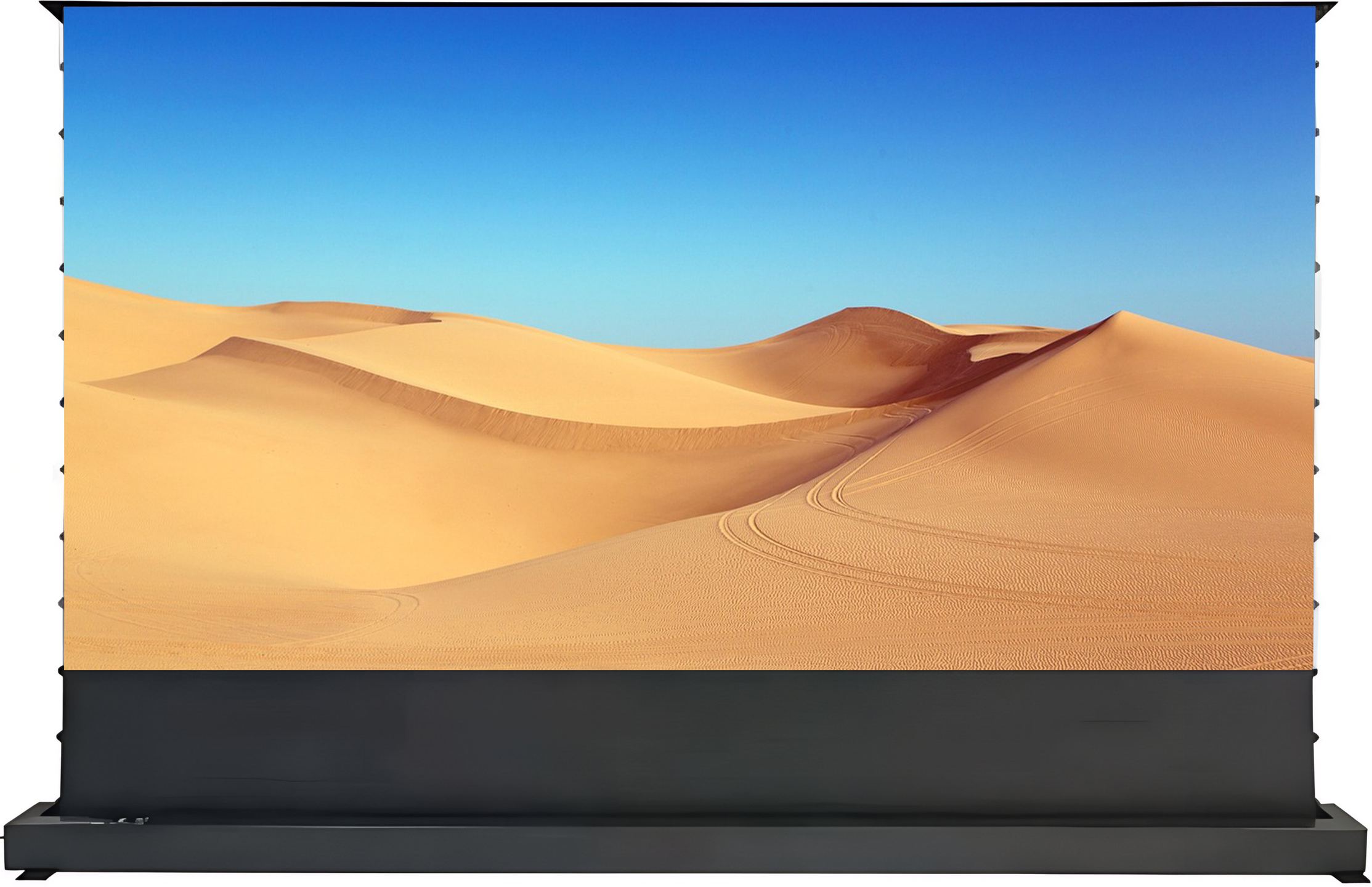
UST projectors, positioned a few centimeters from the wall, cast their beam at a steep angle that makes conventional screens (and white walls) unsuitable: stray reflections, amplified textures, washed-out contrast. The Zenith Eclipse UST addresses this optical constraint with an ALR screen specifically oriented to capture light coming from below while rejecting light from the ceiling and the sides.
A screen that appears and disappears
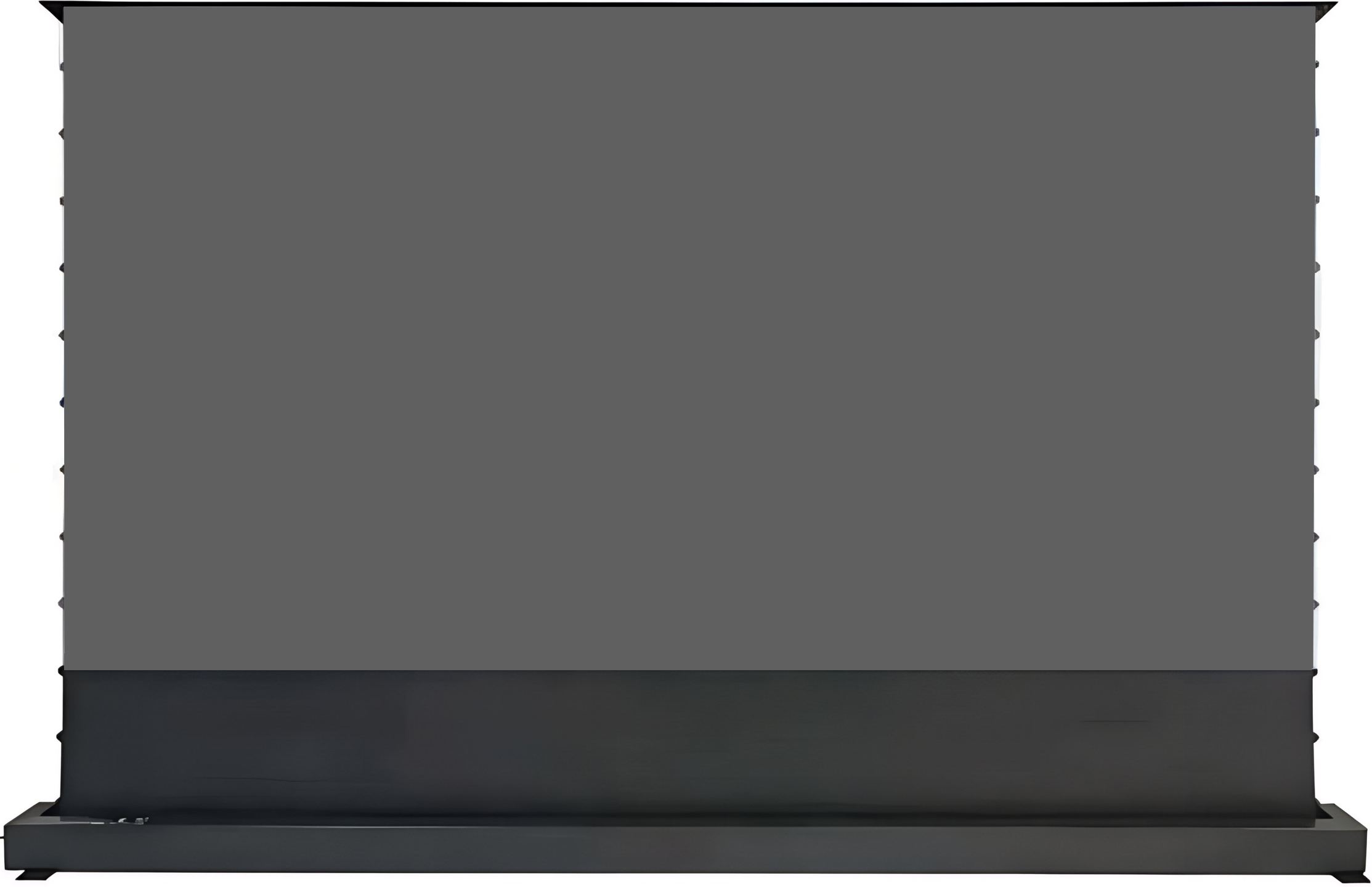
The main advantage of a motorized floor-rising screen lies in its discretion. The Zenith Eclipse UST deploys from its housing, rises in a few seconds thanks to a scissor mechanism, then fully retracts once the viewing session is over. This configuration suits living rooms and multipurpose spaces where a permanent fixed screen is not desirable.
The lateral cable tensioning system keeps the screen perfectly flat once deployed, a critical point with UST projectors that amplify the slightest ripple or surface curvature. The motorization is described as quiet, and deployment is controlled via the included remote control or a USB trigger that can synchronize the screen with the projector powering on.
The aircraft-grade aluminum housing
Élysium Screens has opted for a so-called “aircraft-grade” aluminum alloy enclosure, a term that refers to alloys in the 6000 or 7000 series, known for their strength-to-weight ratio. This choice is justified by the mechanical stress the housing undergoes: it must support the scissor mechanism, the tensioned screen, and repeated deployment cycles without deforming. Aluminum also has the advantage of resisting humidity, which can extend the lifespan of the internal mechanism in less controlled environments.
How the Eclipse ALR screen works
ALR (Ambient Light Rejecting) technology is based on a surface structure that treats light differently depending on its angle of incidence. On a UST screen, the material generally features a “sawtooth” or lenticular microstructure: the upper part of each micro-element, oriented upward, absorbs light coming from the ceiling (the main source of light pollution in a living room), while the angled part reflects the projector beam toward the viewer.
The Eclipse screen offers a 90% rejection rate for light coming from the ceiling and the sides. In concrete terms, this makes it possible to preserve usable contrast during the day with the curtains open, whereas a conventional white screen would produce a washed-out image. The opaque black backing prevents any light from passing through the screen from behind, which further enhances perceived blacks.
0.8 gain: the brightness/contrast compromise
A screen’s gain measures the amount of light reflected back to the viewer compared to a reference surface (gain 1.0). With a gain of 0.8, the Eclipse screen reflects slightly less light than a standard matte screen. This deliberate choice is explained by the very nature of ALR screens: the material that absorbs ambient light also absorbs part of the projector’s light.
In practice, a gain of 0.8 works well with UST projectors rated at 2500 lumens or more, which corresponds to most current laser models (Hisense, XGIMI, Formovie, AWOL Vision, etc.). Colors remain saturated, blacks gain depth, and the image retains a natural look without the “mirror” effect that high-gain screens can produce.
A wide viewing angle: 170°
The 170° viewing angle (that is, 85° on each side of the central axis) means that the image remains visible and properly contrasted even for viewers seated to the sides. This feature distinguishes lenticular screens from Fresnel screens, which often offer better light rejection but a restricted viewing angle of around 50° that becomes limiting as soon as you move away from the center.
For family use where several people are watching from a sectional sofa or side chairs, this wide angle avoids image degradation issues at the edges of the field.
4K, 8K, and HDR compatibility
The screen is compatible with 4K and 8K Ultra HD content as well as HDR. In practice, this means that the surface microstructure is fine enough not to create moiré or visible texture with high-resolution content. On some low-end ALR screens, the optical structure can interfere with definition and produce a “shimmering” effect or visible grain at close range. Screens in this category generally use micrometer-pitch structures that remain invisible at normal viewing distance.
Installation and setup
The Zenith Eclipse UST is designed to be plug-and-play: place the housing, connect the power, sync the remote control. The manufacturer claims installation takes just a few minutes, which matches what is typically seen with competing motorized floor-rising screens.
A few points deserve attention. The housing must be perfectly aligned with the UST projector, which projects from below at a precise angle. A shift of just a few centimeters can create geometric image distortion. Most UST projectors feature keystone correction and four-corner adjustment, but proper initial physical alignment remains preferable.
Documentation
French
Technical Specifications
Motorized deployment and discreet design
- Deploys from the floor in seconds and retracts completely after use
- Perfectly flat surface: lateral cable tension for a sharp, high-contrast image
- Plug & Play installation: quick setup, effortless, in just a few minutes
- Simplified control: remote control and USB trigger included
Dimensions
- Aspect ratio: 16/9
- Diagonal: 228.6 cm (90”)
- Image surface: 199.2 × 112 cm
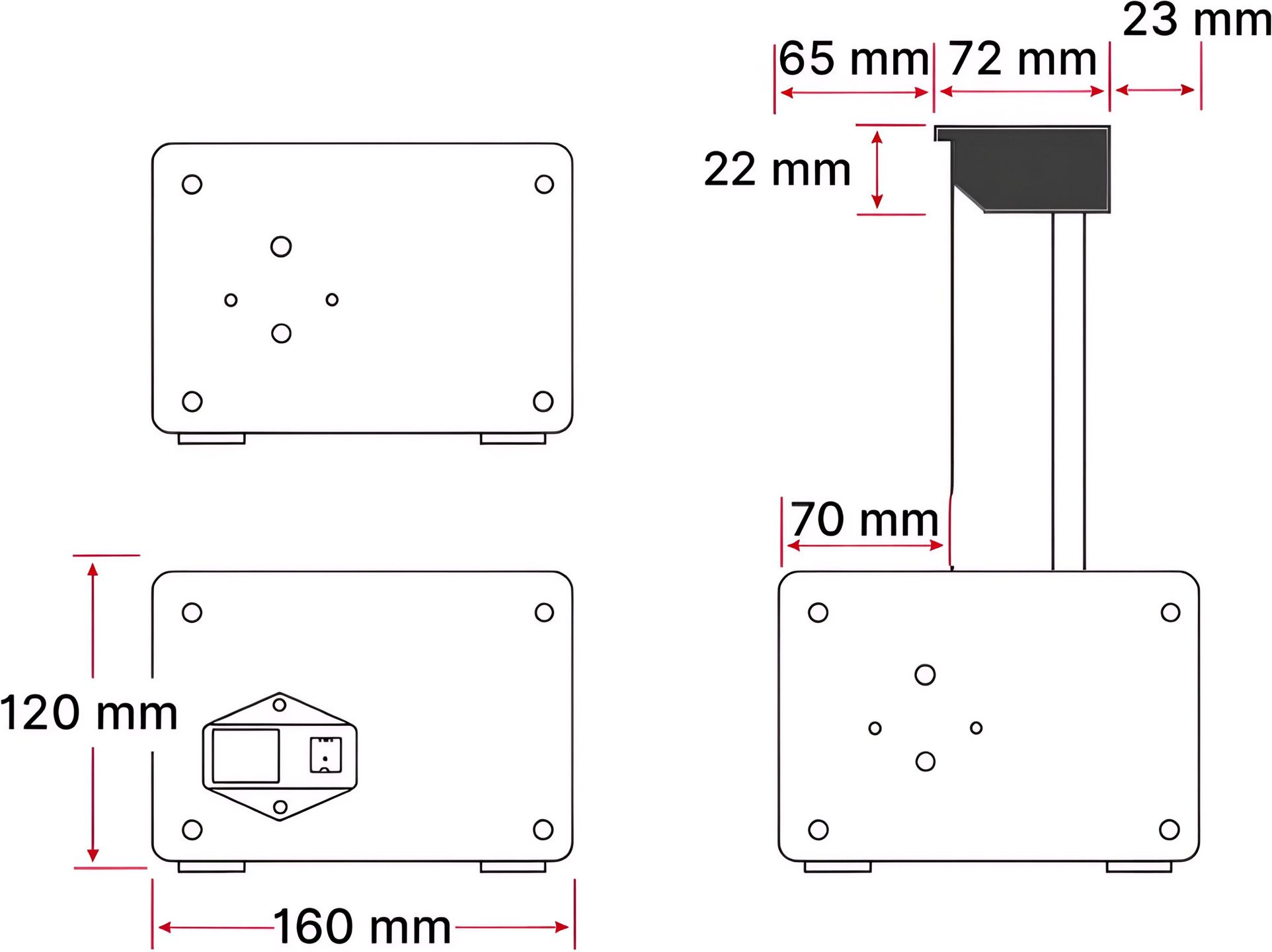
- Housing width (cable included): 225.7 cm
- Top bar width: 208 cm
- Total height: 153 cm
- Height under housing: 35 cm
- Weight: 26 kg
Housing
- Aircraft-grade aluminum alloy housing: maximum strength and longevity
- Lateral cable tensioning system for a durable flat surface
- Premium scissor mechanism for smooth, durable movement
- Remote control and USB trigger supplied
Eclipse ALR screen fabric
- ALR ambient light rejection technology
- Designed for Ultra Short Throw (UST) projectors: absorbs ambient light while precisely reflecting the projected image
- Light absorption: up to 90% of reflections coming from the ceiling and sides
- Gain: 0.8, perfect balance between brightness and contrast
- Viewing angle: ultra-wide 170° (85° left / right)
- Optimized colors and blacks: deep blacks, enhanced contrast, vivid colors even in broad daylight
- Compatibility: 4K / 8K Ultra HD, HDR
- Opaque black backing: prevents any light penetration from the rear
General information
- Fast and simplified assembly
- Storage: flat
- Suitable for bright living rooms or multi-purpose spaces
- Transforms any room into an immersive home theater without total darkness
Frequently asked questions
Does the Zenith Eclipse UST work with a conventional projector?
No. The Eclipse ALR screen is designed for UST (ultra-short-throw) projectors that project from below, a few centimeters from the wall. A standard-throw or short-throw projector, installed on the ceiling or at a distance, will cast its beam at an angle that the screen will not be able to reflect properly: the image will be dark, with uneven light distribution.
What minimum brightness is recommended for the projector?
With a gain of 0.8, a projector of at least 2500 ANSI lumens will produce a comfortable image in moderate ambient light conditions. For use in broad daylight with direct light entering the room, a 3000-lumen model or higher will be preferable to maintain bright whites and saturated colors.
Does the scissor mechanism generate vibrations or noise?
The manufacturer states that operation is quiet. Motorized floor-rising screens in this category generally use tubular motors with a noise level ranging between 30 and 40 dB — comparable to a low-voice conversation. No noticeable noise should interfere with viewing once the screen is deployed.
Does the USB trigger synchronize the screen with all projectors?
The USB trigger works with projectors that output a 5V signal on their USB port when they power on. Most recent UST projectors (Hisense, Formovie, XGIMI, AWOL Vision, etc.) have this function. Check your projector’s documentation to confirm compatibility.
What screen sizes are available?
The provided specifications do not specify the available sizes. Motorized floor-rising ALR screens for UST generally come in sizes ranging from 90 to 120 inches.
- Eco-contribution included in the sale price.
- Manufacturer reference: ZENI-90-ECL
- GTIN / EAN: 3760442540034