Pro-Ject MC Step Up Box DS3 B silver


Overview
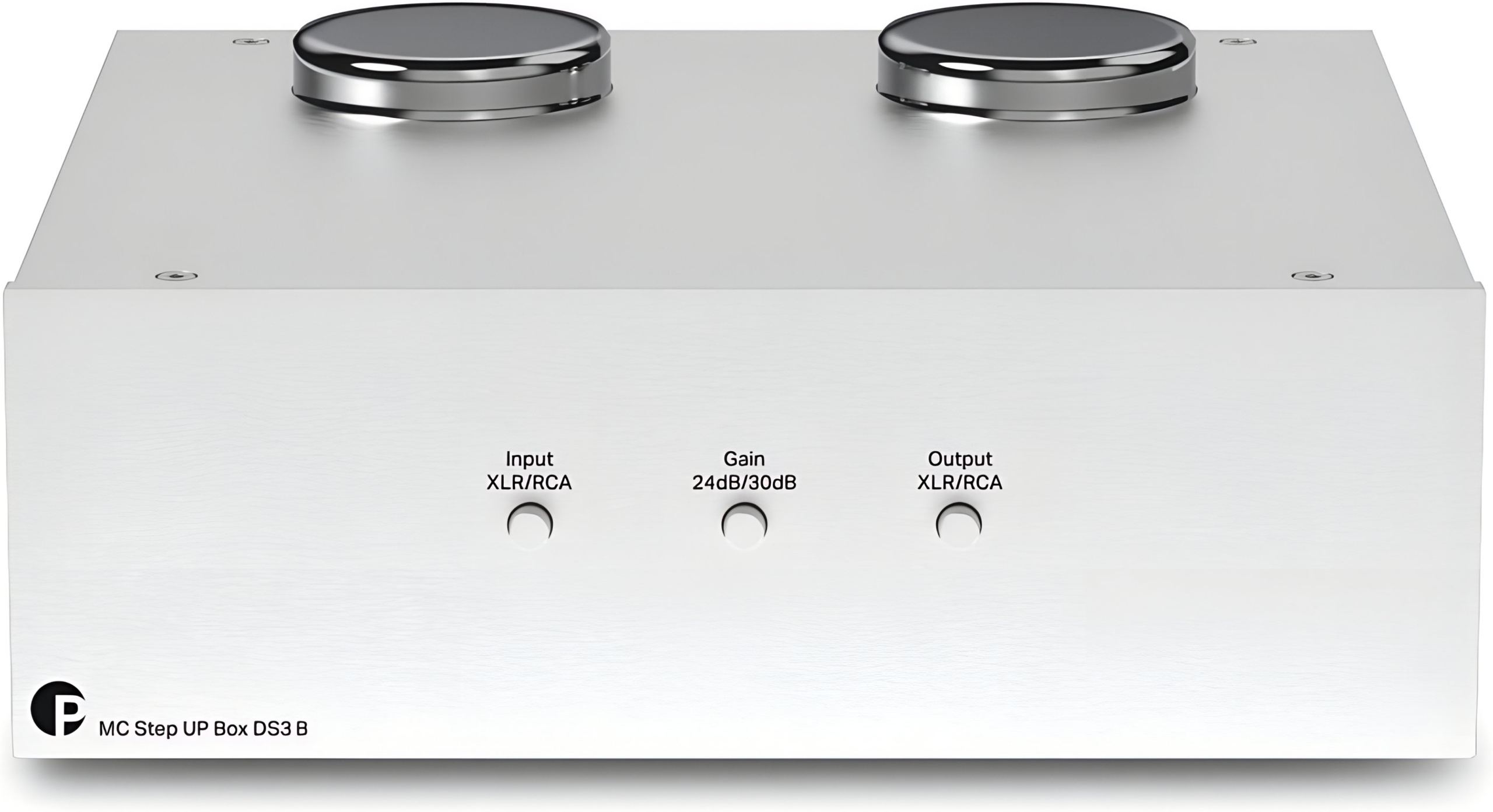
Before the rise of solid-state MC phono preamplifiers, step-up transformers were the standard in high-end vinyl systems. Pro-Ject is bringing this approach back into the spotlight with the MC Step Up Box DS3 B, a passive transformer with balanced outputs based on Lundahl LL 1678 transformers with an amorphous core. The principle: raise the signal from an MC cartridge to the level of an MM cartridge, without any active amplification, and without a power supply.
Why a transformer rather than an MC preamp
A moving coil (MC) cartridge delivers a signal about ten times weaker than a moving magnet (MM) cartridge. To compensate, an MC phono preamplifier must apply high gain, which tends to increase background noise and distortion. The step-up transformer gets around the problem: it uses the turns ratio of its windings to increase the signal voltage, with a proportional reduction in current. No active component is involved. No power supply is required.
The result, according to Pro-Ject, is a lower noise floor and reduced distortion compared with equivalent active amplification. Listening gains in dynamics and naturalness, qualities that the brand specifically associates with the passive transformer-based approach.
Pro-Ject recommends pairing the MC Step Up Box DS3 B with a quality MM phono preamplifier, via the MM input. The step-up + tube MM preamplifier combination is the one the brand favors.
Lundahl LL 1678 amorphous-core transformers
The choice of transformer determines everything in a device of this type. Pro-Ject selected the Lundahl LL 1678, a Swedish model with an amorphous cobalt-alloy core. This material has an interesting characteristic: unlike conventional mu-metal cores, it does not store energy, which eliminates low-frequency resonances caused by parasitic capacitances in series. The specified frequency response extends from 10 Hz to 55 kHz (±1 dB), a wide range that easily covers the audio content of a vinyl record.
Each channel has its own transformer (dual mono design), which maximizes separation between the left and right channels. The transformers are protected by mu-metal shielding against external electromagnetic interference.
Selectable gain and adjustable impedance
The transformation ratio can be switched between two positions: 1:16 (24 dB of gain) and 1:32 (30 dB of gain). Adjustment is made from the front panel by simply pressing a push button. The 24 dB position is suitable for most common MC cartridges, while the 30 dB position is intended for cartridges with a very low output level.
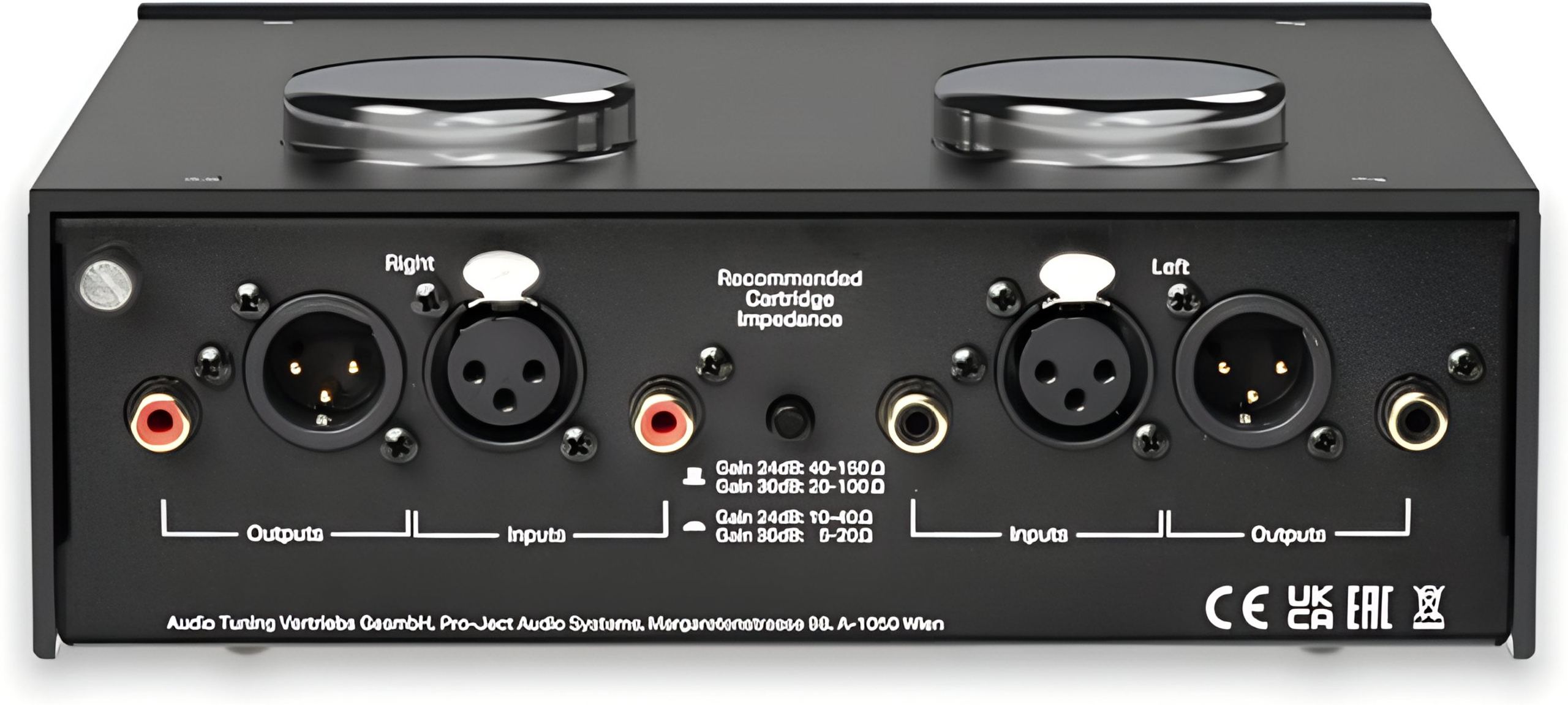
The cartridge load impedance is adjusted on the rear panel, again using a push button. This adjustment capability is important: an improperly matched impedance alters the cartridge’s frequency response and dynamic behavior. Pro-Ject recommends a 47 kΩ / 100 pF load at the output, which corresponds to the standard MM input of most phono preamplifiers.
Balanced and unbalanced connectivity
The “B” suffix in the model name indicates the presence of balanced connections (XLR), in addition to the gold-plated RCA sockets. The non-B version (the MC Step Up Box DS3, sold separately) offers only RCA connections.
The advantage of balanced mode is interference rejection: the signal travels on two conductors in opposite phase, and any noise picked up along the way is canceled at the destination. In a domestic environment saturated with electromagnetic interference (Wi-Fi, dimmers, switching chargers), this property has practical value.
Switching between RCA and XLR inputs/outputs is done from the front panel using push buttons.
Documentation
Technical Features
Sonic Advantages
- Sound improvement for any MC cartridge
- Particularly recommended for tube phono preamplifiers
- More lively, dynamic, and natural reproduction
- Superior sound quality
- Low noise
- Maximum channel separation
- Very low distortion level
Electronic Design
- High-quality Lundahl LL1678 audio transformer
- Fully passive signal path, no power supply
- Selectable transformation ratio: 24 / 30 dB
- Transformer with mu-metal shielding
- Dual mono design principle
- Balanced inputs and outputs
Connectivity
- MC input: 1 pair of RCA phono sockets, XLR
- Output: 1 pair of RCA phono sockets, XLR
- Gold-plated RCA terminals
- Input and output switching via front-panel push buttons
Chassis
- Solid aluminum enclosure protecting against interference
- Designed and handmade in Europe
- Timeless design and robust construction
Technical Specifications
- Frequency response 10 Hz - 55 kHz: +/- 1 dB
- Recommended load: 47 kOhm / 100 pF
- Dimensions: 206 x 79 x 197 mm (209 mm with sockets)
- Weight: 1740 g
Frequently asked questions
What is the difference between the MC Step Up Box DS3 and the DS3 B?
The DS3 offers only RCA (unbalanced) connections. The DS3 B adds XLR inputs and outputs (balanced), which allows signal transmission in balanced mode. The DS3 B uses the same Lundahl LL 1678 transformers.
Does the MC Step Up Box DS3 B need a power supply?
No. The signal path is entirely passive. The transformer raises the voltage through its turns ratio, without any active component or external power source.
Can this transformer be used with any MC cartridge?
Yes, provided that the cartridge’s output level and impedance are compatible with the two gain settings offered (24 dB or 30 dB). MC cartridges with low and very low output levels are the natural candidates.
How do you choose between 24 dB and 30 dB of gain?
That depends on the cartridge’s output level. A standard MC cartridge (around 0.4 to 0.5 mV) works well with 24 dB. A cartridge with very low output (0.2 mV or less) will benefit from the 30 dB setting to reach a sufficient level at the input of the MM preamplifier.
Is a tube phono preamplifier absolutely required downstream?
No, a transistor MM preamplifier also works. Pro-Ject believes that pairing it with a tube preamplifier gives the best results, but this is a recommendation, not a technical requirement.
Can the RCA and XLR outputs be used simultaneously?
No, switching between RCA and XLR is done using the push buttons on the front panel. Only one type of connection is active at a time, both at the input and at the output.
What type of interconnect cable should be used between the turntable and the DS3 B?
In RCA mode, a standard shielded phono cable is suitable. In XLR mode, a quality balanced cable is recommended. The turntable must be equipped with an XLR output to take advantage of balanced mode.
- Eco-contribution of €2.58 included in the sale price.
- GTIN / EAN: 9120129860413