Velodyne SC 1500

Complementary product
Specifications and features

Velodyne SC 1500: rack-format subwoofer amplifier
In a 2 U rack format, the SC 1500 powers a passive subwoofer with 1000 W RMS into 4 Ω. This amplifier from the SubContractor series combines a class D stage, a high-resolution AKP DSP, and automatic acoustic correction via a calibrated microphone. Its Bluetooth app controls one or more units within the same installation, with synchronization of volume, crossover frequency, and parametric equalization.
2 U rack-format design
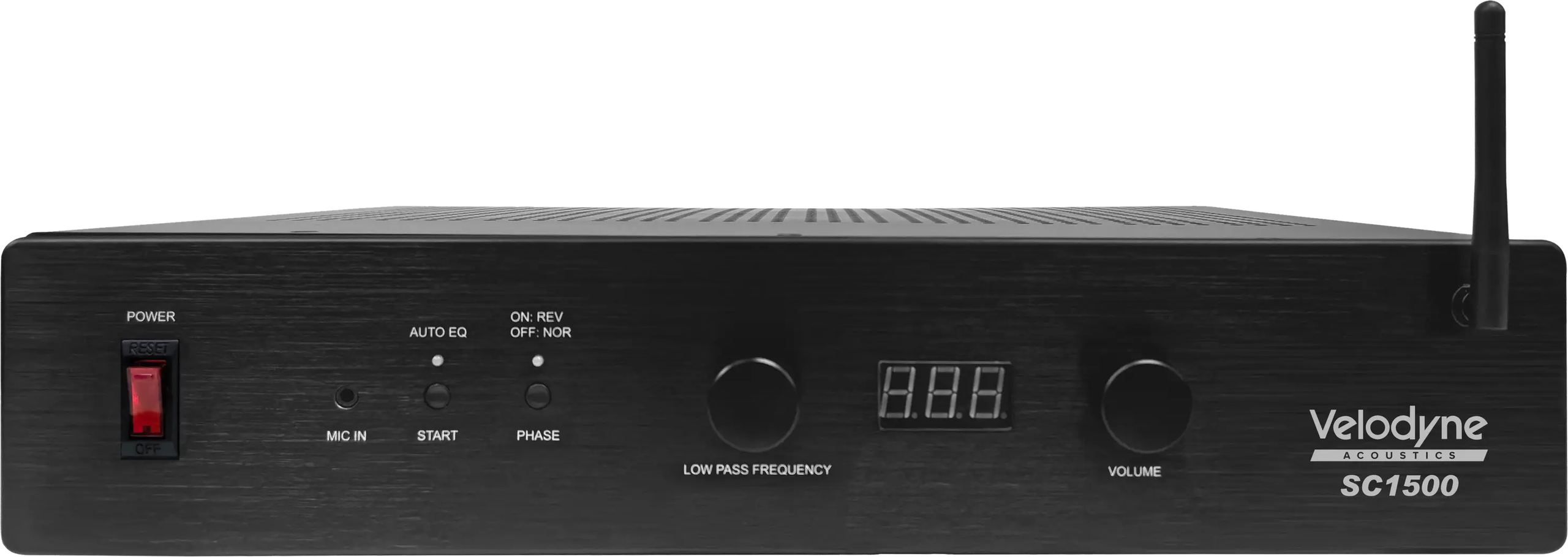
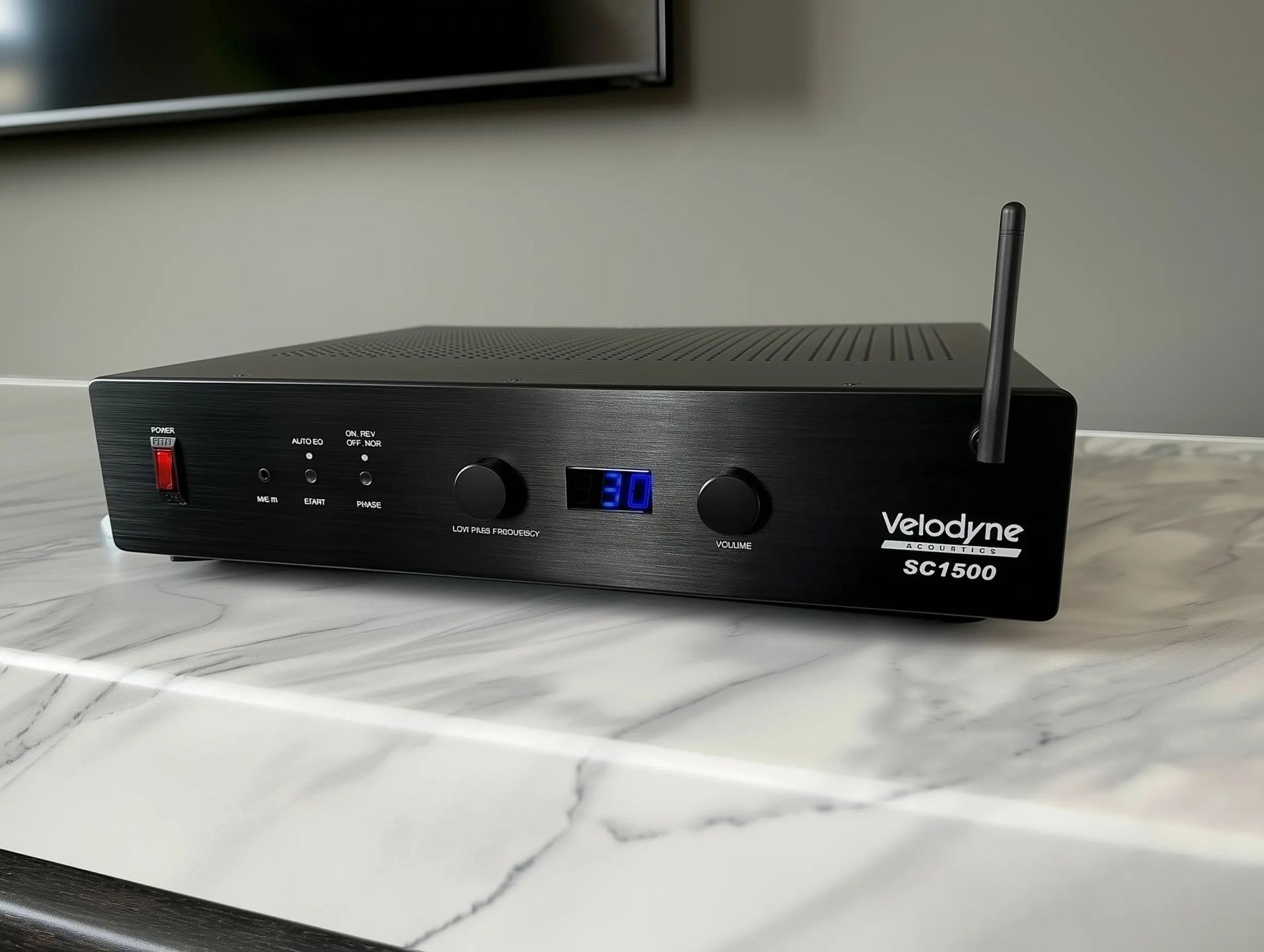
The SC 1500 chassis measures 11 cm in height, 44 cm in width, and 37 cm in depth, with a restrained weight of 8.87 kg. The 19-inch mounting brackets are included, making direct integration into a technical rack alongside an audio-video preamplifier or other components of a custom installation possible. The brushed aluminum front panel groups together the main power switch, microphone input, two buttons dedicated to Auto EQ and phase inversion, the rotary encoders for crossover frequency and volume, as well as a seven-segment display. The 2.4 GHz antenna for app control mounts on the front panel.
Class D power stage
The amplification is based on a cool-running class D switching topology, equipped with eight 72 A / 200 V MOSFETs. The stage delivers 520 W RMS into 8 Ω and 1000 W RMS into 4 Ω, measured at 0.1% total harmonic distortion. Frequency response extends from 10 Hz to 20 kHz. The high-efficiency switching power supply uses 60 A / 650 V MOSFETs and accepts voltages from 100 V to 240 V (50 or 60 Hz) with automatic switching, a configuration that makes the amplifier compatible with use outside Europe without an additional transformer. The minimum accepted output impedance is 2 Ω under combined load.
High-resolution DSP and acoustic correction
The SC 1500 integrates a high-resolution AKP DSP that handles the low-pass filter (30 to 200 Hz, 12 dB/octave slope), the subsonic filter (24 to 80 Hz, 24 dB/octave slope), a six-band parametric equalizer, and automatic acoustic correction. The latter relies on an external calibrated microphone, supplied with a 7.5 m cable terminated with a 3.5 mm mini-jack. The procedure is triggered by the dedicated button on the front panel or from the app: the device emits a series of sound sweeps, measures the room response, and applies corrections to flatten the curve toward the target. Three curves can be viewed in the app: original, corrected, and target.
Connectivity and subwoofer daisy-chaining
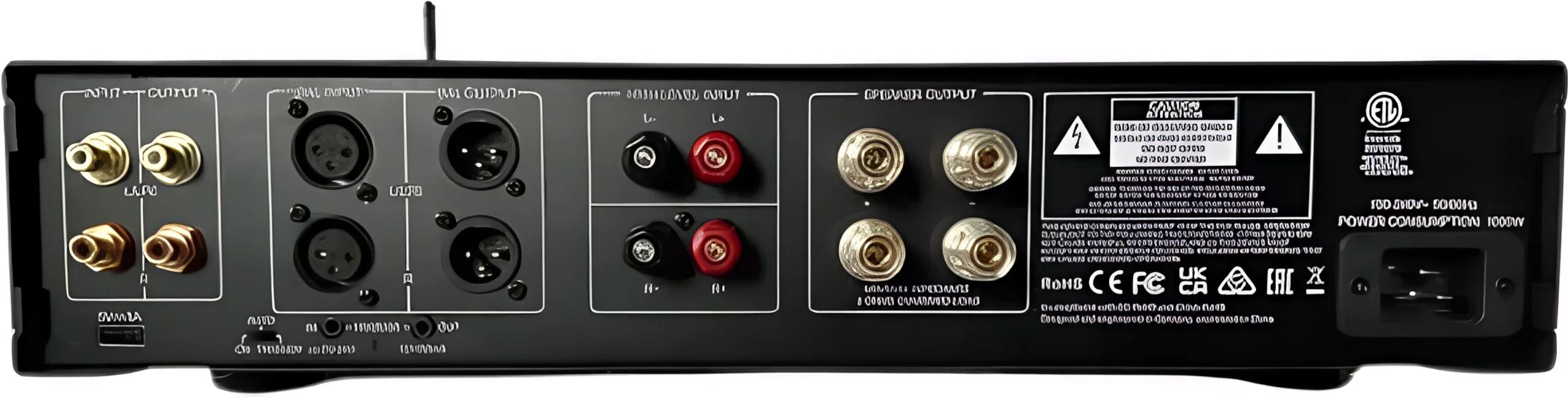
The rear panel offers three input types: unbalanced stereo / LFE RCA with 20 kΩ impedance, balanced stereo / LFE XLR, and speaker-level terminals with 2.5 kΩ impedance. Each line input has a corresponding output for daisy-chaining to a second amplifier or subwoofer. A dedicated switch in the app activates or bypasses the output high-pass filter (30 to 200 Hz), making it possible either to relieve the main speakers of deep bass or to pass the full signal to another subwoofer amplifier. The input voltage bandwidth accepts up to 4 V, a value that covers both consumer and professional line levels.
AutoEQ SUB app and parametric equalizer
The AutoEQ SUB app, available on the App Store and Google Play, communicates with the amplifier via Bluetooth. It synchronizes the volume shown on the front panel and the crossover frequency indicated on the rear panel. Frequency adjustment is made in 1 Hz steps from the app, versus 5 Hz via the rotary encoder. The six-band parametric equalizer covers the 20 to 200 Hz range, with adjustable gain from +6 dB to -18 dB and a Q factor from 0.1 to 15. Six renameable presets can be saved to switch between different configurations depending on use (cinema, music, gaming). The app also manages simultaneous control of multiple SC 750, SC 1500, or MiniVee X amplifiers.
Power-up and system integration
The amplifier features three startup modes: manual switch on the front panel, automatic input signal detection, and triggering via 12 V trigger in 3.5 mm mini-jack format. The trigger output reproduces the signal with a 5-second delay to cascade other components. The 0.5 W standby consumption complies with current environmental standards. A 5 V / 1 A USB port powers the Wi-Connect II wireless receiver, which avoids having to run a cable to the source and is not included in the box. The LED indicator changes from red (standby) to blue (on) depending on the device status.
Documentation
Technical specifications
Amplification
- Output power
- 520 W RMS into 8 Ω at 0.1% THD
- 1000 W RMS into 4 Ω at 0.1% THD
- Frequency response: 10 Hz - 20 kHz
- Adjustable low-pass filter from 30 to 200 Hz with a slope of 12 dB / octave
- Signal detection for automatic power on / off
- Universal auto-switching power supply from 100 V - 240 V, 50 Hz / 60 Hz
- AKP high-resolution DSP
- Wide input voltage bandwidth, compatible with consumer and professional audio applications up to a 4 V line level
- High-efficiency switching power supply with 60 A / 650 V MOSFET
- Cool-running Class D switching amplification topology, with 8 massive 72 A / 200 V MOSFETs
- Input impedance
- 20 kΩ (unbalanced RCA)
- 2.5 kΩ (speaker-level)
Front panel
- Button to launch the automatic equalization process
- 7-segment display for volume and crossover frequency
- Subwoofer volume adjustment
- Crossover frequency adjustment via rotary encoder in 5 Hz steps
- Phase control (0° / 180°)
- 3.5 mm microphone jack for automatic room acoustic correction
Rear panel
- Unbalanced stereo / LFE RCA input
- Unbalanced stereo / LFE RCA output for daisy chaining
- Balanced stereo / LFE XLR input
- Balanced stereo / LFE XLR output for daisy chaining
- Stereo speaker-level input terminals
- Automatic power on / off switch
- 12 V trigger input on 3.5 mm mini-jack
- Trigger output on 3.5 mm mini-jack with 5-second delay
- 5 V / 1 A USB power port for the external Wi-Connect II wireless signal transmission system
- Mode indicator LED: blue (powered on) / red (standby)
- Low standby power consumption of 0.5 W, compliant with environmental standards
Dimensions and weight
- Dimensions (H / W / D): 11 cm x 44 cm x 37 cm
- Rack mounting: 2 U
- Shipping dimensions (H / W / D): 23 cm x 60 cm x 50 cm
- Weight (without packaging): 8.87 kg
- Shipping weight: 11.64 kg
App control
- Control of multiple MiniVee X or SC subwoofer amplifiers via Bluetooth connection
- Automatic room acoustic correction via external microphone
- Volume control synchronized with the front panel display
- Crossover frequency control from 30 to 200 Hz, synchronized with the rear panel display, adjustable in 1 Hz steps
- 6-band parametric equalizer
- Range: 20 - 200 Hz
- Gain: +6 dB / -18 dB
- Q factor: 0.1 - 15
- Phase switch
- Subsonic filter frequency adjustment from 24 Hz to 80 Hz
- High-pass filter adjustment for the XLR and RCA outputs from 30 Hz to 200 Hz
- Output high-pass filter bypass switch, to send the full signal to the output and daisy chain multiple subwoofers
- 6 individual presets, renameable
Included accessories
- 2 m 20 A high-current power cords, US and Euro / Schuko formats
- 19” rack mounting brackets
- Calibrated external microphone with 7.5 m cable terminated with a 3.5 mm mini-jack
Frequently Asked Questions
Can the SC 1500 power any passive subwoofer?
The amplifier accepts a minimum combined load of 2 Ω. Any passive subwoofer meeting this impedance can be connected via the speaker output terminals. The available power, 1000 W RMS into 4 Ω, covers the majority of domestic and private cinema subwoofers, including those equipped with large-diameter drivers.
What is the difference between the RCA / XLR inputs and the speaker-level terminals?
The RCA and XLR inputs receive a line-level signal from a preamplifier or an audio-video processor. The speaker-level terminals take the signal directly from the outputs of a stereo amplifier without a dedicated subwoofer output. The 2.5 kΩ input impedance avoids disturbing the source amplifier.
Should the automatic acoustic correction be redone if something changes in the room?
Any movement of the subwoofer, the main listening position, or any major change in furnishings modifies the room’s acoustic response. Restarting the Auto EQ procedure after a significant change readjusts the corrections. The six renameable presets make it easy to save several configurations for comparing results.
How does daisy-chaining multiple subwoofers work?
The RCA and XLR outputs reproduce the input signal and connect to the input of another subwoofer amplifier. When the output high-pass filter is bypassed from the app, the transmitted signal remains full-range, making it possible to cascade multiple SC 1500 units or other compatible amplifiers. The Bluetooth app then manages grouped control.
Is the SC 1500 suitable for a professional installation?
The input accepts up to 4 V line level, a value that covers consumer (generally 2 V) and professional sources. The balanced XLR inputs preserve the signal-to-noise ratio over long cable runs. The 2 U rack format and 12 V trigger startup integrate into the technical racks of fixed installations.
What is the Wi-Connect II receiver used for?
Wi-Connect II is an external wireless transmission system that avoids having to run a cable between the source and the subwoofer. The SC 1500’s 5 V / 1 A USB port powers it directly, with no additional power supply required. The receiver is not supplied with the amplifier and must be purchased separately.
- Eco-contribution included in the sale price.
- GTIN / EAN: 4260732440437