Auris Audio Jazz

Buy as a bundle and save
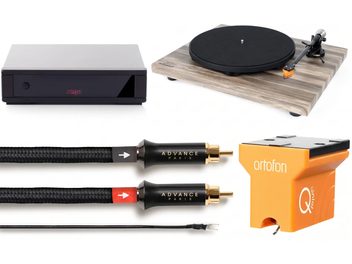
Auris Audio Jazz: a turntable with a wooden plinth
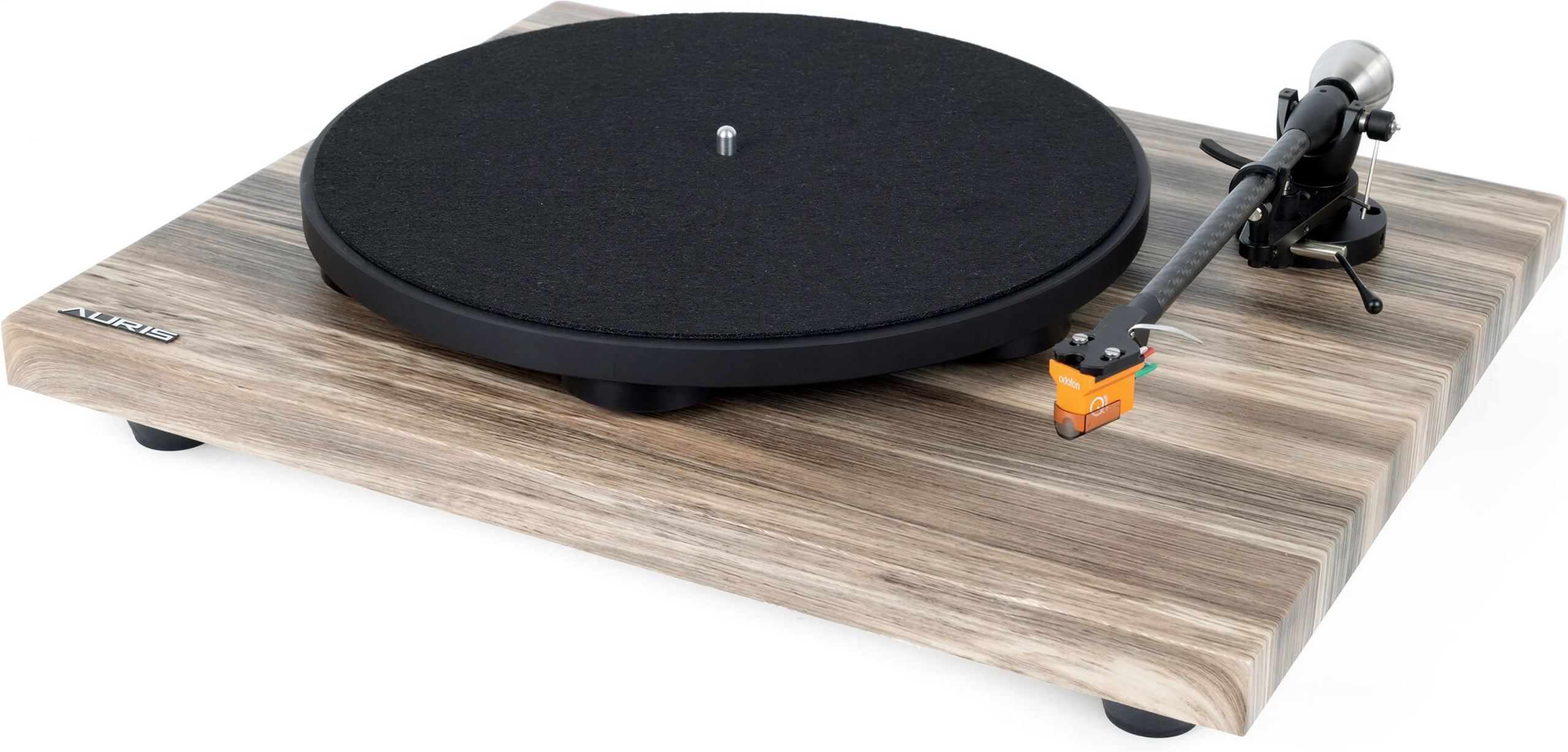
Solid wood is not merely an aesthetic choice on a turntable: its mass and damping determine what the cartridge ultimately reads from the groove. Auris Audio’s Jazz rests on a zebrano-finished wooden plinth, with a nine-inch carbon tonearm and belt drive concealed beneath the platter. A package focused on mechanical stability rather than automation.
A wooden plinth and damping feet
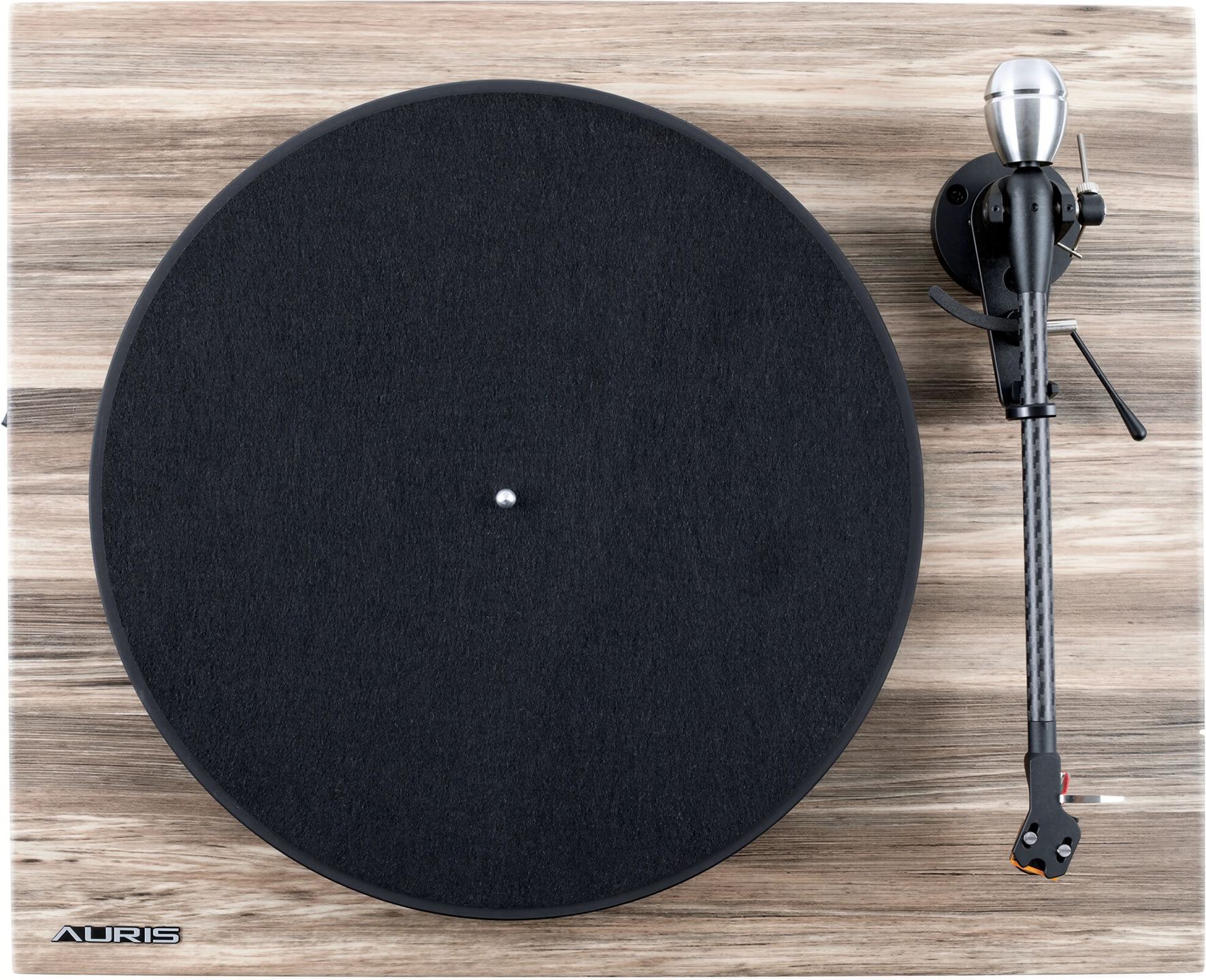
The Jazz is built around a wooden plinth, available in a zebrano finish with pronounced grain. The choice of solid wood is not insignificant: its mass and rigidity absorb some of the vibrations that would otherwise travel up to the stylus and result in background noise or a loss of definition.
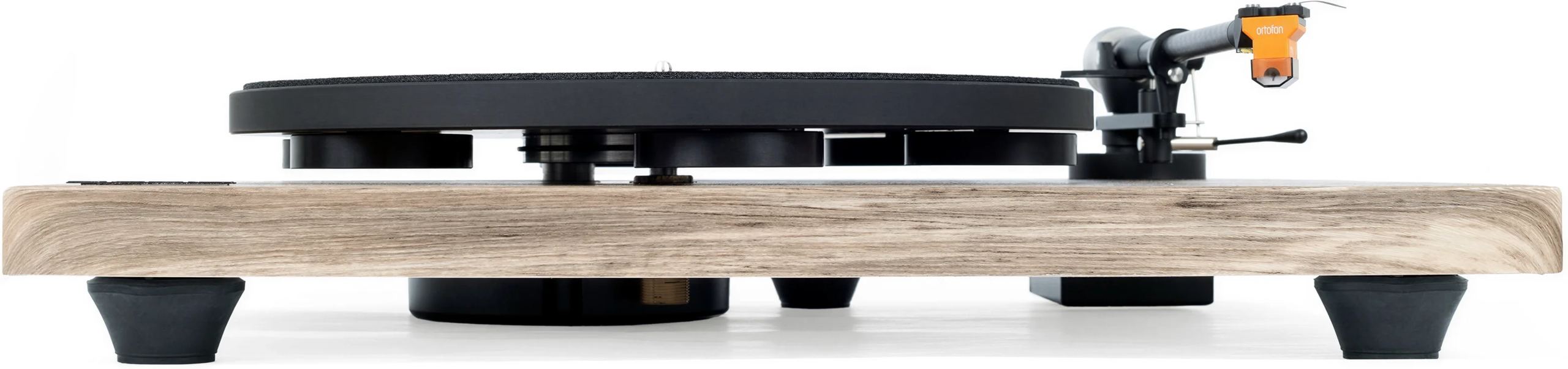
Under the plinth, rubber compound feet decouple the turntable from its support. Their horizontal adjustment is used to level the platter perfectly, a requirement for tracking force to remain constant from one edge of the record to the other and for the tonearm geometry not to be distorted. On an unstable support or a flexible floor, this levelling becomes crucial.
The sub-platter, bearing and synchronous motor
The drive is belt-driven, but the belt remains invisible: it wraps around a sub-platter rather than the main platter. This sub-platter combines an aluminium base and a chrome-plated steel spindle, which transmit rotation to the platter without slipping.
The bearing consists of a bronze cylinder and a ceramic ball. Bronze is chosen instead of brass for its longevity: it withstands mechanical stress better over time. The ceramic ball, hard and less prone to wear, reduces play and friction at the spindle.
The main aluminium platter measures 299 mm. It is driven by a synchronous motor powered by 16 to 24 volts AC and controlled by dedicated electronics, which maintain speed despite mains fluctuations. Selection between 33 and 45 rpm is made directly on the supplied EON power supply: there is no need to move the belt onto a stepped pulley. The stated speed tolerance is ± 0.11%.
The carbon W9 tonearm and its adjustments
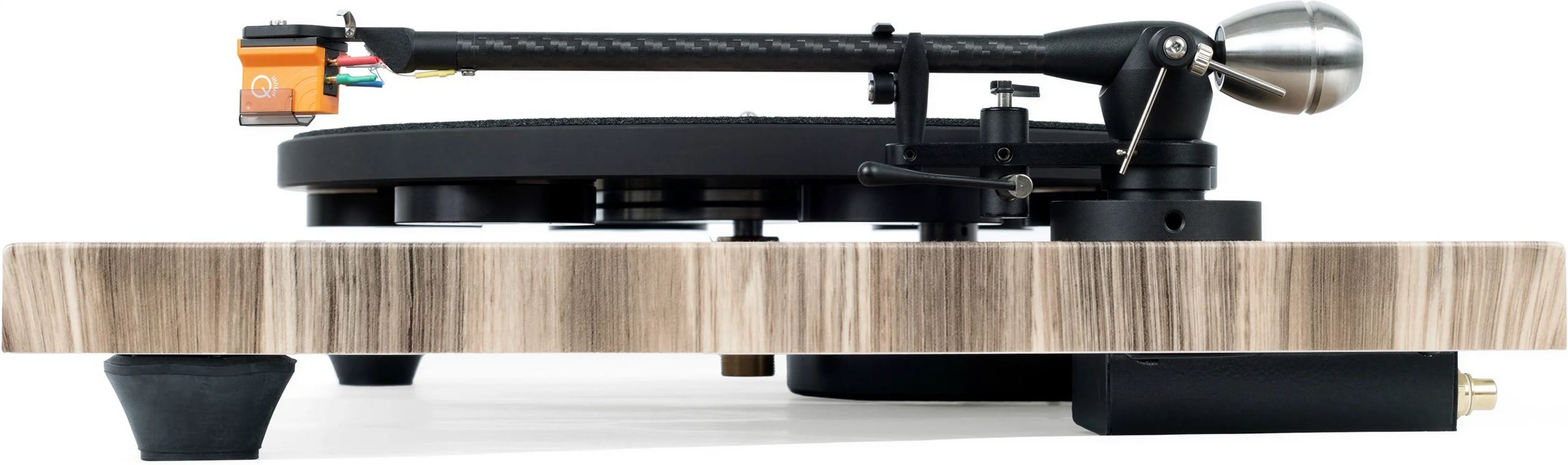
The tonearm supplied with the Jazz is the W9, a nine-inch carbon model. Its tube has a wall thickness of just 1 mm: light and rigid, it limits inherent resonances that could be superimposed on the signal. Effective mass is 12 grams, a value suited to medium-compliance moving magnet cartridges.
Machining is carried out using computer-aided design and CNC machines. The ball bearings, derived from the medical industry, limit play at the pivot, where even the slightest movement affects groove tracking. The counterweight incorporates a rubber thread that damps vibrations transmitted through the rear of the tonearm.
The adjustment options are fairly comprehensive. VTA, the vertical tracking angle, can be adjusted over 10 mm at the base of the tonearm: enough to compensate for the thickness of a platter mat or the height of a particular cartridge. Azimuth can be corrected by ± 3° by rotating the tonearm tube once the locking screw has been loosened. Tracking force and anti-skating are adjusted conventionally, with an 18 mm overhang and a 24° offset angle.
Fitting a cartridge and connecting the Jazz
The Jazz is supplied without a cartridge and without an RCA cable. Both must therefore be provided, along with a phono input: the turntable has no built-in preamplifier, and its signal must pass through a moving-magnet phono input or an external preamplifier before reaching the amplifier. At the rear, output is via RCA line sockets accompanied by a ground screw, to be connected to the preamplifier chassis to prevent hum.
The headshell accepts cartridges weighing between 6 and 14 grams, covering the majority of moving-magnet models on the market. It includes a finger lift, and the tonearm features a damped cueing lever as well as a lock to secure the assembly during transport.
The complete power supply, including EON, is provided. An acrylic dust cover keeps dust at bay between listening sessions.
The Jazz in the Auris turntable range
Auris Audio offers several turntables based on similar designs. Below the Jazz, the Funky and Blues make up the entry-level range: lighter, at around 4.5 kg, they use the same belt-drive principle and nine-inch carbon tonearm, with an aluminium platter for the Funky and an acrylic platter for the Blues.
The Jazz moves upmarket with its 7.7 kg mass and wooden plinth. Just above it, the Classica shares this heavier base but features a ten-inch tonearm, the W10, and is one centimetre taller. The choice between the two primarily comes down to tonearm length: a ten-inch arm slightly reduces tracking error across the record surface, at the cost of a larger footprint.
Documentation
French
Technical specifications
Drive and speed
- Drive principle: belt
- Speeds: 33.3 rpm and 45 rpm
- EON PSU power supply included for extremely precise speed control
- Speed variance: 33.3 ±0.11%, 45 ±0.11%
- 16V-24VAC synchronous motor controlled by advanced PCB electronics, managing vibrations and maintaining stable tempo regardless of power grid fluctuations
Platter and sub-platter
- Aluminum platter: 299 mm
- Aluminum-based sub-platter and chrome shaft ensuring faithful, stable transfer of speed to the platter, without slippage
- Ball-bearing-mounted platter, forged from cemented carbide with a Rockwell hardness reaching 90 for lasting precision
Main bearing
- Ceramic ball and bronze cylinder
- Central bronze bearing providing increased longevity and sustained performance compared with conventional brass alternatives
- Reduced stress on the bearing for optimal performance over time
W9 tonearm
- 9” tonearm designed using 3D CAD / CAM technology and precision-machined on state-of-the-art CNC machines
- Effective tonearm mass: 12 g
- Overhang: 18 mm
- Tracking force: 5 to 40 mN
- Offset angle: 24°
- Cartridge compliance: 6 to 14 g (0.013 to 0.030 lb)
- VTA (vertical tracking angle) adjustment over 10 mm for versatile compatibility with different platter mats
- Specially designed counterweight with rubber threading for vibration damping
- Medical-grade ball bearings ensuring minimal play and exceptional sound transmission
- Ultra-thin 1 mm carbon fiber tube minimizing vibrations and resonances
Isolation and stability
- Innovative rubber compound in the feet providing remarkable stability and protecting the music from vibrations
- Adjustable support allowing precise horizontal adjustment for optimal isolation according to installation conditions
Dimensions and weight
- Dimensions: 445 x 360 x 130 mm
- Weight: 7.7 kg
Frequently asked questions
Is the Jazz an automatic turntable?
No. Operation is entirely manual: you place and lift the tonearm using the cueing lever, and move it away at the end of the side. There is no automatic start, return, or stop of the platter.
Can a moving coil (MC) cartridge be used?
Mechanically, yes: MC cartridges fall within the weight range supported by the cartridge holder. However, an MC-compatible phono stage is required, with higher gain and suitable loading, whereas a simple MM phono input is sufficient for a moving magnet cartridge.
Does the Jazz play 78 rpm records?
No, only 33 and 45 RPM speeds are supported. Playing 78 RPM records would require a specific cartridge and a speed that the turntable does not offer.
Does the acrylic cover stay in place while listening?
It is a removable cover, to be taken off to play a record, not a hinged lid that folds down. It protects the platter and tonearm from dust when the turntable is not in use.
What should I do if the furniture or floor transmits vibrations?
Start by carefully levelling the turntable using the adjustable feet. On a moving floor or a resonant piece of furniture, a wall shelf fixed to a load-bearing wall, or a heavy, rigid stand, cuts out most of the vibrations coming up from the floor.
- Eco-contribution included in the sale price.