EarMen Angel
Specifications and features


Overview
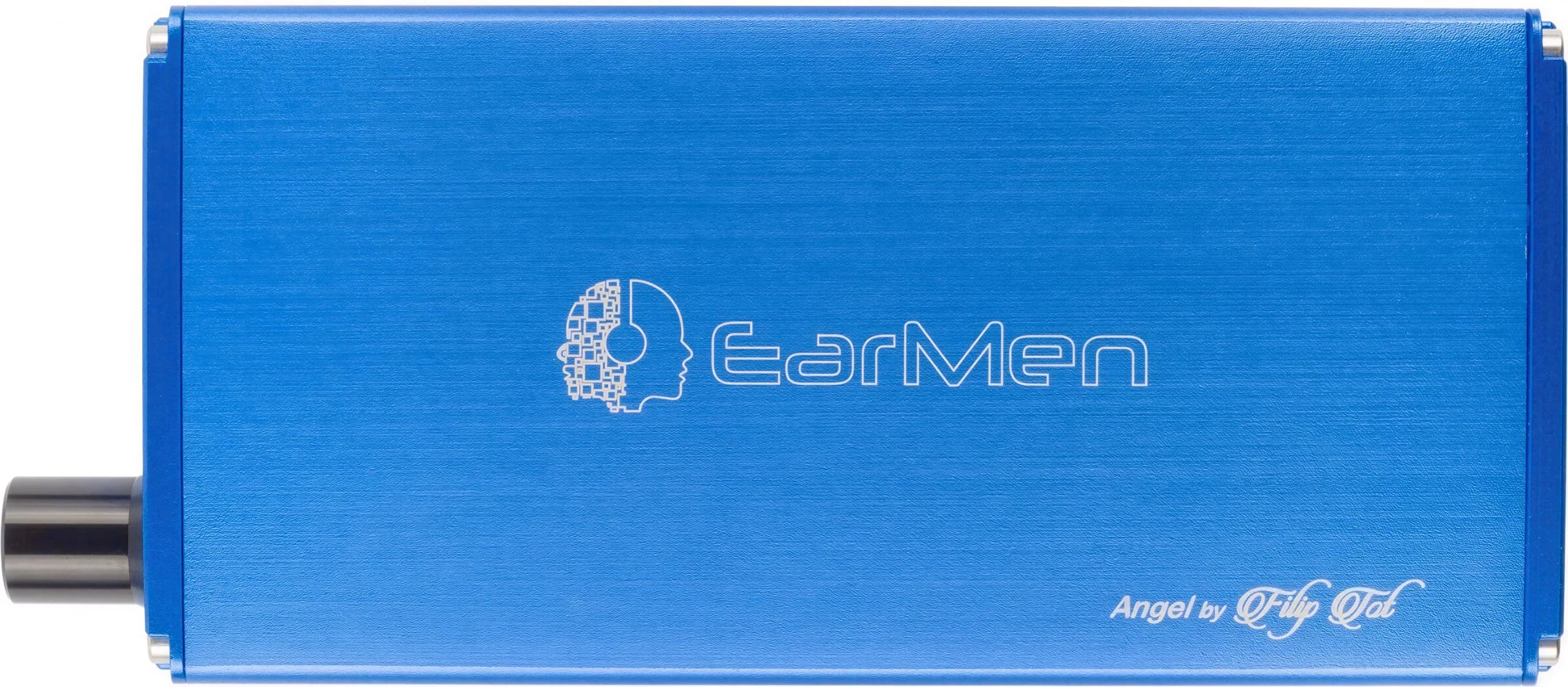
Behind EarMen is Auris Audio, a Serbian manufacturer of high-end tube amplifiers that launched this brand to bring its expertise to the portable format. The Angel follows on from the TR-Amp, the company’s first portable model, replacing its converter with an ESS chip and making the entire circuit balanced. A pocket DAC-amplifier designed to rival desktop equipment.
A 340-gram blue aluminium block
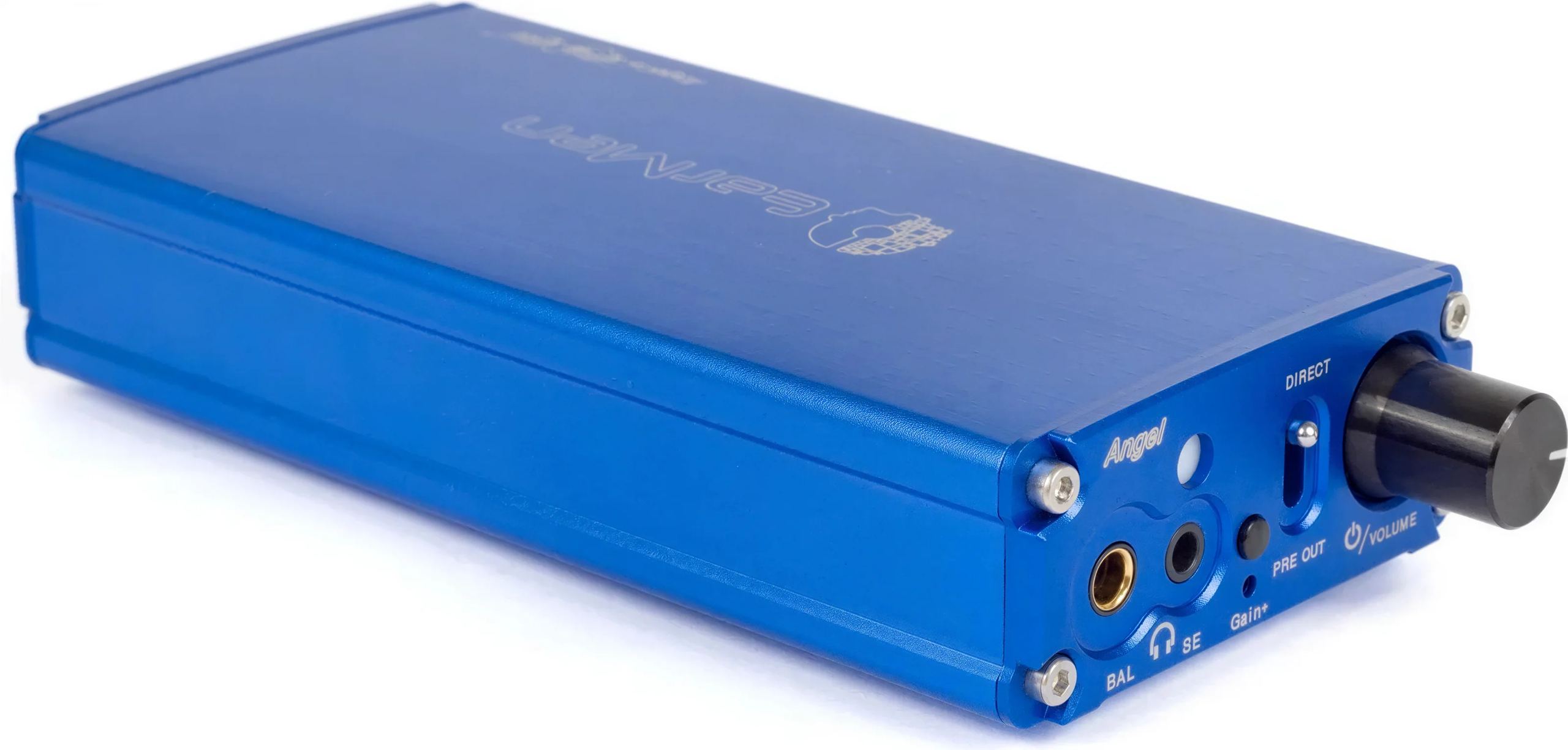
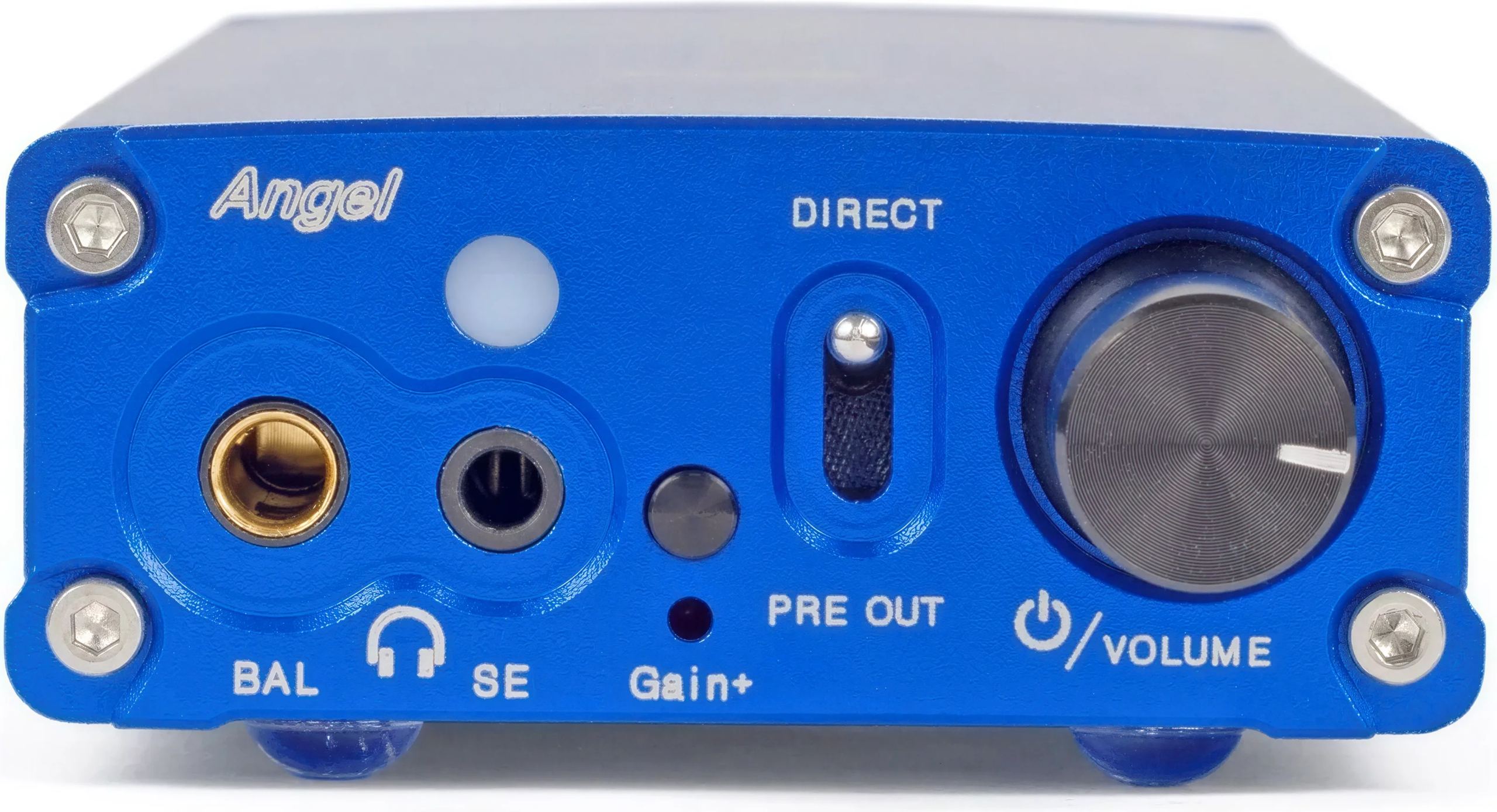
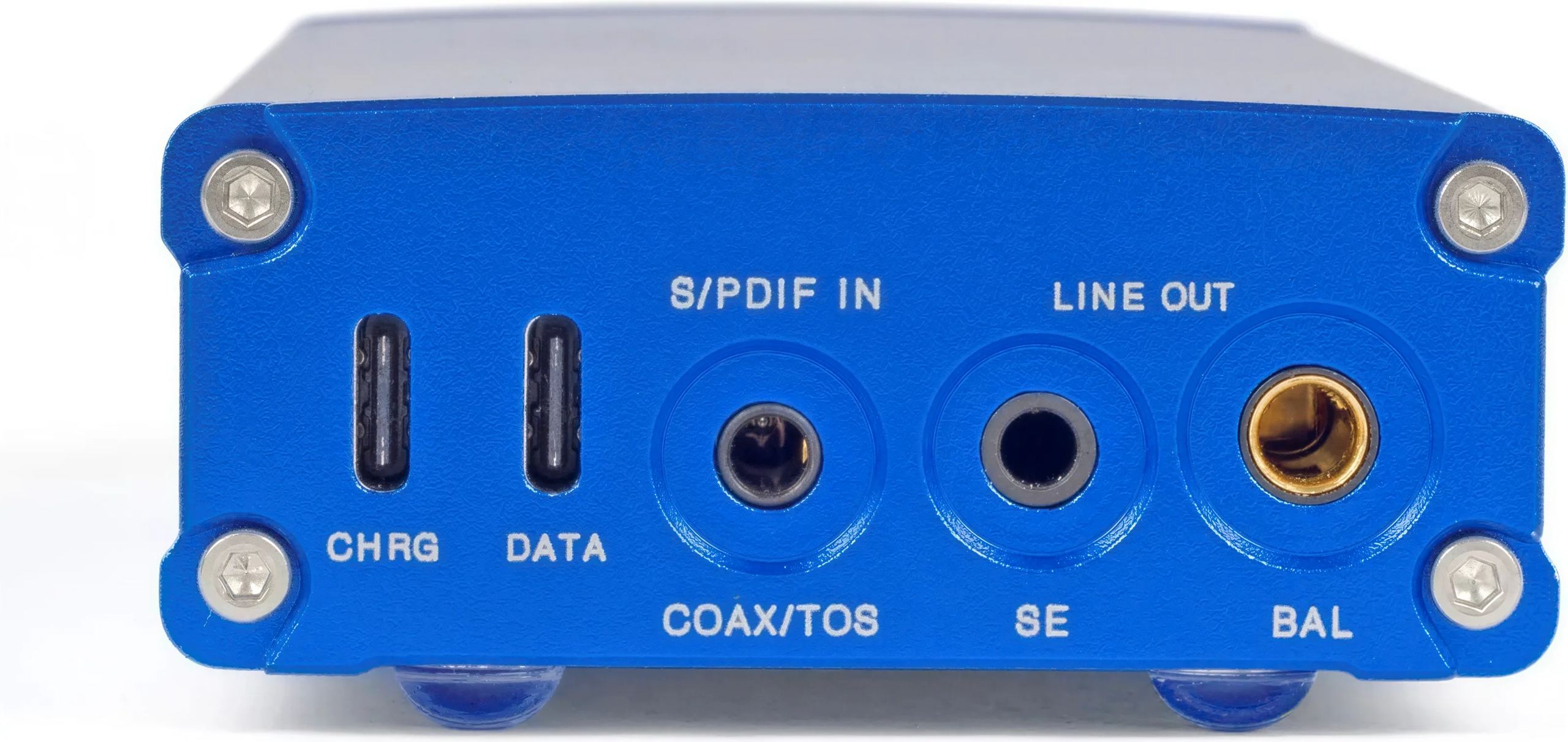
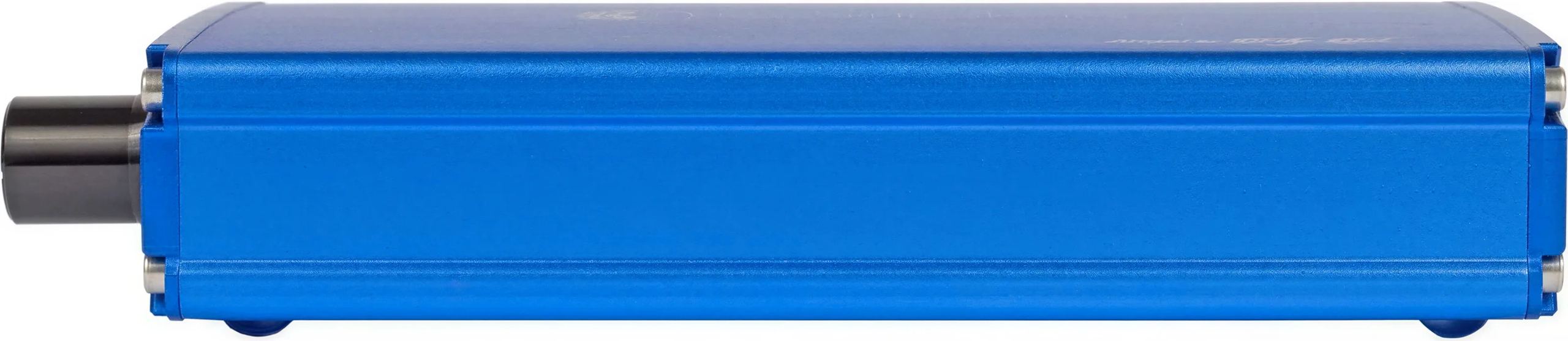
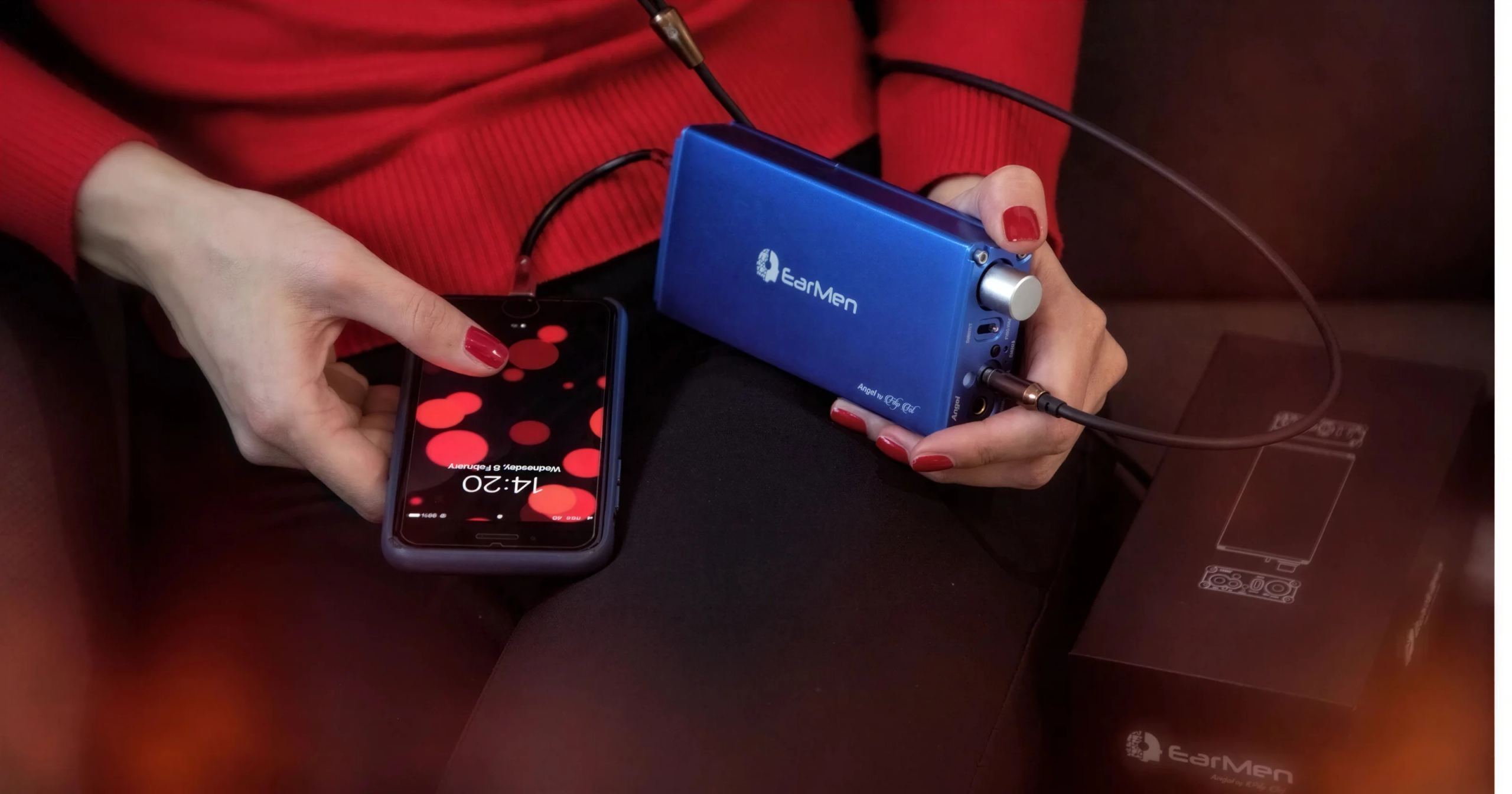
The enclosure is machined from a single piece of blue anodised aluminium, with silicone feet underneath to protect the surface it rests on. On the front are the two headphone outputs, the volume control and an LED that changes colour according to the format and sample rate being played. The rear houses the line outputs and inputs. At 152 millimetres long, 27 millimetres thick and weighing 340 grams, the Angel has some heft: too dense for genuine use while walking, but comfortable strapped to a phone or placed on a desk.
ESS conversion and a fully balanced signal path
At its core, an ESS Sabre ES9038Q2M converter receives the digital stream via an XMOS USB receiver. The design is fully balanced, in dual mono: each channel has its own signal chain, and the signal remains balanced from the converter to the headphone outputs, with no additional coupling capacitor in the path. In terms of formats, the Angel reads PCM up to 32-bit/768 kHz, DXD at 768 kHz, DSD up to 512 natively (256 in DoP), and includes a complete hardware MQA decoder that handles full unfolding, including MQA Studio and MQA Core. At device level, dynamic range reaches 120 dB.
Two gain modes and plenty of voltage headroom
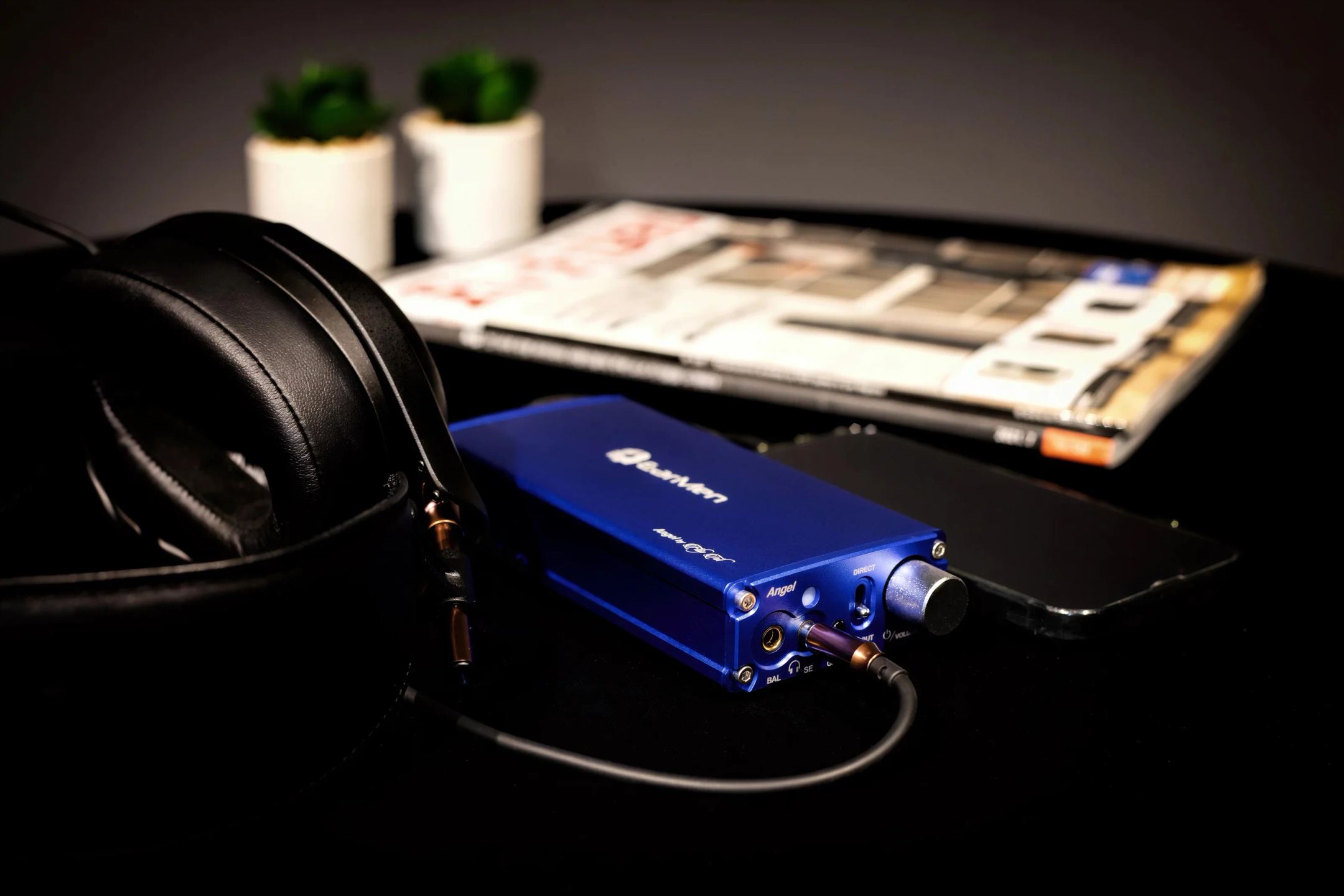
Two headphone outputs occupy the front panel: a balanced 4.4 mm jack and an unbalanced 3.5 mm jack. The 4.4 mm is the more powerful one. In Gain+ mode, it reaches 8.5 Vrms, versus 7.2 Vrms on the 3.5 mm output, with very low harmonic distortion (0.002% balanced) and a signal-to-noise ratio above 119 dB. Standard gain serves sensitive IEMs without audible hiss; Gain+ wakes up high-impedance or low-sensitivity headphones, those that remain timid on an ordinary dongle.
Fixed or variable output, as a preamp
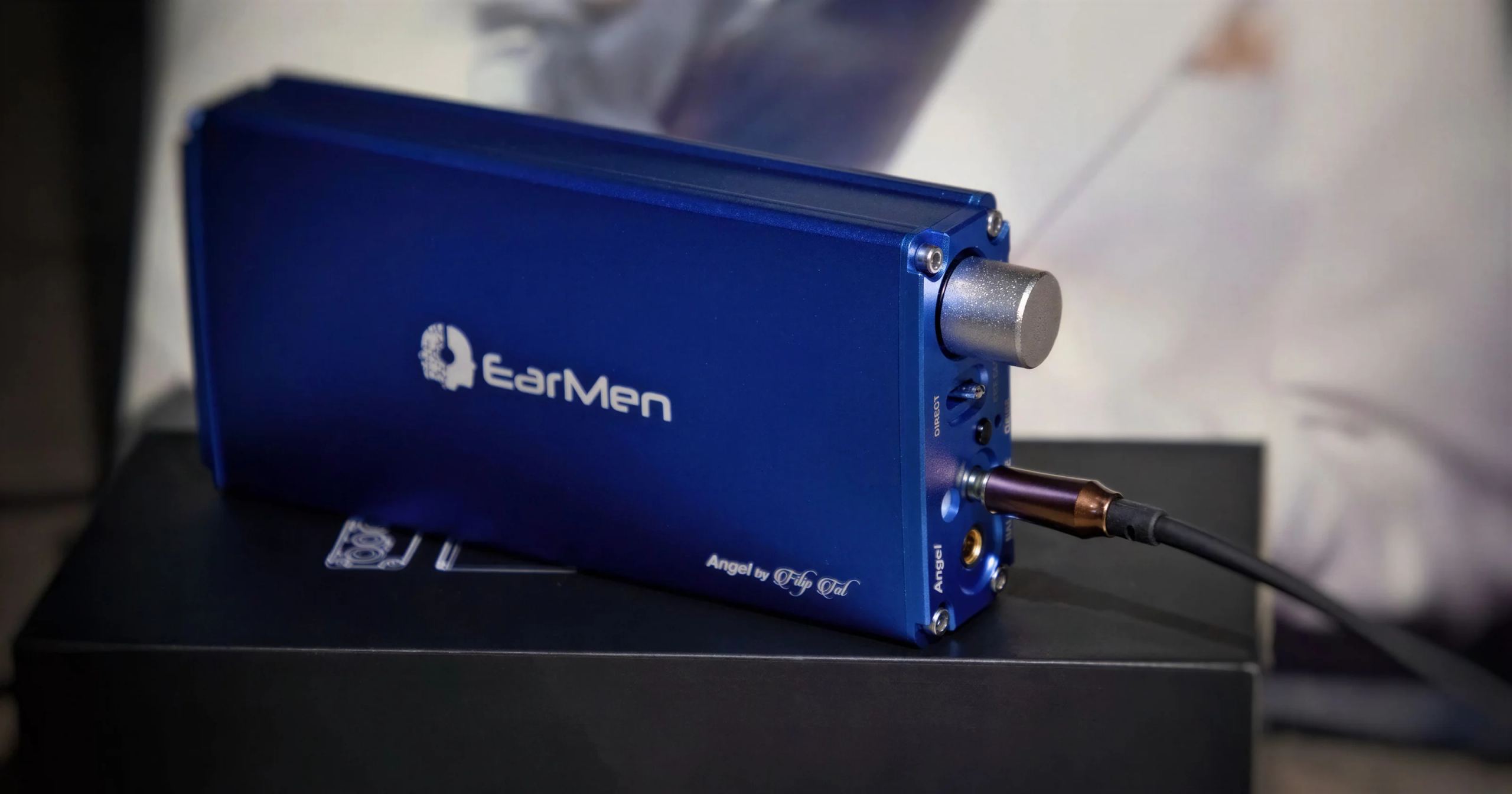
At the rear, two line outputs duplicate the connectivity, again with a balanced 4.4 mm output and an unbalanced 3.5 mm output. A switch selects between two operating modes. In the Direct position, the level is fixed (3 Vrms balanced, 1.5 unbalanced): connect the Angel to the line input of an amplifier that handles volume control. In the Pre Out position, the output becomes variable and follows the volume knob, up to 8.5 Vrms balanced; the Angel can then drive a power amplifier or active speakers directly, serving as the system’s preamp. Enough to build a compact system around a device that fits in the hand.
Two batteries and listening while charging
Power is supplied by two 3000 mAh lithium-polymer batteries, for a total of 6000 mAh, selected for their very low noise floor. A practical point: charging and data are handled through two separate USB-C ports. You can therefore listen while recharging, which solves the battery-life issue whenever an outlet is within reach and makes the Angel suitable for all-day desktop use. A full recharge takes approximately three hours with a 5 V / 2 A charger. For inputs, a first USB-C port receives the audio stream from a computer, phone or tablet; an S/PDIF input on a mini-jack accepts Toslink optical or coaxial signals using the supplied adapter.
Documentation
Technical specifications
Design
- Portable battery-powered DAC and headphone amplifier
- ESS Sabre ES9038Q2M converter
- XMOS USB receiver
- Fully balanced architecture (dual mono processing)
- Two gain modes, including a Gain+ mode for demanding headphones
- Switchable Direct output (fixed level) or Pre Out (variable level, preamplifier function)
- LED indicator for format and sampling rate
Audio compatibility
- PCM up to 32-bit / 768 kHz
- DXD up to 768 kHz
- Native DSD512, up to DSD256 in DoP
- MQA with full hardware decoder: MQA, MQA Studio, MQA Core / MQB, MQA Auth
Connectivity
Inputs
- 1 USB-C audio input for DAC mode
- 1 USB-C input dedicated to charging (simultaneous use possible)
- 1 S / PDIF input on mini-jack, optical Toslink or coaxial (adapter included)
Outputs
- 1 balanced 4.4 mm jack headphone output (front)
- 1 unbalanced 3.5 mm jack headphone output (front)
- 1 balanced 4.4 mm jack line output (rear)
- 1 unbalanced 3.5 mm jack line output (rear)
Audio performance
Balanced 4.4 mm headphone output
- Maximum output level: 8.5 Vrms in Gain+
- THD+N: 0.002%
- Signal-to-noise ratio: greater than 119 dB
Unbalanced 3.5 mm headphone output
- Maximum output level: 7.2 Vrms in Gain+
- THD+N: 0.004%
- Signal-to-noise ratio: greater than 120 dB
Balanced 4.4 mm line output
- Output level: 3 Vrms in Direct to 8.5 Vrms in Pre Out
- THD+N: 0.003%
- Signal-to-noise ratio: greater than 119 dB
Unbalanced 3.5 mm line output
- Output level: 1.5 Vrms in Direct to 7.2 Vrms in Pre Out
- THD+N: 0.005%
- Signal-to-noise ratio: greater than 120 dB
Power supply
- Dual Li-Po battery 2 x 3000 mAh, for a total of 6000 mAh
- Separate charging and data ports, operation possible while charging
- Charges in approximately 3 hours with a 5 V / 2 A adapter
General
- Dynamic range: 120 dB
- Dimensions (w x h x d): 152 x 27 x 66 mm
- Weight: 340 g
Frequently asked questions
Do I need an adapter to connect an optical or coaxial source?
The S/PDIF input comes in the form of a mini-jack. The supplied adapter converts it to optical Toslink or coaxial, depending on the output of your television, network player or digital transport. Nothing else to buy.
Can it be left plugged into the mains continuously for desktop use?
Yes. Since charging and the audio signal use two separate USB-C ports, the Angel plays music while charging. In a fixed setup, it can be left on its charger and the battery is no longer a limiting factor.
Which sources can feed it digitally?
Any source with a USB-C output: computer, smartphone, tablet. Recent USB-C iPhones connect directly; older models with a Lightning port require an adapter. Without USB-C, the S/PDIF input accepts an optical or coaxial output.
How does it differ from the TR-Amp that preceded it?
The TR-Amp was based on a Texas Instruments converter and was limited to unbalanced outputs. The Angel switches to an ESS ES9038Q2M chip, extends balanced operation to 4.4 mm headphone and line outputs, adds a Gain+ mode, and doubles battery capacity. Fundamentally, the same goal remains: bringing the performance of a desktop model closer to that of a pocket-sized device.
What is Gain+ mode used for?
It raises the maximum output level to up to 8.5 Vrms via the balanced 4.4 mm output. This provides the headroom needed for high-impedance or low-sensitivity headphones, which remain underpowered by a small DAC. For sensitive in-ear monitors, stick with standard gain, which is quieter and makes volume adjustment easier.
Can it directly drive passive speakers?
No. Even in Pre Out mode, the Angel remains a line-level source: it sends a signal to a power amplifier or active speakers, not to passive speakers that require a power stage. For headphones, however, everything is integrated.
Does MQA decoding go all the way?
Yes. The Angel features a full hardware MQA decoder, which performs the final unfolding of the file rather than stopping at the first software level. It also supports the MQA Studio and MQA Core variants.
- Eco-contribution included in the sale price.