

Audioquest Sydney Jack/RCA 1m
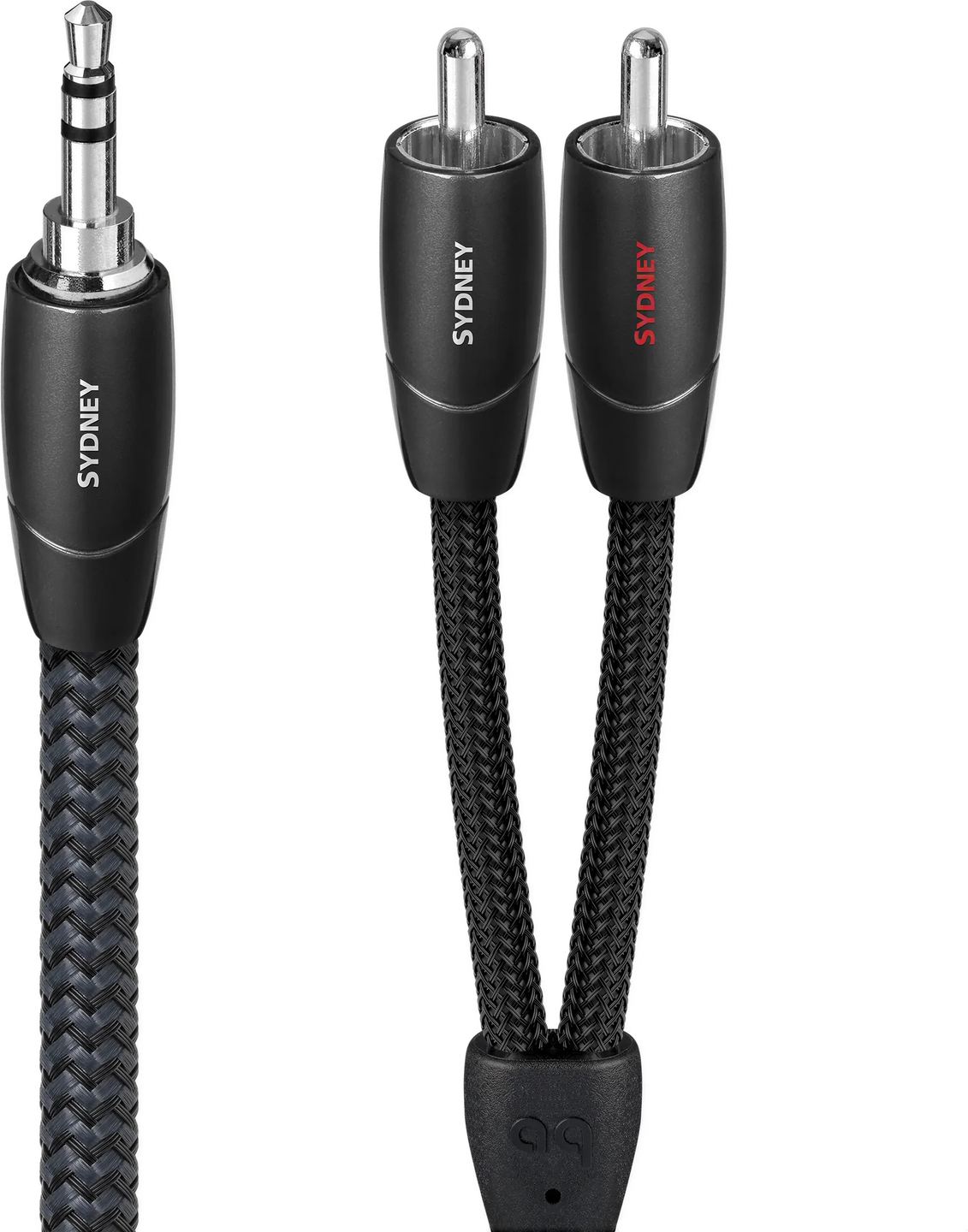
AudioQuest Sydney Jack/RCA, from mini-jack to an RCA input
A 3.5 mm headphone output on a laptop, digital music player, or small converter, and at the other end, the RCA line input of an amplifier or pair of active speakers: between the two, a link is needed to carry the signal without adding noise or coloration. The Sydney with mini-jack-to-RCA termination sits near the top of AudioQuest’s Bridges & Falls series, where the brand moves to its most sophisticated materials and shielding in the range.
A 3.5 mm source connected to a line input
A 3.5 mm mini-jack plug on one side, two RCA connectors on the other: this version connects a 3.5 mm output to a stereo line input with RCA connectors. Computer, music player, compact headphone converter with line output, music player dock—the source varies, while the destination remains a pair of RCA inputs on an integrated amplifier, preamplifier, or active speakers. The Bridges & Falls series is designed for unbalanced connections, those of the RCA world, where the signal travels through two conductors and a ground rather than a balanced pair.
Within this series, the Sydney sits above the Big Sur and below the Yosemite and Angel that complete the range. The left and right channels run within the same jacket, resulting in a slim, flexible cable, but inevitably bringing the two RCA plugs closer together at the end.
PSC+ copper as the conductor
The conductor is solid Perfect-Surface Copper+ (PSC+) copper, meaning single-core rather than stranded. A single strand eliminates electrical and magnetic interactions from one wire to another, which the brand considers a source of distortion. The high purity of the metal reduces the number of grain boundaries the signal crosses, while the conductor’s very smooth surface limits added harshness in the treble. It is the same grade of copper as in the Big Sur just below it: the upgrade happens elsewhere.
The asymmetrical double-balanced geometry
This geometry separates the ground path from the shielding, whereas many cables use the same conductor for both roles. The ground then has its own lower-impedance path, while the shield remains dedicated to its function. The positive and negative conductors are of identical quality. The intended result is a quieter, more dynamic connection over an RCA link, which remains inherently unbalanced.
Polyethylene air-tube insulation
Any solid material against a conductor absorbs some energy, stores it, then releases it as distortion. The Sydney surrounds its two conductors with a polyethylene air tube: a high proportion of air, which absorbs almost nothing, and low-loss polyethylene with a benign distortion profile. This insulation better stabilizes the internal geometry and reduces the blurring introduced by other dielectrics. It is also what distinguishes the Sydney from the first four models in the series, which use foamed polyethylene insulation.
The series’ first carbon shielding
Covering a cable 100% is simple; preventing captured radio frequencies from modulating the device’s ground reference is less so. To achieve this, the Sydney uses a three-layer carbon-based NDS noise-dissipation system: alternating layers of metal and carbon-loaded materials absorb and reflect stray energy before it reaches the layer connected to ground. Less RF noise reaches downstream active circuits, and the associated masking effect is reduced. The Sydney is the first model in the series to receive this carbon NDS, while lower-tier models make do with metal foil.
Silver-plated purple copper connectors
The terminations are made from pure purple copper, a metal that sounds cleaner than the nickel-plated or OFHC copper used in common connectors. The silver plating is applied directly to this copper, without a nickel underlayer: silver is a good conductor, and eliminating nickel removes a known source of distortion. The connectors are assembled by cold welding, without solder tin whose presence at the contact point degrades the signal. The Big Sur just below it, meanwhile, stops at gold plating.
Technical Specifications
Overview
- AudioQuest Sydney analog audio interconnect cable
- Connectors: 3.5 mm mini-jack to 2 male RCA connectors
- Compatible with a wide range of audio electronics
- Design focused on flexibility and versatility
Conductors
- Solid Perfect-Surface Copper+ (PSC+)
- Solid conductors prevent electrical and magnetic interaction between strands
- Minimization of distortion caused by grain boundaries
- Maximization of linear RF noise dissipation
- Clearer, cleaner, and naturally more beautiful sound reproduction
Geometry
- Asymmetrical double-balanced geometry
- Designed specifically for unbalanced applications
- Separation of the ground path and shielding, unlike single-path designs
- Relatively lower impedance on the ground
- Richer, more dynamic, cleaner, and quieter listening experience
Insulation
- Polyethylene air-tube insulation on both conductors
- High air content absorbing very little energy
- Low-loss polyethylene with a benign distortion profile
- Increased geometry stabilization
- Significant reduction of the blurring effect common with other materials
- Improved sonic clarity and consistency
Shielding and noise dissipation
- 3-layer carbon-based Noise-Dissipation System (NDS)
- 100% shielding coverage
- Alternating layers of metal and carbon-loaded synthetics
- Absorption and reflection of noise / RF energy before it reaches the ground-connected layer
- Protection against modulation of the reference ground plane by radio-frequency interference (RFI)
- Significant reduction of RF noise reaching active circuits and associated masking effects
Terminations
- Silver-plated pure purple copper terminations
- Direct silver plating optimized for sound
- No underlying nickel layer, a source of distortion
- Direct cold-welded termination
- Highly effective process
- Avoids conventional solder that degrades sound
Frequently asked questions
How does the Sydney differ from the Big Sur, just below it in the range?
Both cables share the same PSC+ copper conductor. The Sydney goes three steps further: insulation changes from polyethylene foam to air-tube insulation, shielding uses three-layer carbon NDS instead of metal foil, and the purple copper plugs are silver-plated, whereas the Big Sur remains gold-plated.
Is the cable directional?
Yes. Arrows printed on the connectors indicate the connection direction: they point from the source to the input. The arrowed end should therefore be connected to the amplifier or active speakers, and the other end to the source with a 3.5 mm output.
Can I connect a smartphone to my audio system with this cable?
If the phone still has a 3.5 mm headphone output, yes. On models that no longer have one, you need a small USB-C to 3.5 mm adapter: its jack socket then connects to the Sydney.
What should I do if the RCA inputs on my amplifier are too far apart?
The two RCA plugs exit from the same jacket and remain close to each other. If your device’s inputs are spaced more than 7.6 cm apart, AudioQuest recommends its Rivers or Elements series, whose left and right channels run on separate cables.
Why do the silver-plated connectors have a dull appearance?
This is normal and intentional. The silver is applied directly to the copper, without a bright nickel underlayer. The absence of this nickel gives the connectors a matte rather than glossy finish, without affecting the contact.
Is Sydney suitable for an optical or coaxial digital connection?
No. It carries an unbalanced analog signal. An optical or coaxial S/PDIF connection requires dedicated digital cables, with different impedance and connectors.
- Eco-contribution included in the sale price.
- Manufacturer reference: SYD01MR
- GTIN / EAN: 92592062078








