Questyle M18i MAX
Specifications and features


Overview
Three hours of wireless listening: that was the limit of the original M18i, constrained by a 500 mAh battery in a tiny enclosure. Questyle addressed the issue from the only angle that really mattered. The enclosure grows by a few millimeters, the battery increases to 1800 mAh, and the audio circuit has not changed by a single resistor. Enough to last through a day of commuting without looking for an outlet at noon.
Three times more battery in an enclosure barely any larger
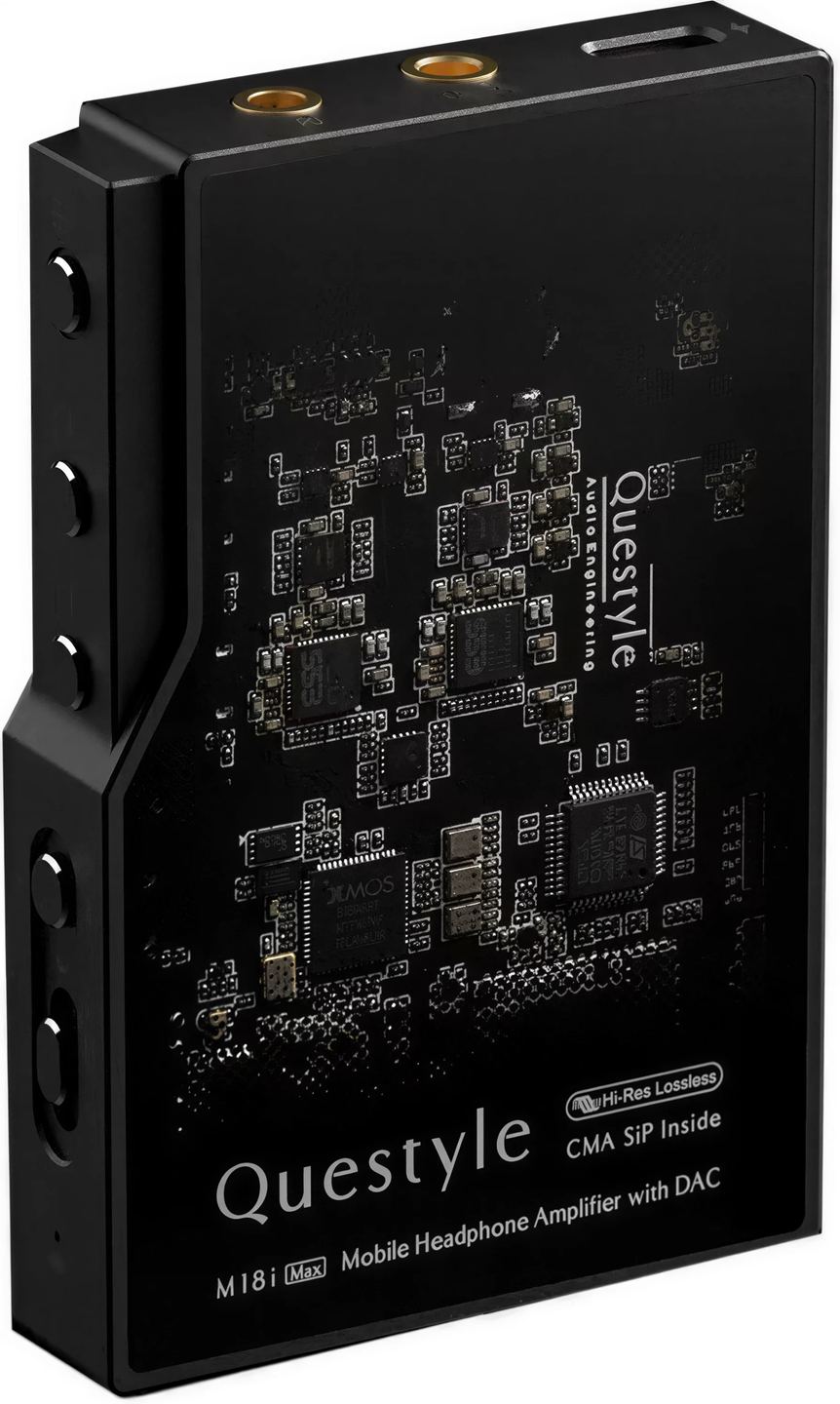
Questyle claims up to 12 hours of Bluetooth playback and 8 hours in USB mode, compared with around 3 hours for the previous model wirelessly. The difference comes down to the battery, increased from 500 to 1800 mAh, which required the chassis to grow to accommodate it: 86 × 55 × 15 mm in CNC-machined anodized aluminum. It remains about the size of a thick lighter, to place against a phone or slip into a jacket pocket, but it moves away from the dongle category that dangles from the end of a cable.
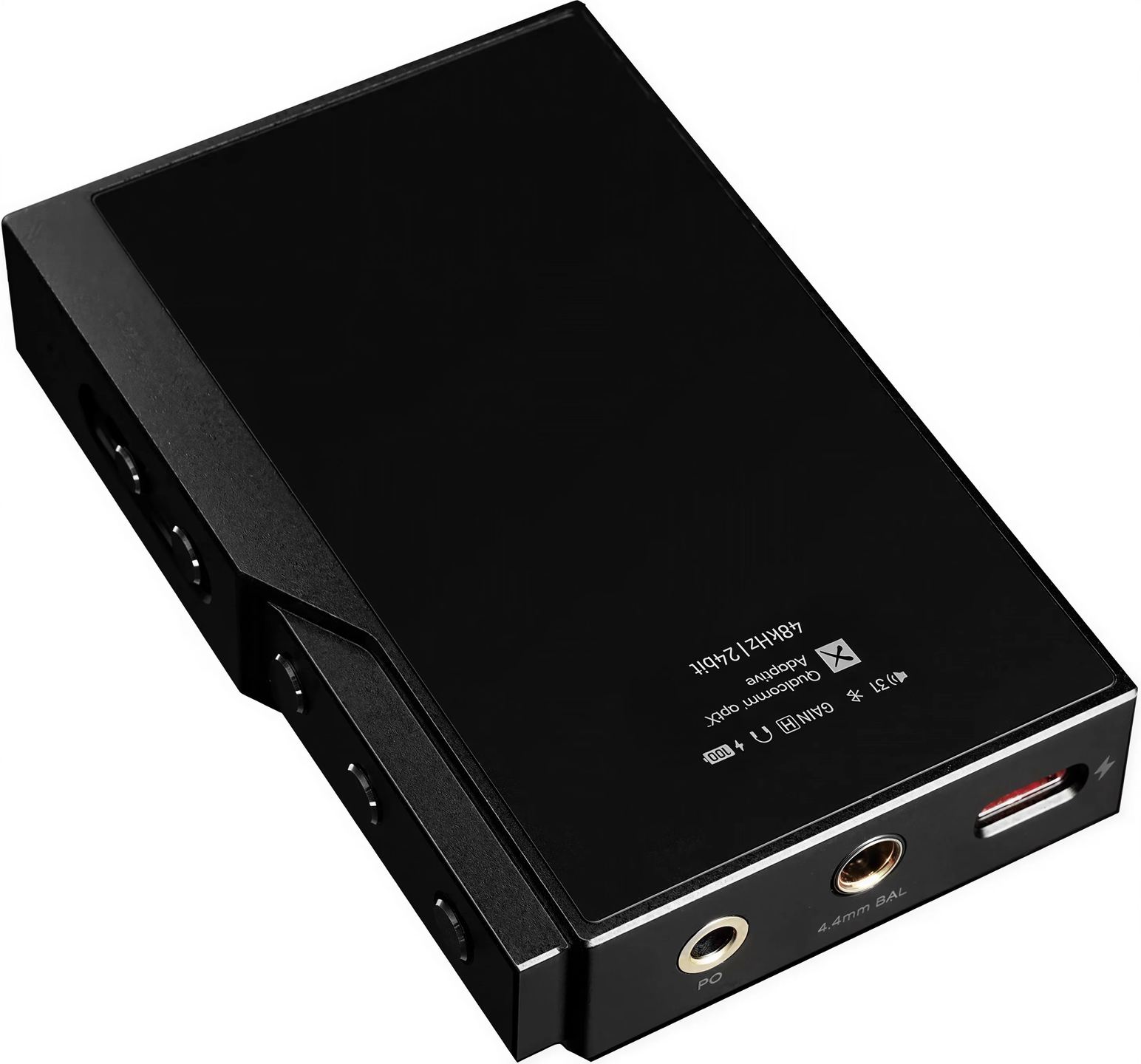
Two USB-C ports are fitted to the enclosure, with separate roles: one carries audio data, while the other is dedicated to charging. This separation allows listening while charging, which matters for extended stationary use with a laptop, and avoids drawing on the phone battery when the M18i MAX is connected to it.
Two ESS converters in dual-mono configuration
Digital-to-analog conversion is handled by two ESS SABRE ES9219Q chips, one per channel. Each channel has its own converter instead of sharing a stereo chip, an arrangement that limits crosstalk between channels. Questyle pairs this with what it calls TTA decoding, for Three-Tier Architecture, a three-stage processing structure developed with ESS engineers.
The M18i MAX plays PCM up to 384 kHz in 32-bit as well as DSD64, DSD128, and DSD256, with the USB interface based on an XMOS XU316 controller. Frequency response remains within ±0.1 dB from 20 Hz to 20 kHz, and extends to ±2 dB up to 80 kHz, a bandwidth resulting from the amplification approach described below.
Current-mode amplification and its real power
Current mode has been Questyle’s technical signature since its beginnings. A conventional amplifier processes the signal as voltage; here, it is processed as current, an approach patented by the brand and used both in its desktop equipment and portable players. The claimed benefit concerns transient intermodulation distortion, which appears when an amplifier struggles to follow rapid signal changes, as well as bandwidth. The stated total harmonic distortion plus noise drops to 0.0002%.
In practical terms, two SiP modules contain four groups of current-mode amplification. Output power is rated at 28 mW into 300 ohms through the 4.4 mm balanced jack. The figure may seem modest when read in isolation, but it corresponds to a voltage of around 2.9 volts RMS: a 300-ohm dynamic headphone with typical sensitivity can easily reach a high level. The limitation is rather with low-impedance, low-sensitivity planar magnetic headphones, which demand current and for which a desktop amplifier remains more comfortable. A manual gain setting adapts the level to the connected headphones, and volume is adjustable in 60 steps, allowing fine control with sensitive in-ear monitors.
Bluetooth 5.4 and Snapdragon Sound certification
The wireless receiver supports SBC, AAC, aptX, aptX HD, aptX Adaptive, LDAC, and LE Audio over a Bluetooth 5.4 connection. Qualcomm’s Snapdragon Sound certification requires a compatible end-to-end chain, from phone to receiver, and therefore requires a smartphone equipped with a recent Qualcomm platform to be used.
Sony’s LDAC reaches 990 kbit/s in its highest-quality mode, while aptX HD reaches 576 kbit/s. Neither bitrate matches a wired connection, where the M18i MAX receives the stream without additional compression, but the gap has narrowed considerably. In practice, the wireless connection is suited to commuting and travel, while the USB-C cable is for focused listening.
An OLED screen and physical controls
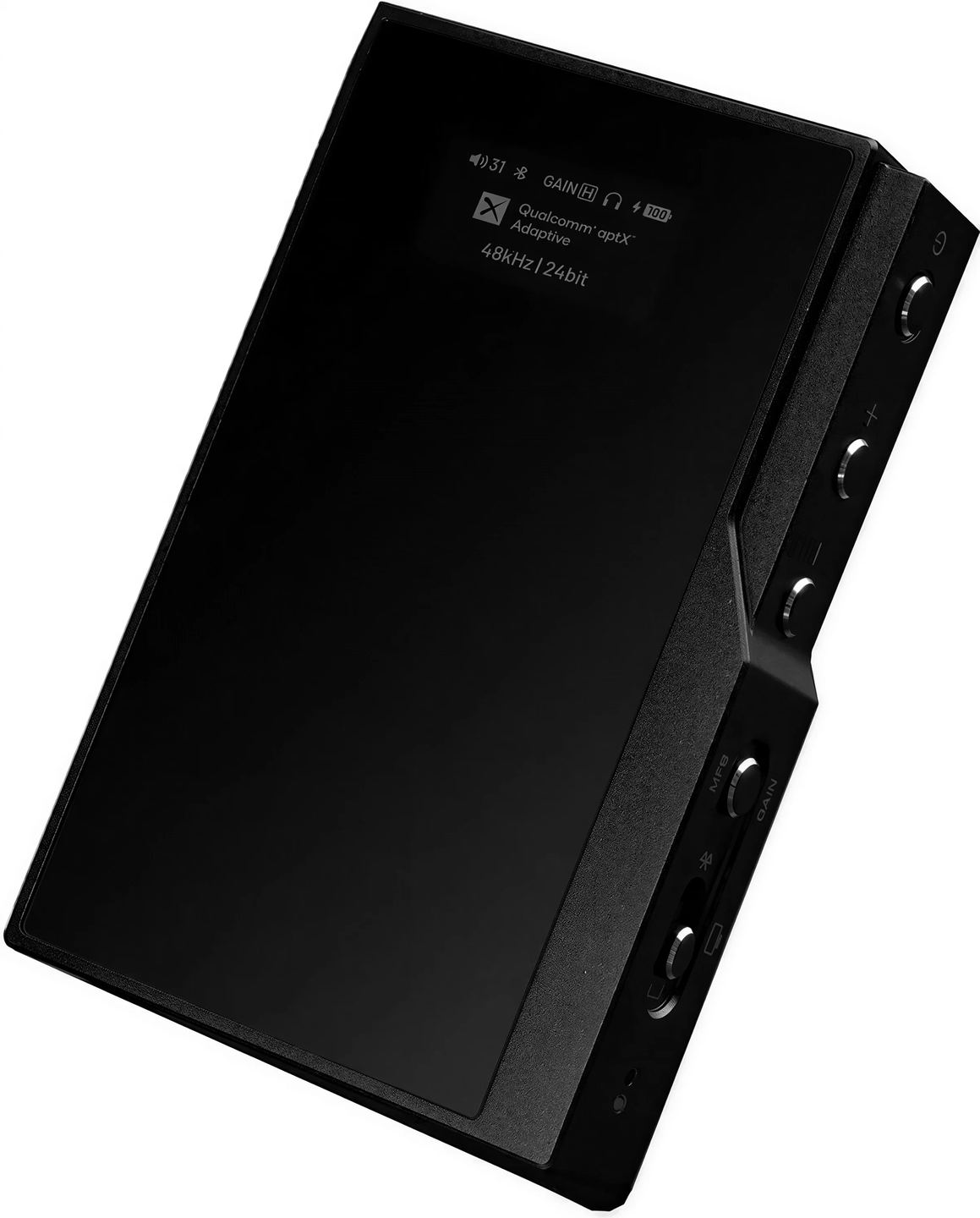
The fully laminated OLED screen occupies the front face and displays the active mode, incoming stream sampling rate, negotiated Bluetooth codec, gain level, and battery status. It is the visible counterpart to the format choice: where a dongle is operated blindly from the phone, here you can see what the device is receiving and at which setting it is operating.
The controls are grouped along one edge: power, volume, and a multifunction button that handles pairing and playback in Bluetooth mode. The two headphone outputs, an unbalanced 3.5 mm mini-jack and a balanced 4.4 mm jack, occupy the side opposite the USB-C ports.
Phone calls and multi-device compatibility
An Infineon microphone is integrated into the enclosure, with a stated pickup range of two meters and Qualcomm cVc 8.0 processing, which reduces ambient noise for the person on the other end. Wired headphones connected to the M18i MAX can therefore be used for calls, including when they do not have a microphone.
On the platform side, Apple MFi certification guarantees compliant operation with iPhone and iPad. Android smartphones and tablets are supported from version 5.0 onward, as is HarmonyOS. On computers, Windows 10 version 1803 and later works without drivers to install, as does macOS. Handheld gaming consoles with a USB-C port are recognized. iPhones with a Lightning connector require the Questyle LTC02 adapter, sold separately.
Technical Specifications
Type and design
- Type: Portable DAC / headphone amplifier
- Enclosure material: CNC-machined anodized aluminum
- Dimensions (L × W × H): 86 × 55 × 15 mm
Digital-to-analog conversion
- DAC: 2 × ESS SABRE ES9219Q
Amplification
- Amplification technology: Current Mode Amplification (CMA)
- Amplification module: 4-channel SiP
Audio output
- Headphone output: 4.4 mm balanced
- Output power: 28 mW at 300 Ω (4.4 mm balanced output)
- Frequency response:
- ±0.1 dB (20 Hz – 20 kHz)
- ±2 dB (20 Hz – 80 kHz)
Wireless connectivity
- Bluetooth: version 5.4
- Supported Bluetooth codecs: SBC, AAC, aptX, aptX HD, aptX Adaptive, LDAC, LE Audio
Communication functions
- Built-in Infineon microphone
- Call function: yes
Power and battery life
- Battery: 1800 mAh
- Claimed battery life: approximately 10 hours
Compatibility
- Compatible systems: Android 5.0 and later, Windows, macOS, iOS
- Certification: MFi
- iOS Lightning compatibility: via Questyle LTC02 adapter
Frequently asked questions
What distinguishes the M18i MAX from the original M18i?
The battery, with three and a half times the capacity, and the chassis, which has been enlarged to accommodate it. The conversion and amplification section remains identical: the same dual-mono ES9219Q DACs, the same TTA decoding, the same current-mode amplification modules, and the same stated distortion. Both models coexist in the catalog, with the MAX sitting at the top of the M series above the M12i, M15i, and M18i.
Can you listen to music while charging?
Yes. The USB-C port dedicated to charging is separate from the one receiving audio data, so playback is not interrupted. This also allows, when on the go, connecting an external battery without affecting the connection to the phone.
Does the advertised battery life apply in all situations?
No, and the difference between the two official figures already shows it: 12 hours via Bluetooth versus 8 hours in USB mode. Within each mode, battery life depends on the listening level, the selected gain, the headphone impedance and the codec used. High-bitrate LDAC through the balanced output at high volume consumes noticeably more than a pair of sensitive in-ear monitors on low gain.
Do you need an adapter for an iPhone?
iPhones with a USB-C port connect directly using a USB-C to USB-C cable. Models with a Lightning connector require the Questyle LTC02 adapter. MFi certification concerns connection compatibility with Apple devices; it does not require any specific cable beyond this use case.
Is the M18i MAX suitable for 300-ohm headphones?
For a dynamic headphone with this impedance and typical sensitivity, yes: the stated 28 mW on the 4.4 mm output corresponds to sufficient voltage to reach a comfortable level. Low-impedance, low-efficiency planar headphones, which require current rather than voltage, remain the domain of a desktop amplifier.
What is the difference between the 3.5 mm and 4.4 mm outputs?
The 3.5 mm jack is unbalanced: both channels share a common ground. The 4.4 mm jack is balanced, with each channel having its own pair of conductors, which requires a headphone cable terminated with a four-pole 4.4 mm plug. This is the output with the highest available power. Headphones supplied with a 3.5 mm plug work perfectly with the first one, without rewiring.
Does the M18i MAX replace a portable audio player?
It has no internal memory or playback interface: it receives a stream from an external source—phone, computer or console—via wired connection or Bluetooth. The music library and playback app remain on the source side. In return, it benefits from the phone’s updates and streaming services without depending on the built-in software of a portable player.
- Eco-contribution included in the sale price.
- Manufacturer reference: QY-M18IMAX
- GTIN / EAN: 6972007017272