Elipson Classic Sub 8

Overview
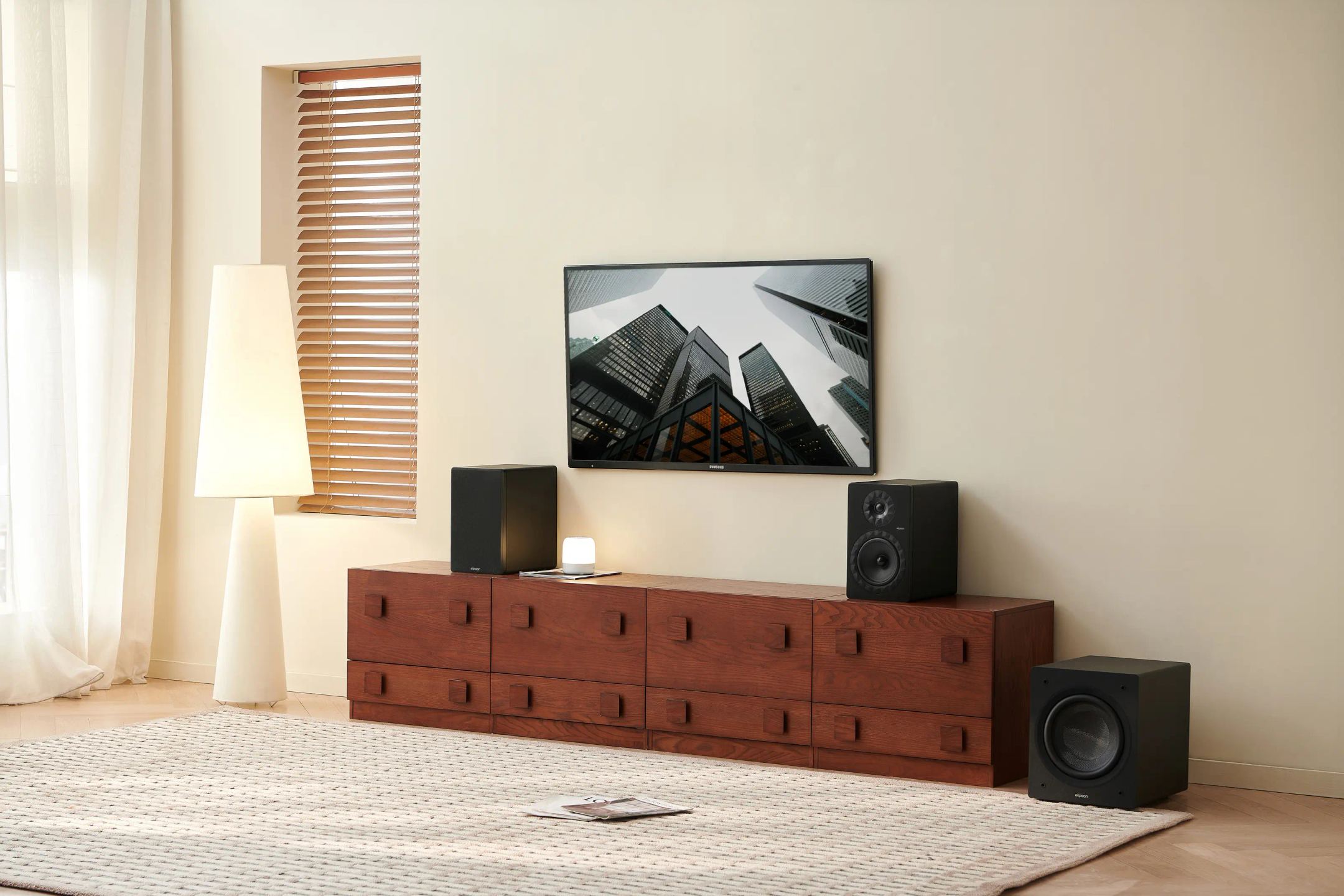
Giving a pair of compact speakers a solid foundation without sacrificing a corner of the living room: that is the role of the smallest model in Elipson’s new Classic Sub range. At just over 25 cm wide and around 30 cm tall, this active subwoofer slips in at the foot of a TV unit and handles the lower end of the spectrum that small speakers leave out, for music and films alike.
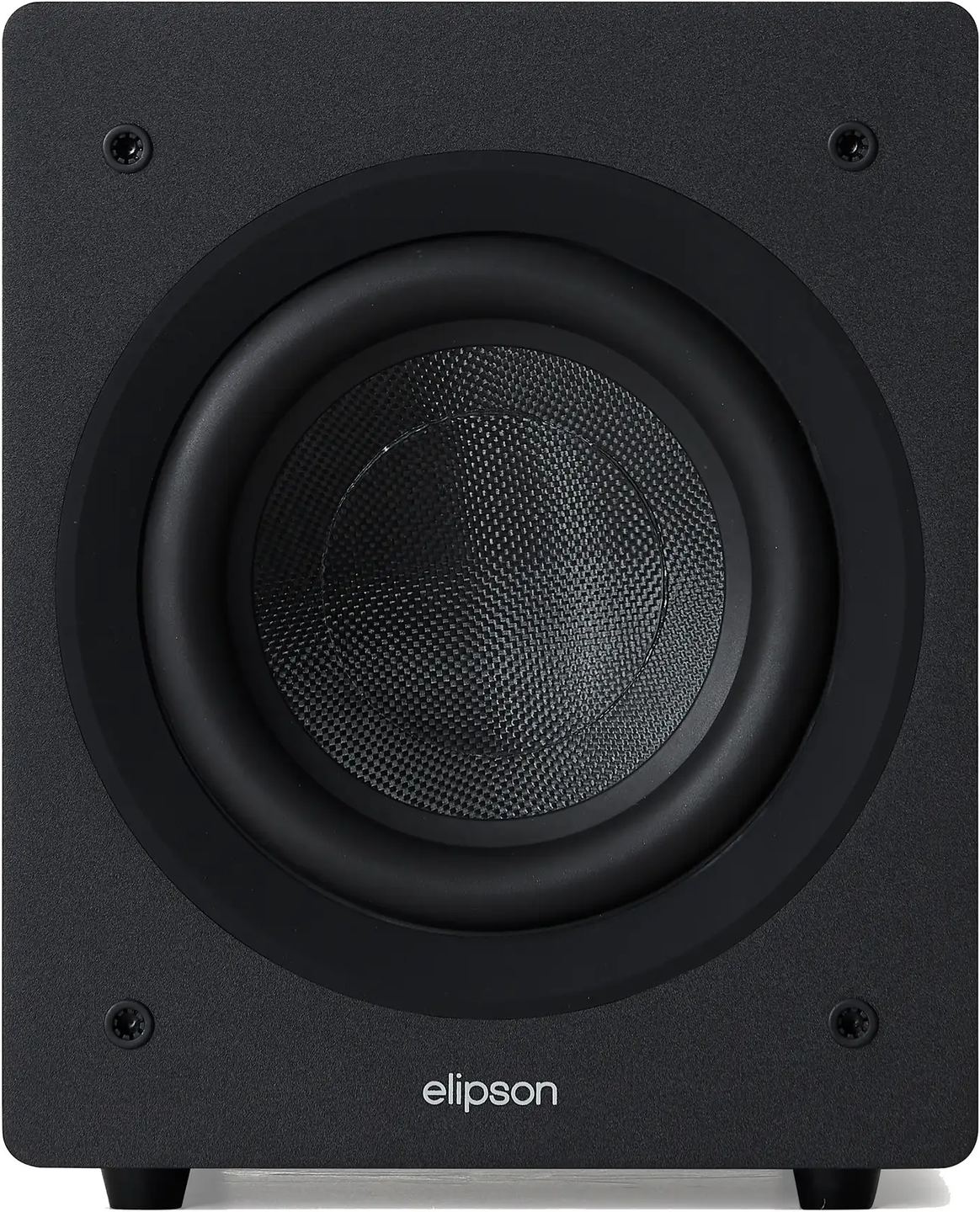
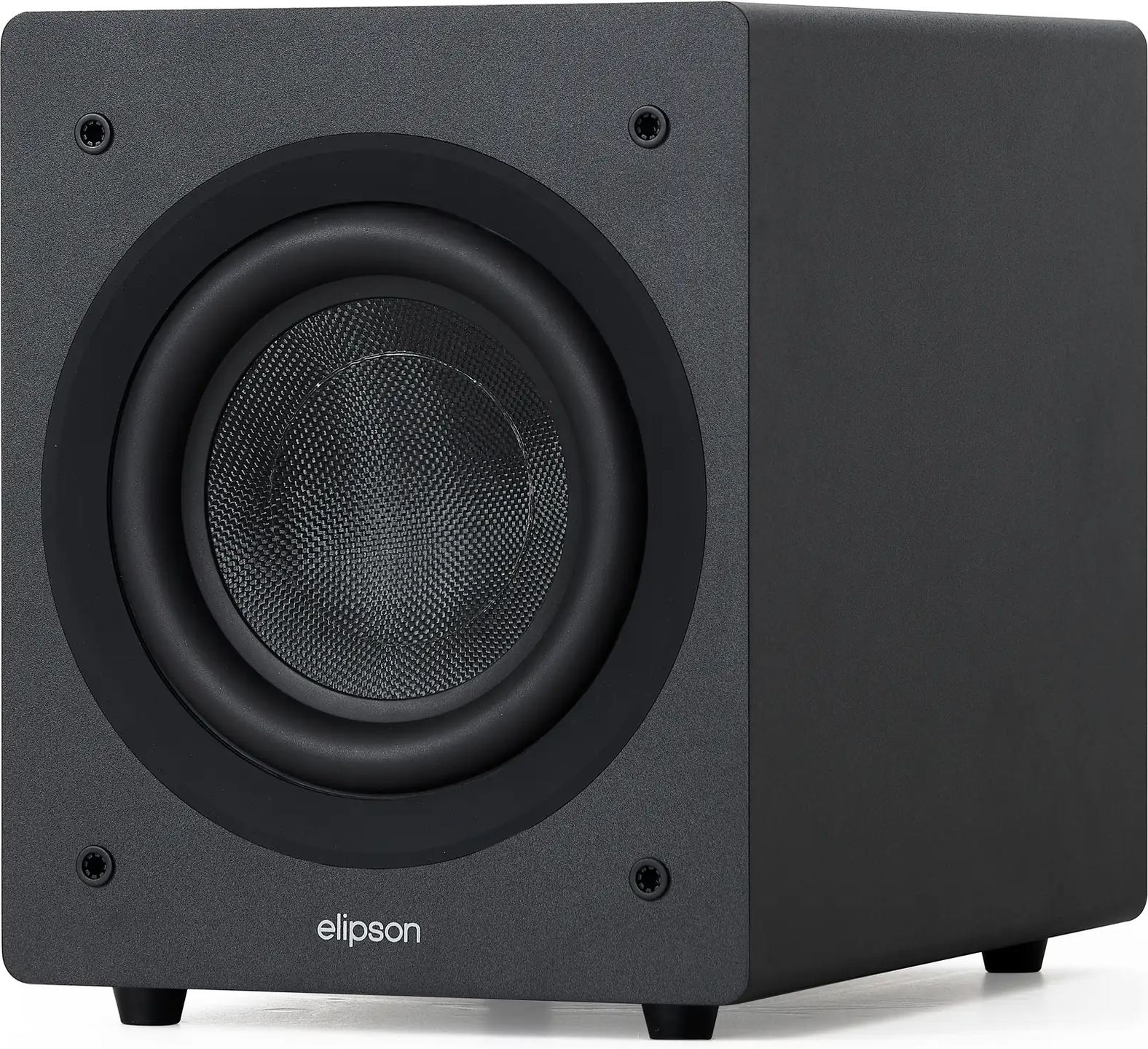
A discreet 25 cm black cube
The cabinet has an almost cubic shape, measuring 256 × 322 × 350 mm, with a black finish. The driver radiates from the front, making it easy to aim the subwoofer into the room, and small feet raise the cabinet off the floor. A grille covers the front and adds only 14 mm to the depth. Weighing 10.1 kg, the Classic Sub 8 is easy to move, a useful detail when looking for the best position in the room.
A 20 cm driver and 150 watts of Class D power
The 200 mm driver uses a fiberglass cone, a material that is both light and rigid. This rigidity matters for bass: the cone moves as a single unit, like a piston, without deforming as the volume rises, and its low mass helps it follow the attacks of a kick drum or double bass without lagging. It is powered by 150 W of Class D amplification. This type of amplifier is highly efficient and generates little heat, which explains how it fits inside such a compact cabinet.
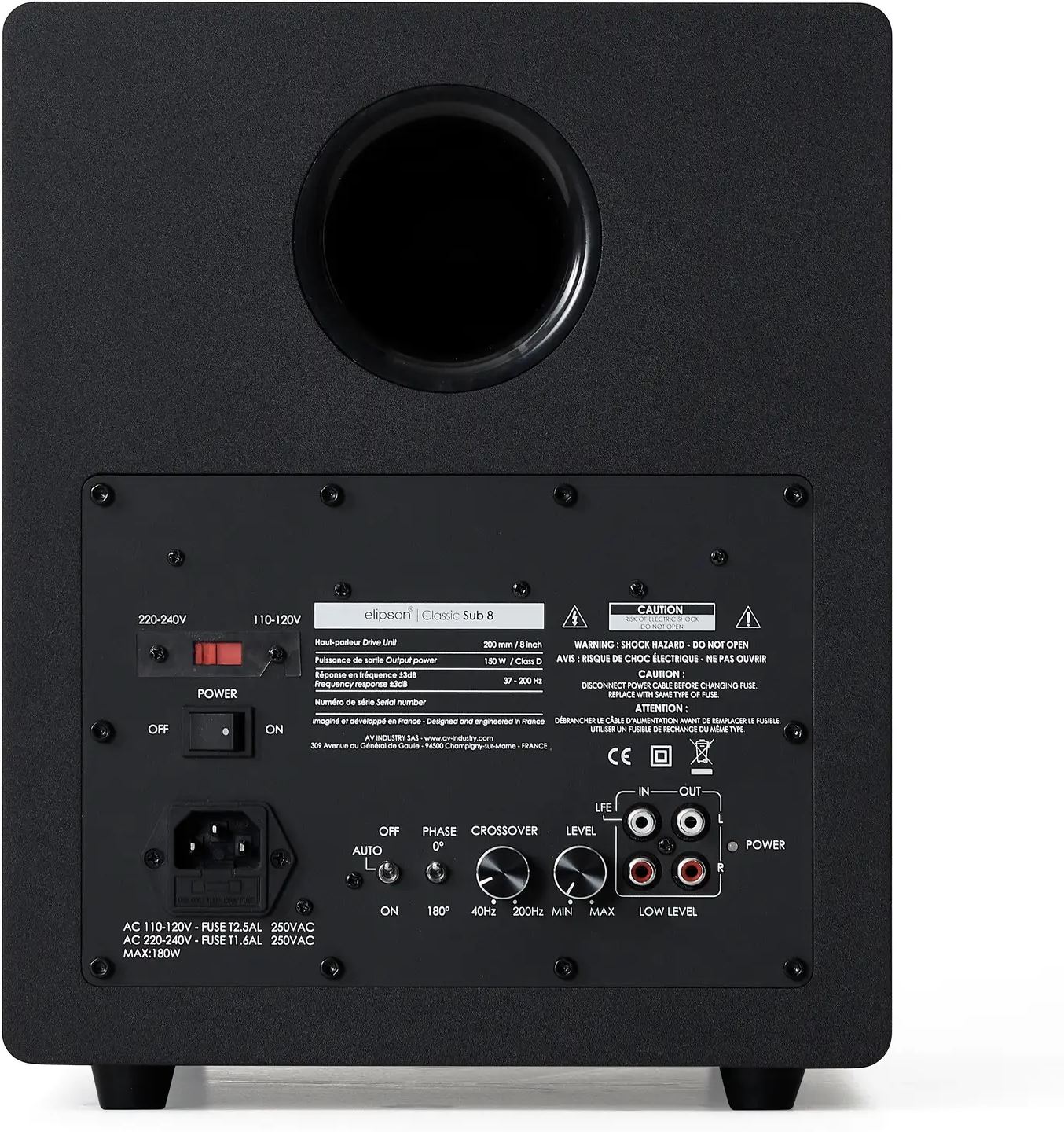
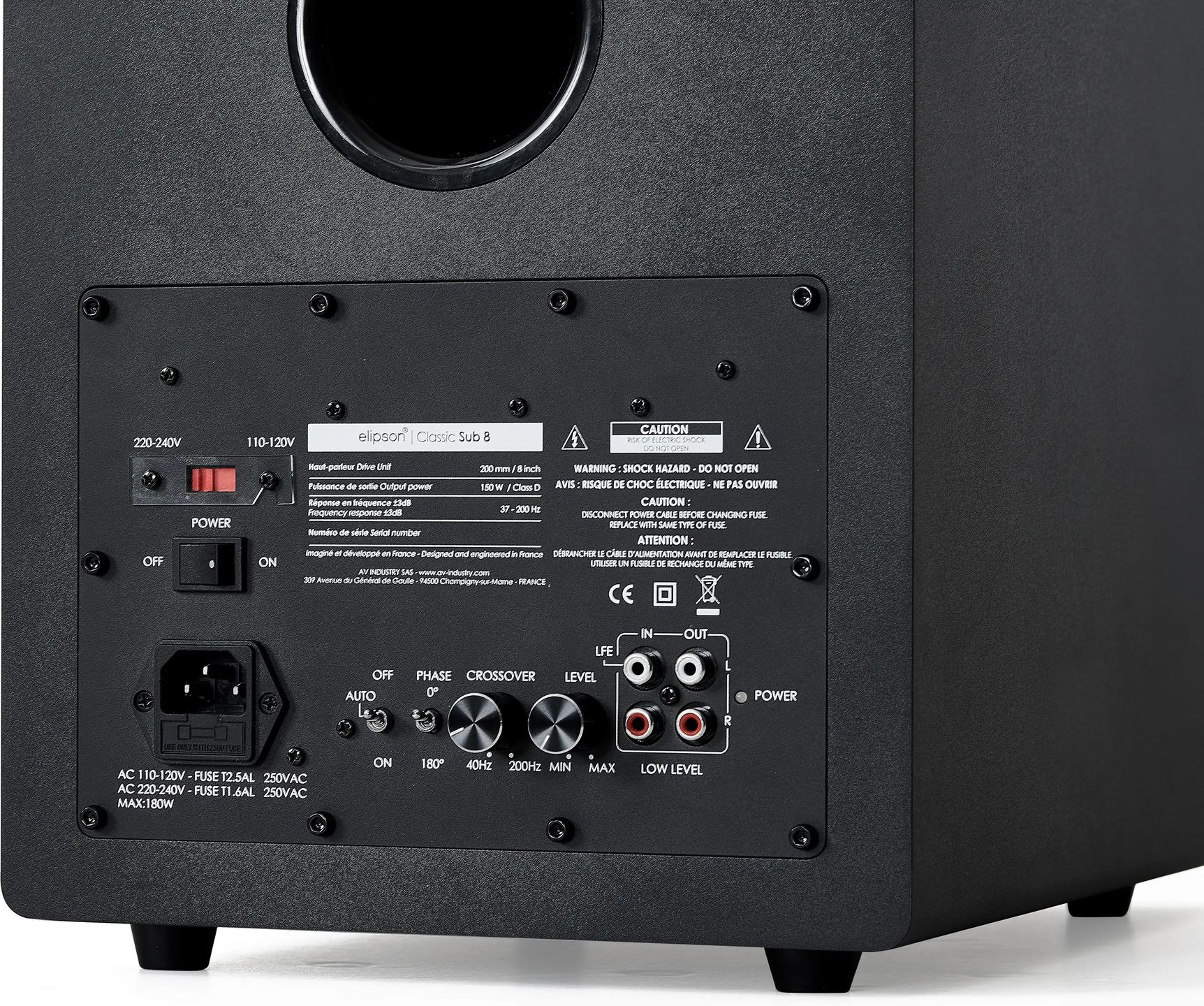
A bass-reflex design completes the package. A port puts the air inside the cabinet to work to extend the low-frequency response, with greater efficiency than a sealed cabinet of the same volume. Elipson specifies a response of 37 to 200 Hz at ± 3 dB, meaning that the level stays within 3 dB of the average value across this entire range. Below 37 Hz, the subwoofer still produces sound, at a decreasing level. Automatic standby switches off the amplification when there is no signal and reactivates it as soon as a source is heard.
Boost at 33 Hz and a filter at 22 Hz, two complementary settings
The boost adds 6.3 dB around 33 Hz, just below the lower limit of the nominal response. On paper, 6 dB represents roughly four times as much electrical power at that frequency: enough to give more body to the rumble of a soundtrack, the low notes of an organ or synthetic bass. In return, this gain places greater demands on the amplifier and the driver’s excursion. At moderate volume or in a reasonably sized room, it fills out the deepest register; pushed to high levels in a large space, it brings the subwoofer closer to its limits more quickly.
The subsonic filter works in the opposite direction. It attenuates everything below 22 Hz with a slope of 12 dB per octave. These frequencies are barely audible, but they exist in some recordings and in the rumble of a turntable. In a bass-reflex cabinet, the driver is no longer restrained by the air inside the cabinet below the port’s tuning frequency: allowing it to reproduce this sub-bass would make it perform large, unnecessary movements. The filter protects the cone and reserves the amplifier’s power for the audible part of the spectrum.
Connecting the subwoofer to a stereo or home theater amplifier
Connectivity consists of low-level left/right line inputs and outputs. With a stereo amplifier, simply connect its preamp output or subwoofer output to the two inputs on the Classic Sub 8. With a home theater amplifier, the SUB (or LFE) output connects to one of the inputs using a single RCA cable. The amplifier then manages the division between the speakers and subwoofer itself: set the subwoofer’s crossover frequency to its maximum, 200 Hz, so that its internal filter does not interfere with the amplifier’s filter.
The line outputs pass the signal on to another device. The most common use is to daisy-chain a second subwoofer: two bass sources positioned in different parts of the room distribute energy more evenly and reduce the peaks and dips created by the room’s acoustics depending on the listening position.
Adjusting crossover and phase for a seamless transition
In stereo, without bass management in the amplifier, the subwoofer’s crossover frequency, adjustable from 40 to 200 Hz, determines where it takes over from the speakers. A good starting point is to set it slightly above the stated lower limit of the main speakers: around 70 to 80 Hz for bookshelf speakers that reach down to 55 or 60 Hz, and lower for floorstanding speakers. Set too high, the crossover thickens the lower midrange and makes the subwoofer easy to locate; set too low, it leaves a dip between the two.
The 0° / 180° phase selector corrects another issue. Depending on the distance between the subwoofer and the speakers, sound waves may arrive out of alignment at the listening position and partially cancel each other out around the crossover frequency. Adjust it by ear, sitting in your usual spot, using a track with a steady bass line: the position that delivers the fullest bass is the right one. Placement matters just as much as these settings, because a corner increases the level but also accentuates the room’s resonances.
Documentation
French
Technical specifications
Design and amplification
- Type: active bass-reflex subwoofer
- Amplification: 150 W, Class D
- Driver: 200 mm diameter, fiberglass cone
Acoustic performance and settings
- Frequency response: 37 to 200 Hz (± 3 dB)
- Subsonic filter: 22 Hz, 12 dB/oct. slope
- Crossover frequency: variable from 40 to 200 Hz
- Bass boost: +6.3 dB at 33 Hz
- Phase: 0° / 180°
- Standby: automatic
Connectivity
- Line inputs: left / right, low-level
- Line outputs: left / right, low-level
Dimensions and weight
- Dimensions (width × height × depth)
- Without grille: 256 × 322 × 350 mm
- With grille: 256 × 322 × 364 mm
- Packaging: 366 × 480 × 435 mm
- Net weight: 10.1 kg
- Gross weight: 12 kg
Frequently Asked Questions
What size room can this subwoofer fill with sound?
A 20 cm driver paired with 150 W is well suited to a bedroom, office or medium-sized living room, for both music and movies at normal home listening volumes. For a large room or higher listening levels, a subwoofer with a larger driver provides more headroom, unless you add a second Classic Sub 8 using its line outputs.
Can it be paired with speakers from another brand?
Yes. The subwoofer is not tied to any ecosystem: the adjustable crossover from 40 to 200 Hz and the phase selector are specifically designed to match it to any pair of speakers, whether bookshelf or floorstanding.
My amplifier doesn't have a preamp output or a subwoofer output, can I use it?
The Classic Sub 8 only has low-level inputs, with no speaker-level input. It therefore requires an amplifier, an AV receiver, a network player or a connected amplifier equipped with a line, preamp or subwoofer output.
Is the subwoofer useful for listening to music or mainly for movies?
Both. For music, the benefit lies less in the amount of bass than in its extension: a pair of small speakers complemented by a subwoofer with a low crossover setting reproduces the fundamental of a double bass or piano that the speakers cannot reproduce on their own. A crossover set too high, however, reveals the subwoofer’s position, which is why it is best to stay below around 100 Hz with capable speakers.
Where should it be placed in the room?
Placing it near the front speakers makes integration easier, but the best spot depends on the room. A simple method is to temporarily place the subwoofer at the listening position, play a bass-heavy track, then move around the room: the spot where the bass sounds most balanced is the position to choose for the subwoofer. Leaving a few centimetres between the cabinet and the wall prevents the port from being obstructed.
Should the grille be left in place?
The choice is mainly aesthetic. Without the grille, the fiberglass speaker remains visible and gives a more technical look; with it, the front becomes uniform and the cone is protected, an advantage around children or pets.
Should the subwoofer be decoupled from the floor?
On a floating wood floor or a lightweight floor, the cabinet can transmit vibrations to the structure and cause the floor or nearby furniture to resonate. Damping pads or an isolation base limit this effect and make the bass clearer. On a concrete slab or a tiled floor, this is much less of an issue.
- Eco-contribution included in the sale price.
- Manufacturer reference: ELICLASUB8BK
- GTIN / EAN: 3700795194805