PMC COR silver


PMC cor, analog stereo integrated amplifier
Between the input socket and the speaker terminals, the signal encounters no digital converter: volume, bass, treble and balance are adjusted in the analog domain, using motorized controls borrowed from mixing consoles. The first domestic integrated amplifier from the British manufacturer of studio monitors and hi-fi speakers, hand-assembled in the United Kingdom, the cor delivers 95 W per channel into 8 Ω and houses a headphone amplifier with a dedicated circuit.
An integrated amplifier that remains entirely analog
PMC speakers equip recording and mastering studios, and the cor, introduced in 2017, follows the same brief: add nothing to the signal, take nothing away. Its name comes from Latin, where it means the heart and, figuratively, the spirit. While many recent amplifiers digitize the signal to let a processor handle volume or tone, the cor keeps everything analog, from source selection to the speakers, including tone controls. It has no converter, digital input, Bluetooth or network functionality. Listening to a streaming service or files requires a network player or an external converter connected to a line input, leaving the digital side to a component that can be replaced without touching the amplification, with no software to date the unit over the years.
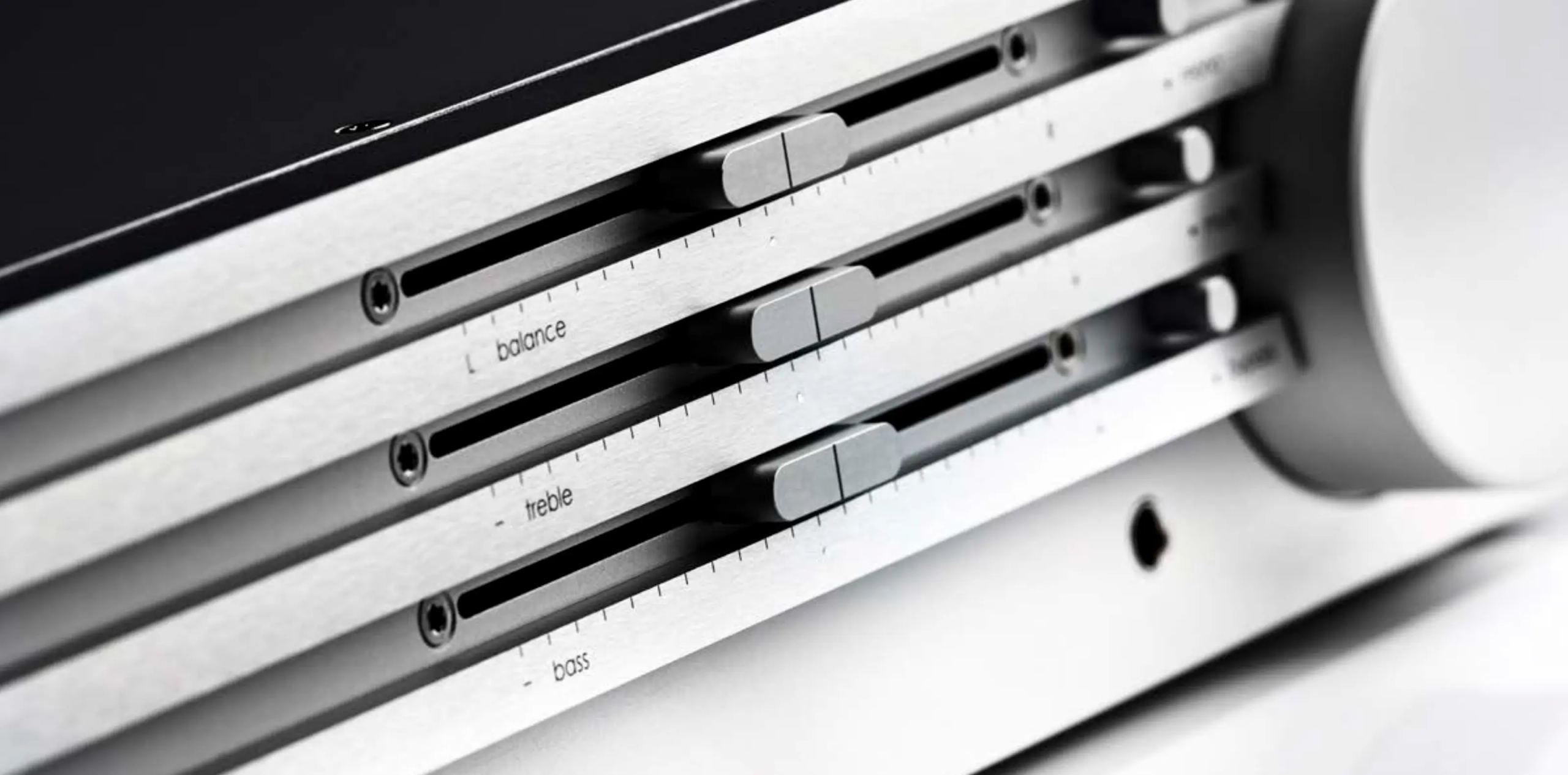
Motorized faders borrowed from the mixing console
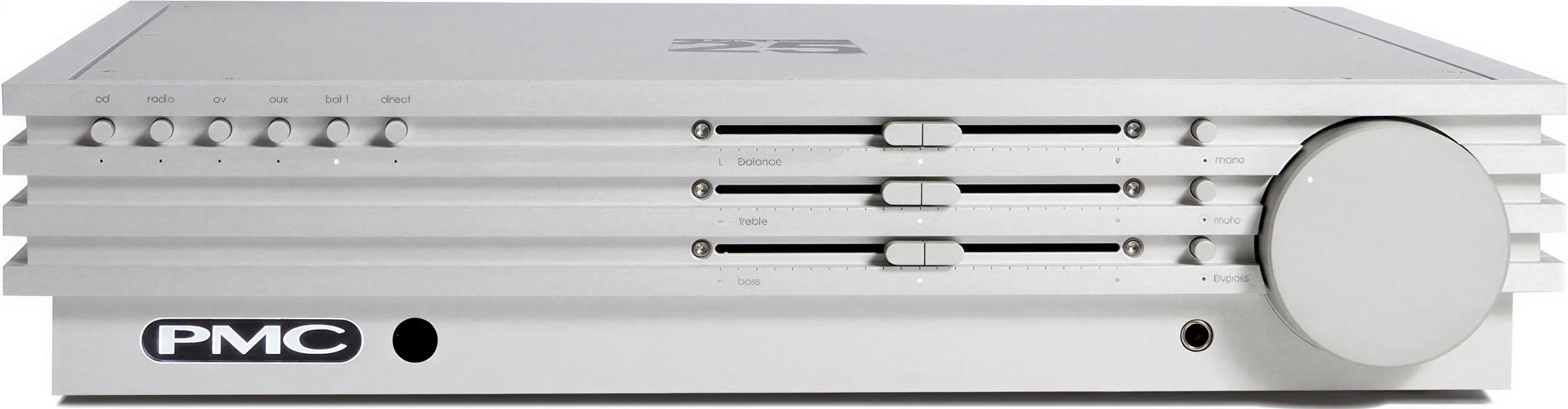
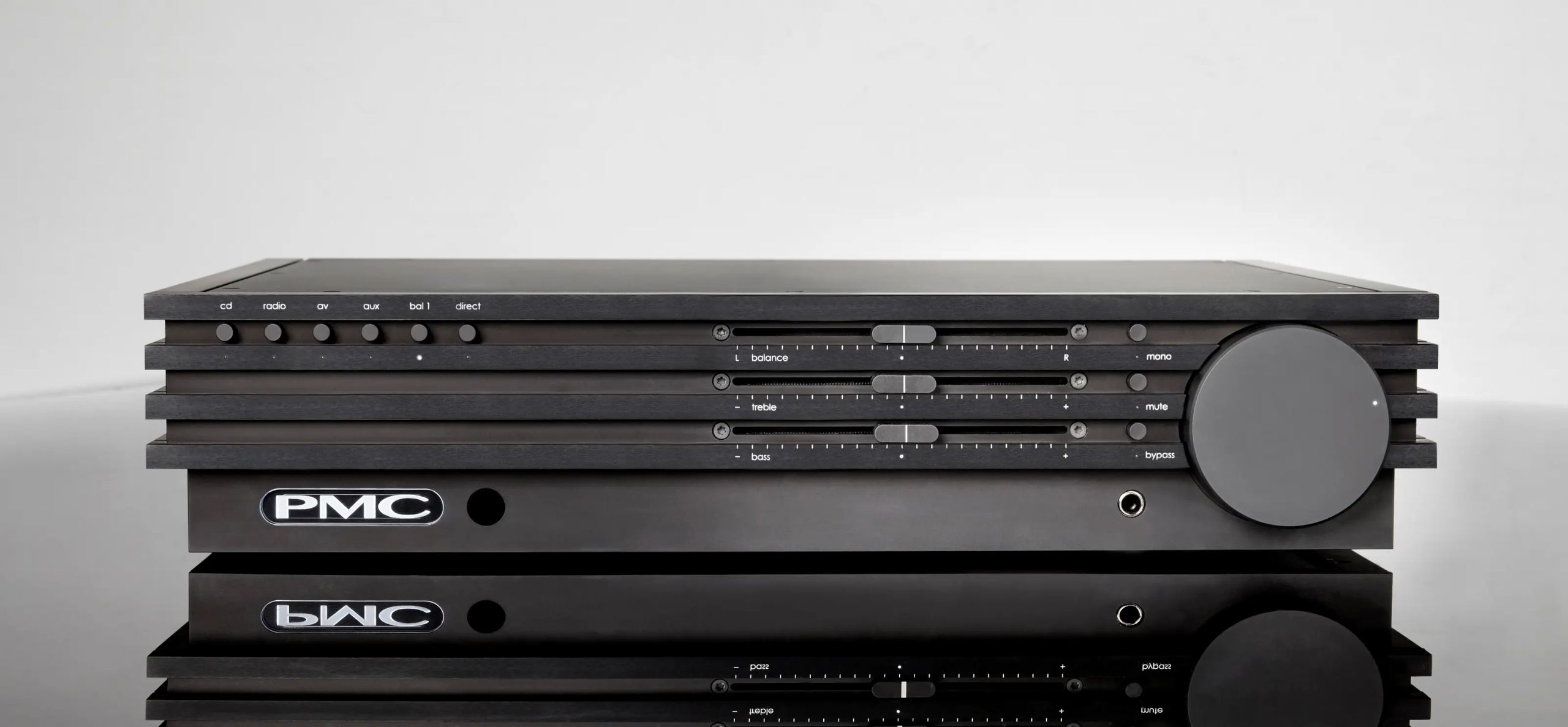
On the front panel, the rotary volume control and three vertical faders for bass, treble and balance are driven by small motors, the same technology used on studio consoles where the sliders reposition themselves. From the sofa, the remote control moves them physically: the position visible on the front panel always matches the actual setting, and that setting remains analog. Each fader has an indicator light, white when centered and red whenever an adjustment is applied, so a glance is enough to tell whether playback is flat. Bass and treble adjustments cover ±10 dB, enough to compensate for a heavily damped room, slightly bright speakers or a recording with thin bass.
The bypass button removes the tone circuit from the signal path, leaving only the volume control, while the mono button sums the left and right channels, useful for older recordings released in mono or for checking that the central image forms properly between the speakers. A mute button and backlit source selectors complete the front panel, where the touch-sensitive PMC logo serves as the power switch; a mains switch is located at the rear. The motorized controls have their own power supply, separate from that of the audio circuits. The remote control, housed in extruded aluminum, duplicates all the front-panel functions and has a range of 5 meters at an angle of 30°.
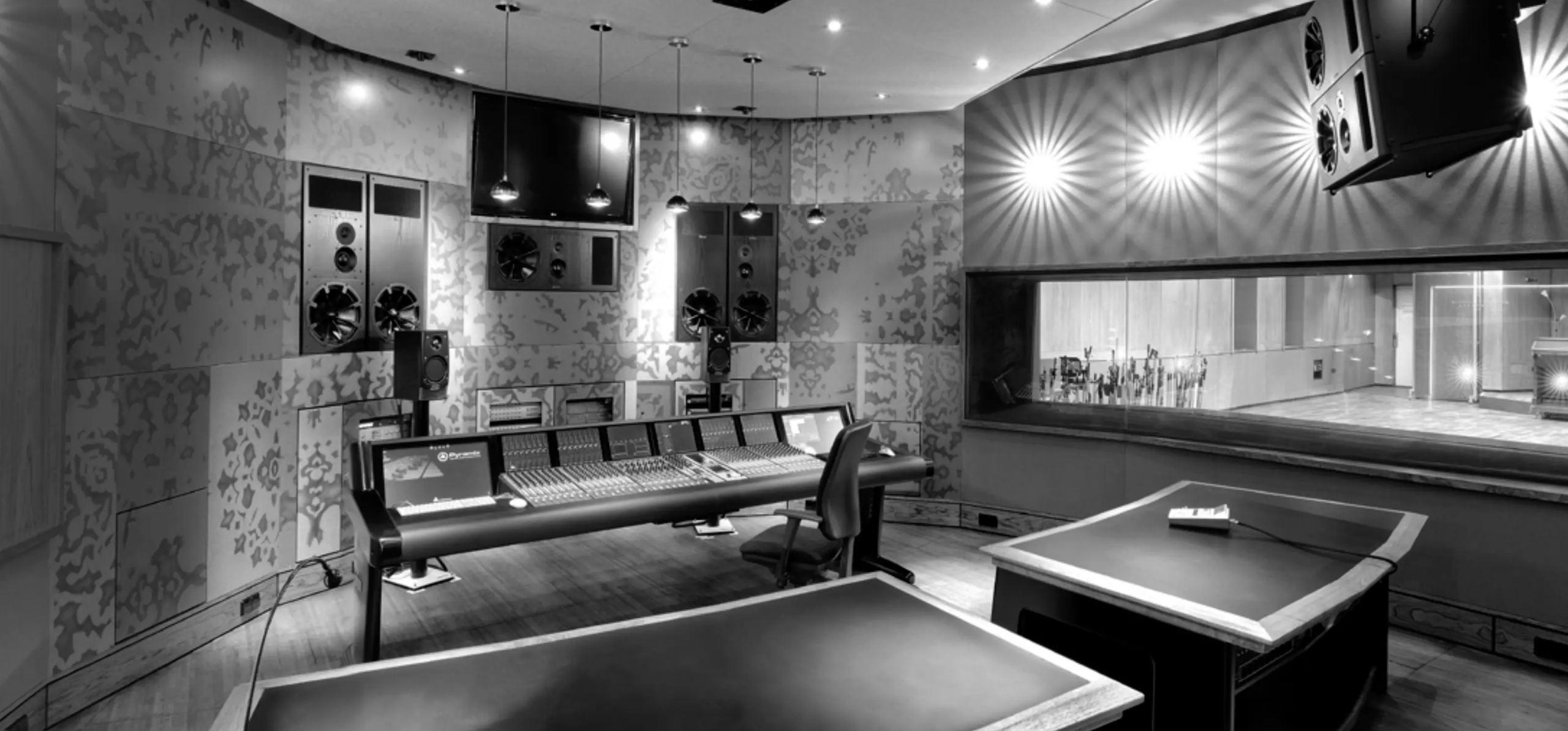
A Darlington power stage and dual power supplies
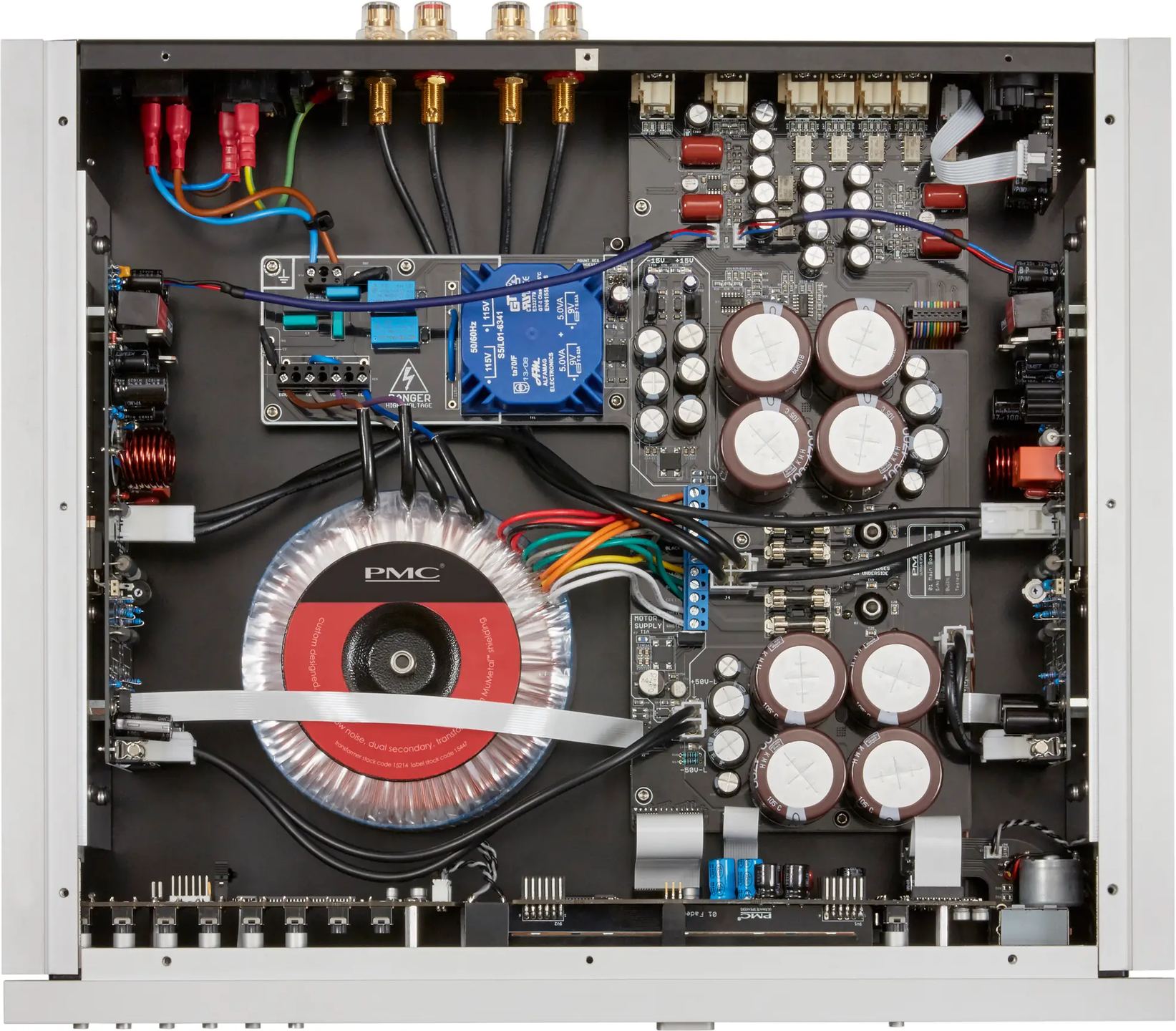
The power amplification uses discrete components, transistors and resistors installed individually rather than grouped in an integrated circuit, arranged according to the Darlington principle. This configuration, described by Sidney Darlington at Bell Laboratories, pairs two transistors, with the first driving the second: it achieves high current gain with few stages, resulting in a short signal path. PMC’s engineers chose it after listening to several other configurations, with a specific goal: limiting thermally induced distortion, which occurs when transistor temperatures vary with the music and alter their behavior. Class A/B operation keeps the output transistors slightly conducting at idle, avoiding crossover distortion between the two halves of the signal without the constant heat of pure class A.
A dual-secondary toroidal transformer feeds two independent power supplies. It is enclosed in a MuMETAL housing, a nickel-iron alloy that channels the transformer’s magnetic field and prevents it from radiating into neighboring circuits, a common cause of hum. Inside, the signal travels in balanced form to better reject interference picked up along the way, and source switching uses sealed, gold-plated relays filled with inert gas, protected from oxidation. Components were selected through listening, and protection circuits monitor overheating, overcurrent, short circuits and mains faults.
The cor delivers 2 × 95 W into 8 Ω and 2 × 140 W into 4 Ω. Power increases significantly as impedance falls, a sign of a power supply that keeps up with the current demanded by more power-hungry speakers. Its damping factor, greater than 160 into 8 Ω across the entire audio band, corresponds to an output impedance below 0.05 Ω: the amplifier firmly controls the bass driver cones and restrains unwanted movement. Harmonic distortion remains at 0.001% at 1 kHz at rated power. This reserve suits most speakers in a living room; low-efficiency models played loudly in a large room will require more, which the preamplifier output allows you to add with a power amplifier.
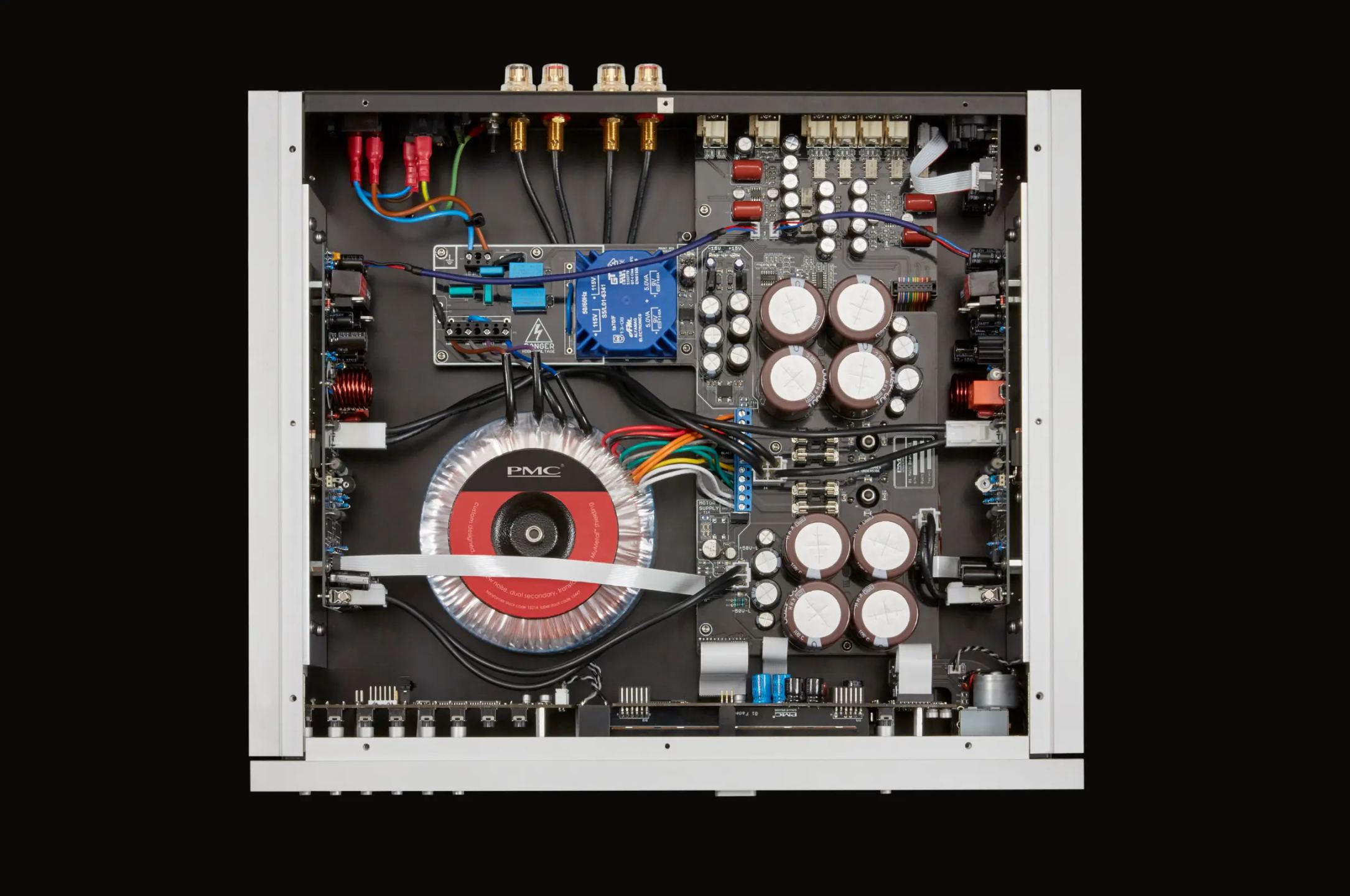
Line inputs and a direct path to the power stage
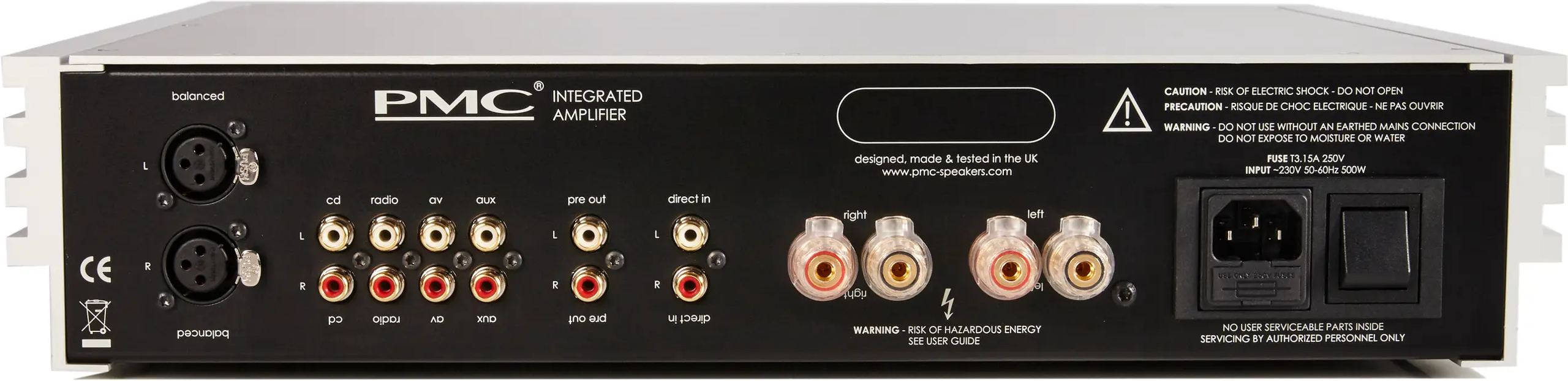
Four unbalanced RCA inputs, labeled cd, radio, av and aux, are identical both electrically and sonically: the labels serve only as reference points. A fifth input, balanced XLR, accepts sources equipped with this format, mainly high-end network players and converters. A balanced connection carries the signal on two conductors in opposite phase and eliminates noise picked up by the cable, an advantage over long runs. All these inputs operate at line level, and a turntable requires an external phono preamplifier.
The RCA direct in input feeds the power section without passing through the preamplifier. It receives the front left and right channels from a home theater receiver, which then controls their volume, allowing the same pair of speakers to serve both movies and stereo listening controlled by the cor. On the output side, an RCA preamplifier output feeds a power amplifier or a processor, and the 4 mm binding posts, one pair per channel, accept spades, banana plugs and bare wire. Speakers with dual binding posts are connected with single wiring, with the jumpers in place.
A headphone amplifier with its own circuit
The front-panel headphone socket is powered by a dedicated class A/B circuit, independent of the stage that drives the speakers. Inserting headphones disconnects the speakers, and removing them activates muting, so the level set for headphones does not switch unexpectedly to the speakers. Overload protection safeguards the headphones.
An aluminum chassis that also serves as a heat sink
The enclosure is made from extruded aluminum, then CNC-machined on three axes, giving it its grooved front panel. The finishing process combines bead blasting (projecting fine beads to give the metal an even, matte surface), satin finishing and anodizing, in silver or black. The sides themselves act as heat sinks: the cor requires around 75 mm of clearance all around, and an enclosed recess without airflow is unsuitable. Measuring 87.5 mm high, 432 mm wide and 401 mm deep, including feet, and weighing 12 kg, it fits into most hi-fi furniture, provided this clearance is maintained. It operates on 230 V mains power.
Technical specifications
Overview
- Model: PMC cor
- Type: fully analog stereo integrated amplifier, class A / B
- Manufacture: designed and hand-assembled in the United Kingdom
- Signal path: 100% analog from input to output, with no digital conversion, including volume, tone and balance
- Available finishes: silver, black
Audio inputs
- 4 unbalanced RCA line-level inputs: CD, radio, AV, AUX
- All sonically identical
- 1 balanced XLR input: BAL 1
- 1 direct RCA input: DIRECT IN
- Feeds the power stage without passing through the preamplifier
- Enables integration into a home theater system for the front channels
- All inputs are line-level: a turntable requires an external phono preamplifier
Audio outputs and headphone amplification
- 4 mm speaker terminals: one pair per channel
- Compatible with spade connectors, banana plugs and bare wire
- RCA preamplifier output: allows the addition of a power amplifier or processor
- Front-panel headphone output
- Dedicated class A / B amplification circuit
- Automatic detection with speaker cutoff when headphones are plugged in
- Automatic muting when headphones are unplugged to protect the speakers
- Headphone overload protection
Controls and adjustments
- Motorized analog volume control
- Motorized bass and treble sliders
- Tone adjustment range: ± 10 dB
- Motorized balance slider
- Motorization derived from professional mixing consoles
- Indicator light for each slider: white in the center position, red when adjusted
- Mono button: sums the left and right channels
- Mute button
- Tone bypass button: the signal passes only through the volume control
- Backlit source selection buttons
- Touch-sensitive PMC logo serving as the power switch
- Rear-panel mains switch
Internal design and protection
- Discrete-component power stage, inspired by Sidney Darlington’s work at Bell Laboratories
- Short signal paths to limit thermally induced distortion
- Two independent power supplies
- Dual-secondary toroidal transformer, shielded by a MuMETAL enclosure
- Separate power supply for the motorized controls
- Electronically balanced internal signal routing
- Components selected through listening tests
- Protection circuits: overheating, overcurrent, short circuit, mains power faults
Preamplifier performance
- Frequency response:
- 20 Hz to 20 kHz (+ 0 / − 0.2 dB)
- 5 Hz to 80 kHz (+ 0 / − 1 dB)
- Maximum gain: 15 dB
- Input impedance:
- Unbalanced: 25 kΩ
- Balanced: > 14 kΩ
- Harmonic distortion:
- 0.001% at 1 kHz
- < 0.005% from 20 Hz to 20 kHz
- Intermodulation distortion: < 0.001% using the SMPTE method
- Noise: − 100 dBV, A-weighted
- Maximum input level: 5.5 V RMS
- Maximum output level: 10 V RMS
Power amplifier performance
- Rated power with a 230 V mains supply:
- 2 × 95 W into 8 Ω
- 2 × 140 W into 4 Ω
- Frequency response:
- 20 Hz to 20 kHz (+ 0 / − 0.1 dB)
- 5 Hz to 80 kHz (+ 0 / − 1 dB)
- Input impedance: 23.5 kΩ
- Sensitivity: 1 V for 100 W into 8 Ω
- Gain: 28.9 dB
- Harmonic distortion at rated power into 8 Ω:
- 0.001% at 1 kHz
- < 0.01% from 20 Hz to 20 kHz
- Noise: − 101 dB, A-weighted, relative to rated power
- Output impedance: < 0.05 Ω from 20 Hz to 20 kHz
- Damping factor: > 160 into 8 Ω, from 20 Hz to 20 kHz
Power supply and installation
- Mains supply: 230 V, 50 to 60 Hz, 500 W
- Mains connection: IEC inlet
- Fuse: T3,15 A
- Recommended ventilation clearance: 75 mm around the unit
Chassis construction
- Extruded aluminum chassis, machined using three-axis CNC
- Fluted front panel
- Finishing process: bead blasting, satin finishing, then anodizing
- Side panels serving as heat sinks
Box contents and remote control
- cor amplifier
- Power cord
- Remote control
- Extruded aluminum housing
- Duplicates all front-panel functions
- The sliders and volume control physically follow the adjustments made
- Adjustments remain in the analog domain
- Range: 5 m
- Angle: 30°
- Power supply: 3 AAA batteries included
- 1.5 mm Allen key for opening the battery compartment
- User guide
Warranty
- Duration: 5 years, subject to product registration on the PMC website within 30 days of purchase
Dimensions and weight
- Dimensions (W × H × D): 432 × 87.5 × 401 mm, including feet
- Weight: 12 kg
Frequently Asked Questions
How do you connect a turntable to the cor?
A phono preamplifier suited to the cartridge type (moving magnet MM or moving coil MC) must be inserted to amplify and equalize the cartridge signal, bringing it up to line level. Its output connects to any of the four RCA inputs, or to the XLR input if the preamplifier has a balanced output. A turntable with a built-in preamp connects directly, with the preamp enabled.
How do I pair the horn with a network player?
The player must have its own analog output, and therefore a built-in converter, or use an external converter. Set its output to a fixed level to leave volume control to the cor: two volume controls in series complicate operation and can degrade the signal-to-noise ratio. With a sensitivity of 1 V for 100 W and a maximum input level of 5.5 V, standard line outputs (2 V via RCA, 4 V via XLR) are suitable without any difficulty.
What precautions should be taken with the direct in input?
This input bypasses the cor’s volume control: the level depends entirely on the connected device. It only accepts a variable-level output, such as the front-channel preamp outputs of a home theater receiver. A fixed-level source (CD player, converter) would send its signal at full power to the speakers.
What can the preamplifier output be used for?
It sends the signal from the preamplifier section to an external device. It is used to add an active subwoofer with a line-level input, to drive the speakers with a more powerful power amplifier, or to bi-amp speakers with dual binding posts: the cor drives one section and a power amplifier the other, with the jumpers removed and the gains of the two amplifiers as closely matched as possible.
Does the cor only work with PMC speakers?
No, it drives any passive speaker. Its power output is rated at 8 Ω and 4 Ω, the two most common nominal impedances, and the increase between these two values shows that it handles lower loads well.
What does the warranty cover?
The horn is guaranteed for 5 years, provided the product is registered on the PMC website within 30 days of purchase.
What's in the box?
The amplifier, its power cord, the aluminium remote control with its three AAA batteries, a 1.5 mm Allen key for opening the remote control’s battery compartment, and the user guide.
- Eco-contribution included in the sale price.