

T+A MP 2500 R G3

Specifications and features


Overview
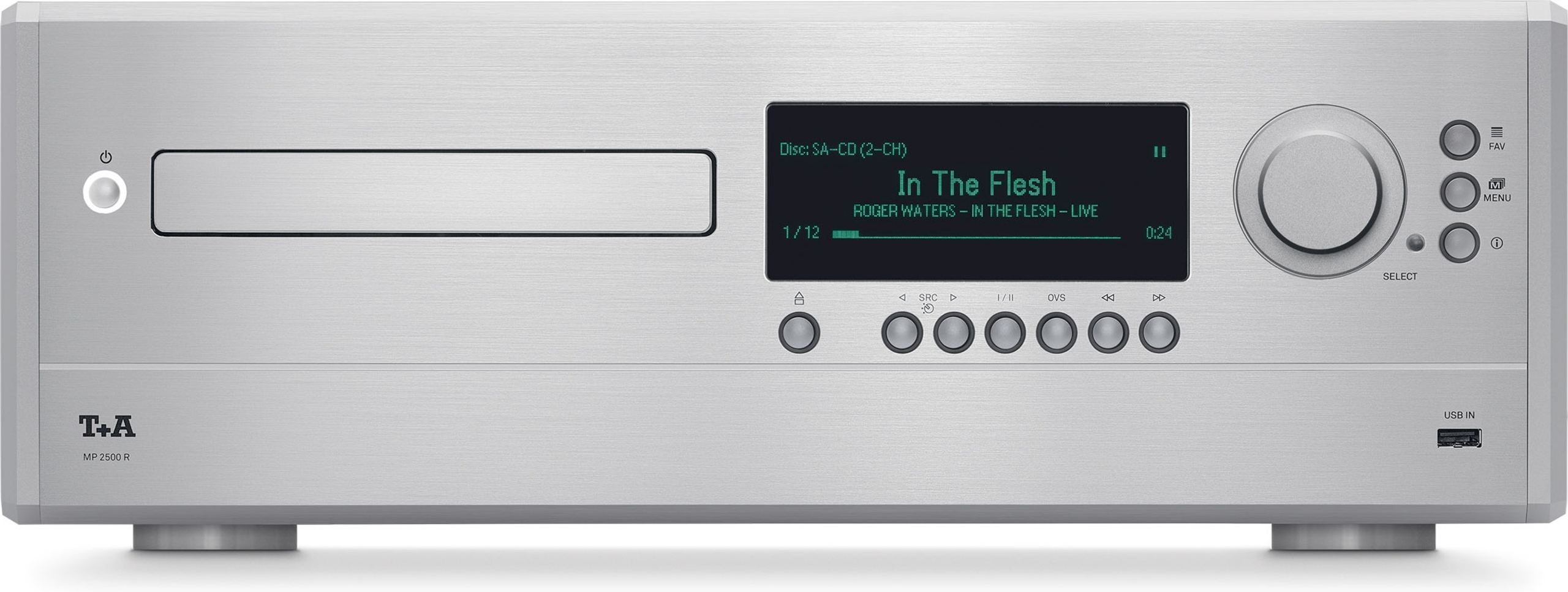
An SACD, an album on Qobuz, morning DAB+ radio or TV sound all pass through this same unit, each following a conversion circuit suited to its format. The taller version in T+A’s R series, this multi-source player combines an SACD mechanism taken from the German manufacturer’s most advanced devices with a third-generation streaming platform, hence the G3 suffix. Together, they replace a stack of sources with a single device.
An SACD mechanism from T+A’s high-end range
The MP 2000 R G3, which shares the same electronics, makes do with a CD player in a lower-profile chassis. The MP 2500 R G3 instead features an SACD mechanism derived from the brand’s most ambitious models, with linear tracking: the optical pickup moves in a straight line beneath the disc rather than pivoting on an arm, keeping the beam perpendicular to the tracks across the entire surface. Two lasers share the work, one at 650 nm for the thinner SACD layer, the other at 785 nm for CDs. The mechanism is enclosed and mounted on heavy plates that isolate it from external vibrations, and its motors run without audible noise.
SACD stores sound in DSD (a 1-bit stream clocked at 2.8 MHz) and extends the frequency response to 44 kHz with a dynamic range of 110 dB, compared with 20 kHz and 100 dB for CD. The player also accepts recorded CD-Rs and CD-RWs and displays CD Text and SACD Text information. When a disc is inserted, the Gracenote database identifies the album and the control app displays its artwork, just as it does for a streamed track.
A different converter for PCM and DSD
Digital music comes in two forms. PCM, used for CDs and the vast majority of files and streaming services, describes sound as a sequence of numerical samples; DSD, used for SACD, describes it as a stream of 1-bit pulses at a very high frequency. Most devices entrust both to the same circuit. T+A provides two separate paths.
PCM, up to 384 kHz, passes through a 56-bit signal processor offering four selectable oversampling filters, then through four 32-bit conversion chips per channel. Configured in a double-differential arrangement, these chips work in pairs in opposite phase: their small linearity errors cancel each other out and residual noise drops by around 6 dB. DSD, up to DSD512 (22 MHz), is handled by a discrete 1-bit converter developed by T+A, which processes the stream as it arrives rather than using the DSD mode of a PCM chip. The native format is preserved right up to analog conversion.
An internal clock independent of the source
Jitter refers to the tiny timing irregularities with which samples arrive at the converter. A computer, an optical connection or an overly long cable can introduce it, and these timing shifts result in a less sharply defined soundstage when listening. The MP 2500 R G3 handles them in two stages: a PLL loop first cleans up the clock extracted from the incoming signal, then a microprocessor checks its stability and, if it meets its criteria, switches conversion to an internal master clock that is completely independent of the source. Two quartz oscillators share the task, one for the 44.1 kHz family and its multiples, the other for the 48 kHz family, so that each sampling frequency is clocked without approximation.
A dual-mono output stage isolated from the digital circuitry
After conversion, the analog signal leaves the digital section through transformers that break all electrical connections between the two domains. T+A calls this system DASS: interference from a computer connected via USB or a TV connected via optical cable cannot reach the audio circuits. The output stage uses a dual-mono design, with an independent circuit for each channel, and its bandwidth reaches 100 kHz. A third-order linear-phase Bessel filter eliminates conversion residue above the audible range without shifting frequencies relative to one another.
Two pairs of outputs are available. The balanced XLR output delivers 5 V, twice that of the RCA output (2.5 V), and provides better rejection of interference picked up by long cables; it is the most suitable choice for T+A amplifiers or any device equipped with balanced inputs. Distortion remains below 0.001%, the signal-to-noise ratio reaches 116 dB and channel separation reaches 110 dB.
Streaming, radio and digital inputs
The ASA G3 network platform supports Ethernet and dual-antenna Wi-Fi 6, and provides access to TIDAL, Qobuz, Deezer, Amazon Music and HIGHRESAUDIO from the T+A app, or directly from the services’ apps via TIDAL Connect, Qobuz Connect and Spotify Connect. AirPlay 2 takes over for Apple devices, Bluetooth aptX HD for guests’ smartphones, and airable provides Internet radio and podcasts. On the home network, the player plays libraries shared by a UPnP or DLNA server at up to 384 kHz/32 bits, as well as native DSD up to DSD256, a first for a T+A network platform. Two USB ports accept a flash drive or hard drive, and Audirvana software can control playback from a computer.
For broadcast radio, the tuner receives FM with RDS information and DAB+, the digital terrestrial radio broadcast in France. The rear panel then opens the MP 2500 R G3 up to other sources: one coaxial input, two BNC inputs (a professional, locking variant of coaxial) and two Toslink optical inputs for a TV, console or CD transport, plus an asynchronous USB input for a computer. All benefit from the same converter and clock as discs and streaming.
Control and integration into the R series
The SRC 1 system remote control is included, and the T+A MusicNavigator G3 app (iOS and Android) controls both the player and its accompanying PA 2000 R and PA 2500 R amplifiers. The R2-Link connection between devices in the series makes them operate as a single system: power, source selection and volume can all be controlled with a single action. Measuring 46 cm wide and 16.5 cm high and weighing 11.3 kg, the MP 2500 R G3 adopts the series’ taller form factor and stacks with the PA 2500 R. The enclosure is available in silver or black anodized aluminum. It consumes a maximum of 40 W, 0.3 W in ECO standby, and switches off automatically after 90 minutes without a signal.
Documentation
Technical specifications
Type and optical playback
- Type: multi-source player / SACD player
- Optical drive: high-precision linear tracking mechanism
- Dual-laser system:
- SACD: 650 nm
- CD: 785 nm
- Supported disc formats and text information: stereo SACD, CD / DA, CD-R, CD-RW, SACD / CD Text
- Frequency response:
- SACD: 2 Hz – 44 kHz
- CD: 2 Hz – 20 kHz
- Dynamic range:
- SACD: 110 dB
- CD: 100 dB
Network audio playback
- Streaming audio formats: MP3, AAC, OGG Vorbis, FLAC, WAV, AIFF, ALAC, DFF, DSF
- PCM: up to 384 kHz / 32 bits
- DSD: DSD64, DSD128, DSD256; conversion up to DSD512
- Streaming services: TIDAL, Qobuz, Deezer, Amazon Music HD, HIGHRESAUDIO
- Connect services: TIDAL Connect, Qobuz Connect, Spotify Connect
- AirPlay: Apple AirPlay 2
- Internet radio and podcasts: airable Radio & Podcasts
- Network servers: UPnP 1.1, UPnP AV, DLNA, Windows Media Connect
Network and wireless connections
- Wired network: Ethernet 10/100 Base-T
- Wi-Fi: IEEE 802.11a/b/g/n/ac/ax, 2 × 2 MIMO
- Bluetooth: A2DP, AVRCP 1.4, aptX HD, MP3, SBC
Audio inputs and outputs
- S/PDIF inputs: 1 × coaxial, 2 × BNC, 2 × TOS-Link
- USB device mode: 1 × asynchronous USB
- USB host mode: 2 × USB 2.0
- Analog outputs:
- RCA: 2.5 Vrms / 50 Ω
- XLR: 5.0 Vrms / 50 Ω
- Digital output: 1 × coaxial, IEC 60958 S/PDIF (LPCM)
Conversion and audio performance
- PCM converter: quadruple double-differential architecture, 4 digital-to-analog converters per channel, 32-bit sigma-delta
- PCM conversion: up to 352.8 / 384 kS/s
- DSD converter: T+A True 1-Bit DSD, up to DSD512 (22 MHz)
- Analog filter: 3rd-order linear-phase Bessel, cutoff frequency at 100 kHz
- Total harmonic distortion: < 0.001%
- Signal / noise ratio: 116 dB
- Channel separation: 110 dB
Radio reception
- FM tuner: FM / FM-HD, 87.5 – 108 MHz
- DAB tuner: DAB / DAB+, 168 – 240 MHz
- FM sensitivity: 1 μV (signal / noise ratio > 65 dBA)
- FM tuner total harmonic distortion: 0.1%
- FM signal / noise ratio:
- Mono: 72 dB
- Stereo: 62 dB
- FM stereo separation: 50 dB
- RDS services: PS, PTY, RT
Operation and remote control
- Control interface: R2-Link
- Remote control: SRC 1
- Control app: T+A MusicNavigator
Power supply and consumption
- Power supply: 100 – 240 V, 50 / 60 Hz
- Maximum power consumption: 40 W
- ECO standby power consumption: 0.3 W
- Automatic shutdown: yes, after 90 min without an audio signal
Dimensions and weight
- Dimensions (H × W × D): 16.5 × 46 × 40 cm
- Weight: 11.3 kg
Frequently asked questions
Does the player play multichannel SACDs?
It plays the stereo layer of SACDs. Discs that offer both a stereo and a multichannel version are therefore played normally, in stereo. Hybrid discs, which also include a CD layer, can be played as either SACD or CD.
Can an older MP 2500 R be upgraded to the G3 version?
Yes. T+A offers to replace the network board in the MP 2500 R and MP 2000 R MK II with the ASA G3 platform. The replacement is carried out at the brand’s workshops through an authorized dealer.
Can it be used as a converter for a computer?
Yes, via the asynchronous USB input: it is the player’s converter, not the computer, that sets the data timing. On Windows, T+A provides a driver to install from its website, required to support PCM up to 384 kHz and DSD up to DSD512. This input is the only one that accepts DSD512.
How do I connect the TV?
Via one of the optical or coaxial inputs. The MP 2500 R G3 is a stereo device: the TV’s digital audio output must be set to stereo PCM, otherwise the programmes’ Dolby Digital or DTS tracks will not be played.
Is Wi-Fi enough, or do I need an Ethernet cable?
Both work. The Ethernet port is limited to 100 Mbit/s, but a 384 kHz/32-bit stereo stream only requires around 25 Mbit/s: there is plenty of headroom. A wired connection remains the most stable solution in a home where Wi-Fi is congested or when the router is far away; dual-antenna Wi-Fi 6 works very well in other cases.
Can the coaxial digital output feed another converter?
Yes, in PCM (LPCM). DSD signals, whether from SACDs or files, are not transmitted through this output: they are reserved for the internal 1-bit converter.
What's the difference compared to the MP 2000 R G3?
Both players share the network platform, converters, clock, output stage and tuner. The MP 2500 R G3 replaces the CD player with an SACD transport and adopts the series’ taller chassis, matching the PA 2500 R.
- Eco-contribution included in the sale price.








