T+A MP 2000 R G3 silver


Specifications and features


Overview
A compact disc, a DAB+ station, a Qobuz album started from a phone or a DSD file sent by a computer all end up in the same slim enclosure here, then each passes through the converter suited to its format. With this G3 version, T+A, a manufacturer based in Herford since 1978, has updated the network board and motherboard of its R series multi-source player. The CD mechanism and conversion stages remain those of the previous model.
The R series’ slim anodized aluminium enclosure
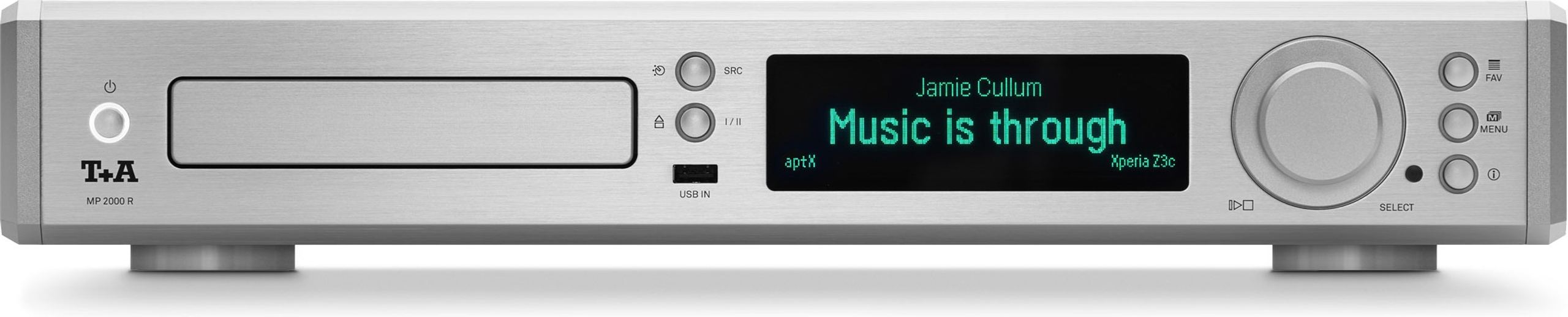
T+A’s R series comes in two enclosure heights: models numbered 2000 use the slim chassis, while those numbered 2500 use a taller chassis. The MP 2000 R G3 measures 8.2 cm high, 46 cm wide and 40 cm deep. It weighs 8 kg and stacks with the PA 2000 R integrated amplifier, sharing its proportions and design. The anodized aluminium front panel, in silver or black, follows Bauhaus-inspired lines. It houses the CD tray, a display showing the source, current track, signal format and menus, as well as control buttons and a rotary navigation knob. The front-panel menu provides access to display brightness, source names, power saving and converter settings, without using the app.
Two separate conversion paths for PCM and DSD
PCM (the encoding format used for CDs and most files) and DSD (a very fast single-bit stream) do not pass through the same circuit. T+A calls this principle Path Separation Technology. PCM signals go to the quadruple converter. A 56-bit signal processor handles them, then each channel is assigned to four 32-bit sigma-delta converter chips arranged in a double-differential configuration. Having several chips work on the same signal averages out their small individual linearity errors, and residual noise drops by around 6 dB compared with a single chip. Conversion takes place at 352.8 or 384 kHz, depending on the frequency family of the original signal.
Before conversion, the processor oversamples the signal using one of four selectable filters: short FIR, long FIR, Bézier/IIR and Bézier. They do not all measure the same, and the choice remains a matter of listening. The long FIR provides the sharpest cutoff above the audible band, while the short filters and Bézier variants shorten the impulse response, at the cost of gentler attenuation beyond 20 kHz.
DSD files go to a T+A True 1-Bit converter, a single-bit analogue circuit that processes the stream as it arrives, without ever converting it to PCM.
Before the two converters, a two-stage clock reconstruction system handles jitter, the tiny timing irregularities that originate in the source or connection. A PLL loop first cleans up the clock extracted from the incoming stream. The microprocessor then checks its stability before switching the converters to an internal master clock, isolated from the source. This clock uses two quartz oscillators: one serves the 44.1 / 88.2 / 176.4 / 352.8 kHz family, the other the 48 / 96 / 192 / 384 kHz family.
An output stage isolated from the digital section
Digital circuits generate interference, especially when a computer is connected. To keep it away, the DASS (Digital Analogue Separation System) galvanically isolates the analogue output stage from the entire digital section using transformers. No direct electrical connection remains between the two. The analogue stage has a dual-mono design, with one circuit per channel, as with the converters. Its bandwidth reaches 100 kHz. A linear-phase analogue filter automatically adjusts its cutoff frequency between 60 and 120 kHz according to the track’s sampling rate.
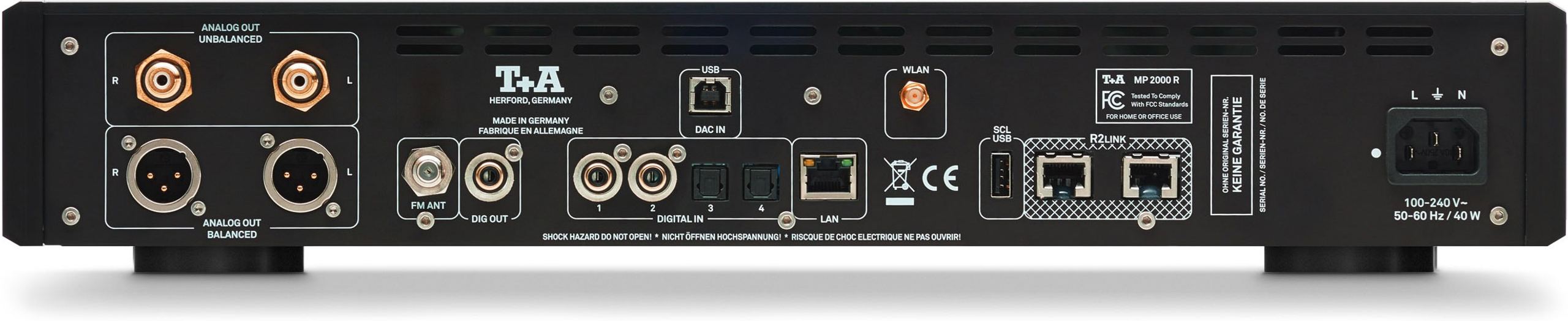
The signal is output through a pair of RCA connectors at 2.2 V or a pair of balanced XLR connectors at 4.4 V, with an output impedance of 50 Ω that supports long cable runs without loss. T+A specifies harmonic distortion below 0.001%, a signal-to-noise ratio of 110 dB and channel separation of 110 dB. A coaxial digital output also transmits PCM to a recorder or another converter.
The G3 network platform: Connect services, AirPlay 2 and native DSD
The third generation of T+A’s network platform, named Audiophile Streaming Architecture G3, brings dual-band Wi-Fi 6 with 2 × 2 MIMO to the player, along with a 10/100 Ethernet port. This data rate is more than sufficient: a stereo file at 384 kHz and 32 bits requires around 25 Mbit/s. The MusicNavigator G3 app directly integrates Tidal, Qobuz, Deezer, Amazon Music and HIGHRESAUDIO, as well as Internet radio and airable podcasts. Tidal Connect, Spotify Connect and Qobuz Connect work separately. The service’s app then acts as a remote control, but the music arrives directly from the servers to the player, leaving the phone free and placing no demand on its battery. AirPlay 2 takes over for Apple devices.
On the local network, the player reads libraries shared by a NAS or computer over UPnP and DLNA. It is also compatible with Audirvana software. PCM files are supported up to 384 kHz and 32 bits, and DSD up to DSD256. For the first time at T+A, DSD transmitted over the network is played natively, without intermediate conversion, then routed to the True 1-Bit converter. Two USB ports in host mode, one on the front and the other at the rear, accept a flash drive or hard drive and support the same formats as network playback: FLAC, WAV, AIFF, ALAC, MP3, AAC, OGG Vorbis, DFF and DSF.
From the MP 2000 R MK II to the G3: a new network board and motherboard
The G3 designation now identifies all T+A multi-source players equipped with this third-generation network platform. Compared with the MP 2000 R MK II, the G3 gains a new motherboard, Connect services, AirPlay 2 and native DSD playback over the network. Discs inserted into the tray are now identified by the Gracenote service, allowing the MusicNavigator G3 app to display their cover art and information. MK II owners can have the G3 platform installed in their unit at T+A’s workshops in Herford.
A CD mechanism with a floating sub-chassis
Development of the CD transport took six months. The mechanism uses a reinforced Mabuchi motor, mounted on a floating sub-chassis that decouples the optical assembly from enclosure vibrations. The tray is made of laminated aluminium and ABS, guided by two stainless steel rods. The assembly is housed in an aluminium chamber damped against resonance, which protects the laser from external interference. The player supports audio CDs, recorded CD-Rs and CD-RWs, as well as CD Text information. Its frequency response extends from 2 Hz to 20 kHz, with a dynamic range of 100 dB.
Radio, Bluetooth and inputs for other sources
The built-in tuner digitally processes the intermediate frequency, demodulation and stereo decoding. It receives FM with RDS services (station name, programme type, radio text) and DAB+ in band III, between 168 and 240 MHz. FM-HD reception is intended for the North American market. A Bluetooth aptX HD connection accepts music from a phone or tablet.
At the rear, two coaxial and two optical S/PDIF inputs support up to 192 kHz and 24 bits. A television, console or CD transport can be connected to them to benefit from the MP 2000 R G3’s conversion. The USB input in device mode turns the player into a converter for a computer. Thanks to its asynchronous transfer, the player’s clock controls the timing of the data. It supports PCM up to 384 kHz and 32 bits and is the only input that goes up to DSD512.
Control via the SRC 1 remote or the app
The SRC 1 system remote control is included. Connected via the R2-Link bus to a T+A R series amplifier, it also controls the amplifier’s functions, including volume and source selection, from a single handset. The MusicNavigator G3 app, on iOS and Android, brings together library browsing, integrated services and settings for both the player and the connected T+A amplifier. IP network control is available as an option for home automation installations. The player consumes a maximum of 40 W and 0.4 W in ECO standby. It switches itself off after 90 minutes without an audio signal.
Documentation
Technical specifications
Type and CD playback
- Type: multi-source player
- CD player
- Compatibility: CD / DA, CD-R, CD-RW, CD Text
- Frequency response: 2 Hz – 20 kHz
- Dynamic range: 100 dB
Supported audio formats
- Formats: MP3, AAC, OGG Vorbis, FLAC, WAV, AIFF, ALAC, DFF, DSF
- PCM: 32 to 384 kHz, 16 / 24 bits
- MP3: up to 320 kbit/s
- DSD: DSD64, DSD128, DSD256
Network playback and online services
- Compatible network servers: UPnP 1.1, UPnP AV, DLNA, Windows Media Connect
- Streaming services: TIDAL, Qobuz, Deezer, Amazon Music HD, HIGHRESAUDIO
- Connect services: TIDAL Connect, Spotify Connect, Qobuz Connect
- AirPlay: Apple AirPlay 2
- Internet radio and podcasts: airable Radio & Podcasts
- Audirvana compatibility: yes
- Wired network: Ethernet 10 / 100 Base-T
- Wi-Fi: IEEE 802.11a / b / g / n / ac / ax, MIMO 2 × 2
Digital and USB inputs
- USB host mode: 2 × USB 2.0
- S/PDIF inputs: 2 × coaxial, 2 × optical TOS-Link
- Sampling rates: 32 / 44.1 / 48 / 88.2 / 96 / 176.4 / 192 kHz
- Resolutions: 16 / 24 bits
- USB device mode: USB Audio Class 2, asynchronous transfer
- PCM: up to 384 kHz / 32 bits
- DSD: DSD64, DSD128, DSD256, DSD512
Radio reception and Bluetooth
- FM tuner: FM / FM-HD
- Frequency range: 87.5 – 108 MHz (Europe / United States)
- DAB tuner: DAB / DAB+
- Frequency range: 168 – 240 MHz
- Bluetooth: aptX HD, A2DP, AVRCP 1.4, MP3, SBC
Digital-to-analog conversion and filtering
- PCM converter: quadruple double-differential, 4 digital-to-analog converters per channel, 32-bit sigma-delta
- Conversion rate: 352.8 / 384 ksamples/s
- Oversampling: 4 selectable algorithms
- Short FIR, long FIR, Bézier / IIR, Bézier
- DSD converter: T+A True 1-Bit, direct DSD signal processing
- Analog filter: linear-phase filter, automatic bandwidth of 60 – 120 kHz depending on the sampling rate
Audio performance
- Frequency response
- PCM 44.1 kHz: 2 Hz – 20 kHz
- PCM 48 kHz: 2 Hz – 22 kHz
- DSD64: 2 Hz – 44 kHz
- PCM 96 kHz: 2 Hz – 40 kHz
- DSD128: 2 Hz – 60 kHz
- PCM 192 kHz: 2 Hz – 80 kHz
- DSD256: 2 Hz – 80 kHz
- PCM 384 kHz: 2 Hz – 100 kHz
- DSD512: 2 Hz – 100 kHz
- Total harmonic distortion: < 0.001%
- Signal / noise ratio: 110 dB
- Channel separation: 110 dB
Audio outputs
- RCA analog outputs: 2.2 V RMS / 50 Ω
- XLR analog outputs: 4.4 V RMS / 50 Ω
- Digital output: 1 × coaxial, IEC 60958 (LPCM)
Control
- Control interface: R2-Link
- Remote control: SRC 1
- Control app: MusicNavigator
Power supply and energy management
- Power supply: 100 – 240 V, 50 – 60 Hz
- Maximum power consumption: 40 W
- ECO standby power consumption: 0.4 W
- Automatic shutdown: yes, after 90 min without an audio signal
Dimensions and weight
- Dimensions (H × W × D): 8.2 × 46 × 40 cm
- Weight: 8 kg
Frequently Asked Questions
Does the MP 2000 R G3 play SACDs?
No, its transport plays audio CDs, CD-Rs and CD-RWs. SACD playback is reserved for the MP 2500 R G3, the multisource player in the same series housed in the taller chassis, which uses the same G3 network platform.
Can an MP 2000 R MK II receive the G3 upgrade?
Yes. The operation involves replacing the network card hardware and installing the device-specific control software at the T+A workshops in Herford. It is carried out by appointment with T+A or an authorised dealer. The MK II then gains Connect services, AirPlay 2 and native DSD playback over the network.
Do I need to install a driver to use it as a converter with a computer?
On Windows, T+A provides its own USB Audio driver, available to download from the player’s support page, along with installation instructions. macOS natively recognizes USB Audio Class 2 without additional software. The Windows driver is the recommended way to use DSD512 and the highest PCM sample rates.
Which oversampling filter should I choose to start with?
The long FIR provides the most linear response and the sharpest cutoff beyond the audible range. Bézier filters prioritize a very short impulse response, often associated with sharper attacks and a more spacious soundstage. It is best to listen to two or three familiar recordings with each setting, selected from the converter’s menu, before making your choice. The setting only applies to PCM: DSD passes through the True 1-Bit converter without oversampling.
What is the output phase setting in the menu used for?
It reverses the absolute polarity of the analog signal. Some recordings are cut with reversed polarity, and some amplifiers themselves invert the phase. This setting restores the correct polarity without touching the speaker cables. The difference is most noticeable on vocals and percussion, with more or less precise instrument placement.
Should you choose XLR or RCA outputs?
The XLR outputs deliver twice the level (4.4 V versus 2.2 V) and better reject interference picked up by the cable. They are preferable if the amplifier has balanced inputs and for long cable runs. On T+A R series amplifiers, the XLR input is the natural connection. The RCA outputs are suitable for any amplifier equipped with standard line inputs.
Does the player work with an amplifier from another brand?
Yes, the RCA and XLR analog outputs can be connected to any integrated amplifier or preamplifier. Only the shared control functions via R2-Link and amplifier volume control from the SRC 1 or the app require a compatible T+A amplifier.
- Eco-contribution included in the sale price.