

T+A CALA CDR
Specifications and features


Overview
Replacing a whole stack of separate components with a single device 37 cm wide, without giving up discs or radio: that is the aim of this receiver made in Herford, Germany. T+A has been building compact systems since the K1 in 1995, which already combined an amplifier, FM tuner and CD player. This second generation of the CALA range adds network streaming and Bluetooth, and is controlled entirely remotely: there are no buttons on the front panel.
An aluminium chassis without a single front-panel control
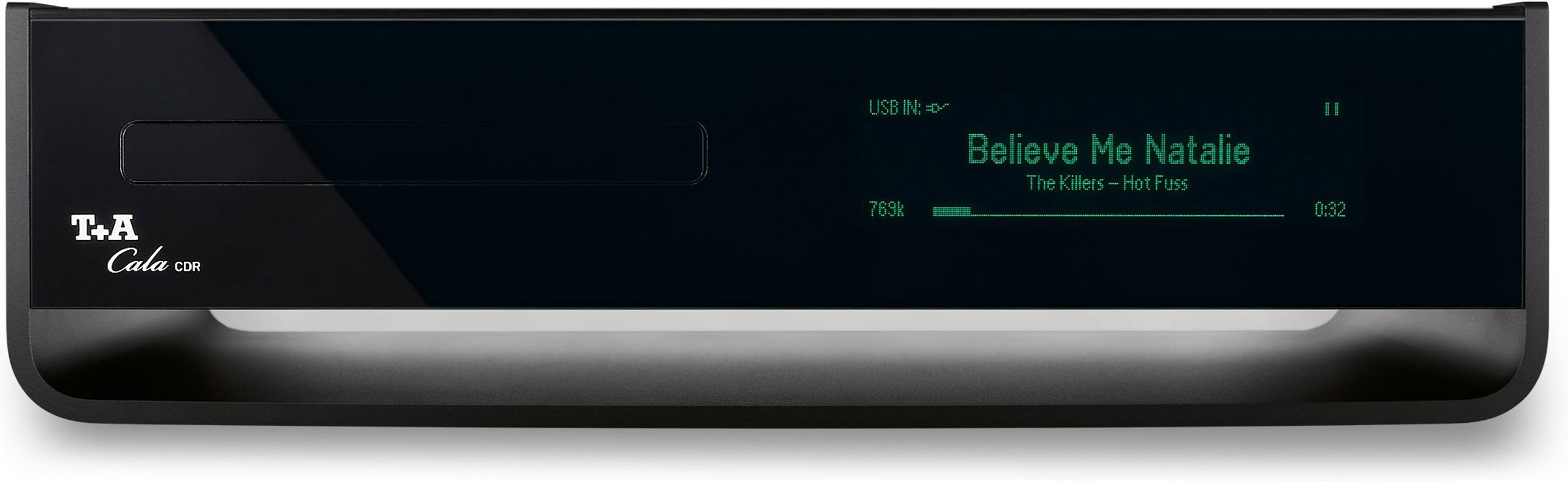
The main enclosure is machined from solid aluminium in a single operation, then bead-blasted and anodised. The cover, also aluminium, is brushed by hand before receiving a gloss anodised finish, and the internal chassis supporting the electronics is made from the same metal. The glossy black acrylic front panel houses only the large graphic display: no volume knob, no buttons; everything is handled through the FM1000 infrared remote control or the MusicNavigator G2 app for iOS and Android. The screen offers a large-character display readable from the sofa and a detailed display showing the sampling rate or bitrate of the current stream. Its brightness has seven settings, and it can be set to light up only while a control is being operated.
At 24.5 cm deep, 10.5 cm high and weighing 6 kg, the CALA CDR fits on an ordinary bookshelf, provided around ten centimetres of clearance is left all around for ventilation. The enclosure is available in silver or black aluminium, always with a black front panel. An LED strip built into the rear section of the panel illuminates the base from underneath in white, blue, green or red, or in a “fluid” mode that cycles through the colours at the chosen speed; the intensity has ten settings, and the lighting can be switched off completely for those who prefer a more understated look.
All music sources in a single enclosure
The CD player loads through a motorised drawer operated from the remote control. It plays pressed audio CDs and CD-Rs or CD-RWs recorded in audio format, displays CD-Text and can store a 30-track playback programme. The network section is based on a streaming client developed by T+A: it plays FLAC, WAV, AIFF and ALAC files up to 192 kHz and 32 bits from a computer or NAS (UPnP AV protocol), as well as the compressed MP3, AAC and OGG Vorbis formats, with gapless playback between FLAC, WAV and MP3 tracks. Tidal, Qobuz and Deezer are integrated (subscription required), and the CALA CDR is Roon Ready certified for those who manage their library with Roon.
Radio is available through three routes: more than 11,000 Internet stations and podcasts via the airable service, an FM tuner compatible with FM-HD and a DAB+ tuner, with RDS display of the station name and radio text. Each radio source has its own list of 99 favourites, accessible directly by number. Two USB ports on the rear accept flash drives and hard drives formatted in FAT16, FAT32, NTFS or ext2 to ext4, and a 2.5-inch drive works without a separate power supply. Bluetooth (SBC, AAC and MP3 codecs) is handy for quick listening from a phone, but remains a step below network or USB playback in terms of quality. AirPlay, Chromecast and Spotify Connect are not included. Network connection is via Ethernet or Wi-Fi, with an antenna mounted on a magnetic base that can be moved away from the device for better reception.
Digital processing from the inputs to the amplifiers
All audio processing is handled by a 48-bit digital signal processor (DSP). Digital sources, from CD to network, undergo no intermediate conversion, and the two analogue inputs are digitised on arrival to follow the same path. This choice has one consequence worth knowing: a turntable connected to the phono input also undergoes analogue-to-digital conversion, which will not suit anyone who insists on an entirely analogue signal path.
The DSP handles a more extensive set of tone controls than most. Bass and treble are adjustable over ±12 dB, midrange over ±6 dB, and loudness compensation offsets the ear’s reduced sensitivity to bass and treble at low volume. Two filters complete the setup: the “presence” contour makes voices more intelligible in speech broadcasts, and the “fundamental” contour warms or lightens the lower midrange, the region containing the fundamental notes of voices and most instruments. A virtual surround mode widens the soundstage without rear speakers, and all tone corrections can be disabled with a single setting to return to a neutral signal.
Matching the sound to the room and speakers
A speaker placed against a wall or in a corner produces more bass than one in the middle of the room. The configuration menu accounts for this with four positions (free-standing, near a wall, in a corner, on a shelf) that correct this reinforcement. A second setting describes the room acoustics: four levels for a room heavily damped by fabrics and rugs, six levels for a reverberant room with hard surfaces, and a “normal” position between the two.
Bass management caters for both large floorstanding speakers and small speakers. In the “full-range” setting, the main speakers receive the entire spectrum. With an active subwoofer connected to the dedicated output, a crossover frequency of 40, 60, 100 or 150 Hz can be selected: below this, bass is routed to the subwoofer, whose level can be adjusted over ±15 dB from the remote control. The smaller the speakers, the higher the crossover should be. For bookshelf speakers used without a subwoofer, the “Bass extd.” setting extends their response downwards.
2 × 100 W switching amplification
The amplification uses bridged switching output stages: the transistors operate by switching rapidly rather than continuously, limiting the heat generated inside such a compact enclosure. T+A specifies 100 W per channel into 4 Ω with harmonic distortion below 0.02%, enough to drive floorstanding speakers in a good-sized living room. The power supply is sized to maintain a stable voltage when current demand rises during demanding passages, and a protection circuit constantly monitors the device’s condition.
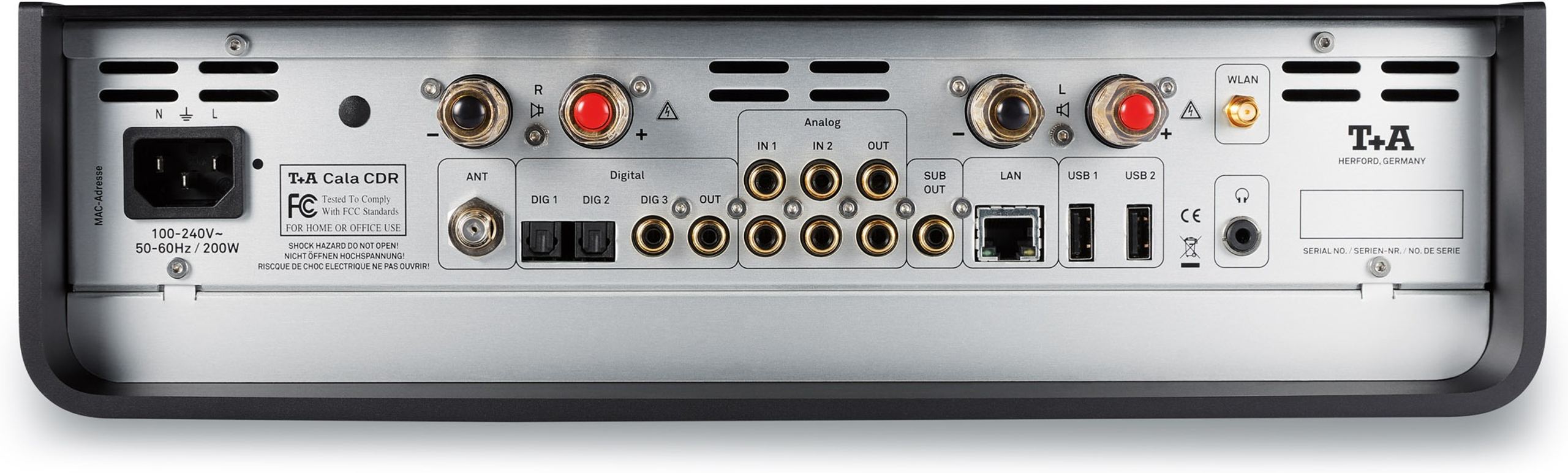
The speakers must have an impedance of at least 4 Ω. The output stages can briefly handle a 2 Ω load, but prolonged listening at very high volume into such a low load would heat the amplifier until protection is triggered. The metal binding posts accept thick cables (at least 1.5 mm² according to the manual) and are supplied with covers that, in Europe, require the use of clamped bare wires or spade connectors.
Turntable, TV, headphones: connections on the rear
The second analogue input becomes a phono input for a moving-magnet (MM) cartridge with a single setting, with three sensitivities (2.5, 5 or 10 mV) and a ground terminal for the turntable’s wire. The two line inputs can be adjusted to match the source’s output level (0.5, 1, 2 or 2.8 V), avoiding volume jumps when switching between sources. The S/PDIF digital inputs turn the CALA CDR into a converter for a TV, console or network player: up to 96 kHz via optical, up to 192 kHz via coaxial. There is no HDMI socket, so the TV connects via optical, set to a stereo PCM output.
On the output side, a variable-level RCA preamplifier output feeds active speakers or a power amplifier, a dedicated socket accommodates a subwoofer, and a digital output sends the signal from the selected source to a recorder. The headphone socket is a 3.5 mm mini-jack on the rear panel, wired in parallel with the preamplifier output: convenient for occasional listening, less so for anyone who plugs and unplugs their headphones every day. A specific setting removes room corrections from this output, as they are unnecessary for headphones.
Technical specifications
Device type
- CD receiver with CD player, audio streaming functions and built-in amplification
CD player
- Supported formats: CD, CD-R, CD-RW
- Frequency response: 2 Hz – 20 kHz
- Signal-to-noise ratio: 100 dB
- CD-Text support
Network audio streaming
- Supported audio formats: MP3, AAC, OGG Vorbis, FLAC, WAV, AIFF, ALAC
- PCM: 32 to 192 kHz / 16 to 32 bits
- MP3: up to 320 kbit/s
- Gapless audio playback:
- Supported formats: MP3 (LAME), WAV, FLAC
- Supported services: Tidal, Deezer, Qobuz
- Roon Ready certification
- UPnP AV protocol support
- T+A MusicNavigator app for iOS and Android
- Internet radio: airable service, over 11000 stations
Network and Bluetooth connectivity
- Ethernet: Fast Ethernet 10/100 Base-T
- Wi-Fi: 802.11 b / g / n with WPS
- Bluetooth:
- Protocols: A2DP, AVRCP
- Codecs: MP3, AAC, SBC
Radio receiver
- FM / FM-HD:
- Frequency range: 87.5 – 108 MHz
- FM sensitivity: 1 μV
- FM signal-to-noise ratio: > 65 dBA
- DAB / DAB+:
- Frequency range: 168 – 240 MHz, band III
- DAB sensitivity: 2.0 μV
- DAB signal-to-noise ratio: > 96 dBA
- RDS / RBDS:
- Station name display (PS)
- Program type (PTY)
- Radio text (RT)
- Clock
Amplification
- Power: 2 × 100 W into 4 Ω
- Total harmonic distortion: < 0.02 %
- High-speed switching bridge output stages
- High current capacity
- Power supply with high load stability
Audio processing
- Signal processing and management by digital signal processor (DSP)
- Configurable sound characteristics
- Virtual surround sound
- Bass management:
- Crossover frequencies: 40 Hz, 60 Hz, 100 Hz, 150 Hz
- Independent management of main speakers and subwoofer
Inputs and USB interfaces
- 2 × auxiliary analog inputs with adjustable sensitivity
- Configurable phono function
- Configurable surround passthrough mode
- 2 × coaxial S/PDIF digital inputs up to 192 kHz
- 1 × TOS-Link optical input up to 96 kHz
- 2 × USB 2.0 ports in host mode
Outputs
- Preamplifier output
- Subwoofer output
- Headphone output
- IEC 60958 digital output: CDDA / LPCM
Functions and lighting
- Automatic shutdown after 90 minutes without an audio signal
- Electronic device protection
- Light-emitting diode (LED) ambient lighting built into the base:
- Available colors: white, blue, green, red
- Adjustable brightness
Included accessories
- Wi-Fi antenna
- FM1000 infrared remote control
- Power cord
- User manual
Power supply and consumption
- Power supply: 100 – 240 V, 50 / 60 Hz
- Maximum power consumption: 200 W
- Idle power consumption: 13 W
- Power consumption in energy-saving standby mode: 0.5 W
Dimensions and weight
- Dimensions (H × W × D): 10.5 × 37 × 24.5 cm
- Weight: 6 kg
Frequently Asked Questions
What power output can you expect with 8-ohm speakers?
The 100 W per channel rating is specified at 4 Ω. For a voltage-limited amplifier, doubling the impedance roughly halves the power: with an 8 Ω speaker, the available power is therefore significantly lower. With average-efficiency speakers in a typical living room, there is still ample headroom; for low-sensitivity speakers in a large room, it is better to choose models rated at 4 to 6 Ω or with good efficiency.
Can you connect a computer via USB as you would with a desktop converter?
No. Both USB ports operate in host mode: they read USB drives and hard drives, but do not receive audio streams from a computer. To listen to music from a computer, there are three options: UPnP sharing over the network, Roon, or an optical or coaxial digital output connected to the S/PDIF inputs.
How do I listen to Spotify or music from an iPhone?
Neither Spotify Connect nor AirPlay is built in. Bluetooth takes over, using AAC from an iPhone, with the loss of quality inherent to this connection. For higher-quality listening from a phone, Tidal, Qobuz and Deezer stream directly over the network, and music stored on a computer or NAS can be played using UPnP or via Roon.
Is a radio antenna included?
Only the Wi-Fi antenna is supplied. The CALA CDR has a 75 Ω antenna input shared by FM and DAB+, for connection to an indoor antenna, a wall antenna socket or cable. A properly installed outdoor antenna provides the most stable reception, especially with DAB+, where a weak signal results in dropouts rather than hiss.
Will a moving coil (MC) cartridge work with the phono input?
A high-output MC cartridge, around 2 mV, works with the highest sensitivity setting (2.5 mV). A conventional low-output MC cartridge, producing a few tenths of a millivolt, requires an external MC preamplifier connected to a line input, or a step-up transformer connected to the phono input.
Can the CALA CDR be integrated into a home theater system?
Yes, via the “pass-through” mode on the first analog input: it disables the CALA CDR’s volume control for this input, allowing the front left and right channels of a home theater amplifier to pass through its power stages without any change in level. Volume is controlled on the home theater amplifier, while stereo music listening still uses the CALA CDR and its speakers. The source must be set to minimum before activating this mode, otherwise the speakers may be overloaded.
Can you turn it on from the app or program it like an alarm clock?
It all depends on the standby mode selected. ECO standby consumes 0.5 W and only wakes the device via the remote control or at a scheduled alarm time. “Comfort” standby consumes more power but allows the device to be switched on from the app and to turn on automatically when a signal arrives at an analog or digital input, which is handy with a TV. The alarm starts the selected source, a favorite station for example, at the set volume, and a sleep timer can be set from 15 minutes to 12 hours. If there is no signal for 90 minutes, the device switches itself off.
How are updates carried out?
Over the Internet, from the device’s information menu, in just a few minutes. Firmware updates provide fixes and new features: Roon Ready compatibility, for example, is activated after installing the latest version.
- Eco-contribution included in the sale price.