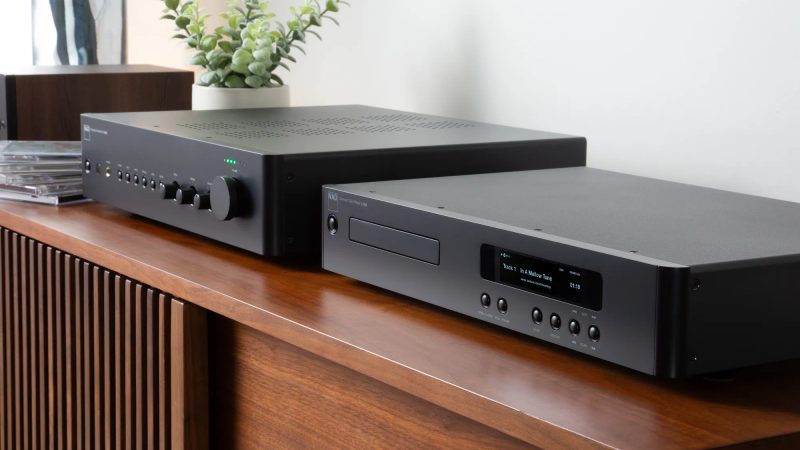
NAD C569
Overview
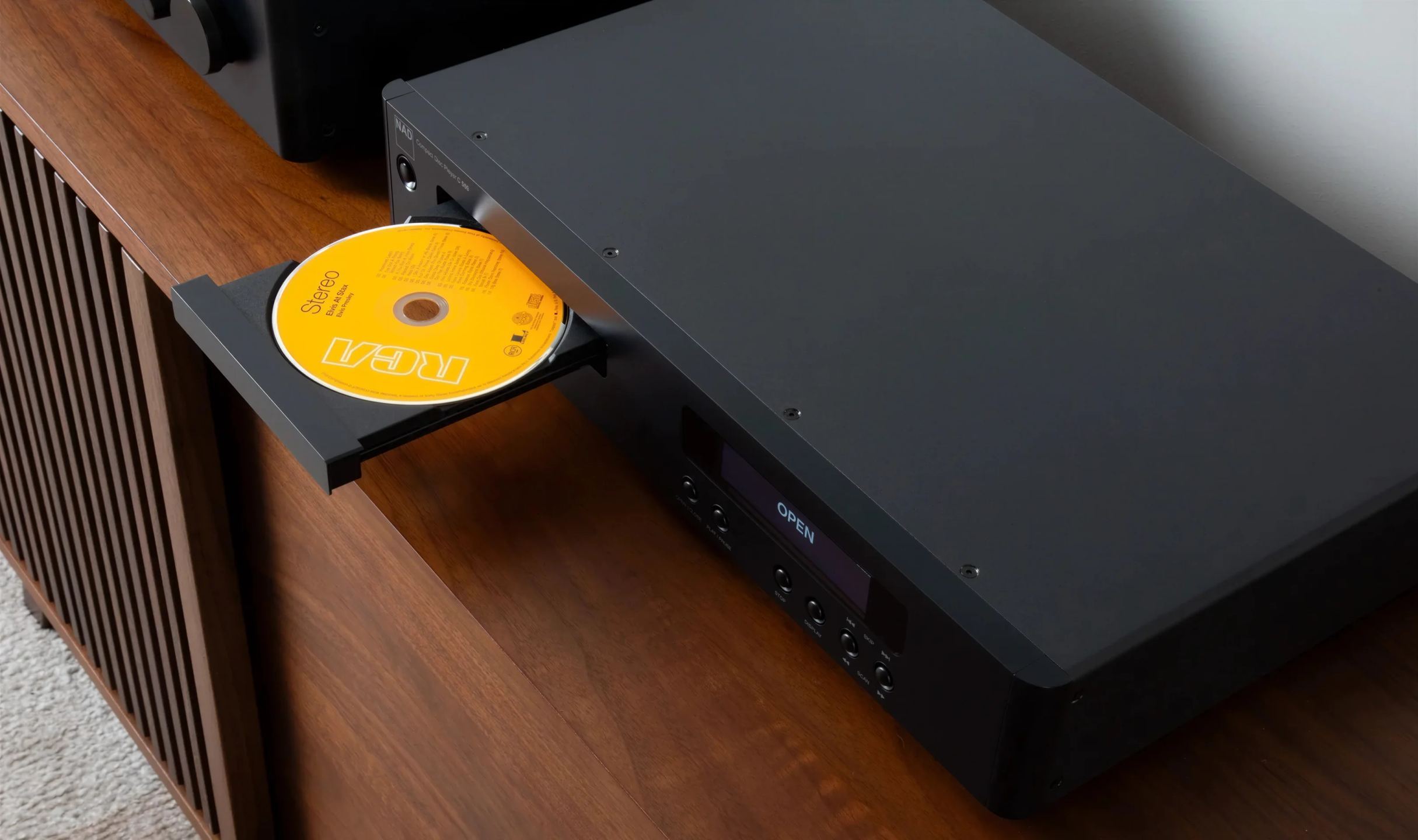
Sliding a disc into the tray, leafing through the booklet, listening to an album in the order intended by the artist: this is the way of listening that NAD keeps alive with a CD player positioned in the middle of its range, between the C 538 and the C 589. It adopts the two digital processing technologies introduced on the higher-end model, one for dynamics, the other for timing accuracy, and pairs them with a recent ESS Sabre converter.
A precisely controlled tray-loading mechanism
The disc loads via a motorized tray, using a proven mechanism that NAD pairs with an NXP-based servo system. This servo system is the electronics that continuously adjusts three parameters during playback: the disc’s rotation speed, the laser’s focus on the recorded surface, and tracking along the spiral track. The finer these adjustments, the more stable playback remains, even with discs showing some signs of age.
The internal layout physically separates the mechanism, power supply, and digital processing circuits. This arrangement keeps the analog stage, which is the most sensitive to interference, away from sources of electrical and mechanical noise, preserving the most subtle information recorded on the disc.
DDH, headroom for discs mastered too loud
Many CDs released since the late 1990s are mastered as close as possible to the maximum level allowed by the format. During conversion, the digital filter reconstructs the waveform between two samples, and the peaks calculated in this way can exceed that ceiling: this is known as inter-sample clipping. The result is audible as harshness on drum attacks, brass, or forceful vocals.
NAD’s Dynamic Digital Headroom (DDH) technology provides 3 dB of headroom in the digital domain before conversion. Peaks have room to form without clipping, and transients retain their definition. The benefit is apparent on compressed or aggressive recordings, which sound cleaner and less fatiguing; discs mastered with headroom do not trigger this phenomenon.
QRONO d2a and ESS ES9039Q2M converter
Digital-to-analog conversion relies on an ESS ES9039Q2M chip, a stereo version of the Sabre ES9039 family, whose PRO variant is used in the C 589. Before this stage, NAD applies QRONO d2a, a processing technology developed by MQA Labs, a company that, like NAD, belongs to the Lenbrook group. It works on signal reconstruction to preserve timing information, meaning the exact position of each note’s attack and decay, which determines the sense of definition and the placement of instruments in space. It works with standard CDs as well as MQA-encoded discs.
After conversion, the analog output stage uses selected audio components, revised operational amplifiers, dedicated power supply regulation, and short signal paths. The left and right channels are arranged symmetrically on the board so that both channels behave in the same way. The measurements published by NAD reflect this attention to detail: total harmonic distortion of no more than 0.006%, a signal-to-noise ratio and channel separation of at least 110 dB. In plain terms, hiss remains inaudible and each channel retains its own content without bleeding into the other, a prerequisite for a well-defined stereo image.
A color display and easy-to-use controls
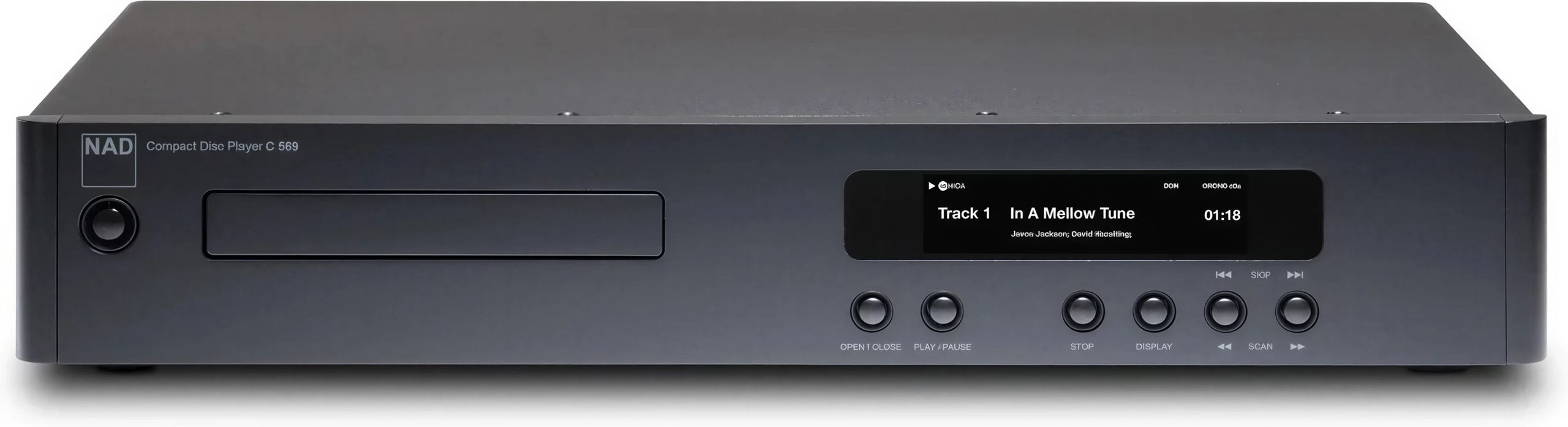
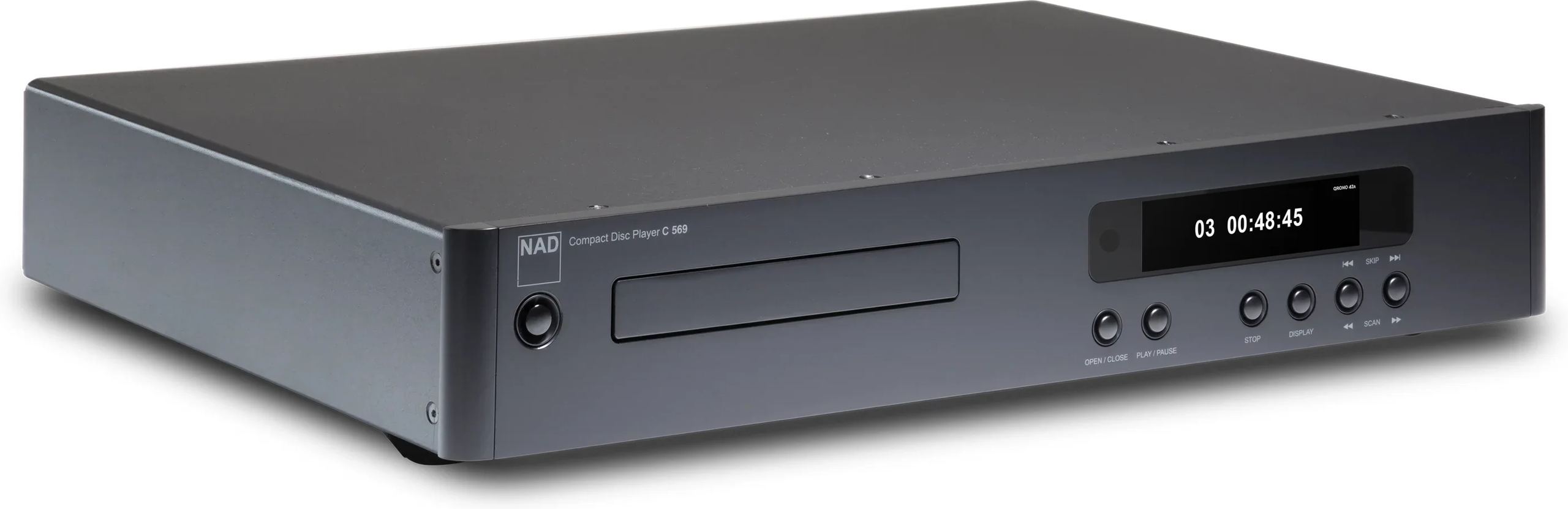
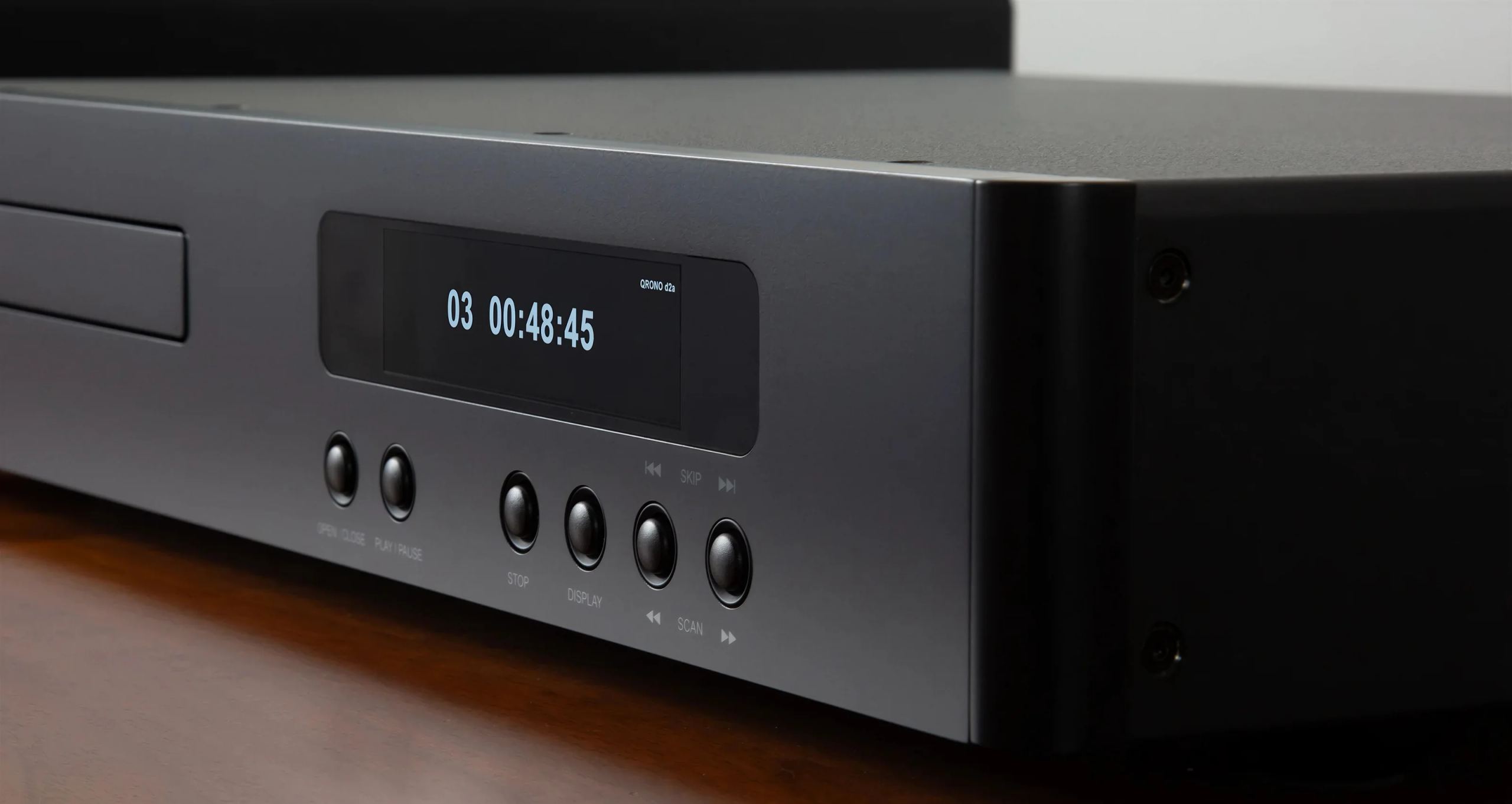
The front panel brings together playback buttons and a 3.7-inch color display (approximately 9.4 cm). When the disc contains CD-Text information, the display shows the album title, artist, and track names, alongside the track number and elapsed time. Playback moves between tracks without pauses (gapless), essential for live albums, operas, or discs with tracks that flow into one another. A remote control is included to control playback from the sofa.
A complete source or a transport for an external converter
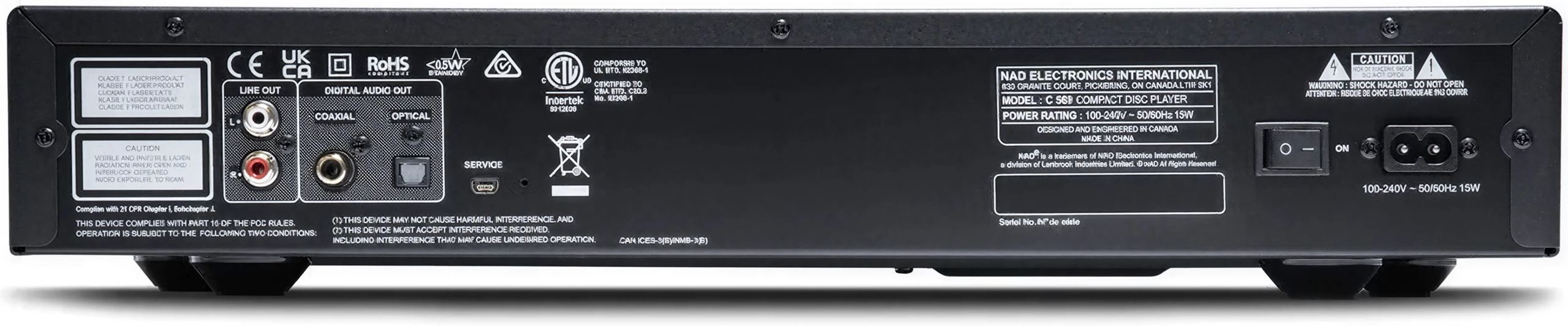
The C 569 connects to any amplifier via its RCA analog output, whose 2.2 V level matches the standard for hi-fi sources. It then operates as a complete source, with its own converter. Its coaxial and optical digital outputs also allow it to serve simply as a disc reader (known as a transport): it reads the disc and sends the digital stream to an external converter or an amplifier equipped with digital inputs. This choice leaves room to upgrade the system without changing the player.
Compared with the C 589, the C 569 omits the balanced XLR output and AES/EBU digital output, two connections mainly useful in systems equipped with balanced inputs. Measuring 435 mm wide, 83 mm high, and 294 mm deep, it adopts the dimensions of the Classic Series and stacks with the other components in the range, including the C 359S integrated amplifier introduced at the same time. Its power consumption remains modest: no more than 20 W when operating at idle and less than 0.5 W in standby.
Documentation
French
Technical specifications
Playback and digital processing
- Type: CD player
- Digital-to-analog converter: ESS ES9039Q2M Sabre
- Digital processing: Dynamic Digital Headroom (DDH), QRONO d2a by MQA Labs
Audio performance
- Frequency response: 20 Hz – 20 kHz (± 0.5 dB)
- Total harmonic distortion: ≤ 0.006% (1 kHz, 20 kHz low-pass filter)
- Signal-to-noise ratio: ≥ 110 dB (A-weighted)
- Channel separation: ≥ 110 dB
- Channel balance: 0.5 dB (0 dB, 1 kHz)
Audio outputs
- Analog output level: 2.2 ± 0.2 V
- Coaxial digital output:
- Level: 0.5 – 0.8 V peak-to-peak
- Impedance: 75 Ω
Display
- Display with CD-Text support
Included accessories
- Remote control included
Power consumption
- Standby power consumption: < 0.5 W
- Idle power consumption: ≤ 20 W
Dimensions
- Dimensions (width × height × depth): 435 × 83 × 294 mm
Frequently asked questions
Does the C 569 play MQA-CDs?
Yes. The C 569 supports MQA-CDs, standard-format CDs that contain MQA encoding. They remain playable on any CD player, but the C 569’s QRONO d2a processing takes their encoding into account during conversion.
Are CDs burned with pre-emphasis played back correctly?
Yes. Some discs from the early days of CD, in the mid-1980s, were mastered with pre-emphasis: the treble was deliberately boosted during recording, and the player must apply the inverse correction during playback. The C 569 detects these discs and applies this de-emphasis, preventing overly bright treble.
Which digital output should I choose, coaxial or optical?
Both carry the same stereo signal from the disc. The coaxial connection uses an electrical cable with an impedance of 75 Ω and RCA connectors. The optical connection transmits the signal via light, which electrically isolates the two devices and prevents ground loops, a source of hum. The choice mainly depends on the inputs available on the converter or amplifier.
Can the C 569 play music files or connect to the network?
No. The C 569 is a compact disc player: it has neither network functionality nor USB flash drive playback. The port marked “SERVICE” on the back is for maintenance. For streaming, the C 359S amplifier from the same range features the BluOS platform, and the C 569 connects to it via an analog or digital connection.
How do I connect the C 569 to an amplifier with a built-in converter?
There are two options. Via the RCA output, the C 569’s ESS converter does the work, with DDH and QRONO d2a processing. Via the coaxial or optical output, the amplifier’s converter takes over. The simplest approach is to connect both outputs to two different inputs on the amplifier and compare by listening.
How much space is needed to install it?
The C 569 measures 435 mm wide, the standard width for hi-fi components, by 83 mm high and 294 mm deep. Allow a few extra centimetres at the rear for cables and enough space at the front for the tray to open freely. Its low profile allows it to fit on a shelf in a standard hi-fi cabinet or to be stacked on top of a Classic Series amplifier.
Does the C 569 consume power in standby mode?
Very little: less than 0.5 W, in line with European requirements for standby power consumption. During playback, its power consumption remains below 20 W, so you can leave it on standby between listening sessions without noticeably affecting your electricity bill.
- Eco-contribution included in the sale price.
- Manufacturer reference: NAD-C569
- GTIN / EAN: 786357003481