

NAD C359S
Specifications and features


Overview
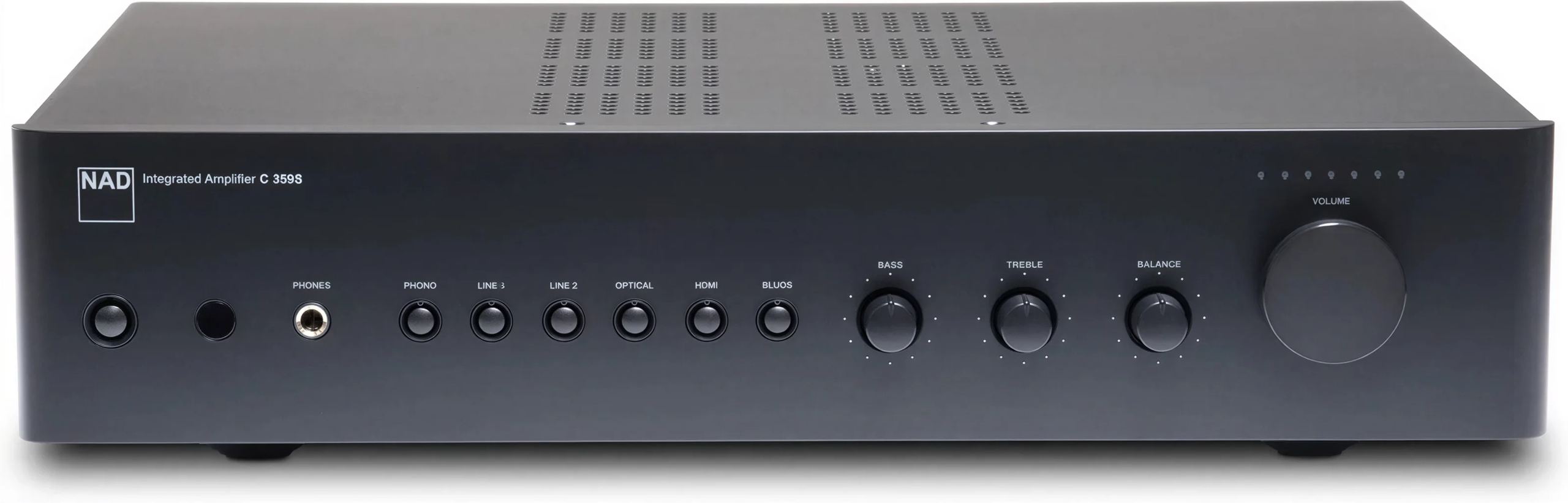
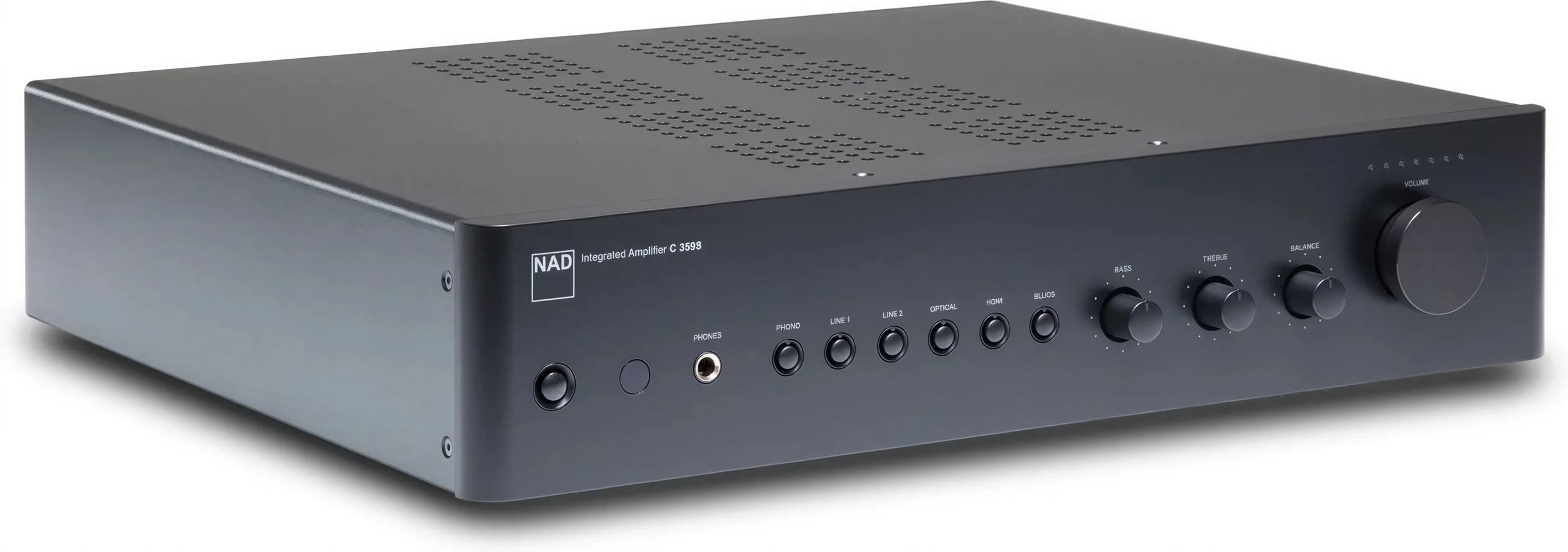
Select a source, turn up the volume, listen: the front panel is still that of a NAD Classic series amplifier, with its buttons and rotary controls. Behind it, the unit streams Qobuz, TIDAL or Spotify, receives TV audio via HDMI, accommodates a turntable and drives a subwoofer. Amplification remains class AB, a proven technology that NAD pairs here with a newly designed power supply.
A front panel with buttons, no menus to navigate
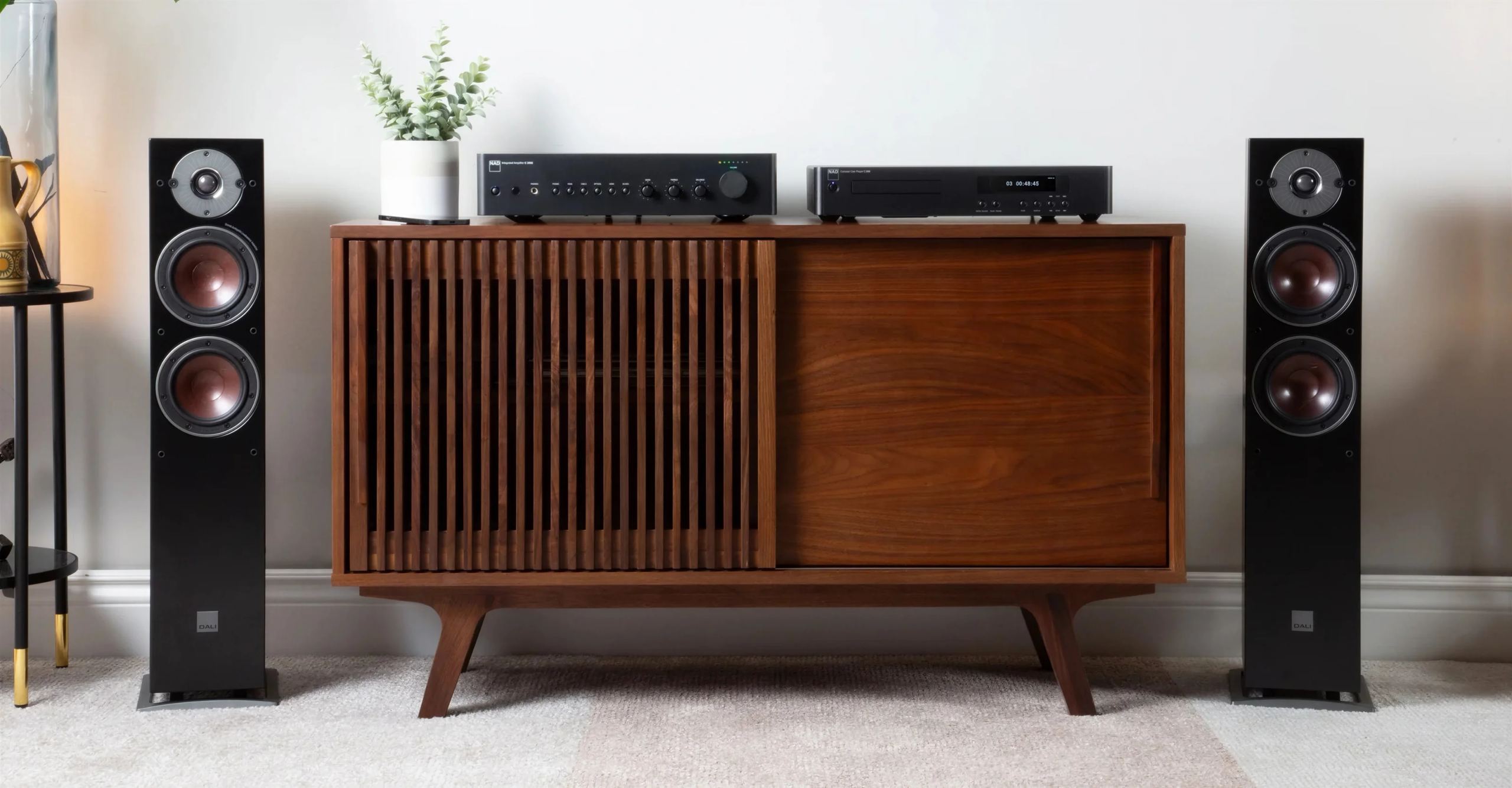
The C 359S has neither a large screen nor a menu-based interface. Everyday functions are adjusted from the front panel, with source buttons and volume knobs, while the supplied infrared remote duplicates these controls and adds preset buttons to recall a favourite radio station or playlist. Finer adjustments and browsing music services are handled through the BluOS Controller app, available on iOS, Android, Windows and macOS. The chassis measures 435 mm wide, the standard width for hi-fi components, by 100 mm high and 400 mm deep, and weighs 8.9 kg.

Class AB backed by a switching power supply
In class AB, the output transistors remain slightly conductive at all times. This avoids the distortion that occurs when one half of the signal hands over to the other, while producing much less heat than pure class A. NAD powers it with a high-current, low-noise switching supply, drawing on its class D experience: it delivers stable power and responds quickly to musical peaks, without the weight of a large conventional transformer.
Continuous power reaches 2 × 70 W into 8 Ω and 2 × 120 W into 4 Ω, measured across the full 20 Hz to 80 kHz bandwidth with both channels driven, a more demanding method than measuring at a single frequency. On peaks, the amplifier reaches 210 W into 2 Ω and delivers more than 20 A of current, making it comfortable with speakers whose impedance drops sharply in the bass. The damping factor of over 210 reflects its ability to control driver movement once a note has been played, for tight rather than lingering bass. With bookshelf or floorstanding speakers of typical sensitivity, there is a comfortable reserve; large, low-sensitivity floorstanders in a spacious room will require a more powerful amplifier for high listening levels.
BluOS for online music and multiroom playback
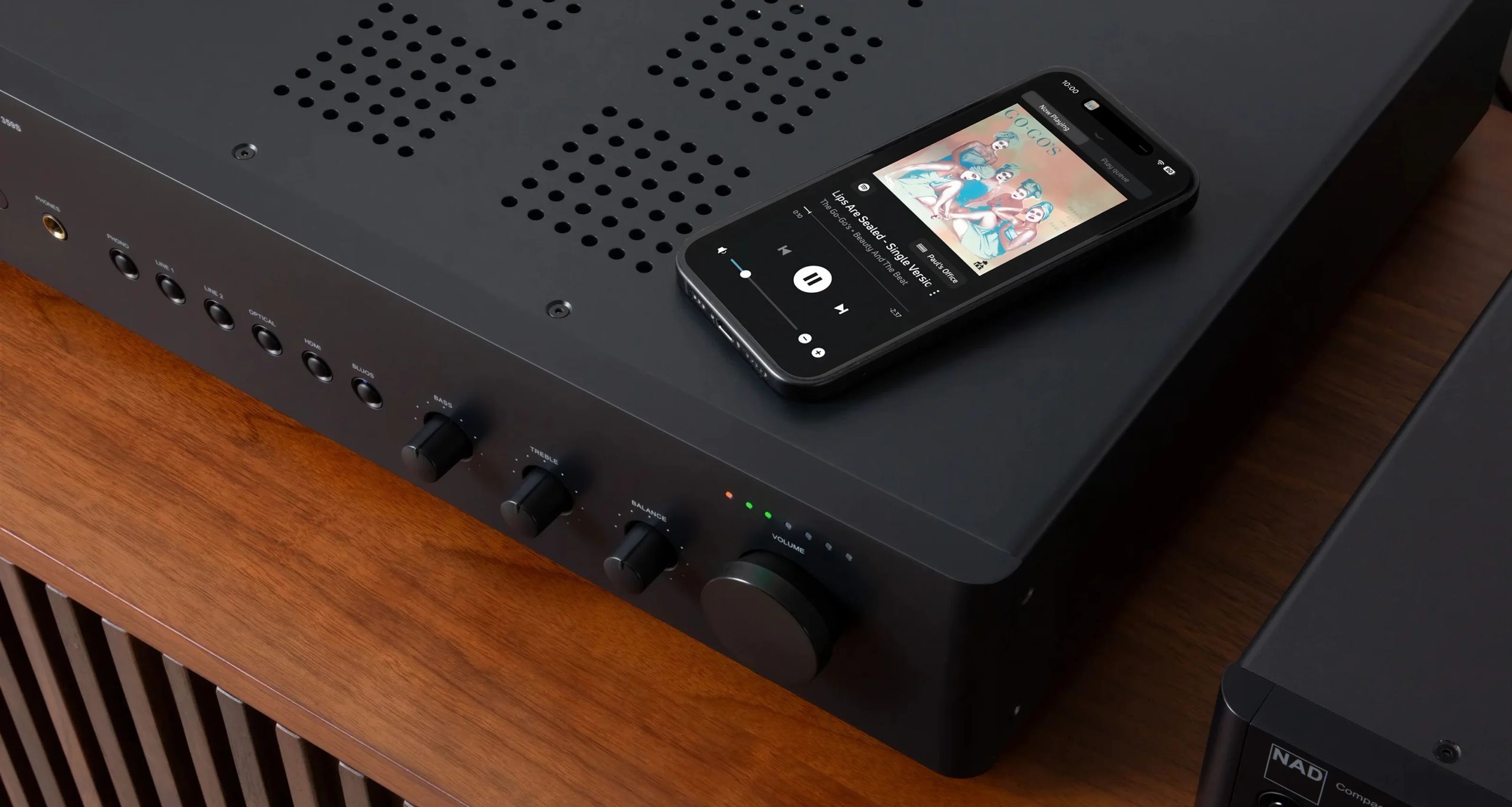
The BluOS network player is built in, with no module to add. It provides access to Qobuz, TIDAL, Spotify, Deezer, Amazon Music and numerous Internet radio stations, plays files at resolutions up to 24-bit/192 kHz (FLAC, WAV, AIFF, ALAC, MQA, among others) and retrieves music stored on a computer or server on the local network. It connects via Wi-Fi 5 or a Gigabit Ethernet cable.
BluOS is also a multiroom system: the C 359S groups with other BluOS players in the home to play the same music in several rooms, or different programmes in each. The unit connects to Roon and to Control4, Crestron, ELAN, Lutron, RTI and URC home automation systems. Bluetooth 5.0 with the aptX HD codec receives audio from a phone or tablet without using the network.
TV, turntable and conventional sources
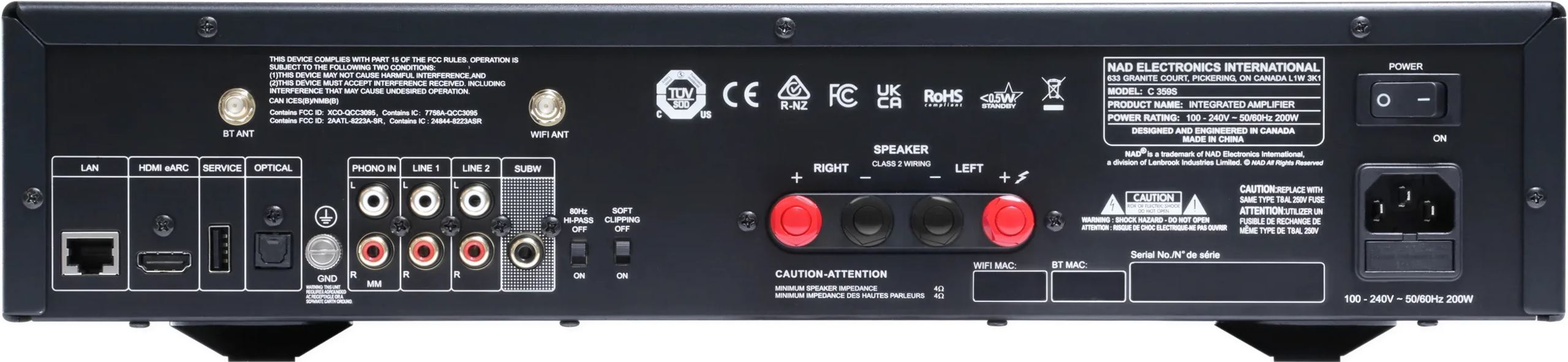
The HDMI eARC port connects directly to a compatible TV: audio from programmes, video streaming apps and devices connected to the TV plays through the amplifier and hi-fi speakers in stereo. An optical input accommodates a CD player, console or older TV, with signals from 44.1 to 192 kHz.
The built-in phono input accepts moving magnet (MM) cartridges, the most common type, with a load of 46 kΩ and 100 pF that matches most cartridge manufacturers’ recommendations. A turntable without a built-in preamplifier therefore connects directly, with no separate box needed. Analogue line-level inputs round out the connections for a network player, an external DAC or a turntable equipped with its own preamp.
The headphone output has its own circuit, with an output impedance of 5 Ω and a signal-to-noise ratio greater than 110 dB: the background remains quiet with sensitive headphones, and the low output impedance preserves the tonal balance of models whose impedance varies with frequency.
A subwoofer that takes the load off the speakers
The subwoofer output does more than just add bass. With the high-pass filter enabled, the amplifier removes the lowest frequencies from the main speakers and sends them to the subwoofer. Freed from this task, the speakers operate in the range where they are most comfortable, with less cone movement: playback gains clarity, the stereo image becomes more precise and the amplifier retains more power in reserve. This 2.1 configuration benefits small bookshelf speakers with limited bass extension, as well as systems used for both music and television.
Technical specifications
Amplification and power supply
- Amplification technology: Class AB
- Continuous output power:
- Into 8 Ω: 2 × 70 W
- Into 4 Ω: 2 × 120 W
- IHF dynamic power:
- Into 8 Ω: 76 W
- Into 4 Ω: 144 W
- Into 2 Ω: 210 W
- Peak output current: greater than 20 A
- Damping factor: greater than 210 (20 Hz – 1 kHz, 8 Ω)
- Total harmonic distortion: less than 0.03%
- Signal-to-noise ratio: greater than 90 dB
- Low-noise, high-current switching power supply
- Standby power consumption: 0.5 W
Connectivity
- Analog line-level inputs
- Optical digital input
- HDMI eARC
- Gigabit Ethernet RJ45 port
- Wi-Fi 5
- Subwoofer output with optional high-pass filtering
Line input audio performance
- Frequency response (line input / speaker output): 20 Hz – 20 kHz (± 0.3 dB)
- Channel separation: greater than 75 dB at 1 kHz
- Line input sensitivity: 510 mV for 70 W into 8 Ω
Phono input
- Type: moving magnet (MM)
- Sensitivity: 3.95 mV
- Input impedance: 46 kΩ / 100 pF
- Frequency response: 20 Hz – 20 kHz (± 0.3 dB)
- Total harmonic distortion: less than 0.05%
Dedicated headphone output
- Total harmonic distortion: less than 0.005% at 1 V
- Signal-to-noise ratio: greater than 110 dB
- Frequency response: 20 Hz – 20 kHz (± 0.3 dB)
- Output impedance: 5 Ω
Network playback and audio streaming
- Integrated BluOS network player
- High-resolution audio streaming up to 24-bit / 192 kHz
- Supported audio formats: FLAC, MQA, WAV, AIFF, MP3, AAC, WMA, OGG, ALAC, OPUS
- Supported audio streaming services: Spotify, Qobuz, TIDAL, Deezer, Amazon Music, other BluOS-compatible services
- Internet radio
- Bluetooth 5.0 reception with aptX HD codec
- Multiroom audio streaming via the BluOS ecosystem
- BluOS Controller app for iOS, Android, Windows, macOS
- Compatibility with selected home automation and control systems, including Control4, Crestron, ELAN, Roon
Features and controls
- Physical controls and knobs on the front panel
- Presets for radio stations and favorite content
Included accessories
- Infrared remote control
Dimensions and weight
- Dimensions (width × height × depth): 435 × 100 × 400 mm
- Net weight: 8.9 kg
- Packaged weight: 10.7 kg
Frequently asked questions
Can a moving coil (MC) cartridge be connected to the phono input?
No, the phono input is designed for moving magnet (MM) cartridges. An MC cartridge, which has a much lower output voltage, requires an MC phono preamplifier or an external step-up transformer, which is then connected to a line input or the phono input depending on the type of device.
Can the C 359S send audio to Bluetooth headphones or a speaker?
No, Bluetooth only works as a receiver: it is used to play music from a phone, tablet or computer. For private listening, the wired headphone output takes over.
Is it better to connect it to the network via Wi-Fi or Ethernet?
Both work. A Gigabit Ethernet cable provides a more stable connection, useful for multiroom setups or high-resolution files if the Wi-Fi signal is weak where the hi-fi system is located. Wi-Fi 5 is sufficient in most homes with adequate coverage.
How do I play music stored on a computer or network drive?
BluOS indexes shared folders on the local network from a computer running Windows 10 or later, macOS, or from a network-attached storage (NAS) server. The library then appears in the BluOS Controller app, alongside online music services.
Are 4 Ω speakers a problem?
No. The amplifier delivers 2 × 120 W continuously into 4 Ω and remains stable down to 2 Ω under dynamic conditions, with over 20 A of peak current available. Speakers whose impedance dips low in the bass are handled without difficulty.
Can it be controlled by voice?
Yes, BluOS supports Amazon Alexa and Siri, provided you have a compatible device and the corresponding app. Voice commands let you start playback, change tracks, or adjust the volume.
- Eco-contribution included in the sale price.








