How to set a subwoofer’s crossover frequency?
December 26, 2025
Contents
A poorly adjusted subwoofer means bass that’s too dominant and overwhelms the room, or on the contrary a gap in the spectrum that leaves the low frequencies floating without foundation. Between these two extremes, the crossover frequency – the point where the subwoofer takes over from the main speakers – determines the overall coherence. Here’s how to set it correctly.
→ Find the ideal subwoofer for your living room
Understanding subwoofer setup
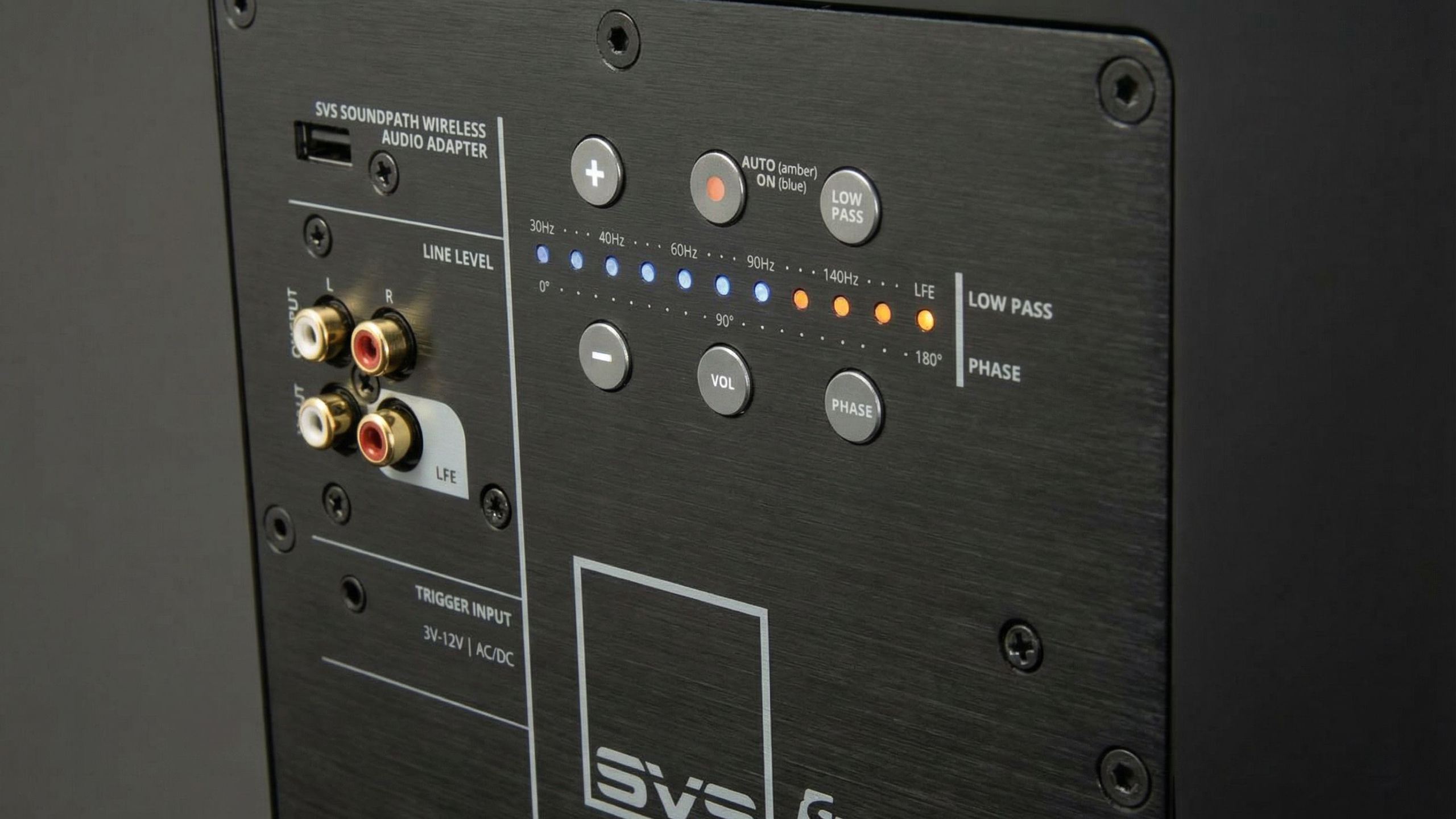
The knob labeled “Crossover” or “Low Pass” on the back of an active subwoofer is not just a simple hard cutoff. It defines the frequency from which the subwoofer’s sound level begins to decrease toward the higher frequencies. Beyond this point, attenuation increases gradually according to a slope expressed in decibels per octave (12 dB/oct or 24 dB/oct depending on the model).
In practice, if the filter is set to 80 Hz with a 12 dB/octave slope, the subwoofer will still reproduce frequencies at 160 Hz, but attenuated by 12 dB. This overlap area between the subwoofer and the main speakers is normal and even desirable to avoid a “hole” in the frequency response.
The 80 Hz guideline and its limits
The value of 80 Hz appears systematically in recommendations, especially because it corresponds to the THX standard for home cinema. This choice is not arbitrary: below roughly 80 Hz, the human ear struggles to localize the sound source. The subwoofer can therefore be placed freely in the room without the sound seeming to come from a specific point.
But 80 Hz is only a starting point. Compact satellite speakers mounted on the wall or placed on a shelf often struggle to extend cleanly below 120–150 Hz, so the crossover will need to be raised. Conversely, floorstanding speakers equipped with 20 cm drivers can properly reproduce down to 40–50 Hz, allowing the crossover frequency to be lowered so the subwoofer handles only the very lowest bass.
The “10 Hz above the limit” rule
A simple method is to consult the frequency response specified by the manufacturer of the main speakers. If they have a low-frequency extension of 55 Hz (±3 dB), set the crossover around 65 Hz. This 10 Hz margin compensates for the natural roll-off of the speaker at the bottom of its range and ensures a smooth transition without dips or peaks.
This calculation remains theoretical. Manufacturer specs, measured in an anechoic chamber, do not reflect real-world behavior in a furnished room. The room itself amplifies or attenuates certain frequencies depending on its dimensions and acoustic treatment. Listening remains the final judge.
Amplifier or subwoofer: where to set the crossover?
Confusion is common. In a home cinema system driven by an A/V receiver, the receiver’s “bass management” already handles frequency distribution. It sends bass below the crossover frequency to the subwoofer and relieves the speakers set to “Small” of that part of the spectrum.
In this case, the subwoofer’s built‑in filter becomes redundant. The LFE (Low Frequency Effects) signal arriving at the subwoofer is already filtered. Engaging a second low‑pass filter on the subwoofer amounts to filtering the same signal twice, which can create dips in the response and degrade dynamics. The usual recommendation: turn the subwoofer’s crossover knob to maximum (“bypass” or “LFE” position) and let the receiver manage the crossover.
For simple stereo listening without bass management in the amplifier for example a hi‑fi preamp connected directly to the subwoofer it’s the subwoofer’s filter that comes into play. The frequency is then set by ear, in coordination with the main speakers.
Phase adjustment
Next to the crossover knob, a phase switch or knob (0° / 180° or continuous adjustment) allows temporal alignment of the subwoofer with the speakers. Incorrect phase causes cancellations: the sound from the subwoofer and the speakers work against each other instead of adding together, resulting in thin or blurry bass.
To find the right setting, play a track with a steady bass line. Switch between 0° and 180° (or sweep the knob) and keep the position where the bass sounds fullest and best integrated with the rest of the spectrum. The test becomes more accurate if you stand halfway between the subwoofer and the front speakers rather than at the usual listening position, where room reflections cloud your judgment.
Gentle or steep slope: 12 dB or 24 dB per octave
Subwoofers sometimes offer a choice of filter slope. A 12 dB/octave slope provides a gradual transition and is more forgiving of placement or tuning differences between speakers and subwoofer. However, it can let through unwanted midrange frequencies if the sub is far from the speakers, making the bass easier to localize.
A 24 dB/octave slope (known as Linkwitz‑Riley in its classic form) cuts more sharply and minimizes overlap. It requires more precise phase alignment, otherwise it may introduce strong cancellations at the crossover point. For most home setups, 24 dB/octave is a good compromise between control and integration.
Step‑by‑step tuning by ear
In the absence of a measurement microphone and analysis software, an empirical method yields good results:
Start by turning up the subwoofer volume so it is clearly audible, without worrying about balance. Turn the crossover knob down toward low frequencies (40–50 Hz). Play a recording with tight percussion taiko drums, acoustic kick drum and gradually raise the crossover frequency until you hear muddiness or a resonant effect. Then back it off slightly.
Next, adjust the phase to maximize bass impact and definition. Finally, reduce the subwoofer volume until it disappears from conscious perception: you should not be able to point to it, but switching it off should immediately reveal a lack of body and depth in the lower spectrum.
Automatic calibration: a starting point, not the end
Recent A/V receivers include microphone‑based calibration systems (Audyssey, Dirac, YPAO, MCACC…) that measure the response of each speaker and the subwoofer, then adjust distances, levels, and sometimes crossover frequencies. These tools provide a coherent foundation, but their choices are not always optimal.
Sometimes the system suggests a crossover that is too high for speakers capable of going deeper, or underestimates the subwoofer’s capability. After calibration, you are free to manually adjust the crossover frequency in the receiver’s menus, staying within a reasonable range around the measured value.
Reference points by speaker type
The values below are starting points; room acoustics and personal taste dictate the final adjustment.
| Speaker type | Suggested crossover range |
|---|---|
| Compact on‑wall satellites | 120–150 Hz |
| Small bookshelf speakers | 100–120 Hz |
| Medium bookshelf speakers | 80–100 Hz |
| Large bookshelf / center speakers | 60–80 Hz |
| Floorstanders with 10–15 cm drivers | 60 Hz |
| Floorstanders with 20 cm drivers or larger | 40–60 Hz |
For large floorstanding speakers capable of going below 35 Hz, the question is different: the subwoofer then serves less to extend response than to relieve the amplifiers and smooth room modes. A low crossover (40–50 Hz) preserves the tonal coherence of the speakers while entrusting the very lowest bass to the subwoofer.
Listen rather than just measure
Numbers and graphs are no substitute for attentive listening. A “perfect” setting on paper can sound hollow if the room absorbs certain frequencies or if the subwoofer excites a resonance. Conversely, an empirical adjustment guided by ear and fine‑tuned over several well‑produced tracks of different styles often leads to a more musical result.
The ultimate test is this: at moderate volume, on a well‑mastered recording, the bass should seem to emanate naturally from the main speakers, without the subwoofer betraying its presence. If you can guess where it is just by listening, the crossover is probably set too high or the volume too loud.
Popular products
You may also like to read
 Klipsch RP-1200CSW, RP-1400CSW and RP-1600CSW: sealed design to reduce floor spaceHi-fi and home cinema news
 Dali Basik Sub: a compact subwoofer to enhance the bass of bookshelf speakersHi-fi and home cinema news
 REL Planar PL-1 and PL-2: ultra-flat subwoofers for home theaterHi-fi and home cinema news
 How to Set Up Your Subwoofer: A Practical GuideTutorials and practical guides
 Q Acoustics 2025: Technological Innovations and Expanded Product RangeHi-fi and home cinema news
 Where to Place Your Subwoofer for Optimal Sound?Tutorials and practical guides