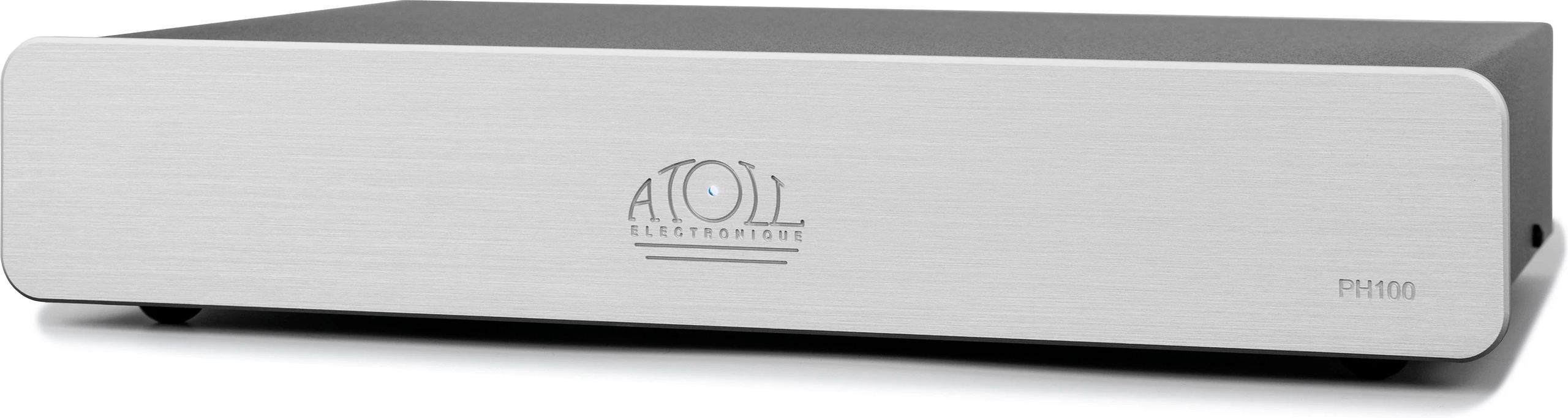
The PH100 from Atoll Electronique is a compact external phono preamplifier. It succeeds the P200-SE model and uses a dual-mono power supply with two separate transformers. Its design is fully discrete, with no coupling capacitors. It is compatible with moving magnet (MM) and moving coil (MC) cartridges.
Construction and architecture
The PH100 is immediately surprising because of its generous dimensions for a phono preamp: 320 x 210 x 63 mm for 2 kg. This unusual size is not a matter of style, but directly results from radical technical choices. The steel chassis, manufactured in Brittany, houses two 3.2 VA linear transformers, one for each channel, creating a genuine dual-mono architecture right from the power supply.
The 4 mm brushed aluminum front panel, machined in Lorraine, goes well beyond the usual standards in this price range. A single green LED, positioned at the center of the Atoll logo, indicates when the unit is powered on. This visual sobriety contrasts with the internal complexity: four separate voltage regulators, a total filtering capacity of 11,280 μF, and a shielded metal compartment separating the power supply from the audio circuits.
The RIAA circuit uses only discrete components — eight class A biased transistors — with no integrated circuits or operational amplifiers. This purist approach, typical of Atoll, eliminates all capacitors from the signal path, thereby preserving the integrity of the musical message.
Technical versatility and RIAA accuracy
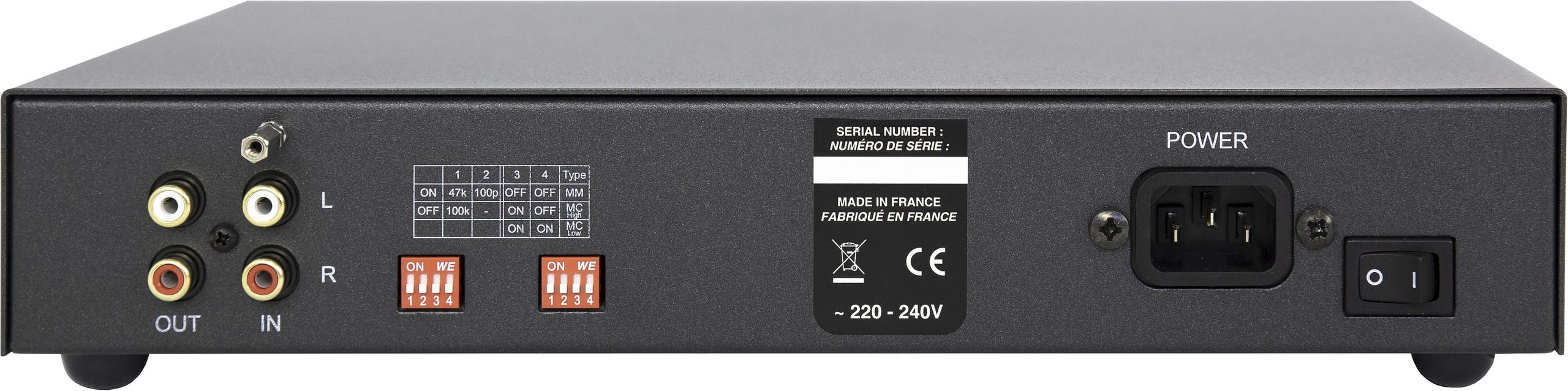
The adaptability of the PH100 is one of its major strengths. Two DIP switch blocks on the rear allow independent settings for each channel. Input impedance can be switched between 47 kΩ and 100 kΩ, while input capacitance offers a choice between 100 pF or no additional capacitance.
The available gain settings cover all typical needs: 40 dB for MM cartridges, 47 dB for high-output MC, and 60 dB for low-output MC. This wide range ensures compatibility with virtually all cartridges on the market, from Rega Elys to the most demanding Ortofon MC models.
The RIAA curve boasts remarkable accuracy of ±0.1 dB over the 20 Hz–20 kHz range. The signal-to-noise ratio of 80 dB at 1 kHz and crosstalk below -85 dB attest to a meticulous design where every detail matters. Total harmonic distortion is kept down to 0.05%, an excellent figure for this category.
Evolution from the P200-SE: tangible progress
The transition from the P200-SE to the PH100 represents a significant step up in class. Whereas the P200-SE used an external power supply in a separate enclosure, the PH100 integrates everything into a single, larger chassis. This evolution makes it possible to implement two separate transformers instead of just one.
Users of the P200-SE unanimously report an extended bandwidth, particularly noticeable in the bass region. Dynamics become more consistent across the entire spectrum, with better articulation of transients. The noise floor is also improved, thanks to enhanced shielding and an optimized grounding topology.
The gain values differ slightly: the P200-SE offered 46 dB and 52 dB for MC cartridges, compared to 47 dB and 60 dB on the PH100. This increase in maximum gain improves compatibility with very low-output MC cartridges, further broadening the field of possibilities.
Setup and optimization
Installing the PH100 is disarmingly simple. Connections are limited to one RCA input and one RCA output, plus an IEC socket for the power cord. Separate grounds for each channel minimize the risk of ground loops, a recurring problem in analog playback.
Adjustments are made with the turntable motor switched off, via the DIP switches accessible on the rear panel. The supplied documentation clearly details the settings for each cartridge type. A minimum burn-in time of five hours is recommended to reach optimal performance.
Some users report noticeable improvements with the addition of accessories: audiophile power cord, vibration-damping supports such as SSC Netpoint. These optimizations remain optional, but demonstrate the PH100’s upgrade potential.
Compatibility extends to the entire Atoll range, from entry-level IN30 amplifiers to the IN400 flagships. The PH100 also fits seamlessly into systems from other brands, its tonal neutrality making system matching easier.