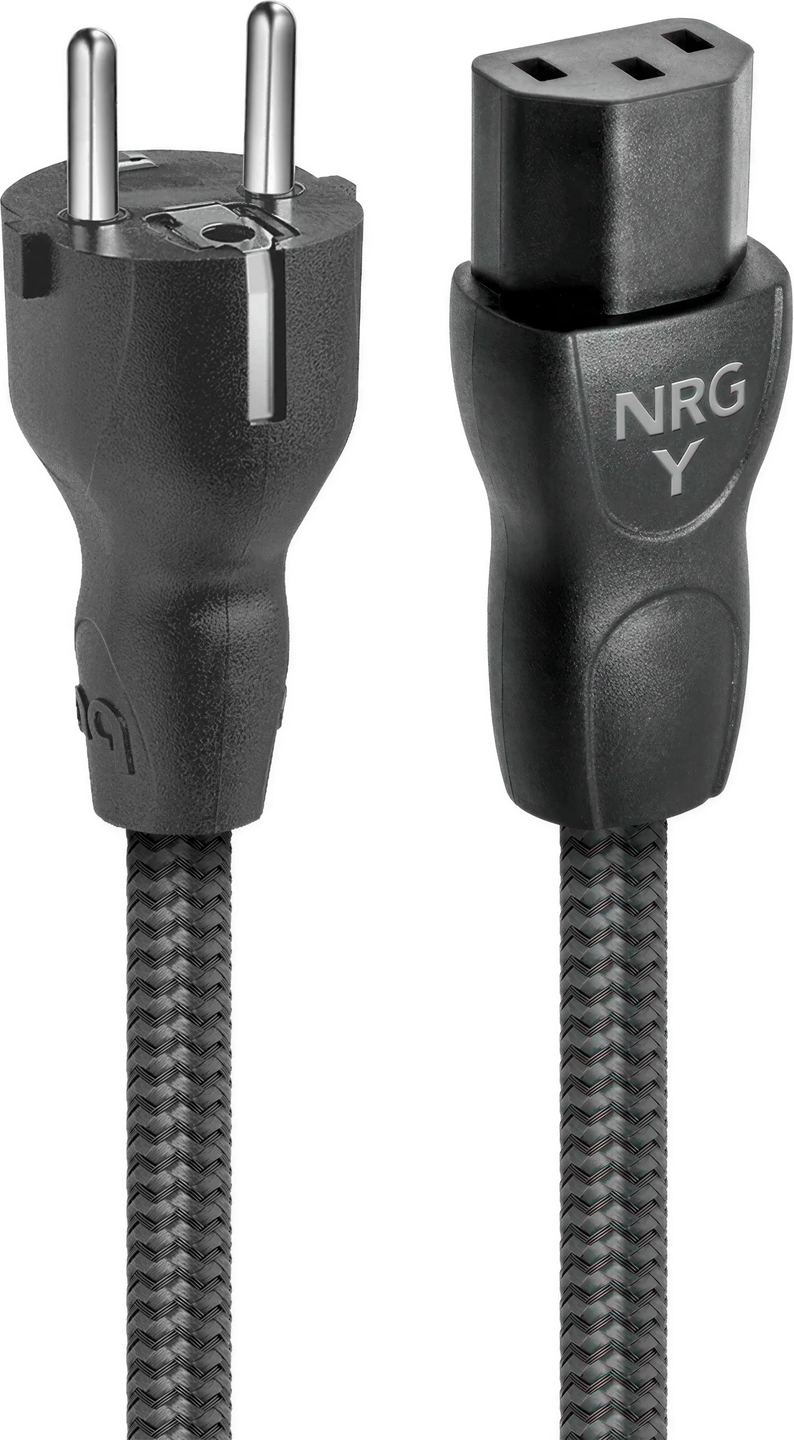
The AudioQuest NRG-Y3 power cable uses long-grain copper conductors in a semi-solid concentric configuration and incorporates ZERO-Tech technology. Designed to minimize alterations to alternating current, this cable aims to ensure stable transmission while reducing radio frequency interference through grounding.
Semi-Solid Construction: When Geometry Dictates Performance
The NRG-Y3’s construction is based on a semi-solid concentric architecture, where the copper strands maintain a fixed, unchanging position within the conductor bundle. This particular configuration is radically different from conventional cables, where the strands constantly shift position, creating unwanted electrical and magnetic interactions. The conductors use Long-Grain Copper (LGC), a material whose uniform crystalline structure minimizes grain boundaries—those transition zones that typically generate distortion in standard conductive metals.
The 0.5% silver-plated drain wires, made from high-purity copper, form a directional system for evacuating radio frequency noise. These direction-controlled shielding conductors channel RF interference picked up by the live and neutral lines toward the ground pin. This targeted evacuation of parasitic noise tangibly improves sound dynamics and spatial presence, creating a more defined and deeper soundstage.
The directionality of the conductors, indicated by arrows on the connectors, is not a marketing gimmick but the result of a meticulous testing process. Each batch of metal conductors is listened to in order to determine the optimal orientation for draining induced noise away from critical areas of the audio signal. This asymmetry in RF impedance depending on conductor direction is a fundamental aspect of AudioQuest’s noise dissipation technology.
ZERO-Tech: Zero Characteristic Impedance for Uncompressed Transients
ZERO-Tech technology represents a radically different approach to power cable design. While most power cables focus solely on low direct current resistance to accommodate high current demands, AudioQuest recognizes that characteristic impedance plays an equally crucial role in optimal performance.
This technology eliminates the electrostatic field between the cable’s high and low signal conductors, allowing for linear dissipation of radio frequency noise and ensuring uncompressed transients. Unlike conventional power cables that constrain or compress audio-induced transients, the NRG-Y3 combines low DC resistance with zero characteristic impedance, delivering high-intensity, uncompressed transients on demand.
The impact of this approach is especially evident during demanding dynamic passages, where power amplifiers may require transient currents several times higher than their average consumption. The NRG-Y3 responds instantly to these demands without introducing transient intermodulation distortion (TIM)—a scourge of conventional cables where induced RF noise modulates the low-level audio/video signal.
Evolution and Heritage: From NRG-X3 to NRG-Y3
The NRG-Y3 succeeds the popular NRG-X3 by incorporating manufacturing techniques inherited from the prestigious Storm series (Thunder, Tornado, Hurricane, and Dragon), which sits much higher in the AudioQuest range. This new generation of entry-level NRG cables far surpasses its predecessors—not only the X3 but also previous higher-end models from the earlier lineup.
Improvements made to the Y3 over the X3 include better conductor design, superior construction features, and significantly enhanced sound performance. The conductor structure has evolved from an arrangement of 37 strands in three layers to a simpler yet more effective configuration of seven larger strands forming a single uniform layer around a central strand. This apparent simplification actually conceals increased sophistication in controlling strand interactions and noise management.
The cable’s diameter, now 14mm, reflects this more robust construction, even if it means a certain rigidity compared to the 10mm of some competitors. This increase in cross-section is not gratuitous: it accommodates the optimized conductor geometry and sophisticated shielding system while maintaining the mechanical integrity necessary for stable long-term performance.