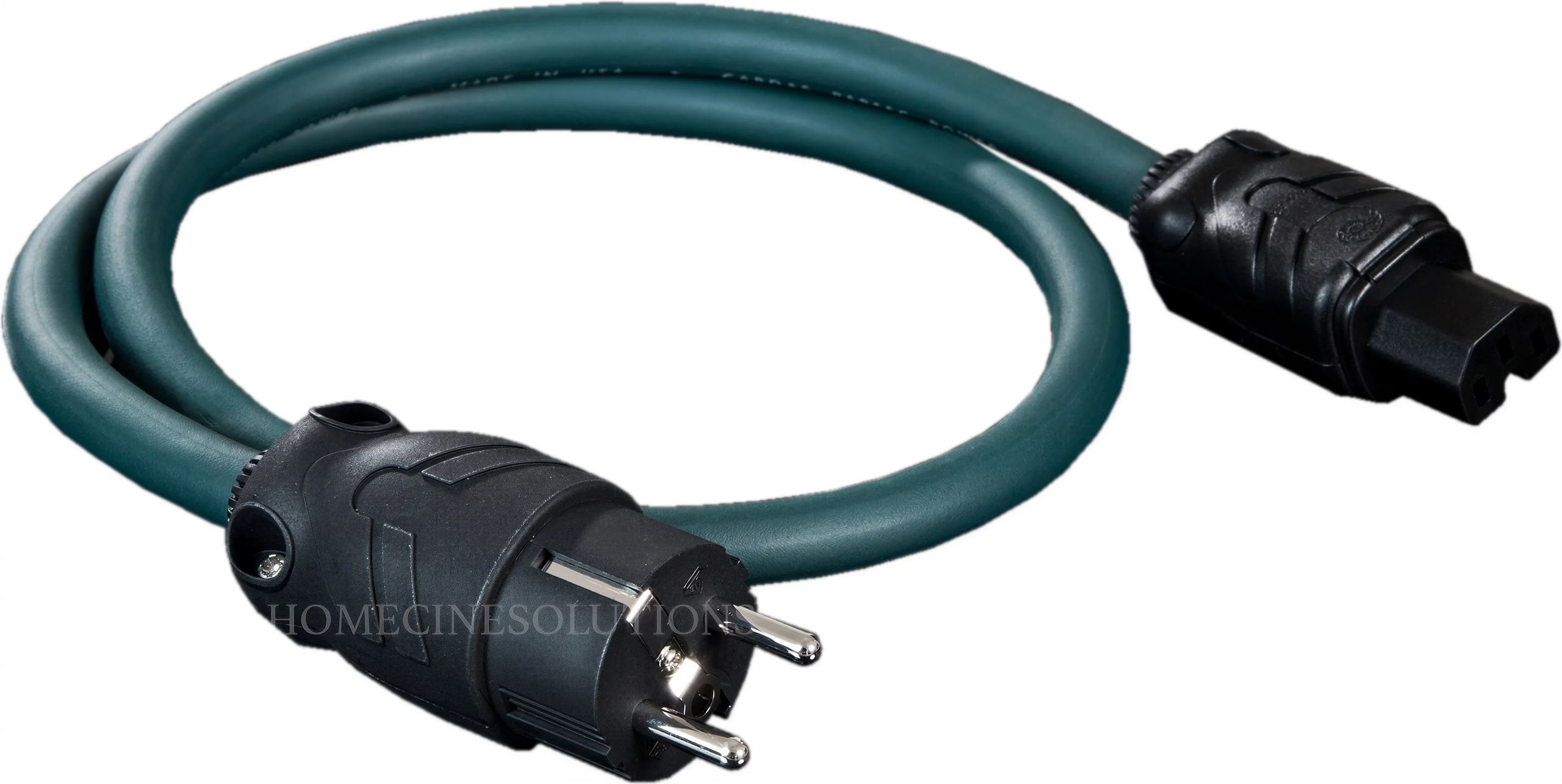
The black cord supplied with a device carries current and nothing more: interference circulating through the household mains travels with it all the way to the power supply. Cardas addresses this noise at the cable itself, with passive filtering applied to live, neutral and earth, and conductors taken from a higher-tier model in its catalogue. The jacket remains flexible enough to power either a source component or an amplifier.
Conductors taken from the Clear Cygnus
Introduced at CES 2015, the Parsec Power replaced the Quadlink in the Cardas catalogue. It occupies the second tier in the brand’s mains cable range, above the Iridium, and borrows its conductors from the higher-tier Clear Cygnus Power. These conductors are made from Grade 1 oxygen-free copper, 99.9999% pure, tinned to protect it from oxidation over the years.
Each conductor is stranded, with the strands individually insulated, as in Litz wire. Their cross-sections follow the proportions of the golden ratio: by combining different diameters in this precise ratio, Cardas prevents the resonances inherent to each strand size from building up at the same frequency. The strands are arranged in successive layers according to the Cross-Field geometry, patented by George Cardas, in which the winding direction reverses from one layer to the next so that the magnetic fields partially cancel each other out. Each conductor is insulated with PTFE, a stable, low-loss material. The cable brings together three 14 AWG conductors, each approximately 2.1 mm².
Passive filtering on all three conductors
A home’s electrical mains carries far more than 50 Hz: switching power supplies, internet routers, chargers and dimmers inject high-frequency interference that ends up in the power supply stages of audio equipment. The Parsec Power incorporates passive filtering on each of its three lines, including earth, whereas many mains cables rely solely on shielding. This filter attenuates noise without affecting the voltage: it does not regulate anything, regenerate the sine wave or act as a power conditioner. Its effect depends on the condition of the mains. In an already clean installation supplied by a dedicated line, the difference compared with a good ordinary cord is smaller.
An air-lightened twist and double shielding
The three conductors are twisted together in a triad, interwoven with air-filled PVC tubes that maintain their spacing and the cable’s round shape, all tightly wrapped in FEP tape. Around this, two shields overlap: one made from tinned copper, the other from enamelled copper wire. The cable protects itself from external radiation and limits its own emissions, which matters behind a hi-fi stand, where mains cords sit alongside interconnect cables carrying signals of a few hundred millivolts. Even when shielded, a mains cable benefits from crossing these connections at right angles rather than running parallel to them along their entire length.
Soldered and crimped 3455R plugs
At the wall end, a Cardas 3455R Schuko plug; at the equipment end, a 3455R 15 A IEC connector. Both feature solid copper contacts plated first with silver, then with rhodium: silver provides conductivity, while rhodium, a hard metal, resists wear from repeated connections and corrosion. The terminations are both soldered and crimped. The compact body of the wall plug fits firmly into the socket, without the play that sometimes allows a heavy cable to slip out.
A flexible 12.7 mm jacket
Many high-end mains cables handle like garden hoses and pull on the equipment’s inlet. The Parsec Power’s thermoplastic rubber (TPR) jacket, 12.7 mm in diameter, bends without resistance and accommodates tight curves behind furniture or in a rack. Like all the brand’s cables, it is handmade in the Bandon workshops in Oregon, where Cardas has been based since its founding in 1987.