Alain
Much better than basic plugs, quality at a reasonable price.
Comment from June 22, 2022 — Experience from June 06, 2022
Automatically translated — Show original (French)
Bien mieux que les prises basics de la qualité pour un prix raisonnable.
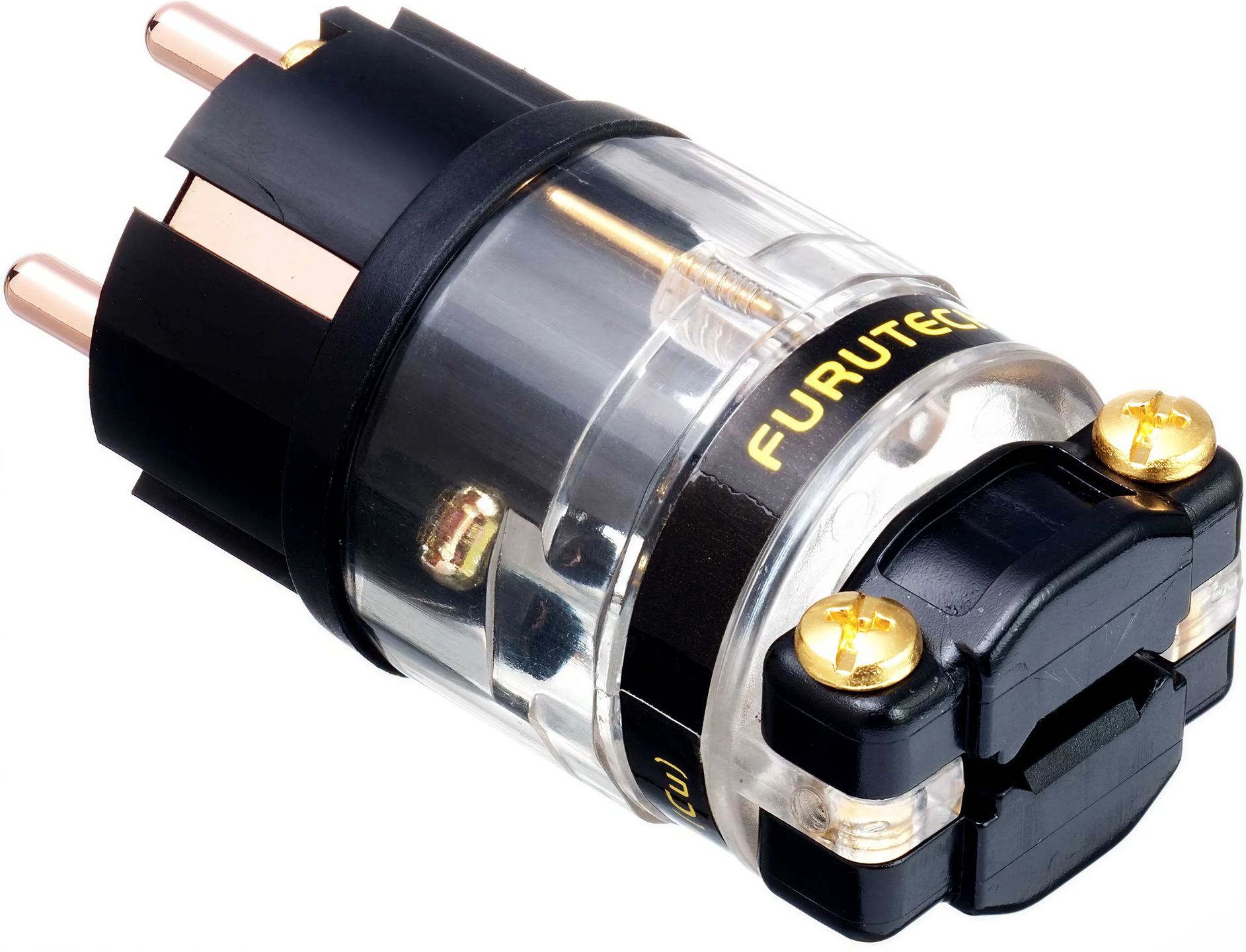
A power cord is only as good as its ends. On the wall side, it is the connector that draws current and transfers it to the cable, with its contacts, clamping system and earth connection. Furutech offers the entry-level model in its range of unplated copper Schuko connectors: ideal for finishing a self-assembled power cable, or re-terminating a cord whose original connectors restrict conductivity.
The FI-E11 (Cu) is a male connector in the Schuko CEE 7/VII format, the continental earthing standard recognizable by its two round pins and earth contacts on the sides. It is KEMA-KEUR approved (the Dutch certification body) under reference 2076430.01, for two poles plus earth, 16 A and 250 V. This is not a finished power cord: it is the part that is screwed onto the end of a bulk power cable to make your own cord, or to replace the connectors on an existing cord. At the other end, on the equipment side, it is paired with an IEC connector from the same line, such as the FI-11 (Cu).
The CEE 7/VII format is type E/F: the connector plugs in and grounds equally well into a French wall outlet or a German Schuko outlet.
The “(Cu)” designation distinguishes this version from the gold- and rhodium-plated variants built around the same body. Here, the conductors are made from so-called eutectic copper alloy (a composition that solidifies uniformly, without separation between its constituents), left bare, with no plating layer between the copper and the cable. Copper conducts better than the brass and bronze commonly used in connectors, and nothing comes between it and the conductor here. The trade-off is real: bare copper develops a patina over time, a thin surface oxidation that can be cleaned if needed, and it remains softer than a rhodium-plated contact. Choosing copper means prioritizing conductivity over surface durability.
All metal parts undergo Furutech’s two-stage Alpha process. The first stage is cryogenic treatment: the parts are brought down to between -196 and -250 °C using liquid nitrogen or helium, a temperature that reorganizes the metal’s structure and relieves internal stresses accumulated during manufacturing. The second is ring demagnetization, which removes residual magnetic fields left in the metal. Furutech applies this treatment across its entire connector range, from entry-level models to high-end references.
The front body is made of glass fiber-reinforced nylon, while the shell is polycarbonate. Screw clamping holds cables with an outer diameter of 6.6 to 16 mm, up to 20 mm with longer screws. On the conductor side, the connector accepts cross-sections up to 5.5 mm² (10 AWG), enough to accommodate thick power cables. This tolerance has a practical consequence: with a very large or heavily sleeved cable, clamping requires patience and a firm grip. The assembly measures 89.3 mm in overall length, with a diameter of 39.3 mm and a 56.2 mm body.
Installation involves stripping the cable, connecting live, neutral and earth to their respective terminals, then tightening the clamp. This is work on mains power: it requires care and, if in doubt, the assistance of an electrician. The connector is supplied bare, ready to be wired. One point specific to Schuko: the connector is not polarized, so it can be inserted either way into a Schuko outlet, with no fixed live or neutral. Those who wish to maintain mains polarity should mark the orientation during installation and observe it when plugging in.
Yes. Its CEE 7/VII format is type E/F: it plugs in and is grounded on both a French socket and a German Schuko socket.
The FI-E11 (Cu) is fitted on the wall side of the power cord. On the equipment side, it is paired with an IEC connector from the same family, such as the FI-11 (Cu), also in unplated copper for consistency, with the bulk cable of your choice between the two.
It is a mains connection: strip the wires, observe live, neutral and earth, and tighten the clamp properly. Nothing insurmountable for a careful DIYer, but if in doubt, it is best to have the installation carried out by an electrician. The connector is supplied unwired.
All three share the same body and differ only in the surface treatment of the contacts. Copper (Cu) remains bare, providing direct conductivity at the cost of surface oxidation over time. The gold- and rhodium-plated versions add a stable, hard layer to the contacts, offering greater resistance to corrosion and wear, at the cost of plating inserted into the current path.
A surface patina develops over time, as with any bare copper. It can be cleaned and does not prevent the contact from working. This is the accepted trade-off of an unplated connector.
Up to 5.5 mm² (10 AWG) on the conductor side, and a cable outer diameter of 6.6 to 16 mm, increased to 20 mm with longer clamping screws.
It marks the entry point. Above it are models with housings loaded with damping carbon particles, followed by the NCF references whose housings incorporate the brand’s proprietary damping material. The FI-E11 (Cu) provides the most direct access to Alpha treatment and bare copper.
Alain
Much better than basic plugs, quality at a reasonable price.
Comment from June 22, 2022 — Experience from June 06, 2022