A moving-coil cartridge delivers a few tenths of a millivolt, a signal so faint that the quality of its amplification determines much of the background noise and listening detail. Made in England at Rega’s workshops in Southend-on-Sea, this phono preamp is dedicated exclusively to this type of cartridge. It sits between the turntable and the amplifier’s line input, with rear-panel settings that accommodate both the current cartridge and a future one.
A discrete input stage for the weakest signals
An MC cartridge (short for “moving coil”) produces a signal around ten times weaker than an MM moving-magnet cartridge. To bring it up to the level an amplifier expects, the Fono MC MK4 amplifies it by 63.5 or 69.5 dB, depending on the selected setting, a factor of around 1,500 or 3,000. At this level of amplification, the inherent noise of the first-stage components is directly audible in the silences between tracks and beneath quiet passages.
This first stage is built from discrete components, individually wired rather than grouped in an integrated circuit, around the Linear Systems LSK389, a low-noise dual field-effect transistor (FET). Its high input impedance has a practical consequence: the circuit imposes no parasitic load on the cartridge, and the resistance selected by the user, and that alone, determines the actual load.
Next comes RIAA equalization. During cutting, a record’s bass is attenuated and its treble boosted to accommodate the grooves and limit surface noise; the preamp applies the inverse curve to restore the original tonal balance. This stage uses a MUSE series operational amplifier, with polypropylene capacitors in both the signal path and the equalization network. Into a 50 kΩ load, deviation from the theoretical curve remains within ±0.2 dB between 100 Hz and 100 kHz, and the frequency response extends from 13 Hz (at -3 dB) to 100 kHz.
Four switches to match loading and gain
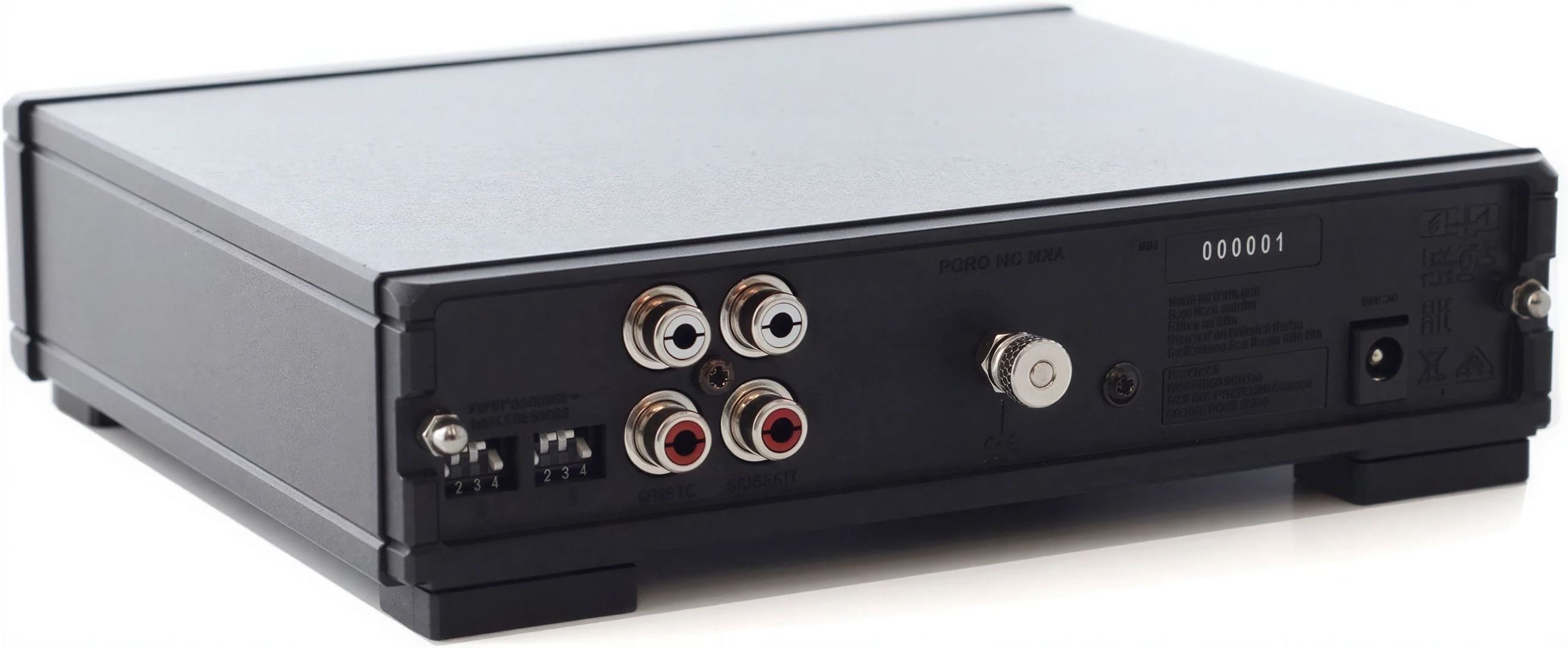
Settings are adjusted using four small DIP switches on the rear panel, next to the sockets. Switches 1 and 2 work in combination to set the load resistance to 400, 150, 100 or 70 Ω, the third switches capacitance from 1,000 to 4,300 pF, and the fourth selects between 63.5 dB and 69.5 dB of gain.
Load resistance is the parameter with the greatest impact on an MC cartridge. The cartridge manufacturer specifies the recommended value in its manual; a lower load damps the coils more and generally softens the top end, while a higher load leaves the treble more open. These four positions cover the recommendations for most low-output cartridges. Capacitance has a subtler influence on this type of cartridge, and the 1,000 pF setting suits most cases.
The choice of gain depends on the cartridge’s output voltage. At high gain, 67 µV is enough to produce an output of 200 mV, and the preamp accepts up to 3.4 mV at the input before clipping. At low gain, 133 µV is needed to reach the same 200 mV, but the headroom rises to 6.7 mV. The lowest-output cartridges use high gain; those that deliver a little more benefit from low gain, with greater headroom on the most heavily modulated passages.
Ready to play with Rega cartridges
The factory settings (100 Ω, 1,000 pF, high gain) suit all of the brand’s MC cartridges: Ania, Ania Pro, Apheta 3 and Aphelion 2. With a Rega turntable fitted with one of them, such as a Planar 6 with an Ania Pro or a Planar 8 with an Apheta 3, there is therefore nothing to adjust: plug in, switch on, listen. The switches are only needed with a cartridge from another brand, or to fine-tune the sound by ear.
An aluminum enclosure matching Rega electronics
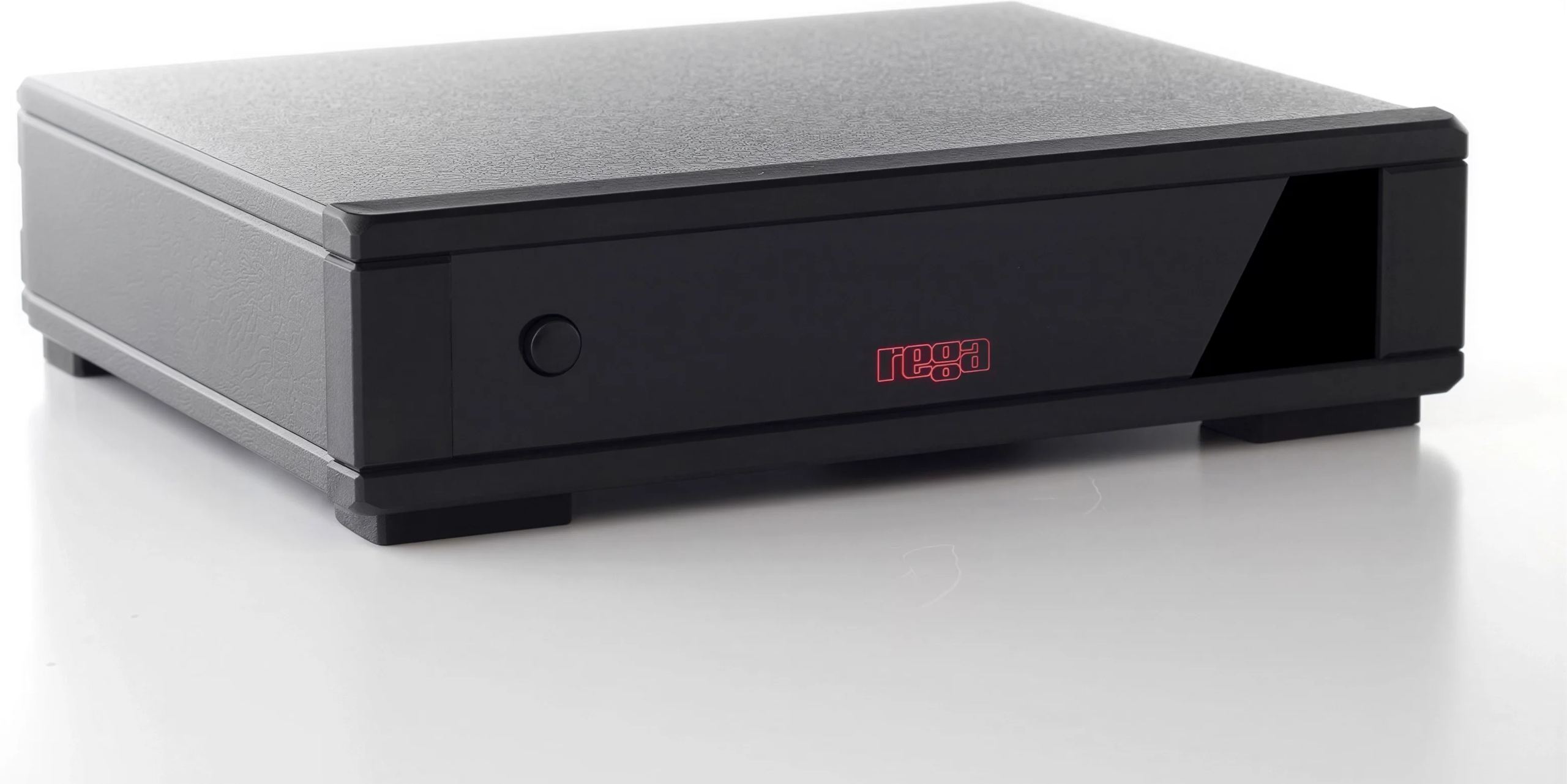
The MK4 version differs from its predecessor through its completely redesigned enclosure. It uses the same aluminum case as the Fono MM MK5 phono preamp and Neo MK2 turntable power supply, allowing several Rega components to be lined up on a cabinet with a consistent look. The circuit itself stems from Rega’s work on the Aria phono preamp.
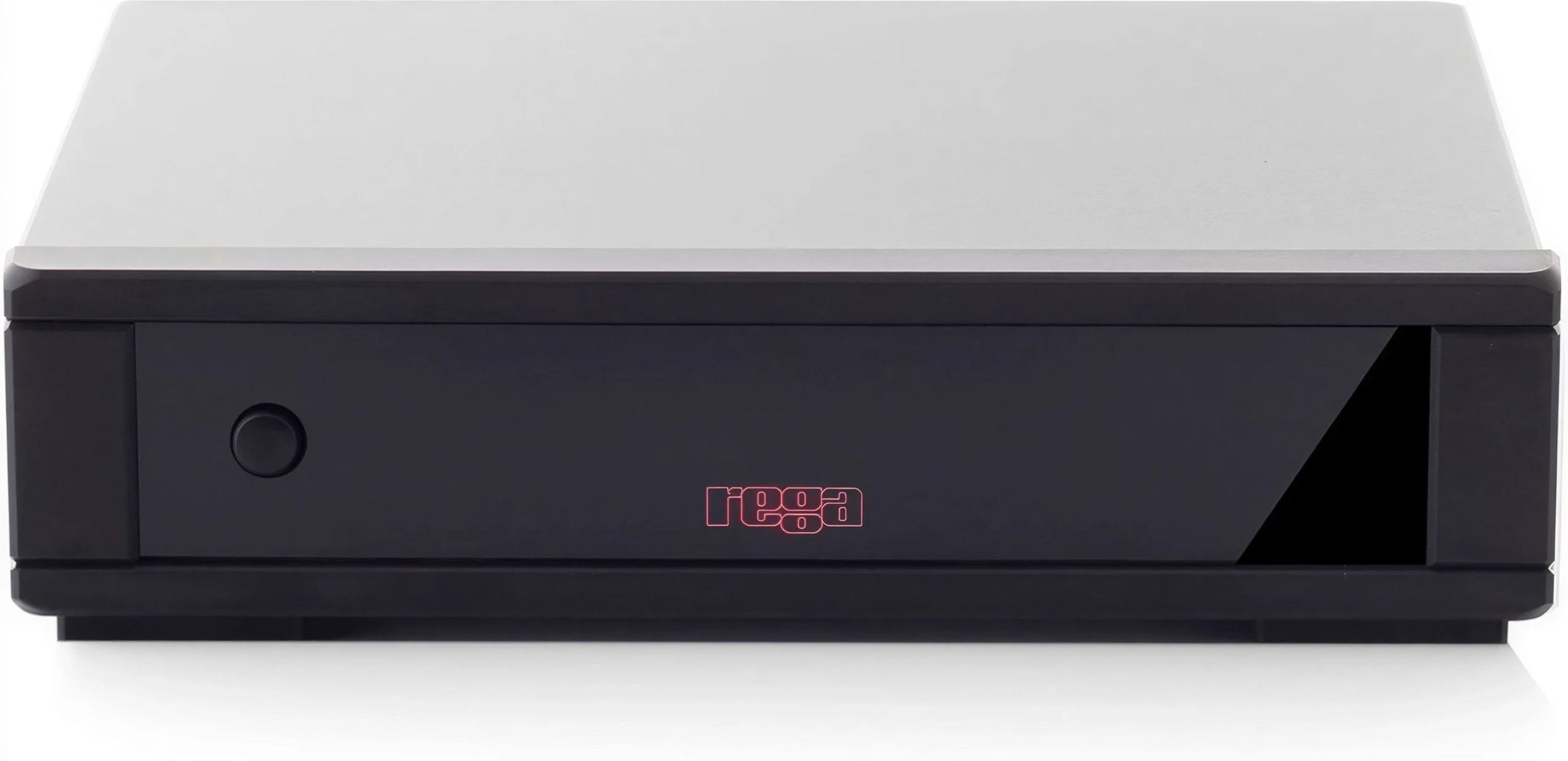
At 180 mm wide, 50 mm high and 155 mm deep, the Fono MC MK4 easily fits beside the turntable or on a shelf in a hi-fi cabinet. The front panel features only the on/off button, and the Rega logo lights up red when the unit is operating.
Connecting the preamp to an existing system
The rear panel brings together an RCA input for the turntable cable, a ground terminal, an RCA output and the power socket. The output connects to a line input on the amplifier (AUX, CD or equivalent). With an output impedance of 200 Ω and a recommended minimum load of 5 kΩ, all hi-fi amplifier line inputs are suitable. If the turntable or tonearm has a separate ground wire, it attaches to the dedicated terminal on the rear.
Power is supplied by an external Rega PS1 24 V AC unit, the only one to use with this device. Keeping the transformer outside the enclosure moves a common source of hum away from the highly sensitive input stage.