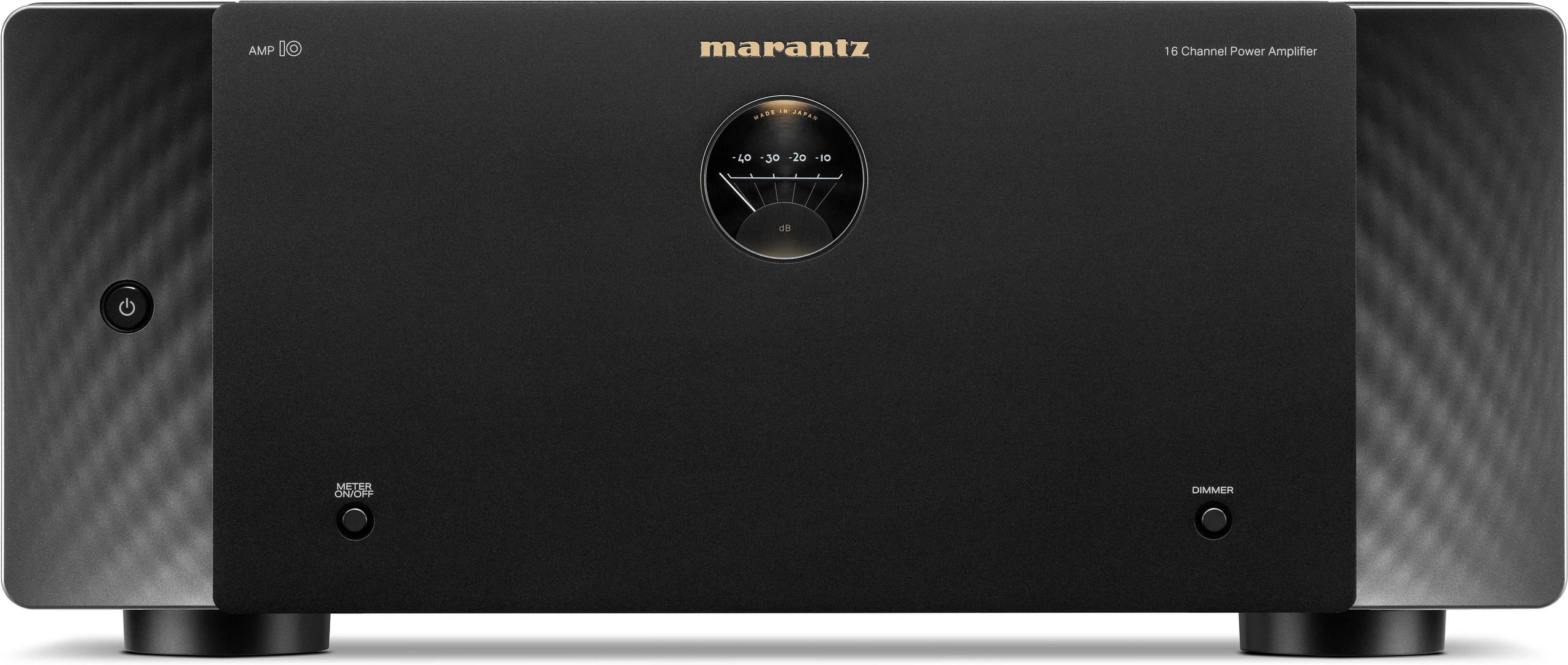
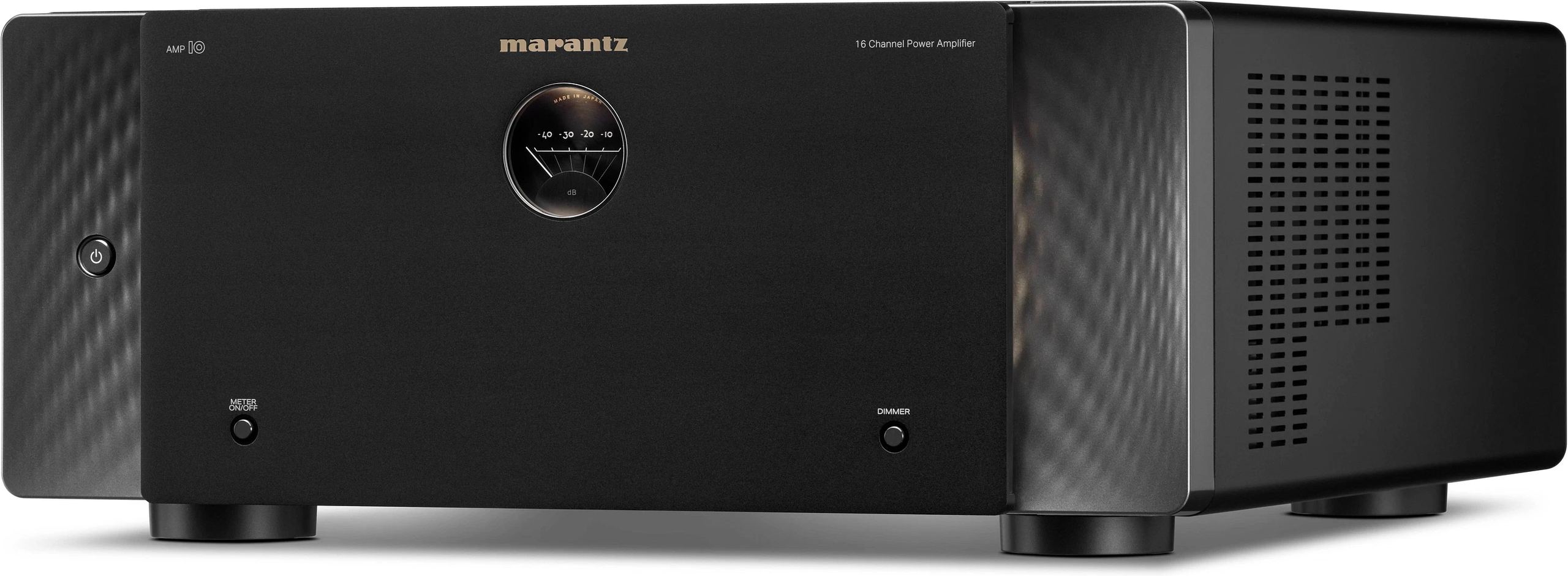
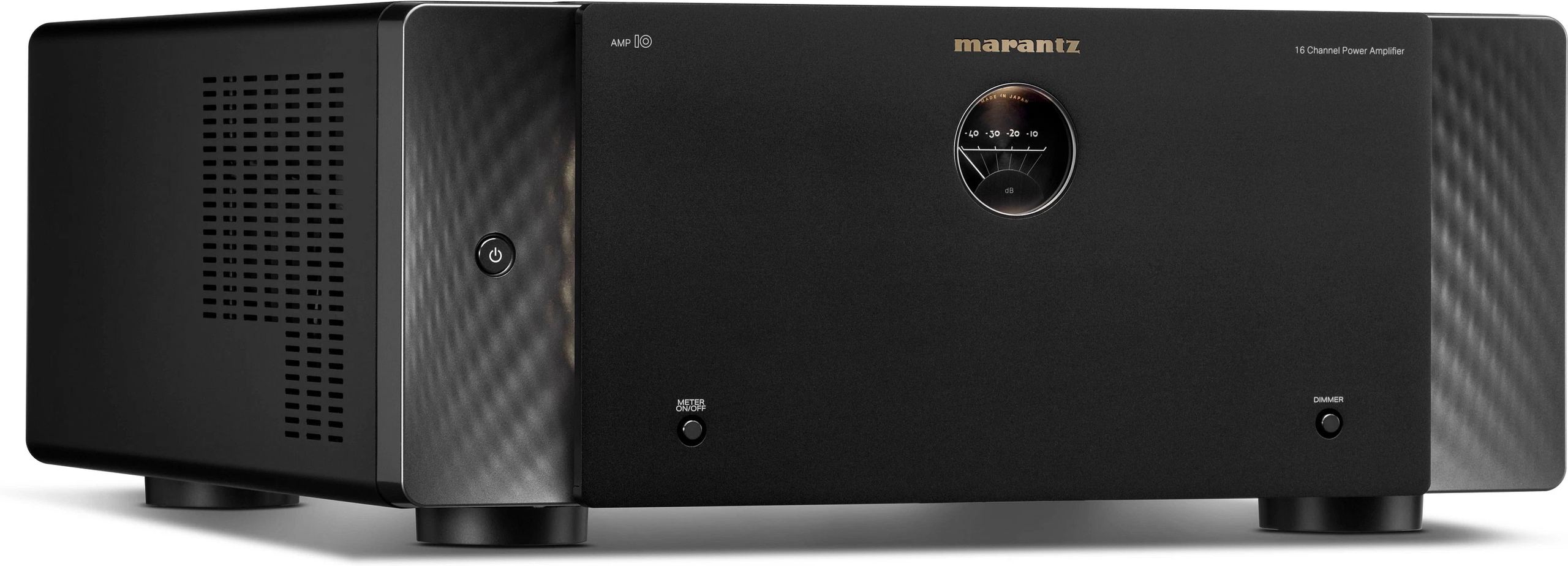
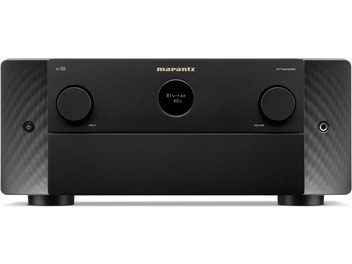
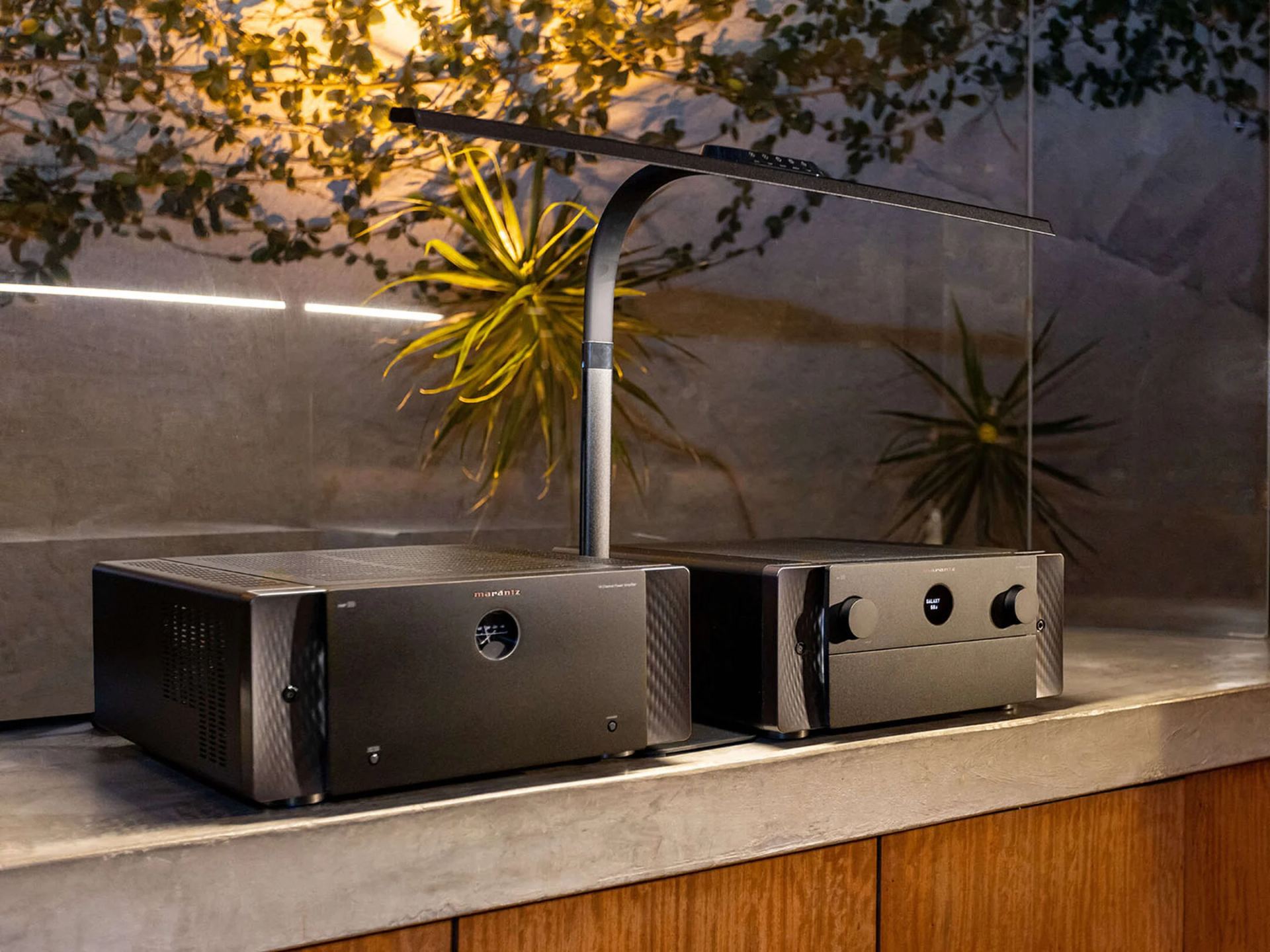
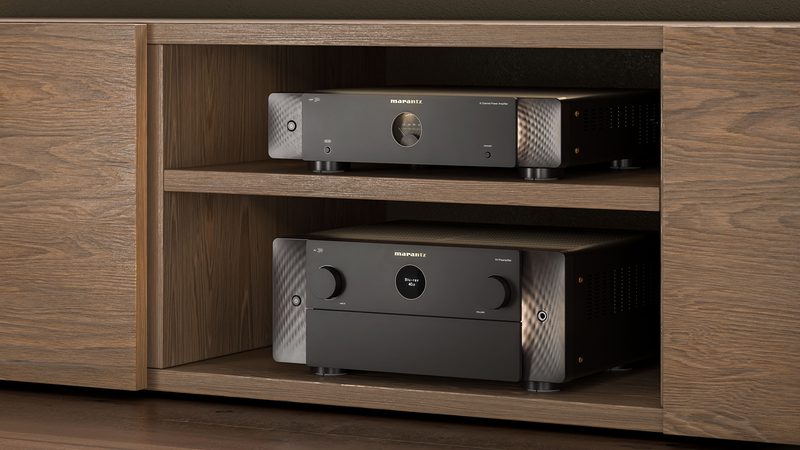
The AMP 10 from Marantz is a 16-channel multichannel power amplifier. It uses a Class D ICE Edge architecture, integrates the brand’s proprietary HDAM technology, and delivers 200 watts per channel into 8 ohms. The unit is designed at the Shirakawa facilities in Japan and tuned by Sound Master Yoshinori Ogata. It is intended to be paired with the AV 10 processor for multichannel home theater installations.
Sophisticated technical architecture and Class D topology
The AMP 10 marks a turning point in Marantz’s design philosophy. Unlike the MM8077 and MM7055 models that use a linear Class AB topology, the AMP 10 adopts a Class D ICE Edge architecture developed in collaboration with Danish company ICEpower. This technology, based on ICEPower 400A2 modules, offers an efficiency over 90%, versus 60–70% for traditional Class AB amplifiers. This remarkable efficiency allows 16 high-power channels to fit in a relatively compact chassis while maintaining reasonable operating temperatures.
The power supply is central to this design. The AMP 10 uses an intelligent hybrid approach: a regulated switching power supply (SMPS) located on the front panel feeds the amplification modules, while a dedicated toroidal transformer supplies power to the HDAM analog circuits, input buffer stages, and signal selectors. This dual architecture isolates critical circuits from potential switching supply interference, thus preserving the characteristic Marantz sound quality.
Solid brass bus bars distribute current from the power supply to the amplifier modules. This material choice is deliberate: brass offers excellent electrical conductivity and mechanical rigidity that contribute to overall stability. The same material is also used for the speaker binding posts and switching relays, ensuring optimal signal transmission to the speakers.
HDAM-SA2 technology and the Marantz sound philosophy
At the heart of the AMP 10, HDAM-SA2 (Hyper Dynamic Amplifier Module) circuits embody the very essence of the Marantz sound. These discrete amplification modules, developed in-house over decades, replace conventional integrated circuits. Each HDAM contains individually selected components assembled according to an exclusive topology that prioritizes musicality.
The HDAM-SA2 used in the AMP 10 employ a current feedback architecture that offers several advantages: extremely low output impedance, high slew rate, and wide bandwidth. These technical characteristics translate into precise transient reproduction, an expansive soundstage, and the characteristic warmth audiophiles have associated with the brand since the era of Saul Marantz.
Final tuning of the AMP 10 was entrusted to Yoshinori Ogata, Marantz’s current Sound Master. Successor to Ryuichi Sawada and heir to a tradition initiated by Saul Marantz himself, Ogata-san brings his personal touch to each product. His approach favors a subtle balance of resolution, spatialization, and harmonic warmth, creating what Marantz calls the “Most Musical Sound.”
Flexibility of use and operating modes
The AMP 10 excels in versatility. Each pair of channels can be configured independently in three distinct modes: Normal, Bi-amp, or BTL (Bridge-Tied Load). This flexibility allows the amplifier to be adapted to the specific needs of each installation.
In Normal mode, each channel delivers 200 watts into 8 ohms or 400 watts into 4 ohms. This power remains constant whether you use a single channel or all 16 simultaneously, thanks to the strict regulation of the SMPS. Independent measurements even confirm a slight exceedance of these specifications, with 215 watts measured at 0.1% total harmonic distortion.
Bi-amp mode allows you to separate amplification for the bass and treble sections of compatible speakers. Odd-numbered channels feed the tweeters while even-numbered channels drive the woofers. This configuration eliminates interference due to back electromotive force and improves speaker control, particularly beneficial for demanding floorstanding speakers.
BTL mode transforms two channels into a single mono amplifier of 400 watts into 8 ohms or nearly 800 watts into 4 ohms. This configuration is ideal for the main front channels of an ambitious home theater setup, where dynamics and control are essential. The amplifiers operate in opposite phase, effectively doubling the voltage available at the speaker terminals.
Exemplary build and attention to detail
The AMP 10’s build quality reflects the artisanal know-how of the Shirakawa factory. The chassis uses a copper base plate that improves grounding and reduces electromagnetic interference. This technique, inherited from the MM8807, helps lower the noise floor by 10 dB compared to the previous model.
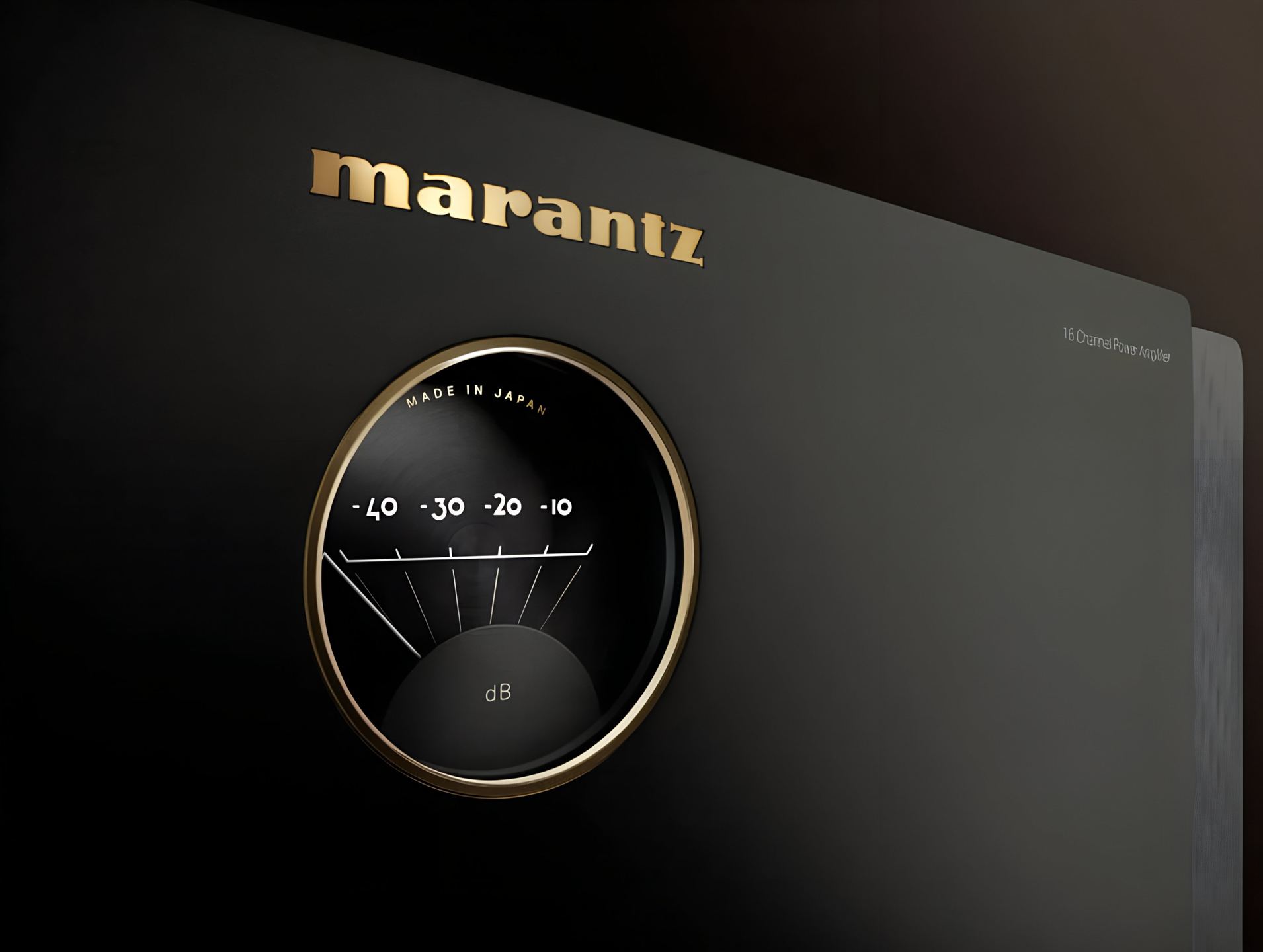
The front features Marantz’s characteristic porthole, here transformed into an analog level indicator for channel 1. This aesthetic touch, which Marantz says is inspired by luxury watchmaking, recalls the indicators of the legendary 1967 Model 9. Subtle side lighting creates a warm ambiance that contrasts with the often austere look of professional equipment.
The connections reveal remarkable attention to detail. Each channel features a balanced XLR input and an unbalanced RCA input, selectable via a switch. The gold-plated speaker binding posts accept cables up to 10 AWG, and Marantz provides a special magnetic wrench that makes tightening easier and can be stored directly on the rear panel thanks to its built-in magnet.
System integration and advanced connectivity
The AMP 10 integrates naturally into sophisticated installations thanks to its multiple control options. The AMP CONTROL connection allows full synchronization with the AV 10 processor: simultaneous power-up, coordinated brightness adjustment, and centralized management. 12V DC trigger inputs and outputs facilitate integration into home automation systems, while the RS-232C port offers bidirectional control for custom installations.
The amplifier’s gain has been carefully calibrated: 23 dB for XLR inputs and 29 dB for RCA inputs. This gain structure aligns perfectly with the output levels of the AV 10 processor, which can deliver up to 12 Vrms. This matching ensures optimal use of dynamic range and minimizes background noise in complex multichannel installations.
The auto-standby function, which can be disabled if necessary, reduces consumption to 0.2 watts in the absence of a signal. In normal operation, the amplifier consumes around 500 watts, a remarkably low figure given the power available across 16 channels.
Measured performance and sonic characteristics
Independent tests reveal performance that often exceeds official specifications. Total harmonic distortion plus noise (THD+N) remains below 0.0015% up to 100 watts per channel, corresponding to a 96 dB SINAD. Frequency response extends from 20 Hz to 20 kHz with less than 0.5 dB variation, even at full power.
An interesting feature of the AMP 10 lies in its ability to maintain nearly identical power whether one or multiple channels are driven simultaneously. Whereas traditional amplifiers see their power drop significantly in multichannel mode, the AMP 10 maintains around 200 watts per channel whether you’re using 2, 5, or 7 channels. This consistency results from the strict regulation of the SMPS and represents a major advantage for home theater installations where all channels can be called upon simultaneously during dynamic passages.
The sonic signature remains true to Marantz tradition: a warm, immersive presentation with a generously wide and deep soundstage. Voices benefit from a particularly seductive texture, while the highs retain smoothness and definition. The bass, controlled and articulate, benefits from the high damping factor inherent to Class D technology.
Positioning against high-end competition
In the high-end 16-channel amplifier market, the AMP 10 mainly faces two competitors: the Storm Audio PA 16 MK3 and the Trinnov Amplitude 16. These three amplifiers share certain characteristics: Class D technology (Pascal for Storm, ICE Edge for Trinnov and Marantz), 200 watts per channel into 8 ohms, and bridging capability.
Storm Audio uses Pascal modules with a single 3200-watt power supply. Trinnov, like Marantz, employs ICE Edge technology but with two separate power supplies and two mains inlets. All three models offer balanced inputs, but Trinnov uses DB25 connectors to simplify cabling, while Marantz and Storm retain individual XLR and RCA connections.
In terms of pricing, the AMP 10 is advantageously positioned. With a retail price of around 7000 euros, it remains significantly less expensive than its direct competitors, which often exceed 14,000 euros. This price difference does not come with major performance compromises, as confirmed by independent tests that place the AMP 10 on par with its costlier rivals.
What the press says
The Marantz AMP10 is a "bridgeable" model designed to handle speakers with particularly low efficiency. Similarly, bi-amplification is also supported. As for the rest, it offers a choice between balanced (XLR) or unbalanced (RCA) inputs for each channel, providing maximum flexibility.
Automatically translated — Show original (French)
Le Marantz AMP10 est un modèle « bridgable » pour gérer des enceintes au rendement particulièrement faible. De même, la bi‑amplification est de la partie. Pour le reste, il propose le choix pour chaque canal entre l'entrée symétrique (XLR) ou asymétrique (RCA) pour une flexibilité maximum.
16 gold-plated speaker binding posts with brass screws
RS-232 and Marantz D-Bus control
12 V DC trigger in/out
IR input
Firmware update via RS-232
Optimal compatibility with the Marantz AV 10 processor
Construction and design
Copper-plated chassis
Double-layer bottom plate
Extensive shielding
Metal front panel construction
Custom audio components
Front display: analog level meter
Warm side lighting
Elegant design
Power and consumption
Power supply for input section: toroidal transformer
Power supply for output section: high-current SMPS
Power consumption:
Maximum: 500 W
ECO ON/OFF: 140 W
Standby: 0.2 W
Auto power off
Dimensions and weight
Dimensions (W × D × H): 443 × 489 × 189 mm
Weight: 19.8 kg
Box contents
AMP 10 amplifier
Quick start guide
Power cord
Amplifier control cable
Remote control cable
Speaker terminal wrench
Highlights
Impressive power: 200 W per channel into 8 Ω / 400 W per channel into 4 Ω
16 channels to drive the most ambitious setups
Bi-amp mode: separates high and low frequencies on dedicated amplifiers
Bridge (BTL) mode: combines two channels for 400 W into 8 Ω
Balanced XLR inputs for optimal noise reduction
Frequently asked questions
What is the difference between the AMP 10’s Class D technology and Marantz’s traditional Class AB amplifiers?
+
Class D offers significantly higher energy efficiency (over 90% versus 60–70%), allowing 16 channels to be integrated into a compact chassis with reduced heat dissipation. Contrary to common misconceptions, modern Class D—particularly the ICE Edge technology used here—does not sacrifice sound quality. Marantz’s HDAM circuits also preserve the brand’s characteristic sonic signature.
How do you configure BTL mode and what precautions should be taken?
+
BTL mode is activated via the switches located between each channel pair. You must perform this setting with the amplifier switched off. Connect only the odd-numbered inputs (CH1, CH3, CH5, etc.) and use speakers of at least 8 ohms. Wiring differs from normal mode: connect the speaker’s positive to the positive of the odd channel, and the negative to the positive of the even channel.
Can the AMP 10 drive demanding 4-ohm speakers continuously?
+
Absolutely. The amplifier doubles its power to 400 watts into 4 ohms and maintains this capability even with multiple channels driven. Class D technology naturally follows impedance variations without loss of control. However, in BTL mode, limit yourself to 8-ohm loads to avoid overload.
Are the ICE Edge modules really designed specifically for Marantz?
+
Marantz uses ICEPower 400A2 modules as a base, but with substantial modifications. The addition of HDAM-SA2 circuits, power supply optimization, and meticulous tuning by the Sound Master create a unique implementation. Collaboration with ICEpower ensures reliability while Marantz’s expertise ensures musicality.
How is the connection with the AV 10 processor made?
+
Use the supplied AMP CONTROL cable for function synchronization. For audio, favor balanced XLR connections, which offer better noise rejection over long distances. The AV 10 processor automatically compensates for the gain difference between XLR and RCA, ensuring a uniform level across all channels.
Can the AMP 10 be combined with other Marantz amplifiers?
+
Certainly. The AMP 10 integrates perfectly with the MM8077 or MM7055 models for installations requiring more than 16 channels. Gain characteristics and sonic signature remain consistent across the range, ensuring perfect uniformity. Use cascaded trigger connections for centralized management.
User reviews
Thierry
With the AV 10 as a preamp, it's an exceptional sound system! Add an Audioquest Niagara 1200 + NRG-Z3 2M Pack to power them.
Comment from October 13, 2026 — Experience from September 24, 2023
Automatically translated — Show original (French)
Avec l'AV 10 en préampli c'est un système de son exceptionnel !
Mettez derrière un Audioquest Pack Niagara 1200 + NRG-Z3 2M pour les alimenter.
Rubén
A flawless product, and as always, this store’s professionalism!!!
Comment from September 16, 2025 — Experience from September 05, 2025
Automatically translated — Show original (Spanish)
Un producto impecable y siempre con la profesionalidad de esta tienda!!!
Jarl
Overall excellent! If you have bulky speakercables a but tricky to manage with the speakerterminals. To short warranty, in Sweden 5-years, in France 2-years??
Best regards/Jarl
Comment from March 06, 2025 — Experience from March 02, 2025
Eco-contribution of €2.58 included in the sale price.
To better understand our visitors, measure marketing effectiveness and personalise ads, we and our partners use cookies and mobile advertising identifiers on your device. This data makes it possible to display personalised and non-personalised ads and measure their performance. Some cookies, which are technically necessary, are exempt from consent. You can accept those that require your consent, refuse them by clicking “Reject”, or customise your choices via “More options”.
To find out how Google uses the data collected once you have given your consent, see Google’s Business Data Responsibility site (opens in a new window).
You can change or withdraw your consent at any time via the “Cookies” link. Your choices will apply on our site for 12 months.