Audioquest Boxer 20m
Overview
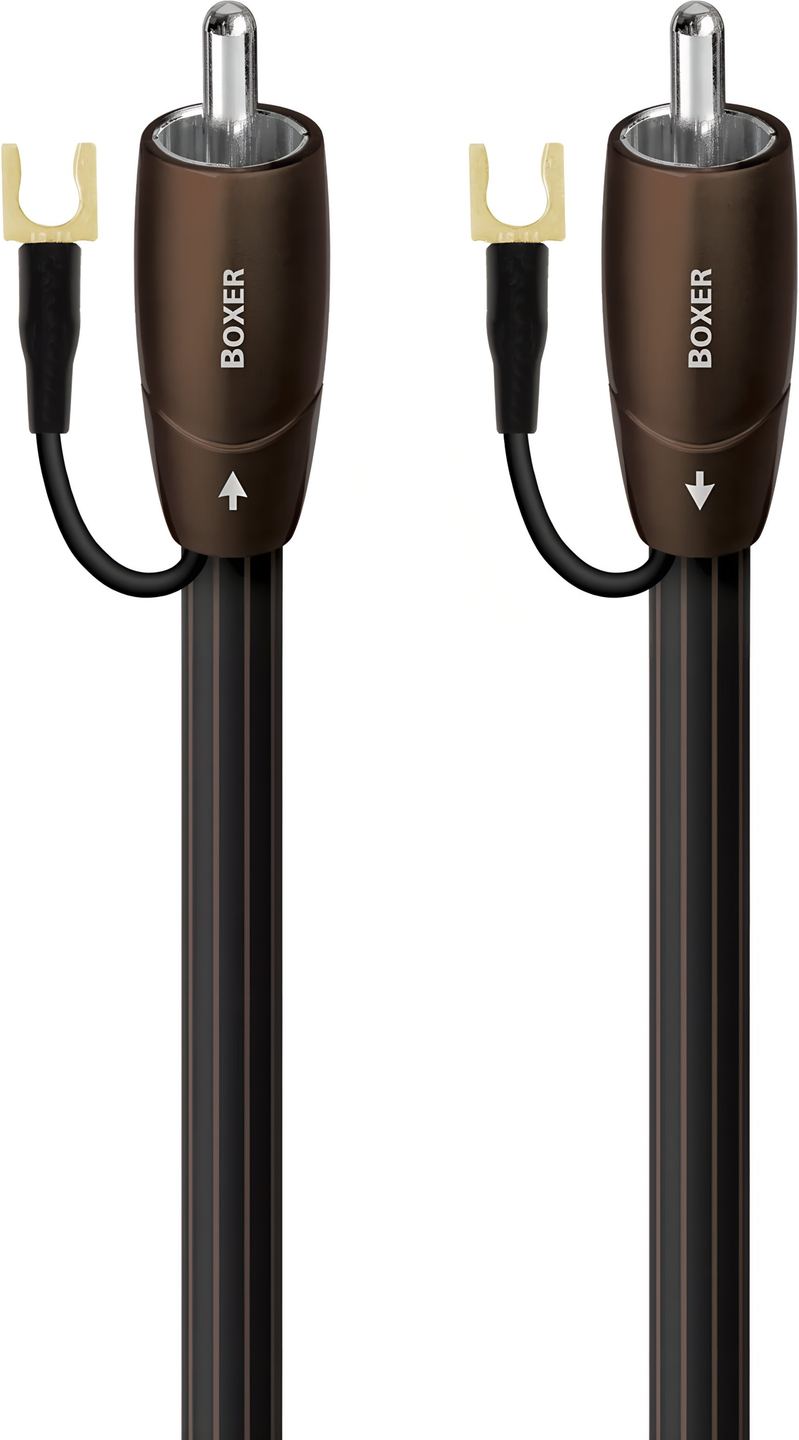
The Audioquest Boxer cable is a model for subwoofers positioned between the Irish Red and the Husky in the manufacturer’s range. It uses 1.25% silver-plated copper conductors, a double-balanced geometry, and a three-layer noise dissipation system to optimize low-frequency transmission.
A metallurgical design serving sonic precision
The Boxer’s conductive structure is based on a radical approach: solid Long Grain Copper (LGC) conductors silver-plated at 1.25%. This silver proportion, higher than the 0.5% of the Irish Red model, transforms the cable’s electrical behavior in critical frequencies for a subwoofer. High-frequency signals traveling mainly on the surface of conductors—a physical phenomenon called skin effect—benefit directly from this high-purity silver layer. The result translates into increased transient sharpness and better definition of bass textures, without ever sacrificing depth or power.
The use of solid rather than stranded conductors eliminates one of the fundamental problems of audio transmission: strand interaction. In a traditional stranded cable, each contact between wires generates an oxidized interface where the signal becomes altered. The magnetic fields of different strands constantly interact, creating constant modulation and temporal confusion of the signal. The Boxer, with its solid monoblock conductors, completely short-circuits this distortion mechanism, preserving the structural integrity of the signal from source to subwoofer.
The conductor finishing employs Audioquest’s exclusive Cold-Weld system, a technique worth examining closely. Unlike traditional soldering or crimping methods that introduce an intermediate layer of different material—a source of reflections and distortions—Cold-Weld uses a combination of extreme pressure and silver-impregnated paste to create a perfect molecular junction. This connection preserves the crystalline integrity of the conductor right up to the connector, eliminating any discontinuity in the signal path.
Air-tube insulation: when vacuum becomes performance
The Boxer’s insulation employs Air-Tube technology in polyethylene, a counter-intuitive but remarkably effective approach. Any solid material in contact with a conductor becomes an integral part of the electrical circuit, absorbing then releasing energy in the form of distortion—a phenomenon engineers call the dielectric effect. The polyethylene used by Audioquest already presents a minimal loss profile and a particularly neutral distortion signature. But it’s the incorporation of air tubes in this structure that reveals its full potential.
Since air is the ideal dielectric after vacuum—it absorbs practically no energy—this hybrid construction drastically minimizes the temporal “blur” effect observed with conventional insulators. The cable’s geometric stability is also reinforced, maintaining constant impedance along the entire length of the conductor. This stability is crucial for low-frequency signals that carry considerable energy and can easily deform the structure of a poorly designed cable.
The sonic impact of this sophisticated insulation manifests through a notable improvement in dynamic contrast. Bass attacks become more direct, decays more natural, and the texture of bass instruments—double bass, timpani, organ—gains in realism. Special effects in action films regain their visceral impact without ever becoming bloated or imprecise.
The NDS system: a fortress against interference
The Boxer’s Noise-Dissipation System (NDS) represents the culmination of decades of research at Audioquest on managing electromagnetic and radio frequency interference. In our modern environment saturated with parasitic signals—Wi-Fi, cell phones, household appliances—simple shielding is no longer sufficient. The NDS adopts a three-layer strategy alternating metal and carbon-loaded synthetic materials.
This multilayer construction works on the principle of “shielding the shield.” The outer layers absorb and reflect most RF energy before it reaches the layer connected to ground. In doing so, the system prevents captured interference from modulating the equipment’s ground reference plane—a major source of often-overlooked distortion. Carbon, with its unique dissipative properties, transforms RF energy into negligible heat rather than letting it propagate through the system.
The NDS’s effectiveness is concretely measured by a drastically reduced noise floor. Silences become truly black, allowing micro-details and subtle ambiances to emerge effortlessly. This signal clarification particularly benefits home theater systems where the dynamics between quiet passages and sonic explosions can exceed 100 dB.
Double-balanced geometry: rethinking asymmetric
The Boxer’s double-balanced geometry represents a significant evolution from conventional asymmetric cables. While most RCA cables use a single path for ground and shielding, creating an electrical asymmetry that sources noise, the Boxer physically separates these two functions. This separation offers lower impedance on the return path, enriching dynamic reproduction while maintaining an exceptionally low noise level.
This geometry—specially optimized for single-ended (asymmetric) applications—allows the Boxer to transcend the usual limitations of RCA connections. The negative signal maintains its integrity thanks to the electrically independent shielding, while the dedicated ground path effectively evacuates parasitic currents. This architecture partly explains why the Boxer manages to reproduce such articulated and controlled bass, even over long distances.
Technical Specifications
Construction and Materials
- 1.25% silver-plated solid conductors
- Reduce strand interaction, the primary source of dynamic distortion
- Deliver clearer, more precise transmission, ideal for deep bass and dialogue
- Polyethylene (PE) air-tube insulation
- Minimizes energy absorption and sonic smearing
- Ensures better cable geometry stabilization and optimized dynamic contrast
- Double-balanced geometry
- Separates the ground and shield paths
- Lowers ground impedance for a cleaner, quieter signal
Noise-Reduction Technologies
- 3-layer carbon-based Noise-Dissipation System (NDS)
- Alternating layers of metal and carbon-loaded materials
- Absorbs and reflects RF/EMI interference before it reaches the equipment’s ground
- Result: a purer signal and a more realistic soundstage
Connectors and Finish
- Premium terminations
- Pure red copper connectors
- Cold-weld with hanging silver plating
- Ensure optimal signal transmission and high durability
Performance and Benefits
- Clearer, more natural, and more detailed sound
- Deep, precise, and perfectly articulated bass
- Effective reduction of noise and interference
- Improved dialogue intelligibility
- Immersive cinematic experience for movies, music, and games
Full Specifications
- Type: RCA subwoofer cable
- Conductors: Long-Grain Copper (LGC) with 1.25% silver plating
- Insulation: Polyethylene (PE) air-tube
- Noise-Dissipation System: 3-layer carbon-based
- Geometry: Double-balanced
- Connectors: Pure red copper, cold-weld, hanging silver plating
Frequently Asked Questions
Is the Boxer suitable for all types of subwoofers?
The Boxer adapts to any subwoofer equipped with a standard RCA/LFE input. Its robust construction and effective shielding make it compatible with active subwoofers of all powers, from compact models for apartments to reference systems for large rooms. The pure red copper RCA connectors guarantee reliable connection with all types of jacks, whether gold-plated or not.
What's the difference between the Boxer and Audioquest's Irish Red?
The Boxer distinguishes itself from the Irish Red through four major improvements: 1.25% silver plating versus 0.5%, Air-Tube insulation in polyethylene rather than injected polyethylene foam, a three-layer carbon NDS system versus simple metallic shielding, and double-balanced geometry absent on the Irish Red. These evolutions translate into superior bass articulation, lower noise level, and more natural dynamics.
How to properly use the integrated ground wire?
The ground wire with its lugs is only necessary in case of audible hum. If your system is silent, simply leave the wire free. In case of buzzing, connect one lug to a screw on the subwoofer’s metal chassis and the other to the amplifier or processor chassis. This connection establishes a common ground reference that generally eliminates any hum. Some equipment has a GND terminal dedicated to this use.
Does the Cold-Weld system require special maintenance?
Cold-Weld connections are permanent and require no maintenance. Unlike traditional solders that can oxidize or crack over time, Cold-Weld maintains a stable molecular junction indefinitely. Simply clean the external surfaces of the connectors occasionally with a dry cloth to maintain optimal contact.
- Eco-contribution included in the sale price.
- Manufacturer reference: BOXER20
- GTIN / EAN: 92592079991