

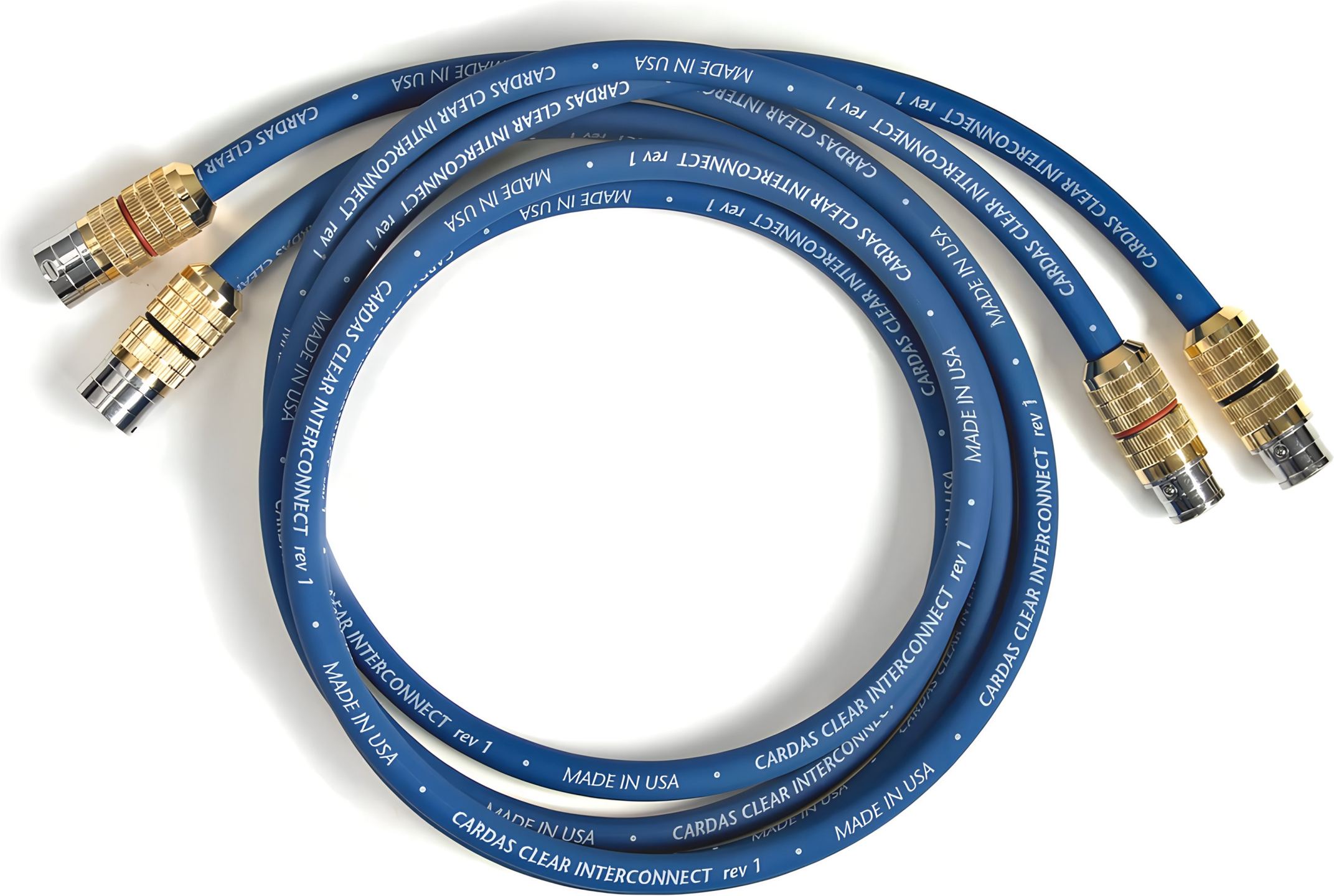
Cardas Clear XLR 2m
Overview
Within the Clear range, this interconnect cable occupies a strategic position: just below the Clear Beyond (the flagship product) and above the Clear Reflection. It represents the culmination of research carried out by George Cardas into Matched Propagation technology, patented in 2008 (US Patent 7,674,973). The Clear XLR follows a lineage that has steered the American brand from the Golden Reference series toward a more transparent and analytical approach to audio signal transmission.
A problem solved at the source
The design of the Clear is based on a technical observation: in a conventional audio cable, the electrical signal travels through the conductors at nearly the speed of light, while the dielectric charge (the insulator) moves about 30% more slowly. This time lag causes the signal to smear and leads to a loss of micro-information.
Rather than correcting this problem downstream with filter networks or loading coils (as some manufacturers do), George Cardas chose to deliberately slow propagation in the conductors in order to synchronize it with that of the dielectric. This harmonization is achieved through precise control of the twist angle of the various layers of conducting strands. The result is a cable in which the signal remains coherent throughout its journey.
Geometry dictated by mathematics
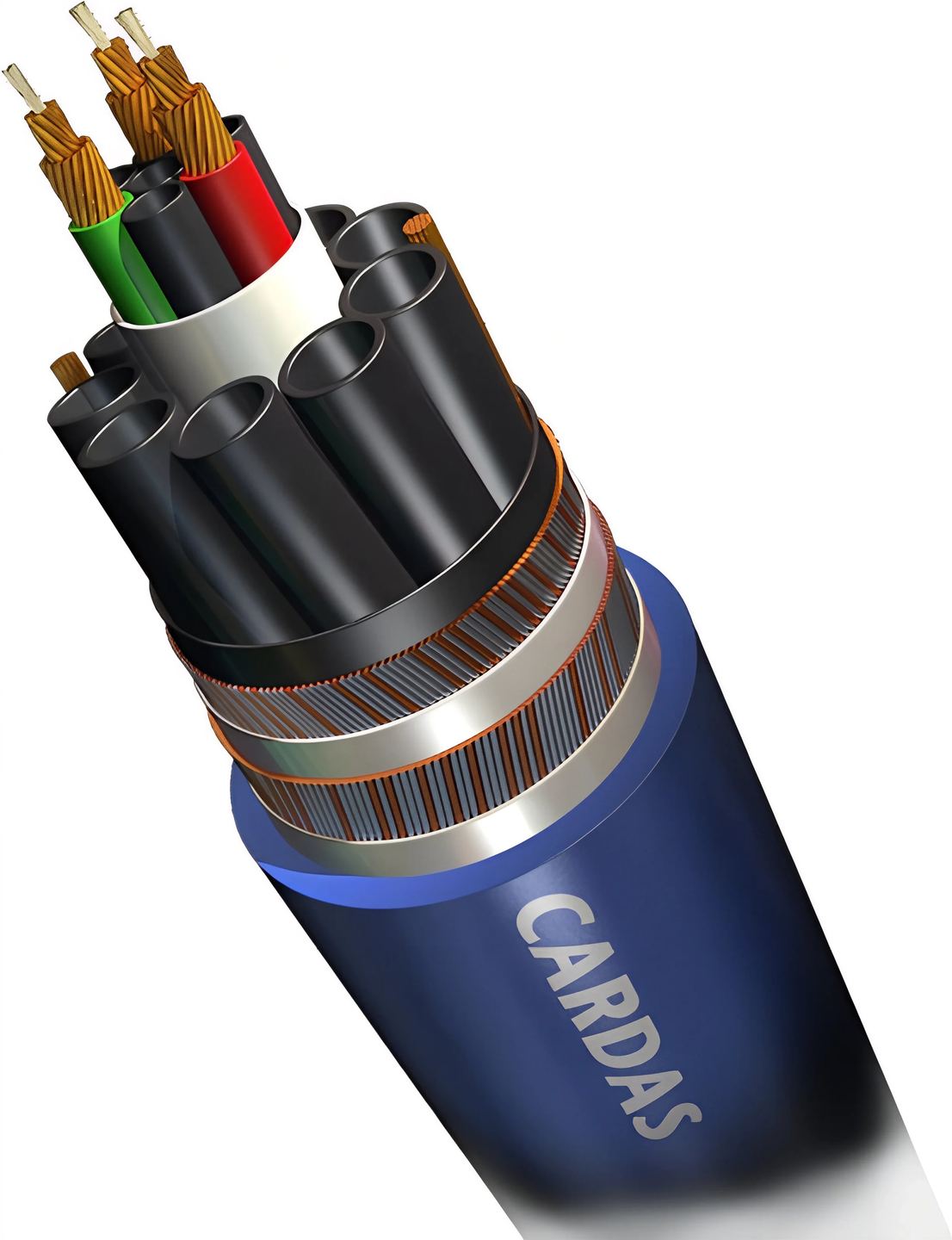
The Clear XLR uses an equilateral triad configuration with three conductors. Each conductor is made up of ultra-fine copper strands (from 41 to 39 AWG) wound around a Kevlar core. The gauges of these strands follow the proportions of the golden ratio (1:1.618), a mathematical constant that George Cardas has used since founding his brand in 1987.
This approach, called Golden Section Stranding, is based on a principle: strands of identical size share the same resonance frequencies and interfere with one another. By using irrational gauges relative to each other, each strand cancels the resonance of its neighbor. The manufacturer refers to this as a “silent conductor.”
No-compromise materials
The copper used is Grade 1, with 99.9999% purity (6N). Cardas is one of the few manufacturers to draw its own copper, starting from ingots produced to its specifications by an American foundry. Each strand is immediately given a transparent SPN coating to prevent any oxidation, a technique inherited from Litz conductors used in high-frequency transformers.
Conductor insulation is provided by PTFE (Teflon) extruded in an ultra-thin layer. The internal geometry combines antistatic LDPE air tubes, held in place by a PTFE tape impregnated with carbon. The outer layer uses PTFE air tubes sized according to the 1.618 ratio relative to the central tubes, which suspends the composite shielding (tinned copper and magnet wire) at a distance from the signal conductors. The outer sheath in extruded TPR (thermoplastic rubber) gives the cable a welcome flexibility in everyday use.
CG XLR connectors
The standard terminations are proprietary Cardas CG XLR connectors, manufactured in the Bandon, Oregon workshop. These rhodium/gold connectors replace the Neutrik models used on previous versions and provide an airtight seal that protects the contact points. Each cable is hand-terminated by a team of nine specialized technicians, under the supervision of head terminator Jesus Ornelas, who has been with Cardas since 1993.
Positioning within the Clear range
The Clear range is available in several levels, from Clear Sky (entry level) to Clear Beyond (top of the line). The standard “Clear” occupies the second position, just below the Beyond. Compared to the Clear Reflection (which borrows some traits from the now-discontinued Golden Reference for a slightly warmer presentation), the Clear focuses on neutrality and transparency. Compared to the Clear Beyond, it offers a four-conductor construction instead of eight, and an outer diameter of 11.43 mm versus 13 mm.
Technical specifications
Connectors
- Standard connectors: Cardas CG XLR
Conductors
- Kevlar core with adapted propagation
- Material: high-grade, oxygen-free pure copper, 99.9999% purity
- Construction: ultra-fine with transparent SPN coating (Litz)
- Gauges: from 41 AWG to 39 AWG, sized according to golden ratio proportions
- Geometry: layered with crossed fields
- Insulation: ultra-thin extruded PTFE jacket
Geometry and construction
- Configuration: 3-conductor equilateral triad
- Antistatic air tubes in LDPE held in place by carbon-impregnated PTFE tape
- Outer layer: PTFE air tubes sized 1.618 times larger than the central tubes to suspend the composite shielding
- Shielding: composite of tinned copper and magnet wire, spaced away from the signal conductors
- Outer jacket: ultra-flexible extruded TPR
Dimensions
- Gauge: 3 × 25.5 AWG
- Outer diameter: 11.43 mm
Frequently Asked Questions
What is the difference between Clear and Clear Reflection?
Clear Reflection combines elements of the Golden Reference (a touch of warmth in the midrange) with Matched Propagation technology. Clear takes a more neutral and analytical approach. Clear uses three conductors in an equilateral configuration, while Reflection employs a twisted pair suspended in air with double shielding.
Does the Clear XLR perform just as well over long distances?
Cardas indicates that the performance of the Clear remains consistent regardless of length. Matched Propagation technology eliminates the differential propagation issues that typically affect long cables.
Does the cable require break-in?
Yes. Allow several dozen hours of use before the cable reaches its final tonal balance. Some users employ accelerated break-in devices to shorten this period.
Can I use this cable with any equipment?
Clear is designed for high-end systems capable of revealing the nuances it preserves. On an entry-level system, its qualities will be less noticeable, and a model from the Clear Sky or Cygnus range may be sufficient.
Does Cardas manufacture its own conductors?
Yes. Unlike most cable manufacturers who buy their copper wire, Cardas draws its own conductors from copper ingots produced to its purity specifications.
- Eco-contribution included in the sale price.




