

Audioquest Rocket 44 (2 x 1.5m)
Overview
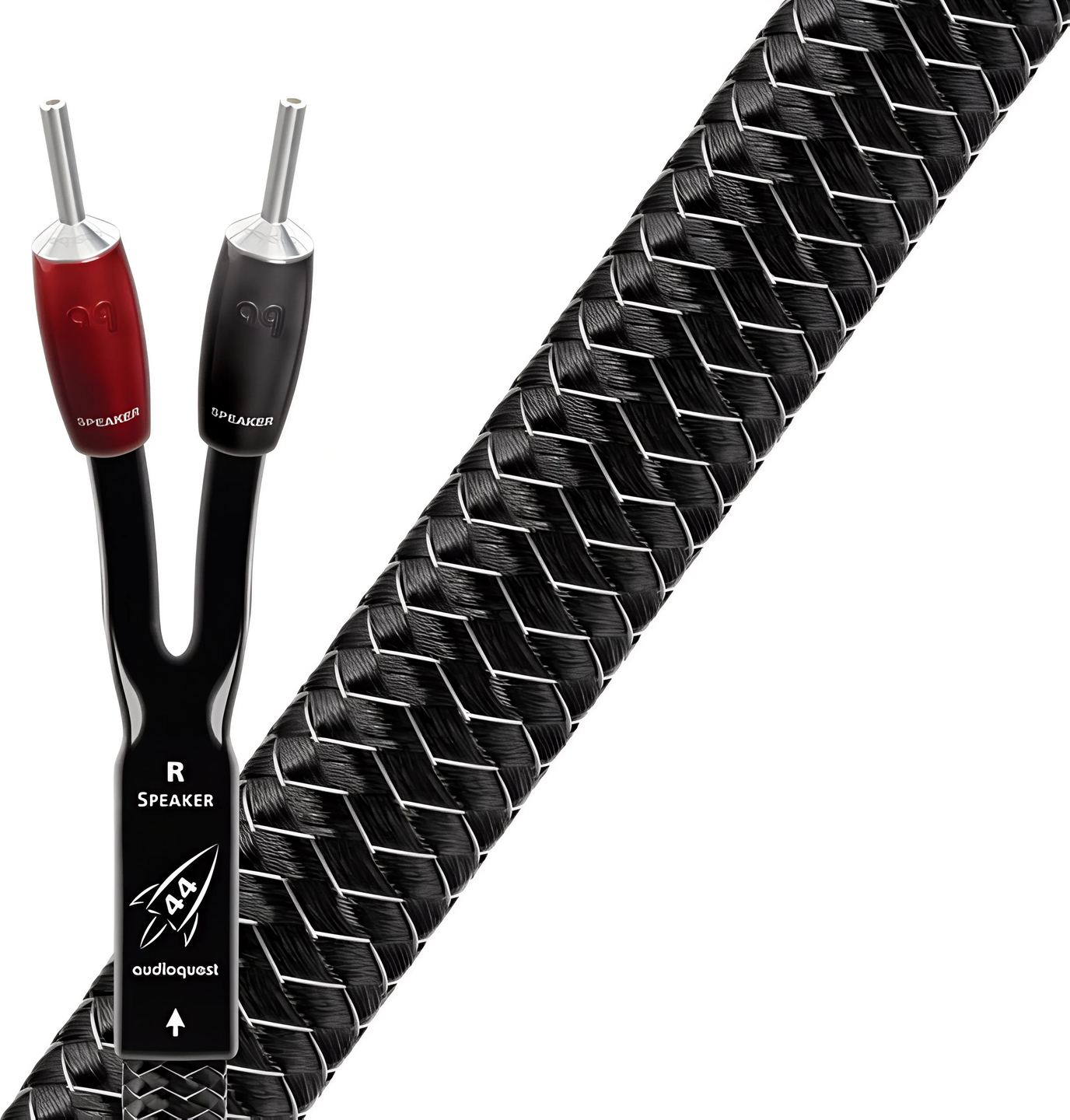
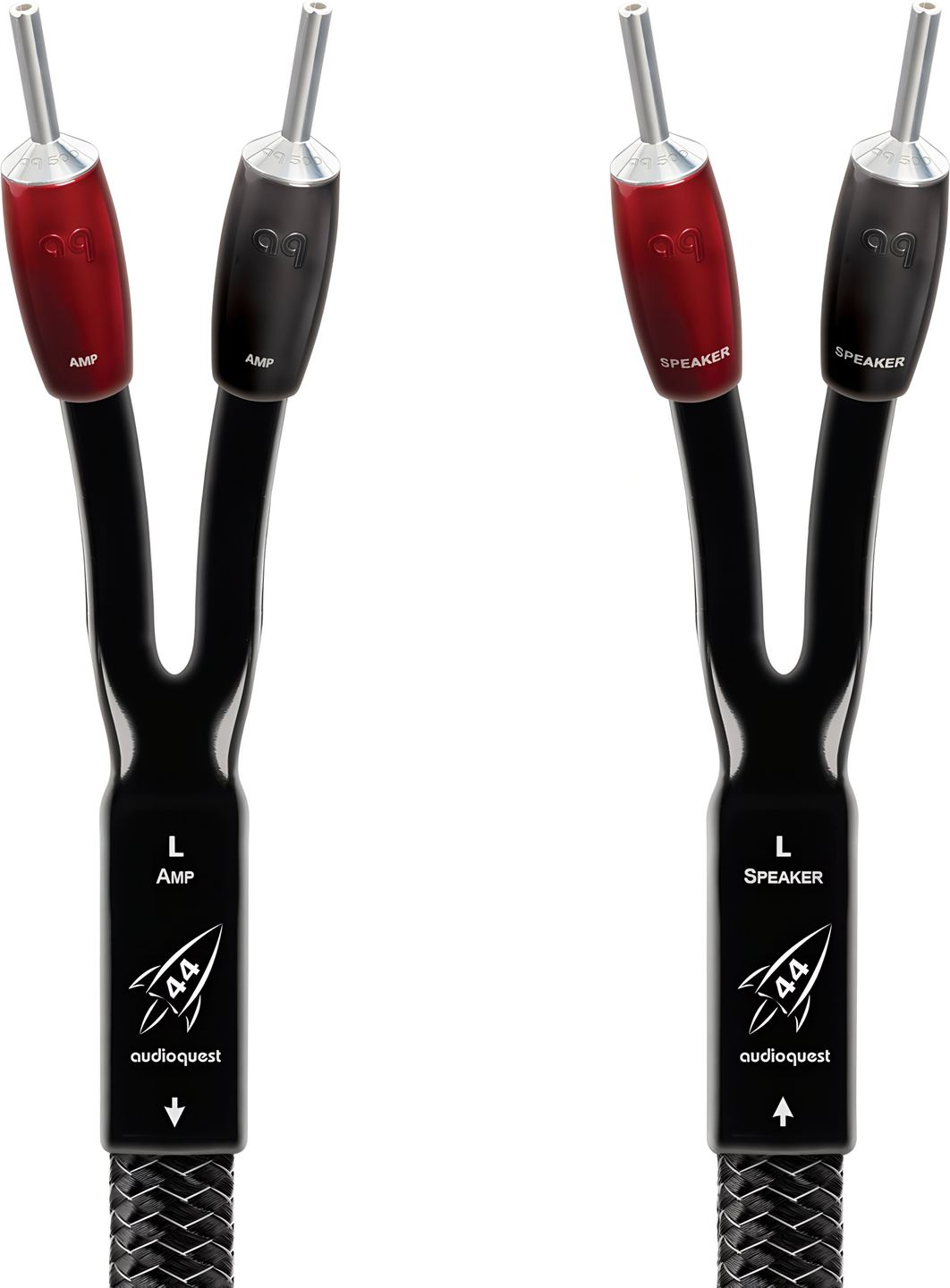
The second most advanced cable in the Rocket series, the Rocket 44 adopts the Double Star-Quad geometry of AudioQuest’s higher-end models while introducing PSC+ copper into its conductor assembly. It stands out from the Rocket 33, its predecessor in the range, through superior metal quality and a more generous cross-section of 3.31 mm² (13 AWG gauge). The cable is supplied here as a 2-meter pair, terminated with silver-plated banana plugs.
Solid conductors and high-purity copper
AudioQuest uses exclusively solid-core conductors across its entire Rocket range. This choice eliminates strand interaction that occurs in multi-strand conductor cables, a well-documented source of dynamic distortion. The Rocket 44 combines two proprietary types of copper: PSC (Perfect-Surface Copper) and PSC+ (Perfect-Surface Copper+). PSC+ has a smoother surface and fewer grain boundaries than common OFC, OCC, or 8N copper. These grain boundaries, present in any metallic conductor, are areas of crystalline discontinuity where the signal undergoes micro-reflections. Reducing their number limits listening harshness, particularly in the upper part of the spectrum.
The Rocket 33 combines PSC copper with LGC (Long-Grain Copper), a lower-grade copper than PSC+. The move to PSC+ in the Rocket 44 is the most significant technical difference between the two models.
A geometry that separates bass and treble
The Double Star-Quad arrangement organizes the eight conductors into two groups of four, each arranged in a star pattern. This geometry controls the cable’s capacitance and inductance values more precisely than a simple parallel assembly or twisted pairs. AudioQuest has calibrated the two groups in a complementary way: one is optimized for finesse in the treble, the other for energy in the bass. Used together in full-range mode, they form a cable balanced across the entire spectrum.
This arrangement has a notable practical advantage: the Rocket 44 can operate in bi-wiring. When the two Star-Quad groups are separated on the speaker side (via a dedicated termination pants, sold separately), each group independently feeds the speaker’s bass or treble terminals. This creates double bi-wiring from a single physical cable, simplifying routing and reducing bulk compared with two separate pairs. The cable is also available in a bi-amping configuration (4 plugs on each side) for systems that require it.
Three levels of interference treatment
The Rocket 44 stacks several measures to limit radio-frequency (RF) noise, a recurring issue with speaker cables that can act like antennas.
The four negative conductors are jacketed with carbon-loaded polyethylene, a partially conductive material. This coating serves two functions: it absorbs RF noise before it travels back to the amplifier, and it attenuates crosstalk between positive and negative conductors. An external carbon-based dissipation layer wraps the entire cable to reduce outside interference. Finally, all conductors are factory-oriented (Direction-Controlled): the granular structure of drawn copper presents directional asymmetry that affects the path of RF noise. AudioQuest tests each conductor to determine the direction that best drains induced noise, then installs it in that orientation.
Foamed polyethylene insulation
Any solid material in contact with a conductor absorbs part of the signal energy, stores it, then releases it as distortion. This is the main flaw of conventional dielectrics such as PVC. The Rocket 44 uses foamed polyethylene on its positive conductors. This material contains a high proportion of air, and air absorbs virtually no energy. Polyethylene itself also has a low distortion profile. The combination of the two reduces the blurring effect that less effective insulation materials can introduce.
The negative conductors, meanwhile, are insulated with the carbon-loaded polyethylene mentioned above, which simultaneously provides insulation and RF treatment.
SureGrip 500 connectors and cold welding
The SureGrip 500 banana plugs terminating this version of the Rocket 44 are machined from a single piece of high-purity Purple Copper, with no brass. The silver plating is applied by dipping (“Hanging Silver”) directly onto the copper, with no intermediate layer of nickel or any other metal. AudioQuest uses a cold-welding technique to attach the conductor to the plug: the cable is mechanically compressed into the connector without heat or solder, preserving the conductor’s metallurgical integrity at the termination point.
Technical Specifications
Conductors
- High-purity PSC and PSC+ conductors
- Blend of very high-purity PSC and PSC+ copper
- Extremely smooth surface reducing distortion
- Fewer grain boundaries for a smoother signal
- Improved clarity and sonic fidelity
- Direction-controlled conductors
- Optimization of signal flow direction
- Reduction of induced noise
- Better management of interference dissipation
Noise Dissipation
- Carbon-based technology
- Negative conductors coated with carbon-loaded polyethylene
- Reduction of radio-frequency (RF) interference
- Lower background noise
- Improved spatialization and sonic dimension
Geometry
- Double Star-Quad configuration
- Optimization of the relationship between conductors
- Reduction of parasitic capacitance and inductance
- Less distortion than parallel or twisted cables
- Better audio signal stability
Insulation
- Foamed polyethylene insulation
- Air-rich insulation
- Very low energy absorption
- Reduction of blurring and energy storage effects
- Improved sonic transparency
Audio Performance
- Clearer, more detailed sound
- Reduced background noise
- Better stereo imaging
- Greatly reduced distortion
- Faithful reproduction of the original signal
Frequently asked questions
Can the Rocket 44 be used for bi-wiring without buying two pairs?
Yes. The Double Star-Quad geometry allows the two conductor groups to be separated on the speaker side to independently feed the bass and treble terminals. You need a bi-wire termination pants (Rocket 44 Single-BiWire Termination Pants) and the corresponding terminated cable version (2 plugs on the amplifier side, 4 plugs on the speaker side). The version sold here is in full-range configuration (2 plugs on each side).
What is the real difference between the Rocket 33 and the Rocket 44?
The Rocket 33 uses PSC and LGC copper, while the Rocket 44 replaces LGC with PSC+, a purer copper with fewer grain boundaries. The Rocket 44 also has a slightly larger cross-section. The Double Star-Quad geometry and the carbon dissipation system are identical on both models.
Why doesn't the Rocket 44 have a DBS system (battery) like the Rocket 88?
The DBS (Dielectric-Bias System) applies a continuous 72 V voltage to the insulation to polarize its molecules and reduce dielectric-related distortion. AudioQuest reserves this system for its higher-end cables. The Rocket 44 partly compensates through the use of foamed polyethylene, whose distortion profile is naturally low.
Are the banana plugs compatible with all speaker terminals?
The SureGrip 500 plugs in standard 4 mm banana format fit the vast majority of speaker terminals. They are also compatible with insulated terminals compliant with European standards, on which spade connectors can sometimes be difficult to tighten properly.
Can the Rocket 44 be used with low-impedance speakers (4 ohms or less)?
The 3.31 mm² (13 AWG) cross-section is sufficient for 2-meter lengths with low-impedance speakers. For longer lengths (beyond 5-6 meters) and very low loads, a larger cross-section may be preferable.
- Eco-contribution included in the sale price.