Pro-Ject Phono Box DS3 B black


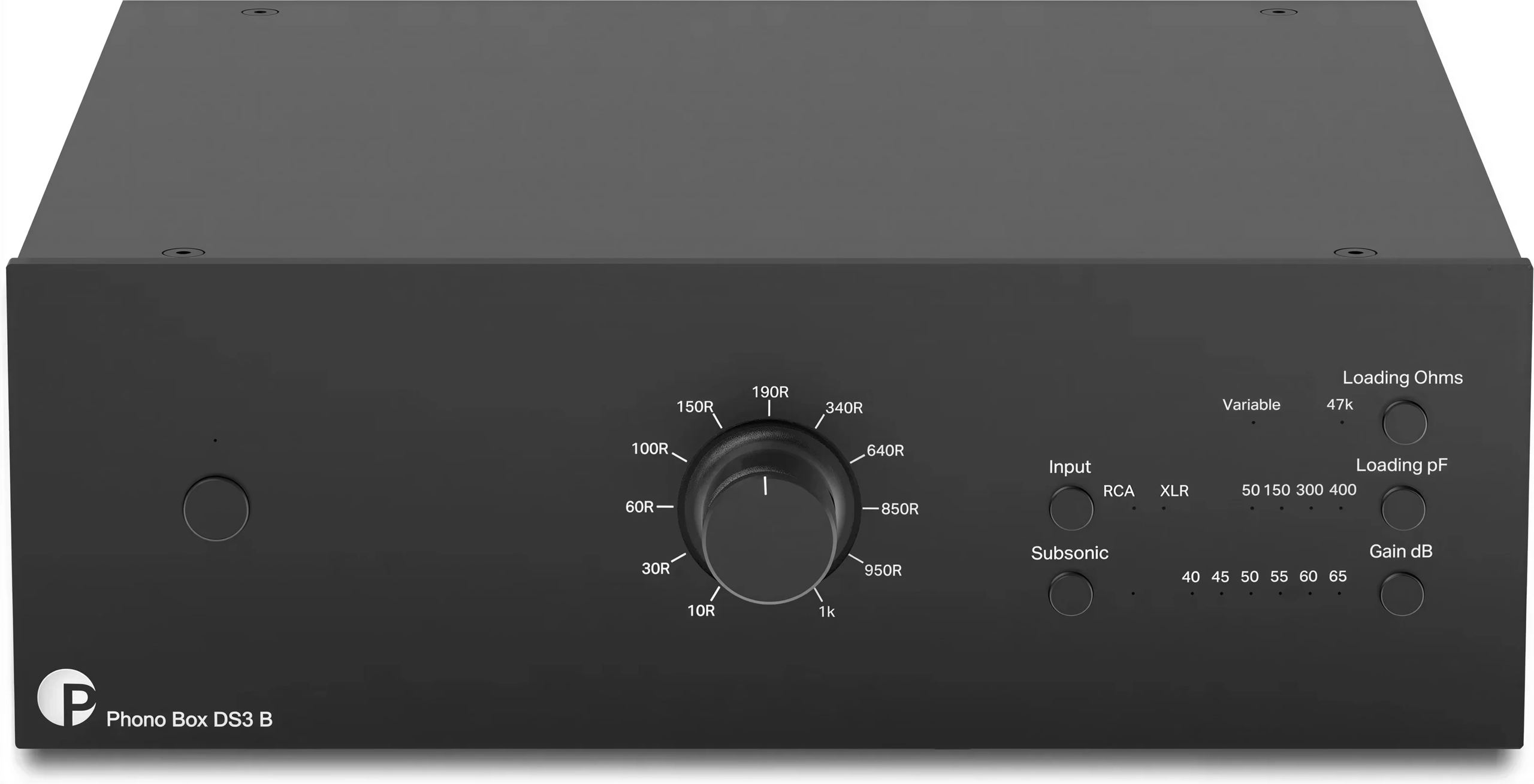

Pro-Ject Phono Box DS3 B: balanced and discrete phono preamp
At Pro-Ject Audio Systems, balanced connections had until now been reserved for the RS range, the top of the catalog. The Phono Box DS3 B adopts several technologies from the Phono Box RS2 (balanced gain stage, passive RIAA equalization, continuously adjustable impedance via potentiometer) and makes them accessible in a compact format manufactured in Europe. Successor to the Phono Box DS2, it adds XLR connectivity, a fully discrete circuit with no operational amplifiers, and a dual mono design.
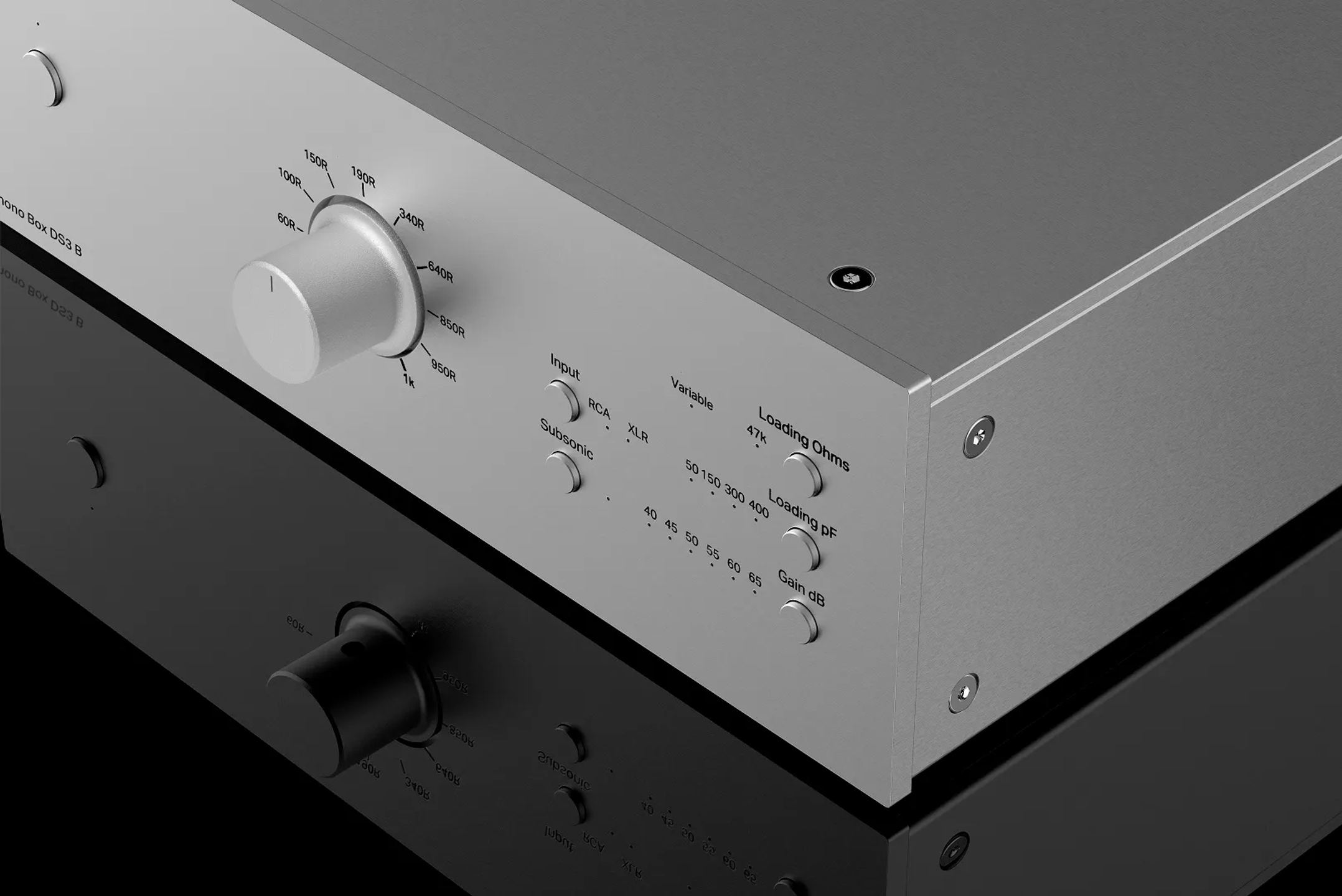
A balanced gain stage with no operational amplifiers
The “B” in the name stands for “Balanced.” The gain stage of the Phono Box DS3 B operates in full balanced mode: the signal is processed through two separate chains (hot and cold), each with its own amplification section. This differential processing rejects interference picked up during transmission, since any noise common to both conductors is subtracted when the signal is recombined.
The entire audio circuitry is based on discrete components (transistors, resistors, individual capacitors) with no operational amplifiers at all in the signal path. After years of comparative listening tests, Pro-Ject believes that discrete circuits deliver a more neutral and more dynamic sound than integrated circuits. The number of components used is far greater than in an operational-amplifier phono preamp, which makes manufacturing more complex but is intended to achieve a measurable qualitative improvement.

Passive and split RIAA equalization
The RIAA equalization stage is also fully passive and discrete. The correction is split into independent sections, an approach that promotes better impedance matching and reduces deviation from the theoretical RIAA curve. Pro-Ject specifies accuracy within 0.25 dB over the 20 Hz – 20 kHz range, a figure that places the DS3 B at a level of precision usually associated with more expensive devices. The Phono Box RS2, with its ±0.4 dB accuracy, also shows a wider tolerance on this parameter.
The XLR outputs benefit from a dedicated discrete balancing stage, while the RCA outputs have their own discrete output stage fed directly by the RIAA equalizer. The two output paths are independent.
Continuous impedance adjustment during listening
The large front-panel potentiometer, inherited from the Phono Box RS2, allows the load impedance to vary continuously from 10 to 1,000 ohms, with no steps or increments. This system, patented by Pro-Ject Audio Systems, allows transparent adjustment during playback: it is possible to turn the potentiometer while listening to a record and immediately hear the effect of the impedance change on the sound. Finding the right load value for an MC cartridge becomes an empirical, fast, and intuitive process.
For MM cartridges, the impedance is fixed at 47 kΩ. Load capacitance can be set in four steps (50, 150, 300, and 400 pF), which covers the majority of cartridges on the market. The low 50 pF value is useful for compensating for the capacitance added by long or average-quality interconnect cables.
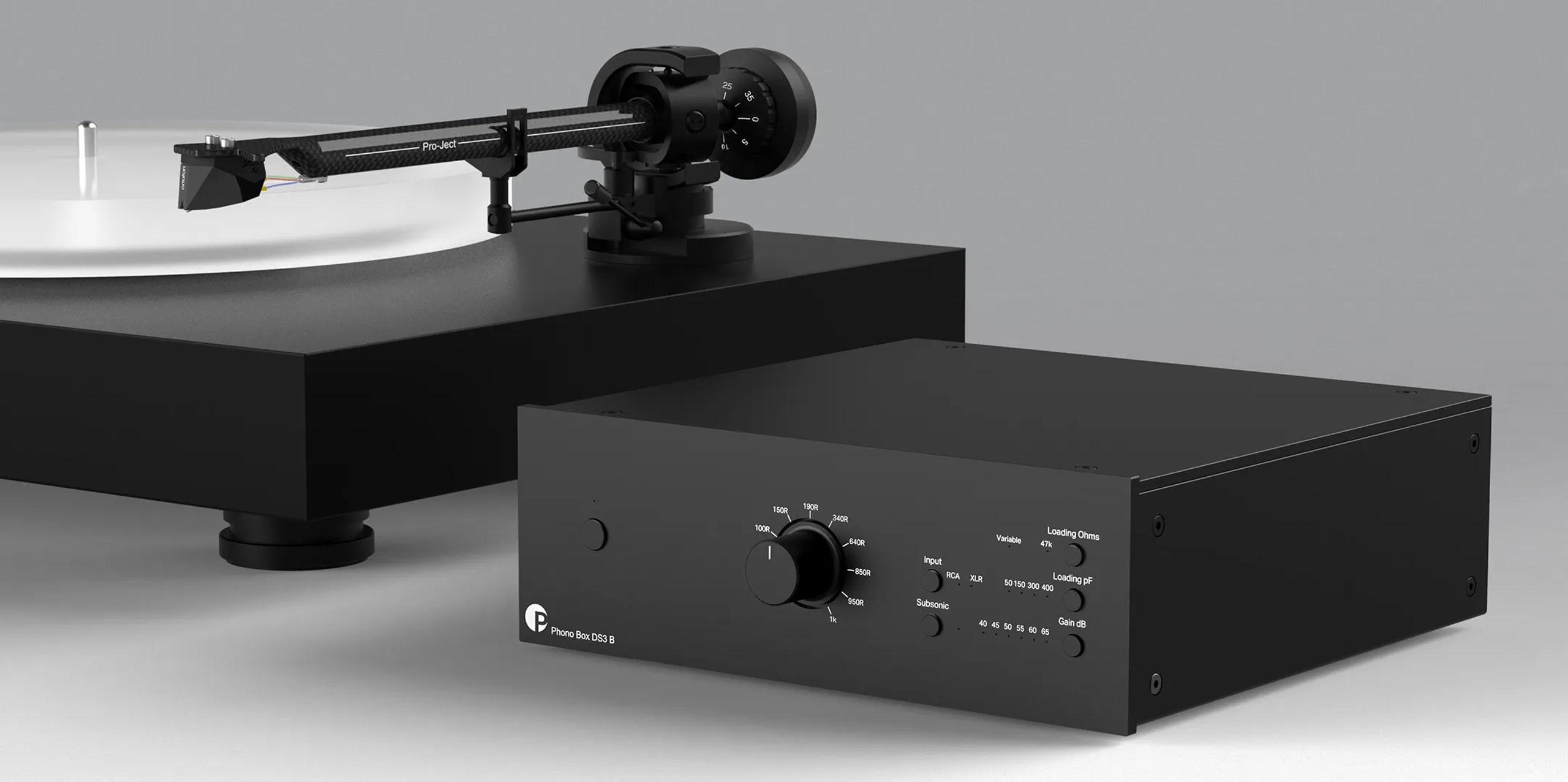
Six gain levels and MM/MC cartridge compatibility
Gain is switchable in six steps: 40, 45, 50, 55, 60, and 65 dB, with a 6 dB bonus on the XLR outputs. This fine breakdown (in 5 dB steps) is a concrete advantage over the Phono Box S3 B, its little brother, which offers only four steps (40, 45, 60, and 65 dB) and imposes a 15 dB jump between MM and MC settings. The intermediate 50 and 55 dB values of the DS3 B make matching easier with medium-output MC cartridges or low-output moving iron (MI) cartridges, since gain is not tied to a fixed MM or MC mode.
Two connected turntables, settings saved
The Phono Box DS3 B accepts two turntables simultaneously: one via the XLR inputs (standard XLR pair or 5-pin mini XLR), the other via the RCA inputs. A front-panel button lets you switch from one input to the other. Settings (gain, impedance, capacitance) are stored individually for each input and recalled automatically when switching. This avoids having to reconfigure the device every time you change turntable or cartridge.
The stereo 5-pin mini XLR input is compatible with Pro-Ject’s “True Balanced Connection” cables. It carries both channels on a single connector with a separate ground connection. Any Pro-Ject turntable equipped with an RCA, mini XLR, or 5-pin output can be connected to the DS3 B.
Shielded construction and refined finishes
The steel chassis is covered with screwed-on aluminum panels (not clipped on), a construction that ensures mechanical rigidity and shielding against electromagnetic interference. This type of protection is all the more important because the high-gain discrete circuit is sensitive to stray fields. Pro-Ject recommends keeping the device away from the large transformers of power amplifiers, whose radiation can pass through the enclosure despite its thickness.
The external switching power supply (18 V / 500 mA) is placed outside the chassis to avoid any electromagnetic contamination of the audio circuit. Its standby power consumption is less than 0.5 W. To go further, Pro-Ject offers the optional Power Box DS2 Sources linear power supply, which uses a low-core-saturation transformer with shielding between windings. This power supply, with dimensions comparable to the preamp itself, provides cleaner current and reduces the transformer’s mechanical micro-vibrations.
Magnetic wooden side panels are available separately in several wood types (walnut, eucalyptus, rosewood). They attach magnetically, without tools. The device is available in silver or black finish.
Subsonic filter and trigger inputs/outputs
A front-panel switchable subsonic filter cuts frequencies below 20 Hz with an 18 dB per octave slope. This filter removes unwanted infrabass (turntable rumble, tonearm resonances, record warps) without affecting the audible band. It is useful with bass-reflex speakers or subwoofers that are sensitive to subsonic signals.
The trigger inputs and outputs (2.5 mm jack, 12 V) make it possible to synchronize powering on the DS3 B with another Pro-Ject Box device or a compatible amplifier. Powering on the turntable can trigger the preamp to switch on as well, which simplifies daily use.
Documentation
Technical specifications
Inputs
- Input connectivity
- 1 mini 5-pin XLR
- 1 pair of XLR
- 1 pair of RCA
- Input impedance: continuously variable from 10 to 1000 ohms, or fixed at 47 kOhms
- Input capacitance: 50, 150, 300, 400 pF
- Compatible with MM and MC cartridges
- Ability to connect two turntables simultaneously, with settings stored for each input
- Settings accessible from the front panel
Amplification stage
- Fully balanced and discrete gain stage (new)
- Fully discrete audio circuitry, without operational amplifiers (new)
- Dual mono design
- Switchable gain: 40, 45, 50, 55, 60, 65 dB (+ 6 dB on the XLR output)
- Continuous impedance matching via potentiometer, Pro-Ject Audio Systems patented system allowing transparent adjustment during playback
- Extremely precise matching of MC cartridges
RIAA equalization
- Fully passive and discrete RIAA equalization (new)
- RIAA equalization accuracy: < 0.25 dB from 20 Hz to 20 kHz
- Subsonic filter: at 20 Hz with an 18 dB / octave slope
- Fully separate passive equalization for better impedance matching and minimal deviation from the ideal RIAA curve
Outputs
- Line output
- 1 pair of RCA
- 1 pair of XLR
- Balanced XLR inputs and outputs (new)
- Balanced mini 5-pin XLR input (new)
- XLR connector pinout: 1 ground, 2 “hot”, 3 “cold”
- Discrete balanced output stage for XLR outputs
- Independent discrete output stage for RCA outputs, fed directly by the RIAA equalizer
Audio performance
- MM signal / noise ratio (40 dB): 104 dBV, 111 dBV A-weighted
- MC signal / noise ratio (60 dB): 85 dBV, 91 dBV A-weighted
- Total harmonic distortion at 1 kHz: < 0.001 % in MM, < 0.004 % in MC
- Total harmonic distortion (20 Hz - 20 kHz): < 0.005 % in MM, < 0.01 % in MC
- Low noise and low distortion
Power supply
- External power supply: 18 V / 500 mA DC
- Consumption: 18 V / 290 mA DC maximum, < 0.5 W in standby
- Trigger input and output: 12 V on / off detector
- External switching power supply, compliant with legal requirements (guaranteed standby consumption of 0.1 W)
- Compatible with the optional Power Box DS2 Sources linear power supply for improved performance
Construction
- Steel chassis covered with screwed aluminum panels, ensuring excellent rigidity and effective insulation against interference
- Solid aluminum housing protecting against interference
- Magnetic wooden side panels available separately
- Available finishes: silver or black
Dimensions and weight
- Dimensions: 20.6 x 7.2 x 19.4 cm (19.5 cm with connectors)
- Weight: 1480 g without power supply
Frequently Asked Questions
Does the Phono Box DS3 B work with an MM cartridge in balanced mode?
MM cartridges do not allow full use of the balanced connection because of their internal wiring, which connects one point of the coil winding to chassis ground. The balanced gain stage of the DS3 B remains active with an MM cartridge (it optimizes the signal-to-noise ratio in all cases), but end-to-end balanced transmission requires an MC cartridge.
What are the main differences compared with the Phono Box S3 B?
The DS3 B adds a pair of standard XLR inputs (in addition to the mini XLR), the continuously adjustable impedance potentiometer (the S3 B has only fixed steps), and two additional gain levels (50 and 55 dB). The enclosure is larger and heavier (1,480 g versus about 920 g for the S3 B).
Can the DS3 B be used with a turntable from a brand other than Pro-Ject?
Yes. The RCA inputs are universal. For the balanced XLR connection, the turntable or tonearm must have an XLR or 5-pin mini XLR output. Some high-end turntables from other manufacturers offer this connectivity.
Does the Power Box DS2 Sources linear power supply bring an audible improvement?
Pro-Ject presents this power supply as improving the cleanliness of the supplied current. The low-core-saturation transformer and shielding between windings reduce mains interference. The improvement depends on the quality of the local electrical network and the sensitivity of the rest of the system. Pro-Ject recommends not placing the power supply in the immediate vicinity of the preamp.
Is continuous impedance adjustment useful with an MM cartridge?
No. In MM mode, the impedance is fixed at 47 kΩ, the universal standard for this type of cartridge. The impedance potentiometer operates only over the 10 – 1,000 ohm range, intended for MC cartridges.
- Eco-contribution of €0.12 included in the sale price.
- GTIN / EAN: 9120097829351