
Hisense 75UR9S 2026

Specifications and features



Overview
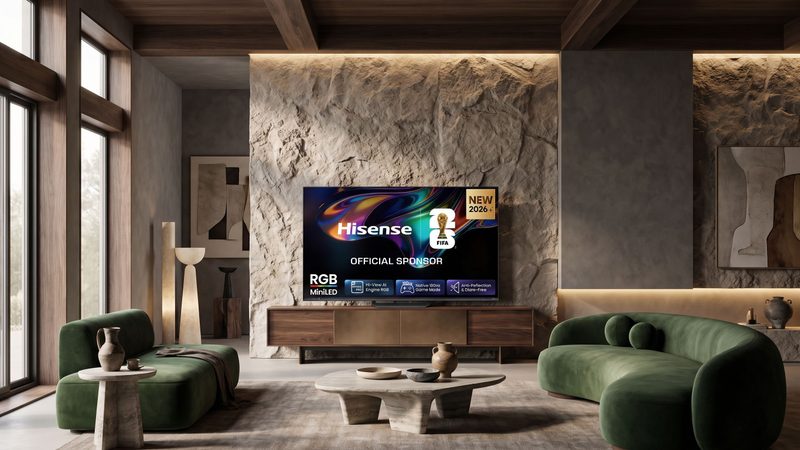
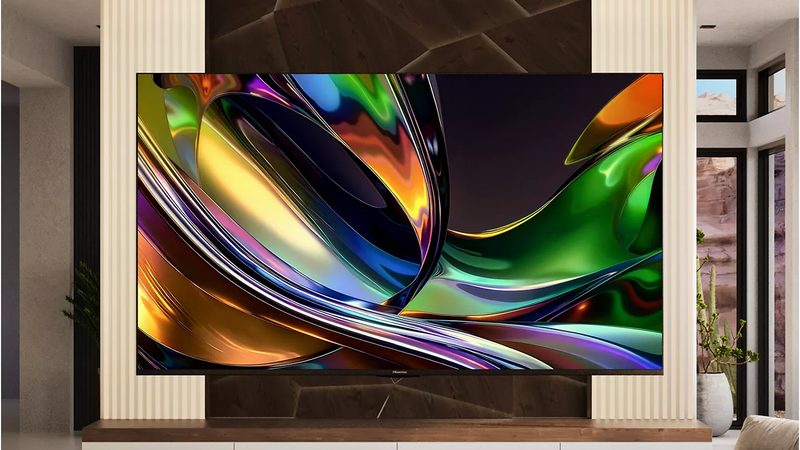
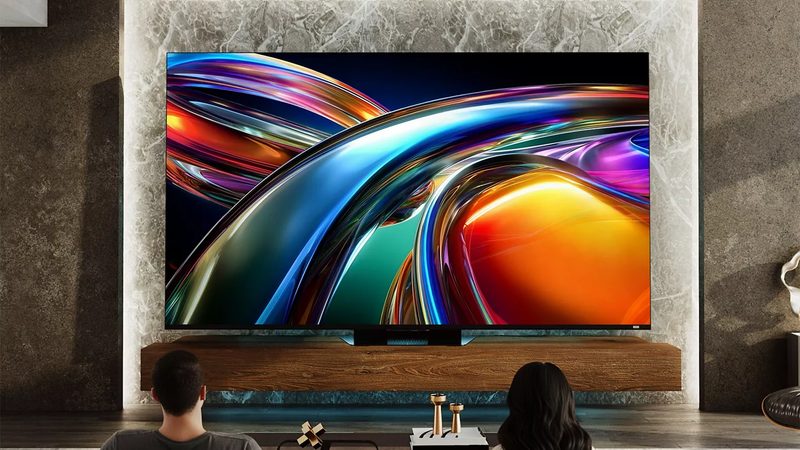
Generate red, green, and blue directly rather than filtering white light: the principle of RGB MiniLED can be summed up in one sentence, but its consequences for the picture require a bit more explanation. In 2026, Hisense is applying this technology to its UR9 range, with this 75-inch model occupying the middle position. The 4K panel reaches 180 Hz native refresh rate, peak brightness is announced at 4000 nits, and the audio section has been tuned with Devialet.
Three diodes instead of one filter
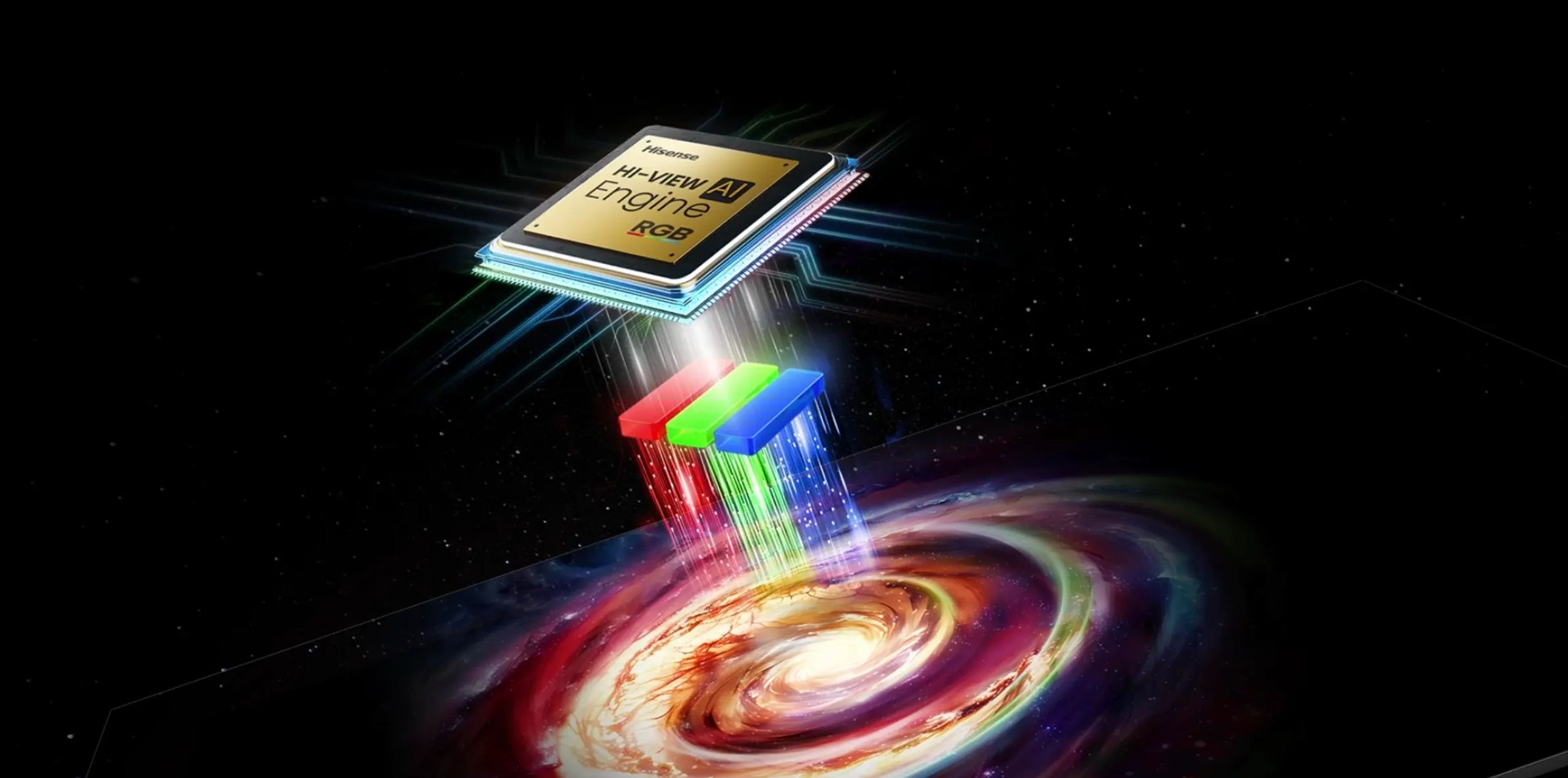
A conventional MiniLED backlight produces white light, which a layer of color filters then splits into red, green, and blue. Each filtering stage costs light output and rounds off the edges of the spectrum. The 75UR9S’s RGB MiniLED backlight removes this step: the diodes emit the three primaries separately, and color is created at the source.
The benefit can be measured on two levels. First, the purity of the primaries, which allows Hisense to claim coverage of up to 100% of the BT.2020 space, a reference that living-room TVs had until now only come remotely close to. Then efficiency, since the light is no longer attenuated by filters. Color depth, however, is still achieved through 8-bit + FRC, a temporal simulation of 10-bit, and not by a native 10-bit panel. On slow, uniform gradients, a twilight sky for example, this method remains theoretically less clean.
Zone-by-zone backlight control
Local backlight control switches off or dims the diodes located behind the dark areas of the image. On an RGB MiniLED screen, each zone modulates not only its intensity but also the composition of its light, which refines the transitions between bright and dark areas. The halo around white subtitles on a black background still depends on how fine the zoning is, and it remains noticeable in the highest-contrast scenes, where a self-emissive panel switches off each pixel individually.
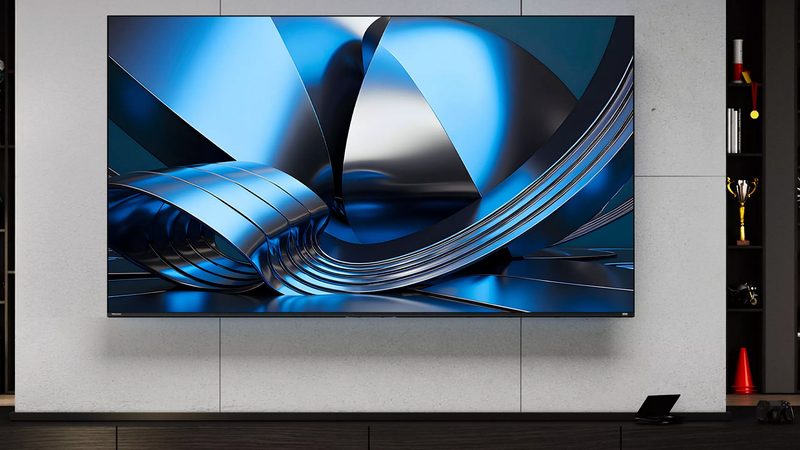
In return, the available brightness far exceeds what an organic panel can sustain over large areas. A desert scene in full sunlight, a metallic reflection, an explosion: the 75UR9S handles these peaks without compressing highlights. Image retention does not exist here, which allows prolonged display of a video game dashboard or a looping news ticker.
The matte panel against windows
The matte anti-reflective treatment may be the most decisive choice for a real living room. A glossy panel reflects a sharp image of the window behind the sofa; a matte panel diffuses this stray light across the entire surface, making it much less distracting. There is a trade-off: diffusion can slightly veil blacks in broad daylight and soften the sense of sharpness. On a screen capable of 4000 nits, the balance clearly tips in favor of the matte treatment, since the brightness reserve easily compensates for the residual veil.
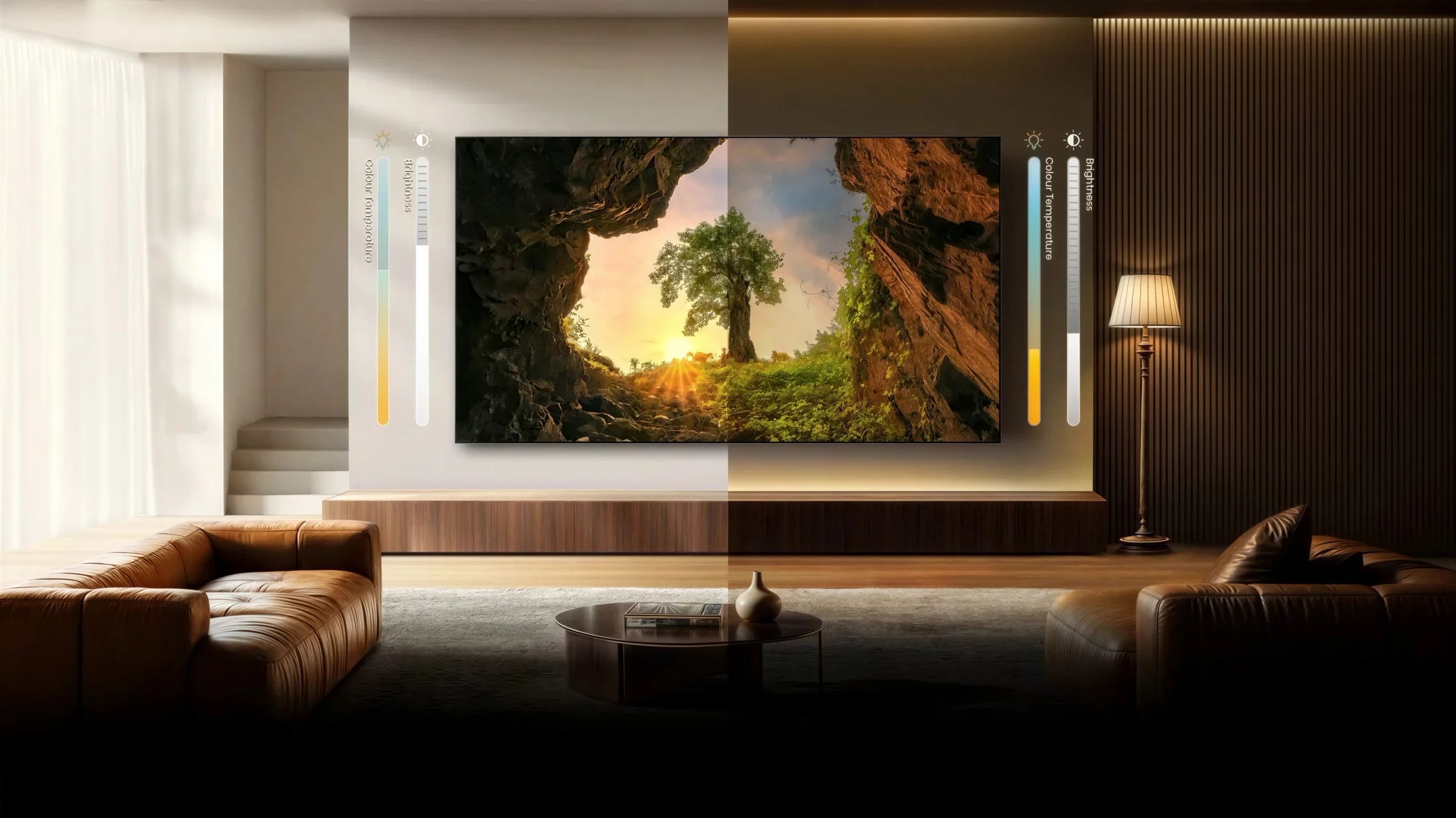
The brightness sensor operates in the same area. It adjusts rendering according to the room’s lighting, and powers Dolby Vision IQ mode, which adapts the HDR image to current conditions rather than the film’s mastering conditions.
The MT9655 and the Hi-View AI engine
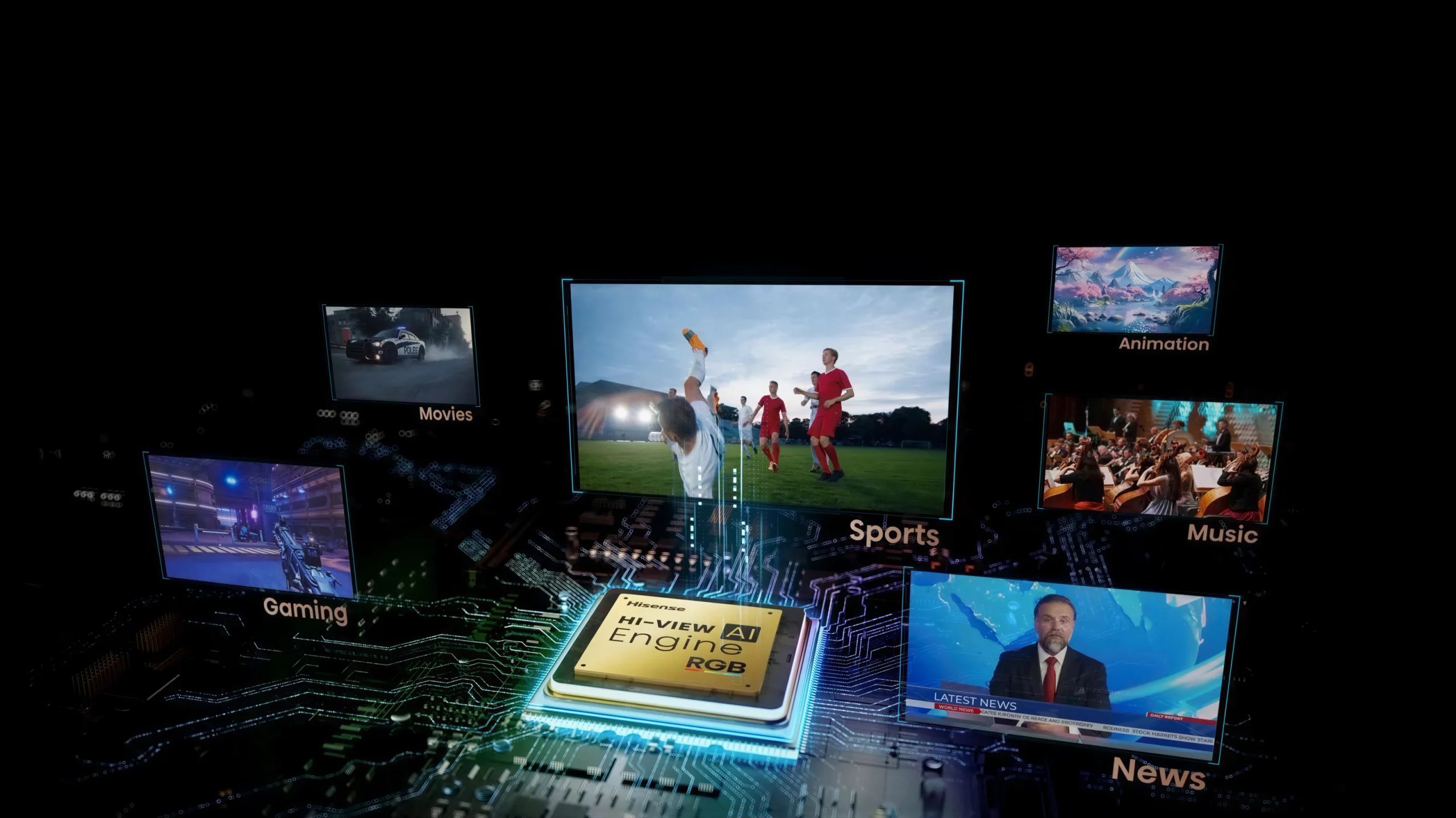
Image processing relies on a quad-core MT9655 processor paired with the Hi-View AI Engine RGB. Its tasks range from upscaling lower-resolution sources to 4K, to MEMC motion compensation, including analysis of colors and brightness levels frame by frame.
MEMC interpolation deserves the usual warning. Pushed too far, it turns 24-frames-per-second cinema rendering into smooth video, an effect many viewers hate. Filmmaker mode disables these processes and respects the original frame rate, white point, and aspect ratio intended by the production. Cinema mode provides a more permissive middle ground. Calman Ready certification opens the door to professional calibration of the TV with the software of the same name, for those who want to pursue colorimetric precision to the fullest.
On the format side, the 75UR9S covers just about everything: Dolby Vision and Dolby Vision IQ, HDR10+ and its Adaptive variant, HDR10, HLG, plus IMAX Enhanced certification. Few TVs handle both competing dynamic HDR formats without sacrificing one of them.
Native 180 Hz, 6.2 ms latency
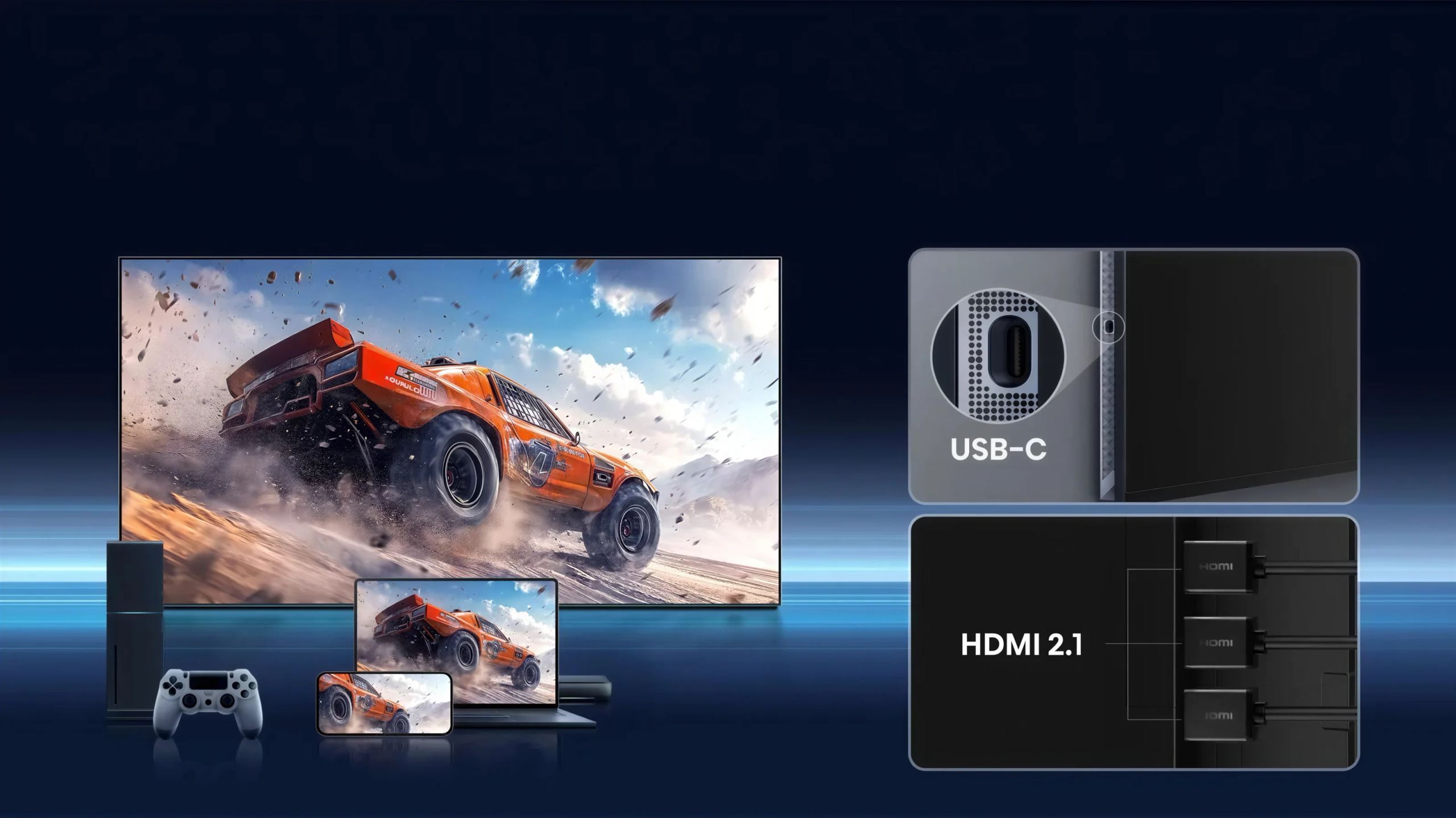
The panel displays natively at 180 Hz, a refresh rate higher than the 120 Hz delivered by current home consoles, and usable by a gaming PC via one of the three HDMI 2.1 ports or the USB-C input compatible with DisplayPort 1.4. HSR mode pushes the refresh rate to 330 Hz by dividing the vertical resolution, a technique that prioritizes fluidity over fine detail.
Input lag drops to 6.2 ms, a value that places this model among the top tier of TVs for gaming. VRR and AMD FreeSync Premium Pro compatibility eliminates screen tearing when the game’s frame rate fluctuates, and ALLM mode automatically switches the TV to its low-latency configuration as soon as a console starts up. USB-C deserves an extra mention: it accepts the video signal from a laptop over a single cable, which simplifies connecting a work or gaming machine.
A 4.1.2 system tuned with Devialet
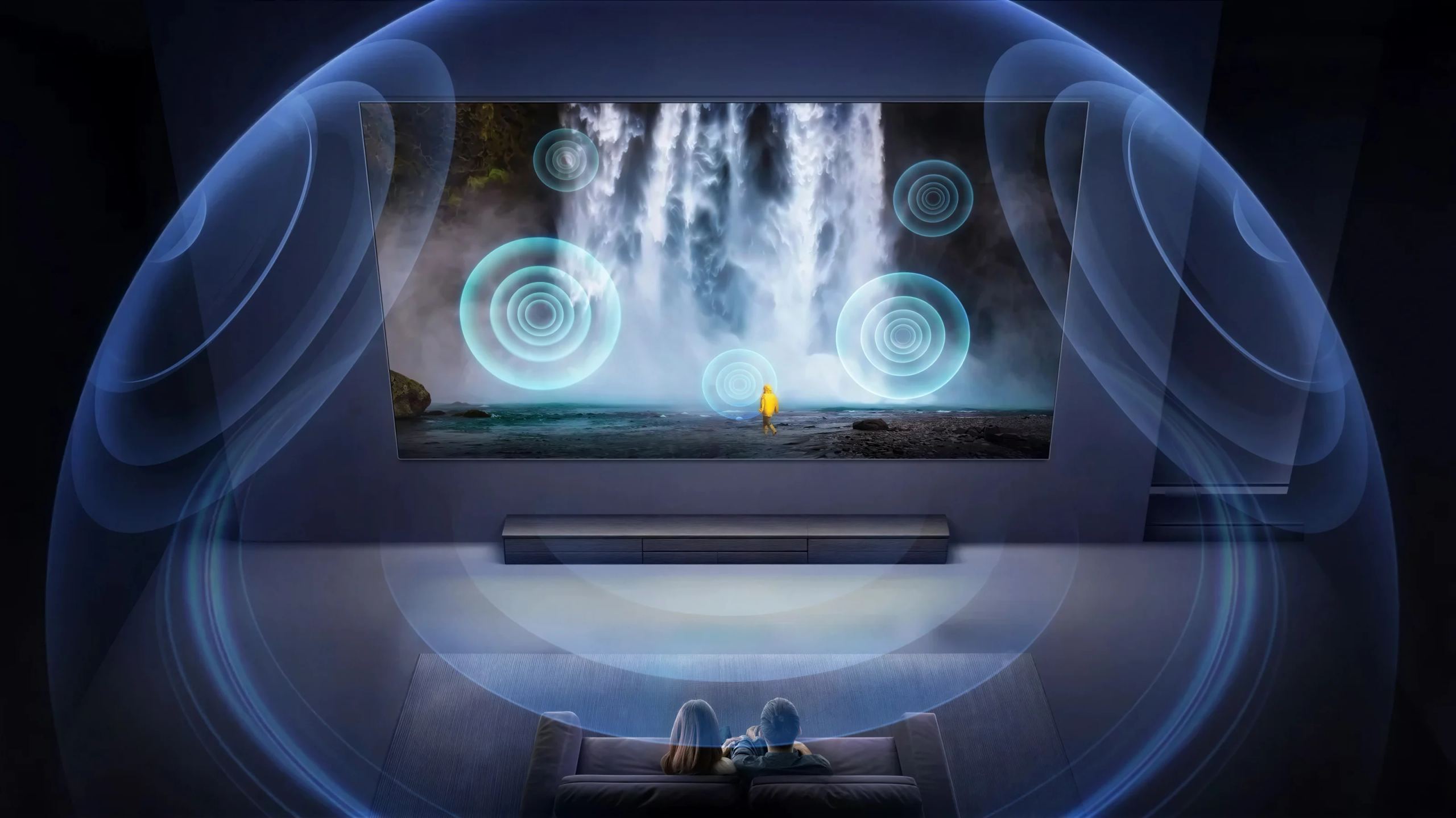
Seven speakers totaling 100 W make up the audio section: two 15 W drivers, two 10 W drivers, one 20 W woofer, and two 10 W upward-firing speakers tasked with projecting height channels toward the ceiling. This 4.1.2 configuration decodes Dolby Atmos without relying solely on software simulation, unlike TVs that make do with two channels and psychoacoustic processing.
Tuning was entrusted to Devialet, and the Room Fitting Tuning function adapts the response to the room’s characteristics. It is important to remain clear-eyed about the physical limits of a 46 mm-thick chassis: bass does not extend very low, and lateral effects remain restrained. For those who want to go further, the HDMI eARC output transmits uncompressed audio streams to a soundbar or audio-video amplifier, and support for WiSA SoundSend allows connection of compatible wireless speakers. An equalizer with advanced settings completes the package.
VIDAA U9.5 and comprehensive connectivity
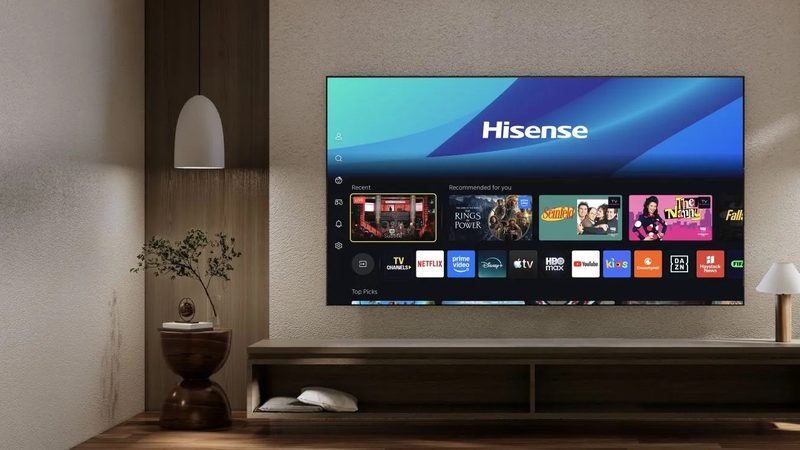
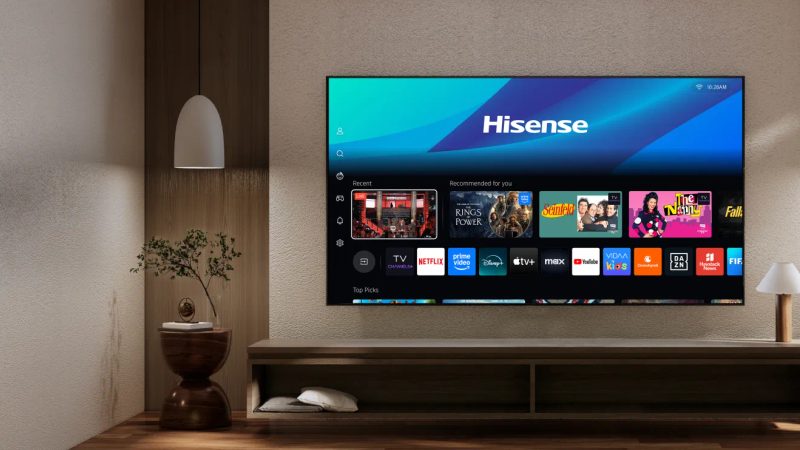
The VIDAA U9.5 interface controls the whole system. It includes Alexa and the in-house Vidaa Voice assistant, a web browser, a media player, AirPlay 2 for sending content from an Apple device, and screen sharing from a computer, phone, or tablet. The VIDAA App Store catalog remains more limited than that of competing systems, even if all the major video-on-demand platforms are present. The included ERF6P66H voice remote provides direct access to several apps.
Connectivity leaves nothing out. All three HDMI ports comply with the 2.1 standard with ALLM, VRR, and 4K at 180 Hz, with the third also carrying eARC. Added to this are one USB 3.0, one USB 2.0, an optical S/PDIF output, a mini-jack audio input, a headphone jack, a composite input, and an Ethernet port. Wi-Fi 802.11ax uses the 6 GHz band, less crowded than 2.4 and 5 GHz, and Bluetooth 5.4 handles wireless headphones. The dual antenna input, DVB-T2/T/C/S2/S tuners, Fransat certification, HbbTV 2.0.4, and CI+ reader cover all French reception modes.
Installation, footprint, power consumption
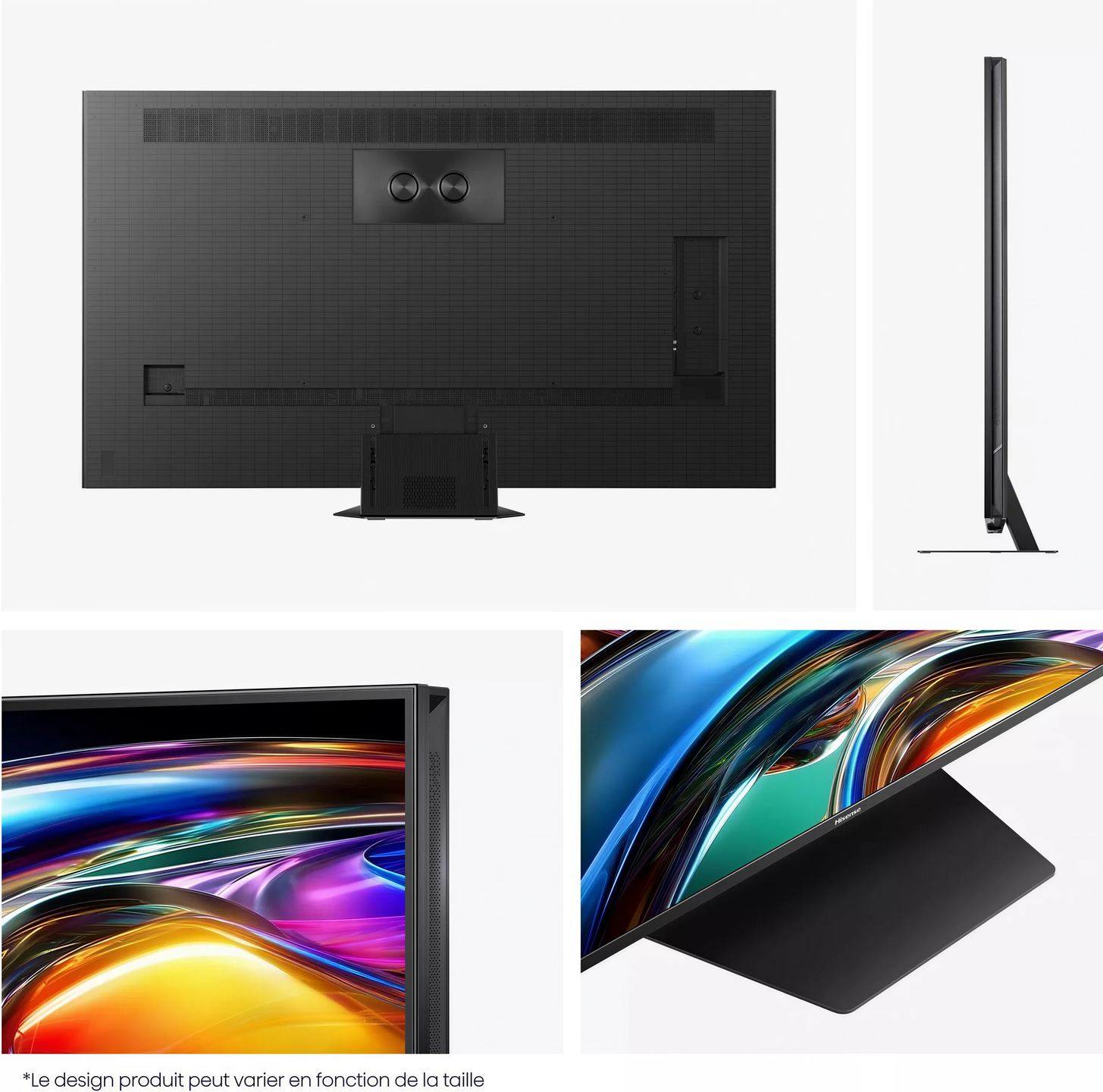
The TV measures 1670 mm wide by 963 mm high without its stand, and 46 mm thick. Expect 34.5 kg bare, 40 kg with the stand, whose footprint reaches 340 mm in depth: a standard living-room cabinet may prove too small. Two stand heights are possible, 1023 or 991 mm overall. Wall mounting follows the VESA 600 × 400 mm standard, with at least two people required for handling.
Power consumption illustrates the gap between the panel’s two usage modes. In SDR, the TV remains in class C with 71 kWh per 1000 hours. In HDR, the class shifts to G and consumption rises to 220 kWh, a direct consequence of the 4000 nits required for highlight reproduction. Standby uses just 0.5 W.

Documentation
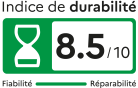
FrenchDurability index
FrenchEuropean product sheet
FrenchEnergy label
Technical specifications
Screen
- 75-inch RGB MiniLED panel (189 cm)
- Ultra HD 4K resolution (3840 × 2160)
- Local Dimming technology
- Matte anti-glare treatment
- Peak brightness up to 4000 nits
- Color gamut coverage up to 100% of the BT.2020 space (8 bits + FRC)
- Native refresh rate of 180 Hz (330 Hz HSR)
HDR compatibility
- Dolby Vision IQ
- Dolby Vision
- HDR10+
- HDR10+ Adaptive
- HDR10
- HLG
- 4K HDR Immersive
- IMAX Enhanced
- Calman Ready
Video processing
- Quad Core MT9655 processor with Hi-View AI artificial intelligence
- Processing functions:
- Ultra HD 4K upscaling
- MEMC motion compensation
- Automatic brightness adjustment
- Cinema Mode
- Filmmaker Mode
- Sports Mode
- IMAX Enhanced
Gaming
- Display up to 4K at 180 Hz
- 6.2 ms input lag
- AMD FreeSync Premium Pro compatible
- VRR compatible
- ALLM compatible
Audio
- 4.1.2-channel audio system Tuned by Devialet
- Speaker configuration:
- 2 × 15 W
- 2 × 10 W
- 1 × 20 W subwoofer
- 2 × 10 W upward-firing speakers
- Supported technologies:
- Dolby Atmos
- Dolby Audio
- Virtual surround
- Room Fitting Tuning
- Hi-Concerto
- WiSA SoundSend
- EzPlay
Smart TV
- VIDAA U9.5 operating system
- Features:
- Built-in Alexa voice assistant
- Vidaa Voice
- Internet browser
- Media player
- AirPlay 2
- Screen sharing (PC, smartphone, and tablet)
- VIDAA App Store
- AI Picture Mode
Wireless connectivity
- Wi-Fi 6E (2.4 / 5 / 6 GHz)
- Bluetooth 5.4
Connections
- 3 × HDMI 2.1 (ALLM, VRR, 4K 180 Hz)
- 1 × HDMI eARC
- 1 × USB-C compatible with DisplayPort 1.4
- 1 × USB 3.0
- 1 × USB 2.0
- Optical S / PDIF audio output
- Mini-jack audio input
- Headphone jack
- Dual antenna input
- Mini AV input
- Ethernet RJ45
TV reception
- Tuners: DVB-T2 / T / C / S2 / S
- Fransat certification
- HbbTV 2.0.4
- CI+
- PVR
- Timeshift
- Hotel Mode
- Parental control
Dimensions and weight
- Dimensions with stand: 1670 × 340 × 1023 mm
- Dimensions without stand: 1670 × 46 × 963 mm
- Weight with stand: 40 kg
- Weight without stand: 34.5 kg
- VESA compatibility: 600 × 400 mm
Energy consumption
- SDR energy class: C
- HDR energy class: G
- SDR consumption: 71 kWh / 1000 h
- HDR consumption: 220 kWh / 1000 h
- Standby consumption: 0.5 W
Frequently Asked Questions
Is 330 Hz HSR mode useful in practice?
It applies to competitive PC shooters, where smoothness takes priority over resolution. The TV halves the vertical resolution to double the frame rate, which produces a less detailed image but more continuous motion. On consoles, where output is capped at 120 Hz, this function remains unused.
Do you need a CI+ card to receive pay channels?
The television includes a CI+ slot that accepts operators’ conditional access modules. Fransat certification, for its part, concerns the free satellite reception of DTT channels, with the card provided by the operator.
How do I connect a laptop via USB-C?
The USB-C port supports DisplayPort 1.4 mode, which means that a single USB-C cable carries both video and audio from a computer whose output port also supports this mode. Not all computer USB-C ports are capable of this: check for the DisplayPort logo or the corresponding mention in the machine’s technical specifications.
Is 8-bit + FRC a problem for HDR content?
FRC alternates very rapidly between two similar shades to simulate an intermediate color. The eye integrates the average. For the vast majority of content, the result is indistinguishable from a native 10-bit panel. Edge cases involve very slow gradients over large uniform areas, where fine banding may appear depending on the quality of the source encoding.
What exactly does Room Fitting Tuning do?
The function analyzes the room’s acoustic response and adjusts the speakers’ equalization accordingly, based on the same principle as the calibration systems found in audio-video amplifiers. It compensates for coloration caused by the proximity of a wall or an enclosed TV cabinet, without, however, altering the room’s acoustics.
Which files can the media player read from a USB drive?
On the video side, mp4, mov, mkv, ts, avi, wmv, and webm containers are supported, with H.264, H.265, VP9, and AV1 codecs among others. On the audio side, the TV opens wav, mp3, wma, and flac files, and supports MPEG-H. Photos are supported in JPEG, PNG, BMP, GIF, WEBP, and TIFF.
Can television programs be recorded?
PVR and Timeshift functions are available. The first records a program to a USB storage device connected to the TV, the second pauses live viewing so it can be resumed later. The speed and capacity of the storage device determine recording stability, with an external hard drive remaining preferable to a flash drive.
What is Vidaa ART used for?
The mode turns the screen into a digital frame when the television is not displaying a program, with a selection of artworks and photographs. On a backlit panel, this prolonged use poses no risk of burn-in, unlike with self-emissive technologies.
- Eco-contribution of €12.65 included in the sale price.
- Spare parts available for 7 years
- GTIN / EAN: 6942351436302