Hisense 85UR9S 2026
Specifications and features



Overview
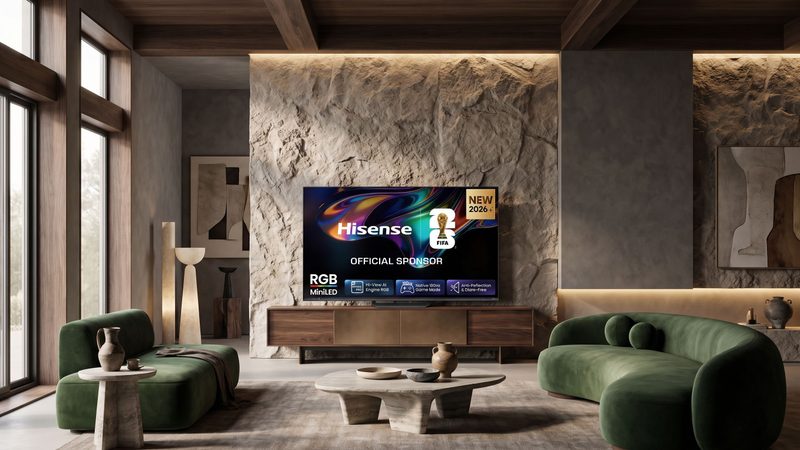
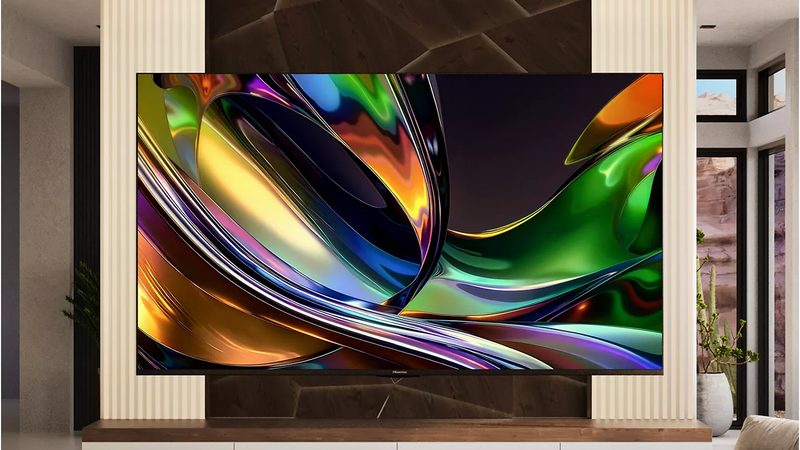
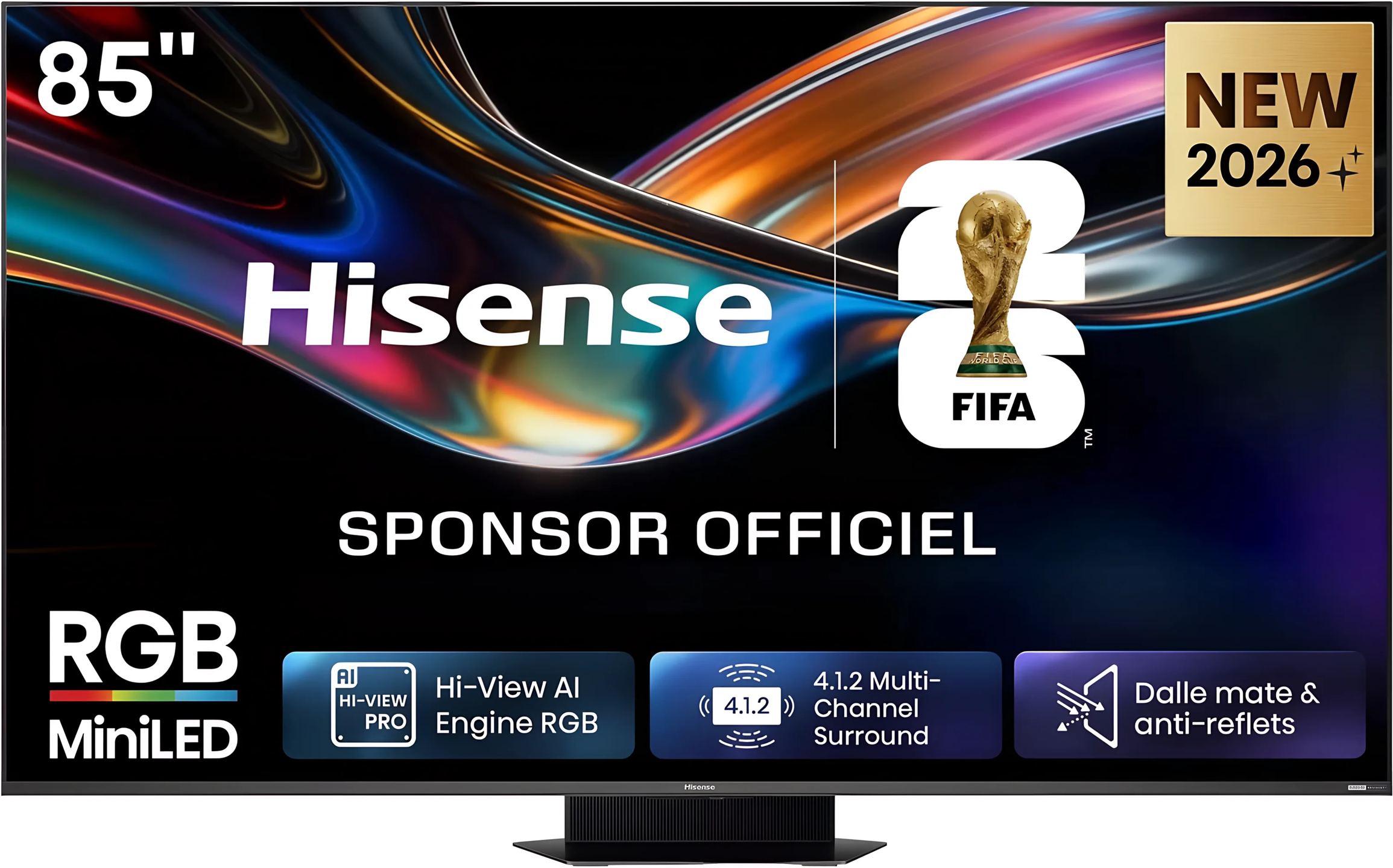
LCD TV backlighting has so far relied on white light filtered to produce colors. Hisense takes a different path with its 2026 UR9S series: red, green, and blue diodes driven separately, with no filter. The 85-inch model tops the European range, with a claimed peak brightness of 5,000 nits, a matte panel, and audio tuned with Devialet. It remains to be seen what this approach actually brings in front of a movie.
Three primaries rather than a color filter
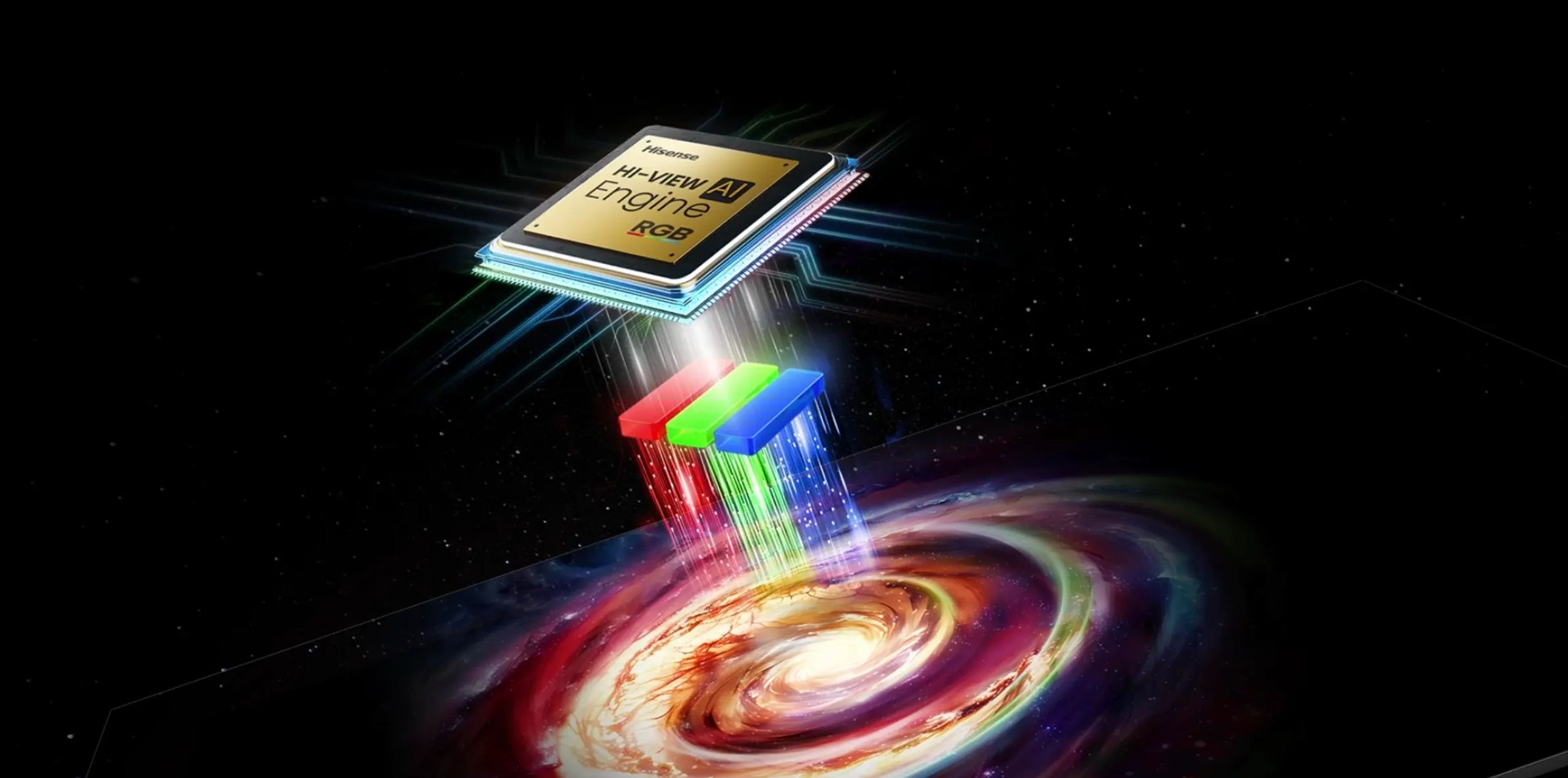
A conventional Mini-LED lights the panel in white, then lets the panel filters sort what should pass as red, green, or blue. Some of the light is lost in the process, and the purity of the primaries depends on the quality of the filtering. The 85UR9S’s RGB Mini-LED backlighting directly produces the three colors at the source, with each group of diodes modulated independently.
The gain is measured on two fronts. First, color gamut coverage, claimed at up to 100% of the BT.2020 space, the widest reference used for HDR content, which very few panels actually reach. Then light management: local dimming no longer merely modulates intensity zone by zone, it also adjusts the hue of the backlight under each zone. An orange ember against a black background benefits from boosted red diodes and nearly extinguished blue diodes, where white backlighting had to light everything up before filtering.
The panel nevertheless remains an 8-bit LCD with FRC, a temporal dithering technique that simulates 10 bits. On very gradual gradients, a twilight sky for example, this solution requires careful processing to avoid visible banding.
Five thousand nits and a matte surface
The 5,000-nit peak should not be read as permanent brightness across the whole surface: it concerns small specular areas, a reflection on bodywork, an explosion, the sun in a shot. That is exactly where HDR matters. The 85UR9S supports Dolby Vision IQ, HDR10+, HDR10, and HLG, with IMAX Enhanced and Calman Ready certifications, the latter opening the door to probe-based calibration for those who want to push accuracy all the way. Filmmaker Mode disables added processing and restores the cadence and colorimetry intended in production.
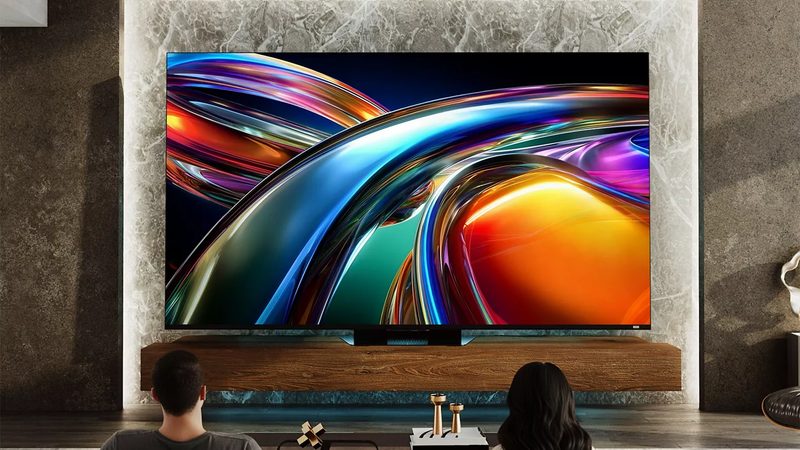
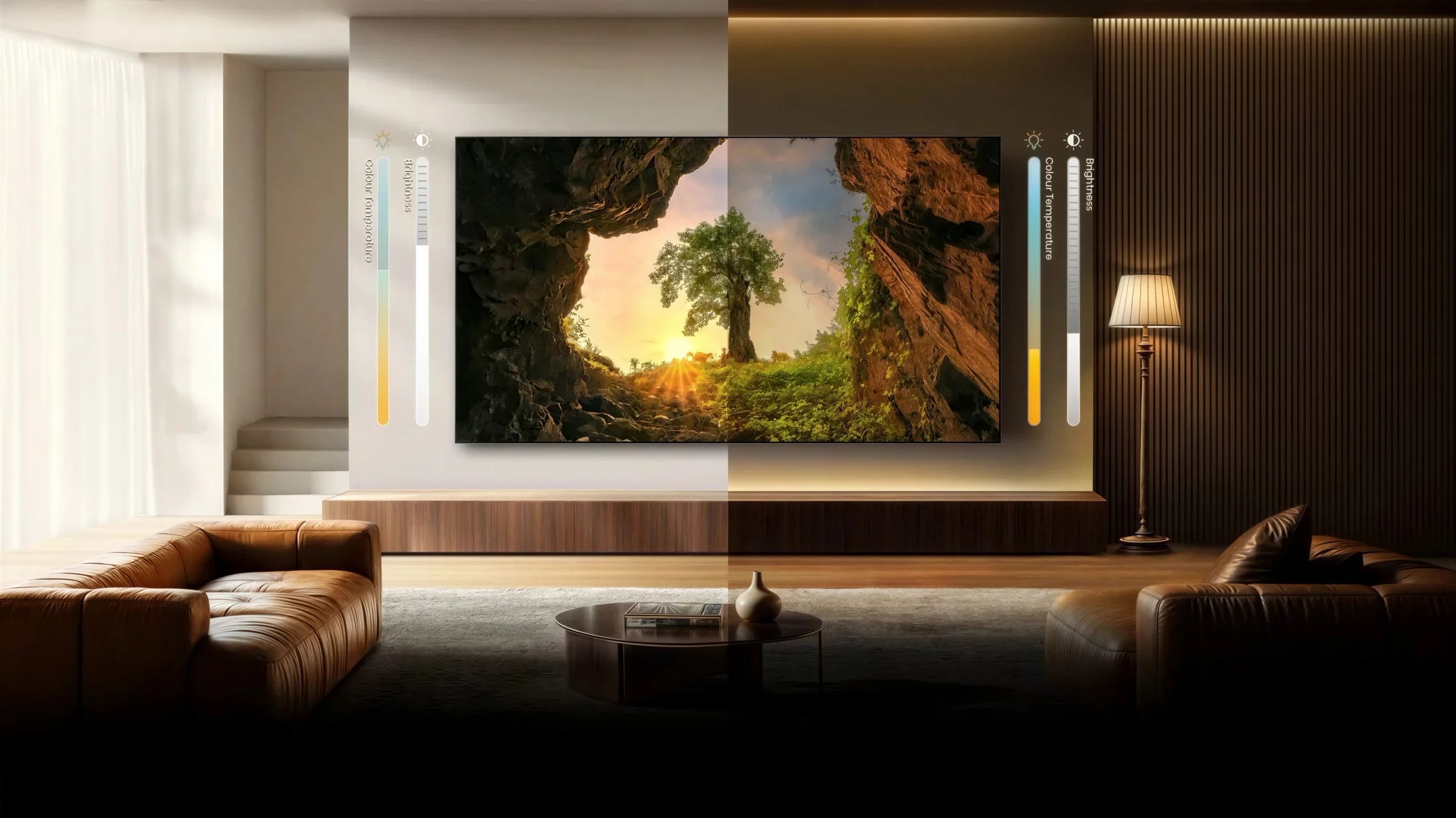
The panel receives a matte anti-reflective treatment. In a living room with large bay windows or lamps behind the sofa, the difference compared with a glossy surface is immediate: light sources are diffused instead of reflected like a mirror. The trade-off is well known: a matte finish can slightly lift blacks in bright ambient light. On a 215 cm diagonal, often installed in a living space rather than a dedicated room, the trade-off clearly falls on the right side.
The MT9655 at the helm of the image
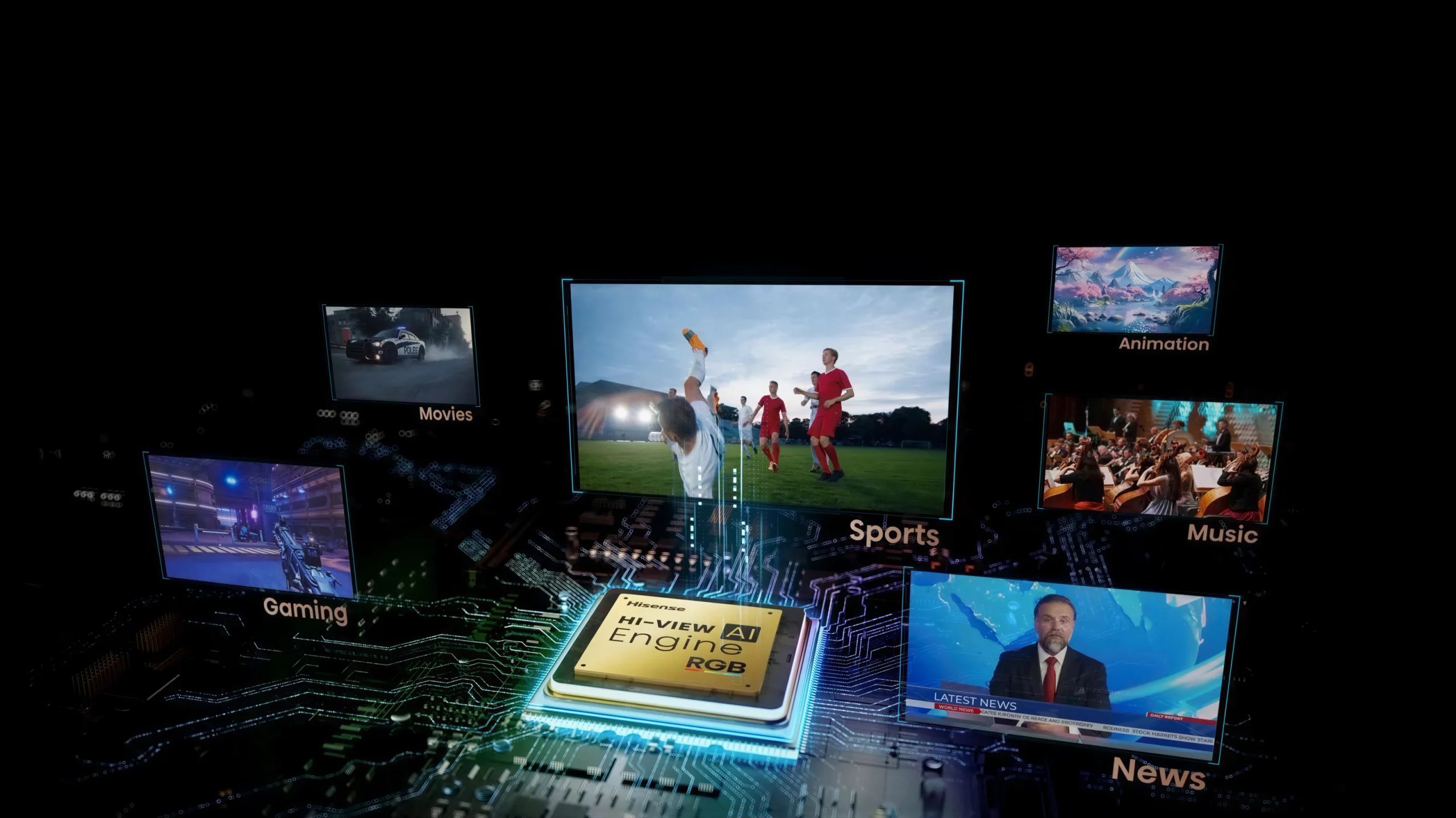
The quad-core MediaTek MT9655 processor powers the Hi-View AI Engine RGB. Its most delicate task is to coordinate in real time the hue and intensity of each backlight zone with the signal sent to the pixels. Tricolor backlighting poorly synchronized with the panel would produce local color casts.
The rest comes under the usual video processing work: upscaling sources below 4K, MEMC motion interpolation for slow pans, a light sensor that adapts the image to room lighting, and an artificial-intelligence-driven automatic picture mode that recognizes the type of content. Motion interpolation deserves careful adjustment: pushed too far, it gives films that video-like look that purists avoid. Filmmaker Mode settles the issue at the press of a button.
One hundred eighty hertz on three inputs
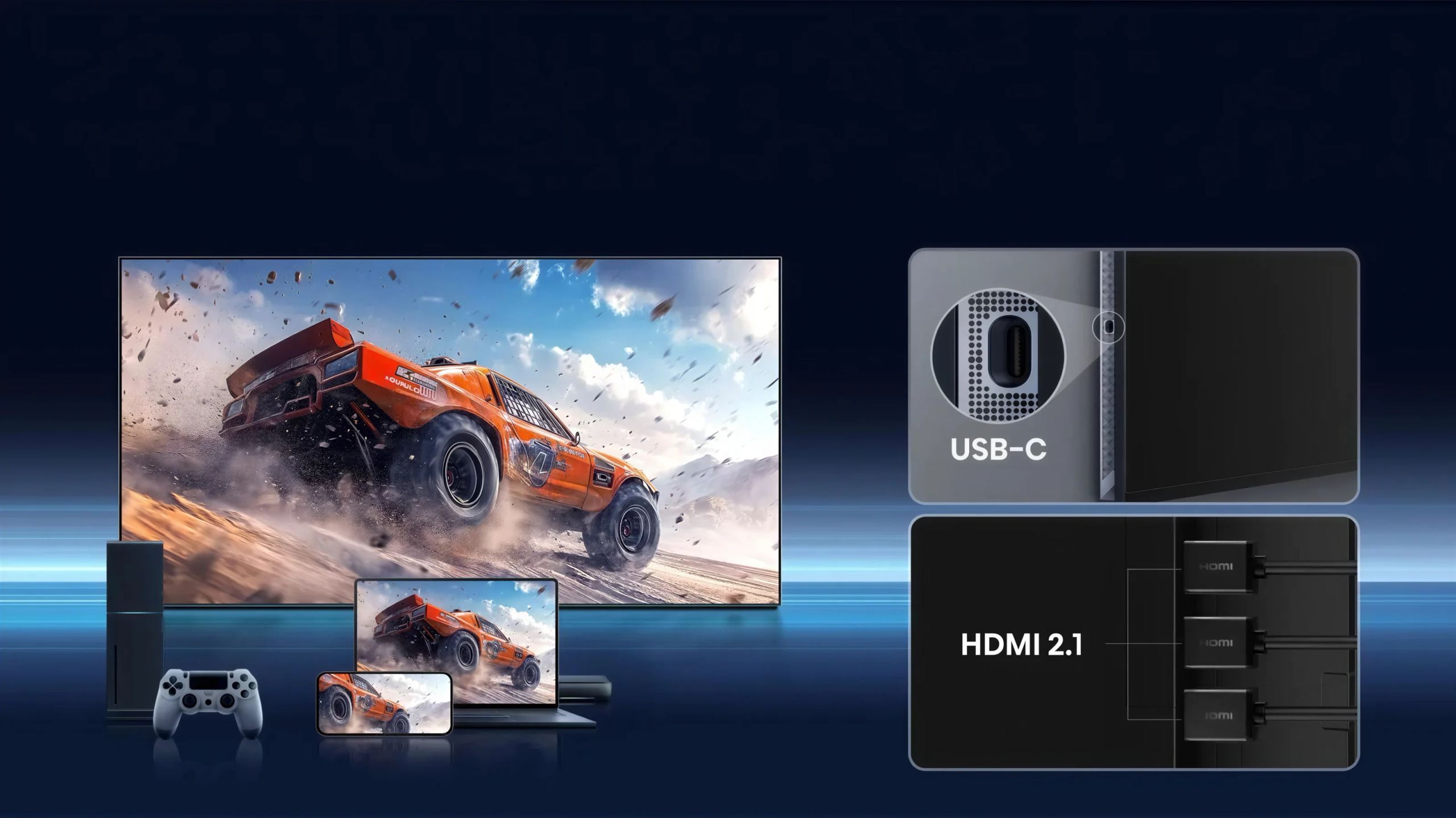
The panel runs natively at 180 Hz, on all three HDMI 2.1 inputs without exception, with 4K compatibility up to 180 Hz. Current consoles top out at 120 Hz, so the higher refresh rate is aimed at gaming PCs. HSR mode goes up to 330 Hz by lowering the definition, an option for competitive games where smoothness takes priority over finesse.
The 7 ms latency in game mode puts the TV among the leading LCD panels. VRR and AMD FreeSync Premium Pro synchronize the display to the GPU’s pace to eliminate screen tearing, while ALLM automatically switches to the right mode as soon as a console starts up. A USB-C port compatible with DisplayPort 1.4 rounds out the connectivity, making it possible to connect a recent laptop with a single cable.
A 4.1.2 setup tuned with Devialet
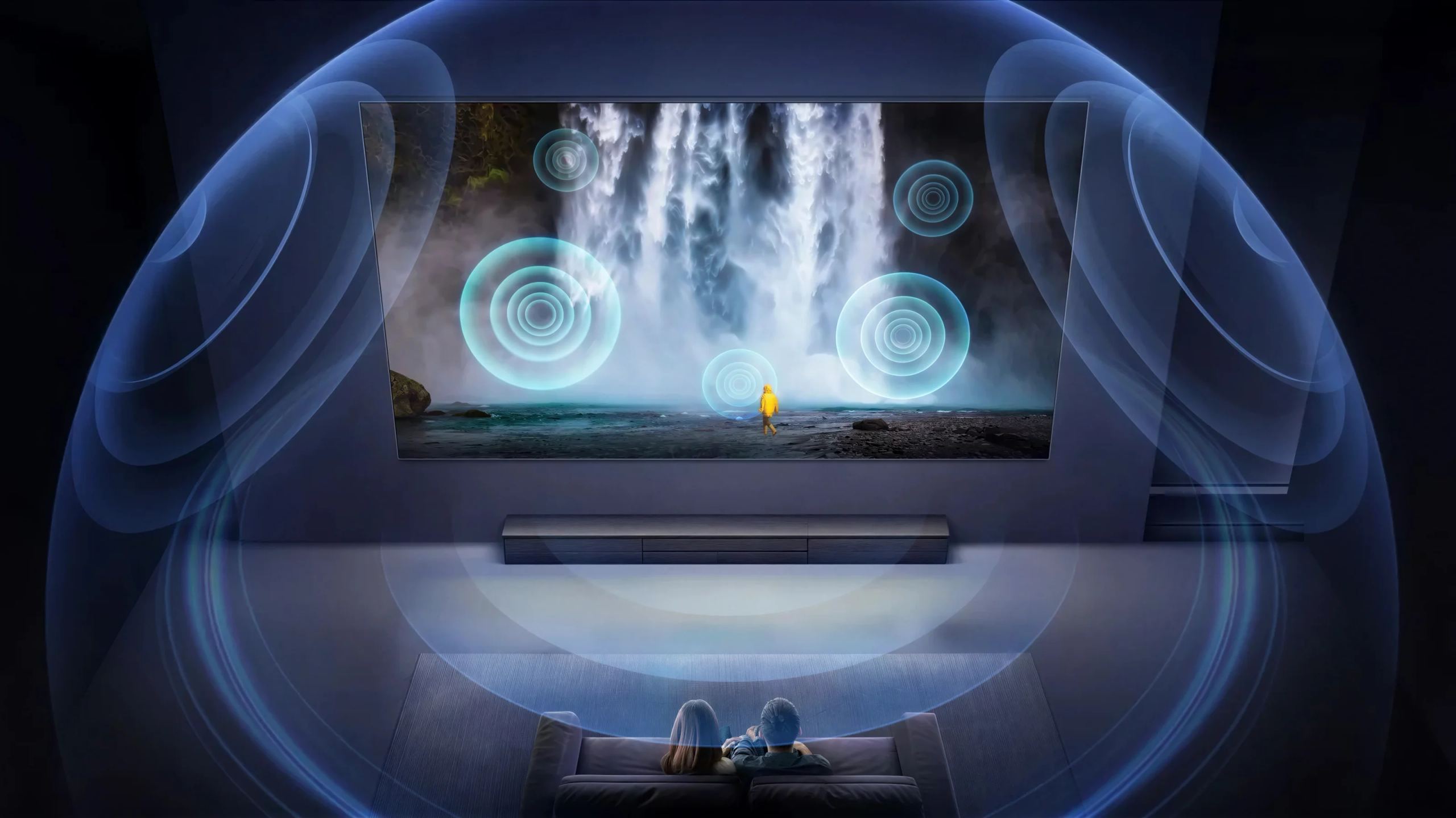
The integrated audio system adopts a 4.1.2 configuration: four main channels, a dedicated subwoofer for bass, and two upward-firing speakers for height, in line with Dolby Atmos. Two 15 W transducers, two 10 W units, one 20 W unit, and two 10 W units share the work.
The tuning was carried out with Devialet. The Room Fitting Tuning function analyzes the room and corrects the response accordingly, with variable results depending on the acoustics of the living room but real value in furnished rooms with hard surfaces. Hi-Concerto pairs the TV with compatible Hisense speakers, EzPlay simplifies pairing, and WiSA SoundSend compatibility opens the way to a wireless speaker system. An equalizer with advanced parameters remains accessible for those who want to take back control. On a diagonal like this, moving to a soundbar or a home theater system via the eARC output on HDMI 3 remains the most worthwhile step, but the integrated playback more than holds up for everyday programs.
Vidaa U9.5 and connected living
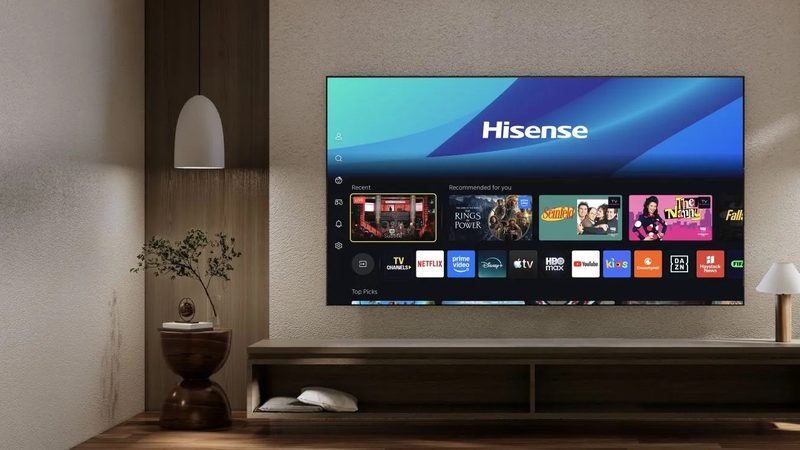
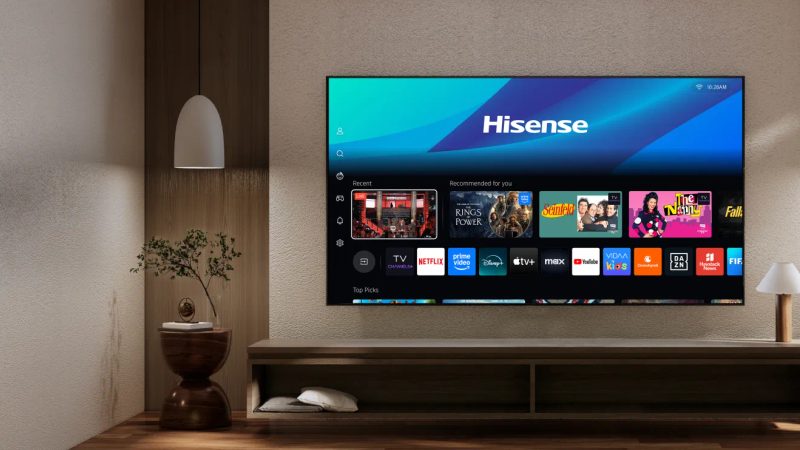
The TV runs on Vidaa U9.5, Hisense’s in-house system. The VIDAA App Store provides access to the main streaming platforms, the ERF6P66H voice remote offers direct-access buttons, and voice control works through built-in Alexa or Vidaa Voice. AirPlay 2 supports streaming from an iPhone or a Mac, screen sharing works from a PC, tablet, or Android smartphone. Wi-Fi 6 and Bluetooth 5.4 handle the wireless side, with an Ethernet port for those who prefer a cable. Vidaa ART turns the screen into a display piece when it is off.
On the reception side, the triple DVB-T2/T/C/S2/S tuner, Fransat certification, HbbTV 2.0.4, and the CI+ reader cover terrestrial TV, cable, and satellite. USB recording and timeshift are still included.
Installing two hundred fifteen centimeters of diagonal
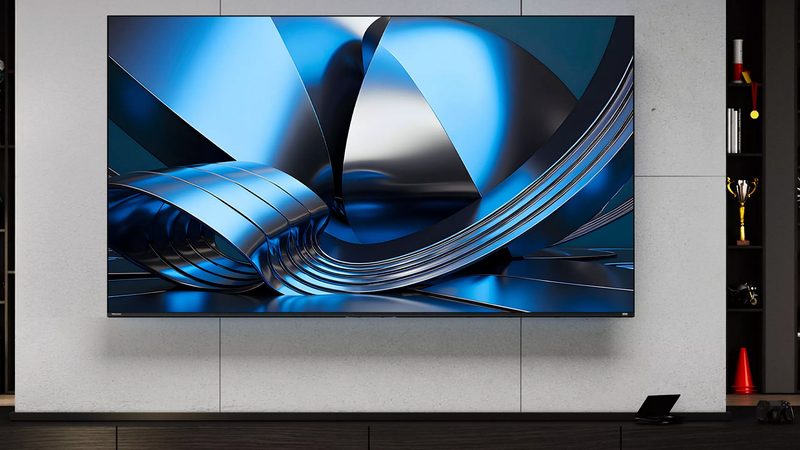
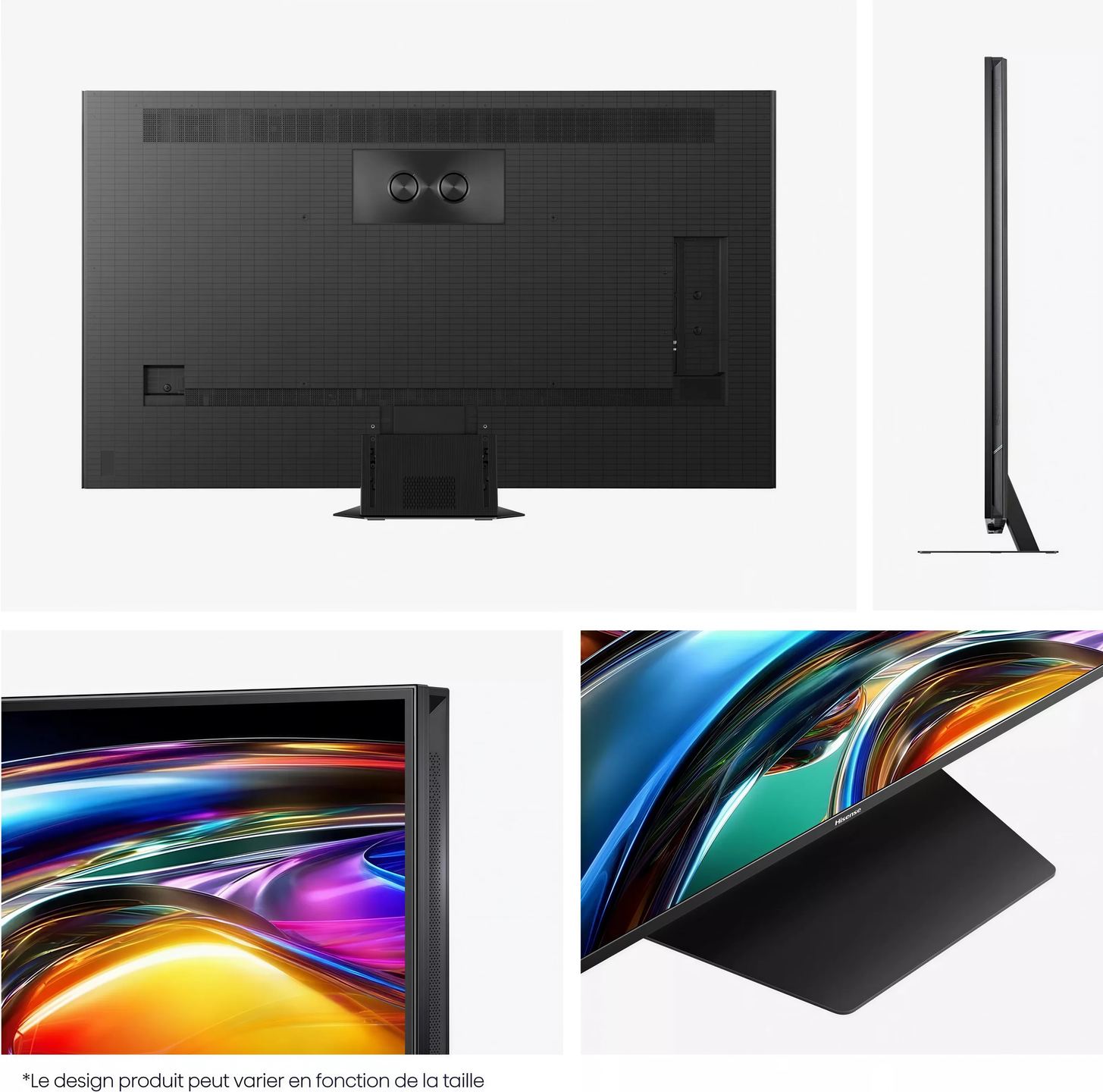
The chassis measures 1894 mm wide by 1092 mm high without the stand, and only 47 mm thick, which allows for discreet wall mounting on a VESA 600 × 400 mount. The weight calls for method: 47.4 kg without the stand, 52 kg with it. At least two people, and a properly sized wall mount.
Placed on its central stand, the set measures 1153 mm high and 360 mm deep. The central stand frees up the furniture on the sides, a practical point when the width of the furniture approaches that of the screen.
Power consumption follows the logic of such bright backlighting: class C in SDR at 86 kWh per 1,000 hours, class G in HDR at 200 kWh. Standby uses just 0.5 W.
Documentation
FrenchEuropean product sheet
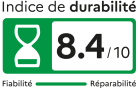
FrenchDurability index
FrenchEnergy label
Technical specifications
Display and picture
- RGB Mini-LED panel with Local Dimming
- Diagonal: 85 inches (215 cm)
- Ultra HD 4K resolution (3840 × 2160)
- Matte anti-glare coating
- Peak brightness up to 5000 nits
- Native 180 Hz refresh rate (330 Hz HSR)
- Coverage up to 100% of the BT.2020 color space
- Quad Core MT9655 processor
- Advanced video processing
- Ultra HD 4K upscaling
- MEMC motion compensation
- Supported HDR formats: Dolby Vision IQ, HDR10+, HDR10, HLG, IMAX Enhanced, Filmmaker Mode
Gaming
- Native 180 Hz panel
- Up to 330 Hz HSR
- 7 ms input lag
- AMD FreeSync Premium Pro
- VRR (variable refresh rate)
- ALLM (auto low latency mode)
- HDMI 2.1 on all three inputs
- 4K compatibility up to 180 Hz
Smart TV
- VIDAA U9.5 operating system
- Access to the main streaming apps via the VIDAA App Store
- Voice assistants: built-in Alexa, Vidaa Voice
- AirPlay 2
- Wi-Fi 6
- Bluetooth 5.4
- Screen sharing (PC, tablet, and smartphone)
- Internet browser
- Media player
- Automatic picture mode by artificial intelligence
- VIDAA Art
Audio
- 4.1.2-channel sound system
- Detailed power
- 2 × 15 W
- 2 × 10 W
- 1 × 20 W
- 2 × 10 W
- Supported formats and effects: Dolby Atmos, Dolby Audio, Surround effect
- Advanced equalizer settings
- Audio technologies
- Tuned by Devialet
- Room Fitting Tuning
- Hi-Concerto
- WiSA SoundSend
- TV Mode
- EzPlay
Connectivity
- 3 HDMI 2.1 inputs
- HDMI 3 compatible with eARC
- ALLM
- VRR
- 4K 180 Hz
- 1 USB-C port compatible with DisplayPort 1.4
- 1 USB 3.0 port
- 1 USB 2.0 port
- Optical audio output
- Mini-jack audio input
- Headphone jack
- Dual antenna input
- Mini AV input
- Ethernet RJ45
Reception and TV functions
- Triple tuner DVB-T2 / T / C / S2 / S
- Fransat certification
- HbbTV 2.0.4
- CI+
- USB recording (PVR)
- Timeshift
- Parental control
- Hotel Mode
Supported formats
- Video: MP4, MOV, MKV, TS, AVI, WMV, WEBM
- Codecs: MPEG-1 / 2, MPEG-4, AVC (H.264), HEVC (H.265), VC-1, VP8, VP9, AV1
- Audio: MP3, WAV, WMA, FLAC
- Photo: JPEG, PNG, BMP, GIF, WEBP, TIFF
Power consumption
- SDR energy class: C
- HDR energy class: G
- SDR consumption: 86 kWh / 1000 h
- HDR consumption: 200 kWh / 1000 h
- Standby: 0.5 W
Dimensions and weight
- Dimensions with stand: 1894 × 360 × 1153 mm
- Dimensions without stand: 1894 × 47 × 1092 mm
- Weight with stand: 52 kg
- Weight without stand: 47.4 kg
- VESA mounting: 600 × 400 mm
Frequently Asked Questions
What viewing distance should you plan for an 85-inch TV?
For 4K content, a distance between 2.5 and 3.5 meters lets you enjoy the resolution without perceiving the pixel structure, while maintaining a comfortable viewing angle. Below 2.5 meters, your eyes must scan the image to follow its edges. Above 4 meters, the benefit of 4K over 1080p becomes difficult to distinguish. This rule applies to a sofa placed facing the screen, with eye level between the lower third and the middle of the panel.
Is the 85UR9S suitable for a very bright room?
It’s even one of its strong suits. The combination of high brightness and a matte anti-glare treatment greatly limits interference from windows and lamps. The brightness sensor continuously adjusts the image according to the ambient lighting.
Can you connect a PS5 and an Xbox Series X at the same time without compromise?
Yes. All three inputs are HDMI 2.1 with ALLM and VRR, which avoids the usual trade-offs on televisions where only one or two ports are fully compatible. The third input also supports eARC: if a soundbar is connected to it, two full-featured inputs remain available for consoles.
What is the difference between the native 180 Hz and the advertised 330 Hz?
The 180 Hz correspond to the panel’s native refresh rate, available up to 4K. The 330 Hz comes from HSR, a technique that increases the refresh rate by reducing the displayed resolution. Useful for competitive gaming, but of no interest for movies or sports.
Is the television compatible with a home cinema amplifier?
The eARC output on HDMI 3 transmits uncompressed audio streams, including Dolby Atmos and Dolby Digital Plus, to a compatible amplifier or soundbar. An optical S/PDIF output and a headphone jack complete the options, with more limited bandwidth for the optical output.
What exactly does the USB-C port allow?
It supports the DisplayPort 1.4 protocol, which allows direct display from a laptop or tablet equipped with video-capable USB-C, using a single cable. Two traditional USB ports, one 3.0 and one 2.0, support file playback and program recording.
Are Hotel mode and parental controls useful at home?
Parental control locks channels and apps with a code. Hotel mode, on the other hand, blocks settings and limits the startup volume: repurposed for home use, it can be useful in a child’s bedroom or a vacation rental.
- Eco-contribution of €12.65 included in the sale price.
- Spare parts available for 7 years
- GTIN / EAN: 6942351436371