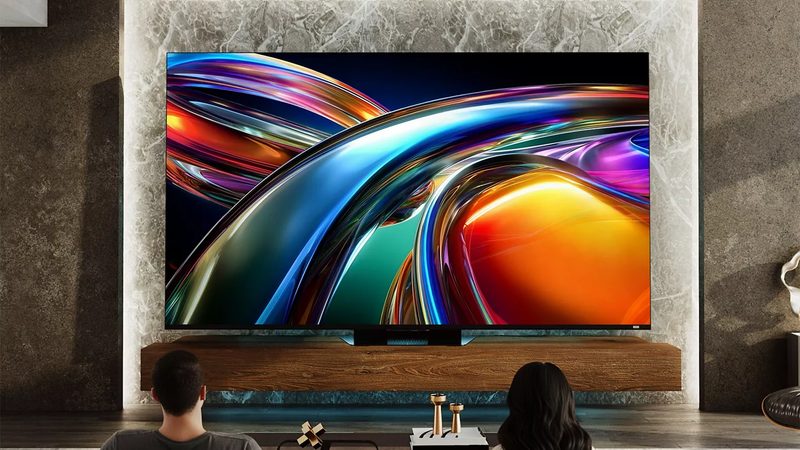

Hisense 65U7S PRO 2026
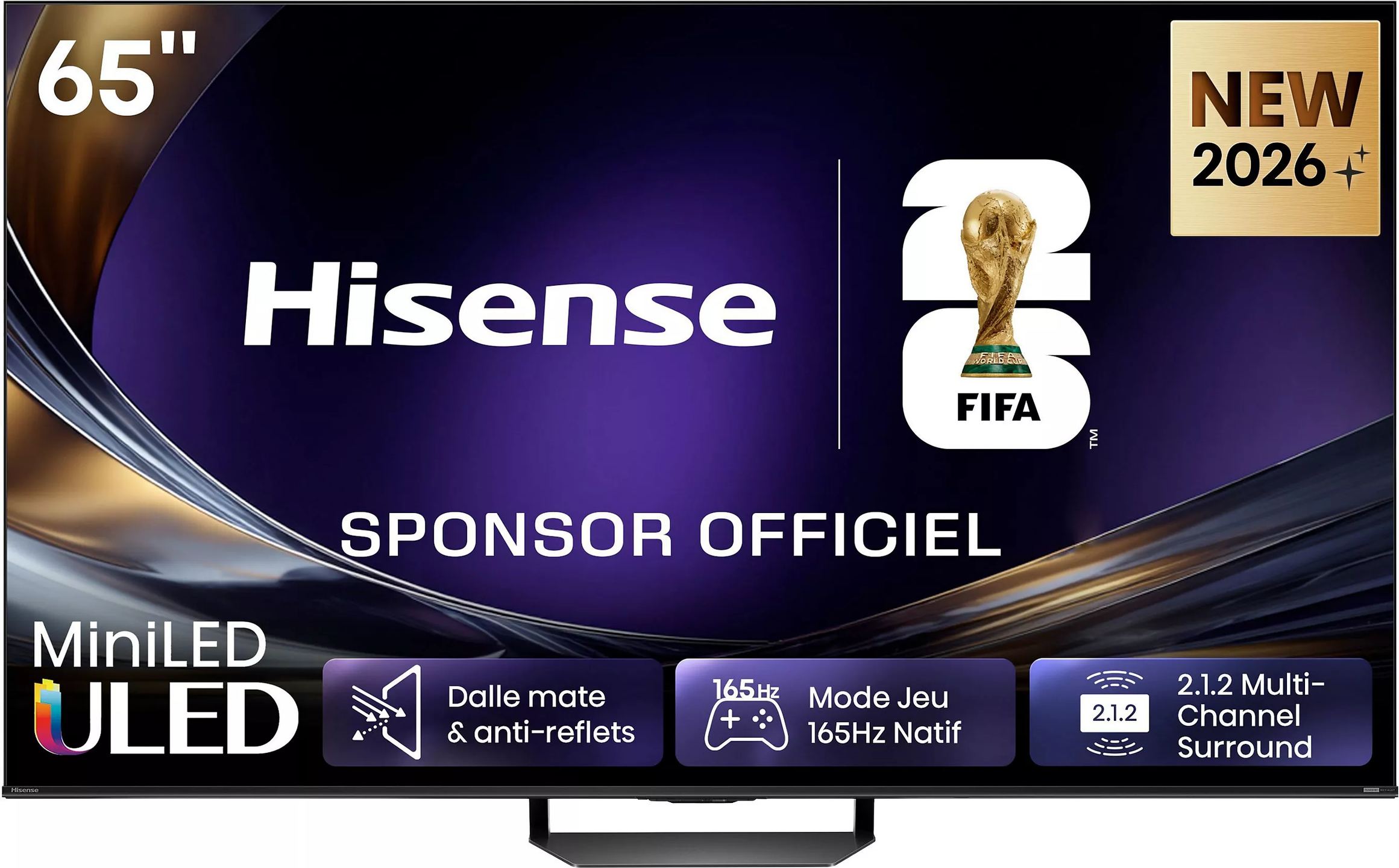
Specifications and features



Awards

EISA Awards: Award-Winning Product
Each year, dozens of European journalists gather to select the best electronic products of the year. Awarded by a diverse and impartial jury, the EISA (Expert Imaging and Sound Association) awards recognize exceptional products for their performance, design, or ergonomics.
Hisense 65U7S Pro, 65-inch MiniLED
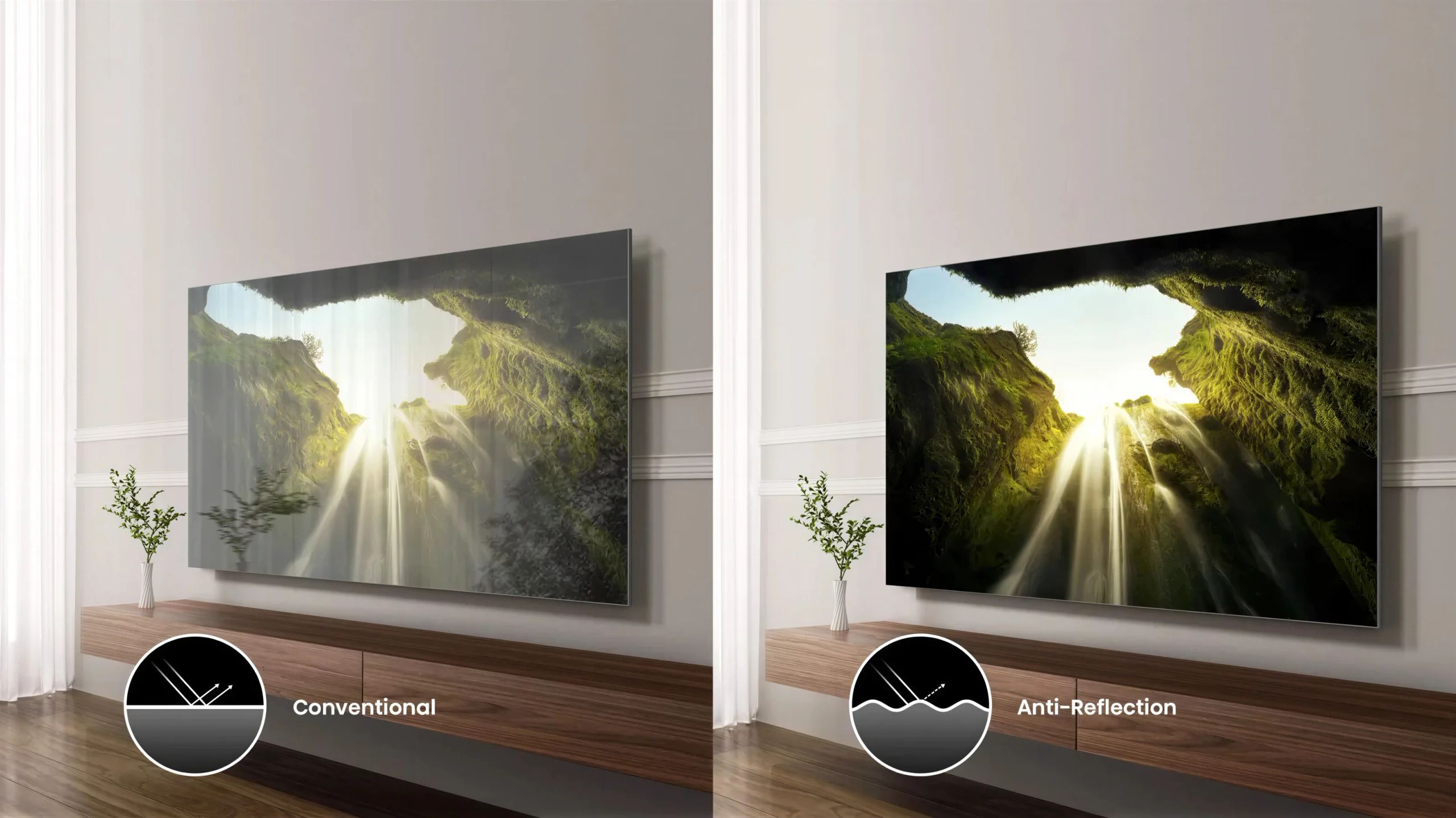
Watching a match in broad daylight, with the shutters open, remains the most unforgiving scenario for a television: reflections on the panel, blacks turning gray. Hisense built its U7S Pro series around this situation, relying on a matte anti-reflective treatment and MiniLED backlighting divided into 960 zones. The 65-inch version is the one that fits into an ordinary living room without demanding excessive viewing distance.
Contrast driven by 960 zones
The MiniLED backlighting brings together thousands of tiny diodes spread across 960 zones that the television controls independently. In a night scene, the glow of a streetlamp stays contained while the surrounding sky keeps its depth. The stated peak brightness reaches 3,000 nits, a value seen on small portions of the image rather than full screen: a metallic reflection, the surface of a lake in sunlight.
The compromise of MiniLED remains well known. The larger a zone is relative to the bright object it illuminates, the more a halo appears around it, for example on white subtitles placed over a black background. Nine hundred and sixty zones spread across 65 inches keep the phenomenon under control without eliminating it completely.
On the color side, the panel works in 8 bits supplemented by FRC, a technique that alternates very quickly between two neighboring shades to simulate the gradient smoothness of the 10-bit depth required by HDR content. The spectrum covers 90% of the DCI-P3 space, the reference for films graded for digital cinema.

The matte panel against living-room reflections
A matte anti-reflective treatment diffuses incoming light instead of reflecting it like a mirror. The window behind the sofa becomes a light veil spread across the surface rather than a sharp rectangle embedded in the image. The trade-off comes down to two points: sharpness softens very slightly, and black levels rise a bit when the room is flooded with direct light. In a bright living room or for daytime viewing, the exchange remains favorable.
A light sensor adjusts the image to ambient lighting, and the adaptive variants of HDR formats use this measurement: Dolby Vision IQ and HDR10+ Adaptive recalculate the tone curve according to the room’s lighting. The television also supports HDR10, HLG, and IMAX Enhanced certification. The Quad Core MT9655 processor handles upscaling for sources below 4K and MEMC motion compensation. Two modes are worth knowing: Filmmaker, which disables image processing to respect the original grading, and Calman Ready compatibility, which opens the door to probe-based calibration.
Native 165 Hz and 7.5 ms latency
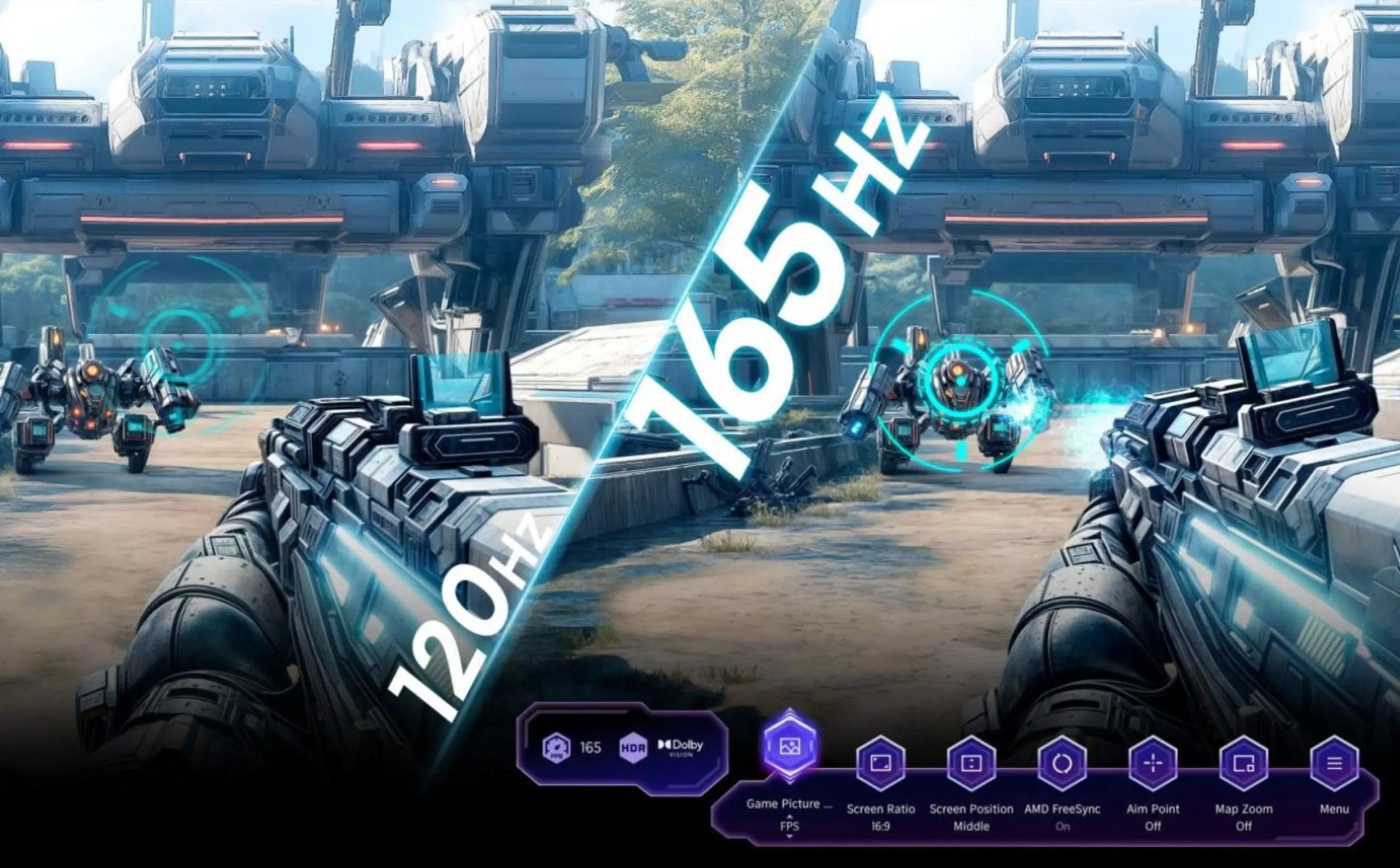
The panel refreshes the image natively 165 times per second, and HSR technology pushes display refresh up to 330 Hz at reduced resolution. In Game mode, the delay between an action on the controller and its appearance on screen drops to 7.5 ms, below the duration of a frame at 120 Hz.
All four inputs are HDMI 2.1 with ALLM, which automatically switches to Game mode when a console is detected, and VRR up to 4K 180 Hz. This ceiling exceeds the panel’s native frequency: beyond 165 Hz, displayed smoothness remains limited by the screen. AMD FreeSync Premium Pro compatibility synchronizes the refresh rate with that of the graphics card and eliminates screen tearing. A PlayStation 5 and an Xbox Series X make full use of all these inputs, and so does a PC equipped with a recent graphics card.
2.1.2 sound tuned by Devialet
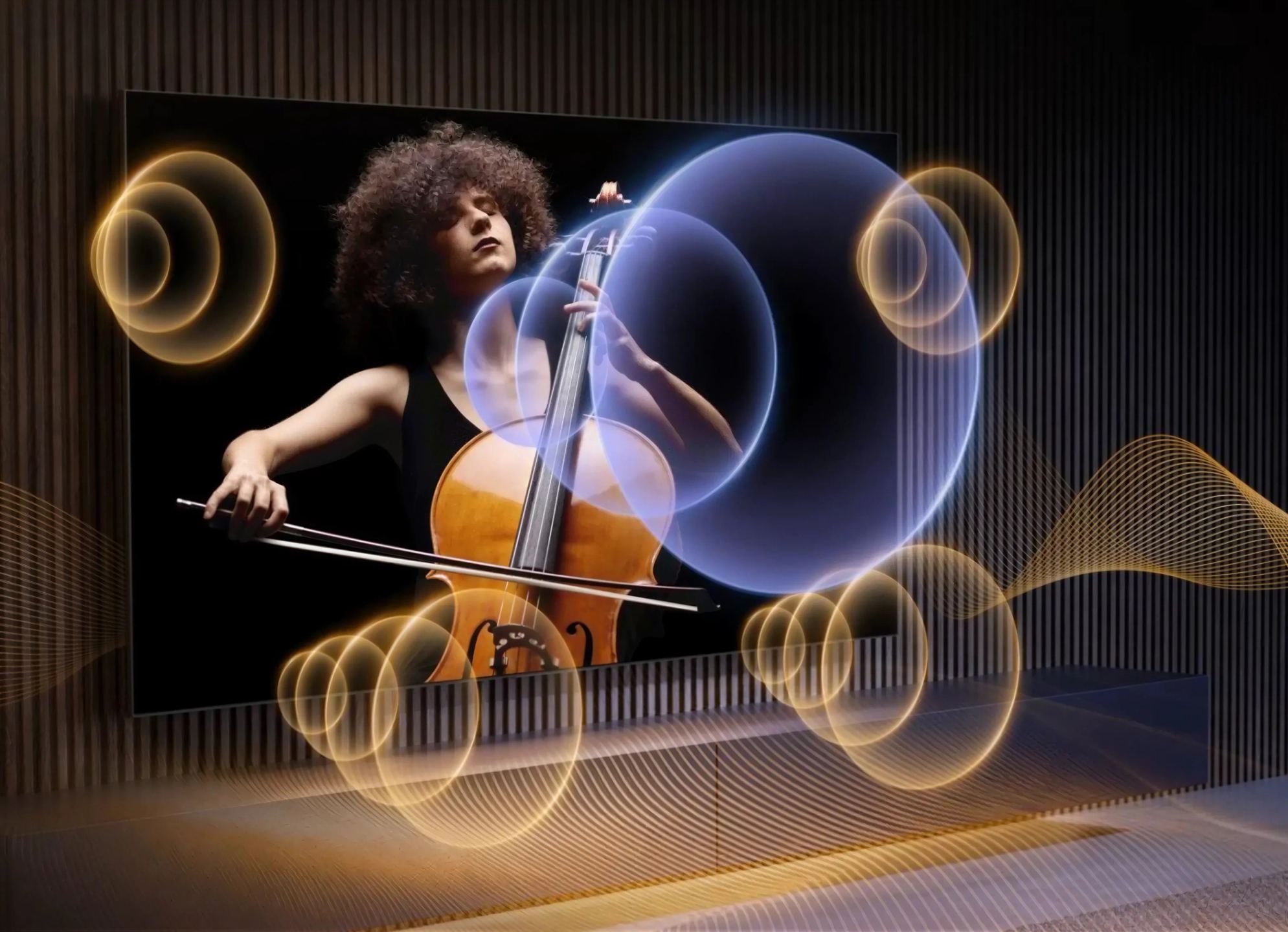
Fifty watts are split between two main channels of 10 W, an integrated 20 W subwoofer, and two 5 W upward-firing speakers dedicated to Dolby Atmos effects. The sound signature has been tuned with Devialet, and the Room Fitting Tuning function adapts playback to the room’s dimensions.
Height effects rely on reflection from the ceiling: spatial rendering therefore depends on the room configuration, with a flat ceiling that is not too high giving the best results. To go further, the eARC output on HDMI 3 transmits uncompressed audio streams to an amplifier or soundbar, the Hi-Concerto function combines the television’s speakers with those of a compatible Hisense soundbar, and WiSA SoundSend support opens the way to dedicated wireless speakers.
Four HDMI 2.1 ports and a few omissions
On the side, the television lines up four HDMI 2.1 inputs, one USB 3.0 port and one USB 2.0 port, a digital audio output S/PDIF, an RJ45 Ethernet port, two antenna inputs, and a Common Interface CI+ slot for subscription cards. No headphone jack, no analog L/R input, and no composite input: an old VCR or an old camcorder will be left out.
Wireless networking relies on dual-band Wi-Fi 802.11ac, on 2.4 and 5 GHz. The standard predates Wi-Fi 6, which is only noticeable on very busy networks, with throughput still remaining more than sufficient for a 4K stream. Bluetooth 5.4 handles headphones and controllers, AirPlay 2 accepts direct streaming from an iPhone or a Mac, and screen sharing works from a PC, tablet, or mobile phone.
VIDAA U9.5 day to day
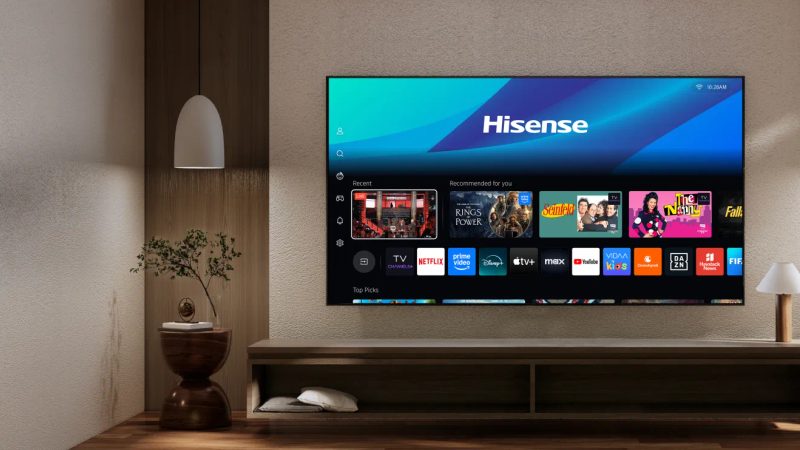
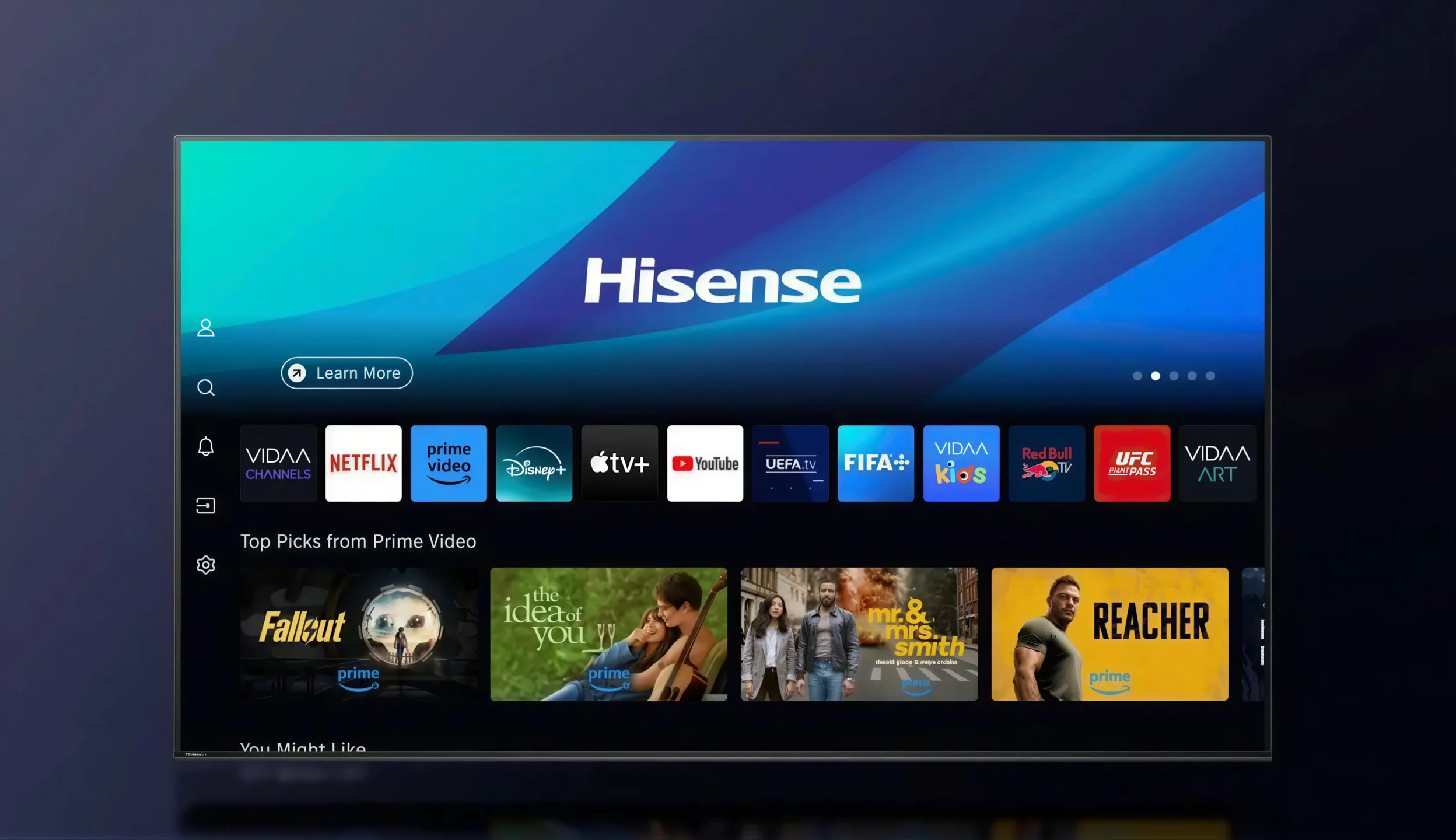
Hisense develops its own system, VIDAA, here in version U9.5. The supplied ERF6P66H voice remote gives direct access to several applications via dedicated buttons, and the VIDAA App Store completes the setup. Alexa and Vidaa Voice respond to voice commands, an automatic picture mode relies on analysis of the displayed content, and Vidaa ART turns the screen into a frame when it is not in use.
The tuner covers terrestrial TV in DVB-T2/T, cable in DVB-C, and satellite in DVB-S2/S, with Fransat certification. HbbTV 2.0.4 provides access to the channels’ interactive services, while PVR recording and live pause via Timeshift work through a USB-connected drive.
Two stand heights and VESA mounting
Without its stands, the chassis measures 1446 mm wide, 837 mm high, and 52 mm thick, for 19.6 kg. The stands add 3.8 kg and can be mounted in two positions: in the high position, the bottom of the panel is raised by about six centimeters above the furniture, compared with three in the low position. The clearance is enough to slide in a slim soundbar without it encroaching on the image. These stands require furniture at least 30 cm deep and more than 1.45 m wide. Wall mounting complies with the VESA 400 x 300 mm standard.
The energy rating reflects the power of the backlighting: class E in SDR at 84 kWh per 1000 hours, class G in HDR at 180 kWh. Power consumption in standby drops to 0.5 W, and the light sensor as well as the programmable shutoff help keep the bill under control.
Documentation
FrenchEnergy label
FrenchDurability index
FrenchEuropean product sheet
FrenchUser manual
French
Display
- Diagonal: 65 inches (164 cm)
- Panel: MiniLED QLED, matte anti-glare treatment
- Resolution: Ultra HD 3840 x 2160
- Native refresh rate: 165 Hz, 330 Hz in HSR
- Local Dimming: 960 zones
- Peak brightness: 3,000 nits
- Wide color gamut: 90% DCI-P3
- Color depth: 8-bit + FRC
- Brightness sensor: yes
HDR formats and image processing
- Dolby Vision, Dolby Vision IQ
- HDR10, HDR10+, HDR10+ Adaptive
- HLG, 4K HDR Immersive
- IMAX Enhanced
- Calman Ready
- Quad Core MT9655 processor
- 4K upscaling
- MEMC motion compensation
- Cinema, Filmmaker, sports modes
Gaming
- 165 Hz Game Mode
- Input lag: 7.5 ms
- AMD FreeSync Premium Pro
- HDMI 2.1 with ALLM and VRR up to 4K 180 Hz
Sound
- Power: 2 x 10 W + 20 W + 2 x 5 W
- 2.1.2 configuration with built-in subwoofer
- Surround effect
- Tuned by Devialet
- Dolby Atmos, Dolby Audio
- Equalizer with advanced settings
- Room Fitting Tuning
- WiSA SoundSend
- Hi-Concerto, TV Mode, EzPlay
System and wireless connectivity
- VIDAA U9.5
- Built-in voice assistant Alexa and Vidaa Voice
- Voice control via remote
- Automatic AI picture mode
- Vidaa ART
- VIDAA App Store, direct-access apps on the remote
- Web browser, media player
- Wi-Fi IEEE 802.11 a/b/g/n/ac, 2.4 GHz and 5 GHz
- Bluetooth 5.4
- Content sharing and screen sharing from PC, tablet, and mobile
- AirPlay 2
Connections
- HDMI 1: HDMI 2.1, ALLM, VRR 4K 180 Hz
- HDMI 2: HDMI 2.1, ALLM, VRR 4K 180 Hz
- HDMI 3: HDMI 2.1, eARC, ALLM, VRR 4K 180 Hz
- HDMI 4: HDMI 2.1, ALLM, VRR 4K 180 Hz
- 1 USB 3.0 port
- 1 USB 2.0 port
- 1 S/PDIF audio output
- 2 antenna inputs
- Ethernet RJ45
- Common Interface CI+
Reception
- DVB-T2/T/C/S2/S tuner
- Fransat certification
- HbbTV 2.0.4
- PVR and Timeshift
- Parental control
- Hotel mode
Supported formats
- Video: mp4, mov, mkv, ts, avi, wmv, webm
- Video codecs: MPEG1/2, MPEG4, AVC (H.264), HEVC (H.265), WMV3, VC1, VP8, VP9, AV1
- Audio: wav, mp3, wma, flac
- Audio codecs: LPCM, MPEG1/2 Layer1, MPEG1/2 Layer2, MPEG1/2/2.5 Layer3, WMA, AAC, MPEG-H, FLAC, Vorbis, Opus
- Photo: jpg, jpeg, png, bmp, gif, webp, tiff
Energy
- Power supply: AC 100-240 V, 50/60 Hz
- SDR energy class: E
- HDR energy class: G
- SDR consumption: 84 kWh/1000 h
- HDR consumption: 180 kWh/1000 h
- Standby consumption: 0.5 W
- Programmable shutdown and automatic standby
Dimensions and weight
- TV without stand: 1446 x 837 x 52 mm
- TV with stand: 1446 x 897 x 290 mm (high position) or 1446 x 867 x 290 mm (low position)
- Box: 1608 x 162 x 996 mm
- Weight without stand: 19.6 kg
- Weight with stand: 23.4 kg
- Weight with box: 29.9 kg
- VESA compatibility: 400 x 300 mm
Included accessories
- ERF6P66H voice remote
- Power cable
Frequently Asked Questions
Do you need a specific HDMI cable to enjoy 4K at 165 Hz?
Yes. The bitrates required for 4K at high refresh rates exceed the capabilities of Premium High Speed cables. You need a certified Ultra High Speed cable, which guarantees 48 Gbit/s. An older cable will often work, but the image may flicker or disappear intermittently in 4K above 60 Hz.
How do I record a program on the television?
A hard drive or USB flash drive connected to one of the two ports serves as the recording medium. The television formats the medium on first use, which erases its contents. The USB 3.0 port is preferable for a mechanical hard drive. Encrypted channels and certain protected streams remain unavailable for recording, regardless of the television brand.
Can the television receive DTT and satellite at the same time?
The two antenna sockets correspond to two separate tuners, one for terrestrial and cable, the other for satellite. A dish and a terrestrial antenna can therefore remain permanently connected, with switching from one to the other done via the source menu.
What exactly does Filmmaker Mode do?
It disables the processing added by the TV, starting with MEMC motion compensation and sharpness enhancement, and sets the color temperature to the reference value used in calibration rooms. The image becomes more faithful to the cinematographer’s work and loses the artificial smoothness that some people appreciate in documentaries.
Can the image be calibrated with a probe?
Calman Ready compatibility enables automatic calibration via Calman software and a colorimeter, with the TV directly receiving the calculated corrections. The process remains intended for an installer or a properly equipped user, with Cinema and Filmmaker modes being sufficient in most living rooms.
What do you need to use WiSA wireless speakers?
WiSA SoundSend compatibility requires the addition of a WiSA transmitter connected to the TV, which then transmits the signal to the certified speakers. The TV alone does not communicate directly with these speakers.
- Eco-contribution of €12.65 included in the sale price.
- Spare parts available for 7 years
- GTIN / EAN: 6942351437293