Hisense 75U7S PRO 2026
Specifications and features



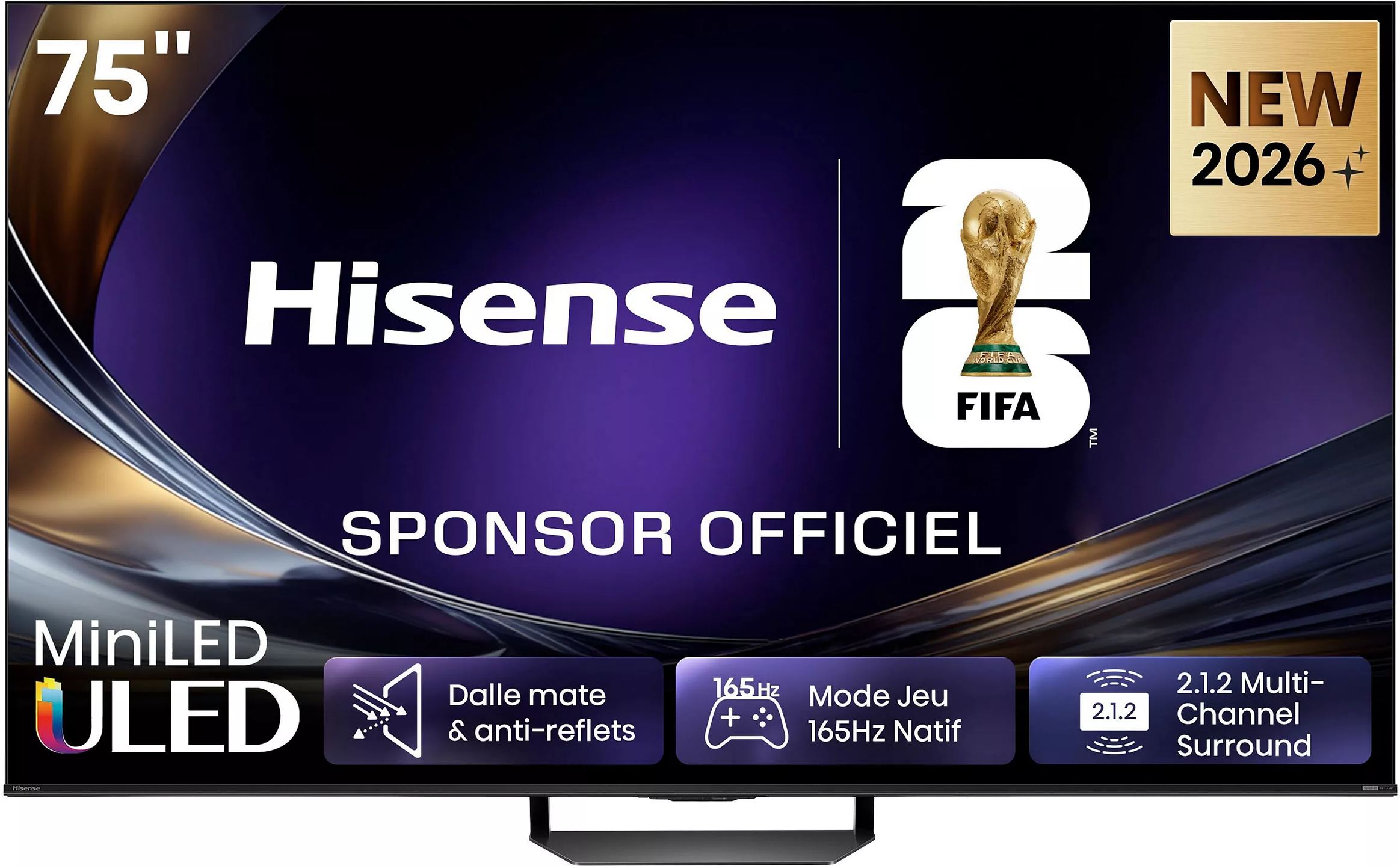
Hisense 75U7S PRO 2026, 75-inch MiniLED
Watching a match in broad daylight, windows open, without seeing the reflection of the sofa in the middle of the field: that’s the problem Hisense chose to address first on its 2026 U7 series. The panel’s matte coating is paired with MiniLED backlighting with 1100 zones and a claimed peak brightness of 3000 nits. The rest of the specifications are geared toward video games and sports.
A matte panel against living room reflections
The surface treatment diffuses incoming light instead of reflecting it like a mirror. A bay window behind the sofa stops turning into a white rectangle in the middle of a dark scene. The trade-off is well known: diffusion slightly softens edge sharpness and raises black levels a little when the room is brightly lit. On a 189 cm diagonal installed in an ordinary living room, the exchange comes out in your favor. The brightness sensor continuously adjusts the image level, and Dolby Vision IQ uses this measurement to adapt tone mapping to ambient light.

MiniLED backlighting and its 1100 zones
Relative to the screen’s active surface area, these 1100 local dimming zones each correspond to a square of about 3.7 cm per side. That’s fine enough to contain halos around white subtitles on a black background, without eliminating them completely: end credits or a starry sky remain the scenes that reveal the backlight’s density. In return, highlights hit hard, with a claimed peak of 3000 nits on a small window, and the color spectrum covers 90% of DCI-P3.
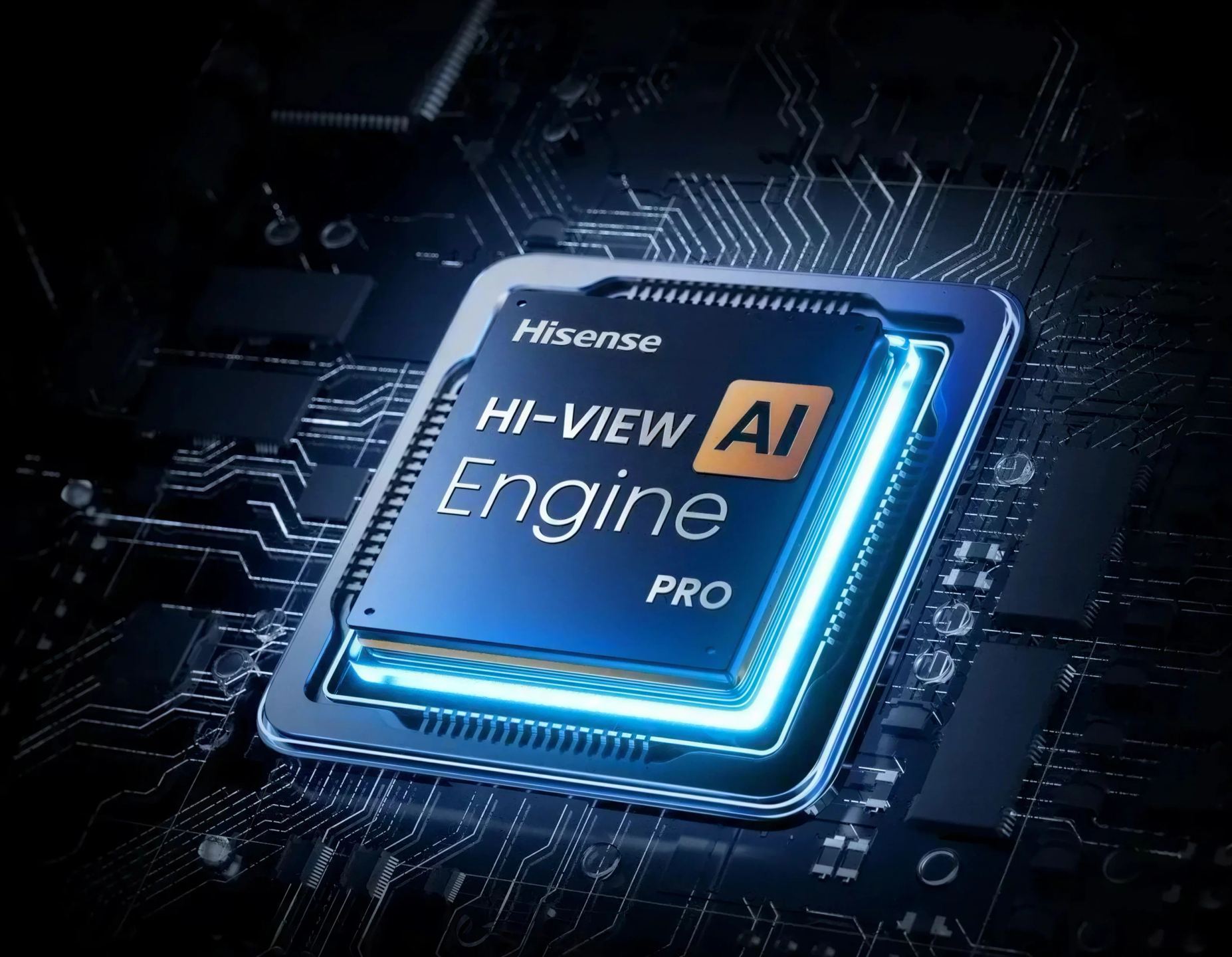
The MT9655 quad-core processor handles upscaling for sources below Ultra HD and MEMC motion compensation. Filmmaker mode disables these treatments all at once to restore the original film cadence, while Sport mode does the opposite.
Native 165 Hz and 7 ms latency
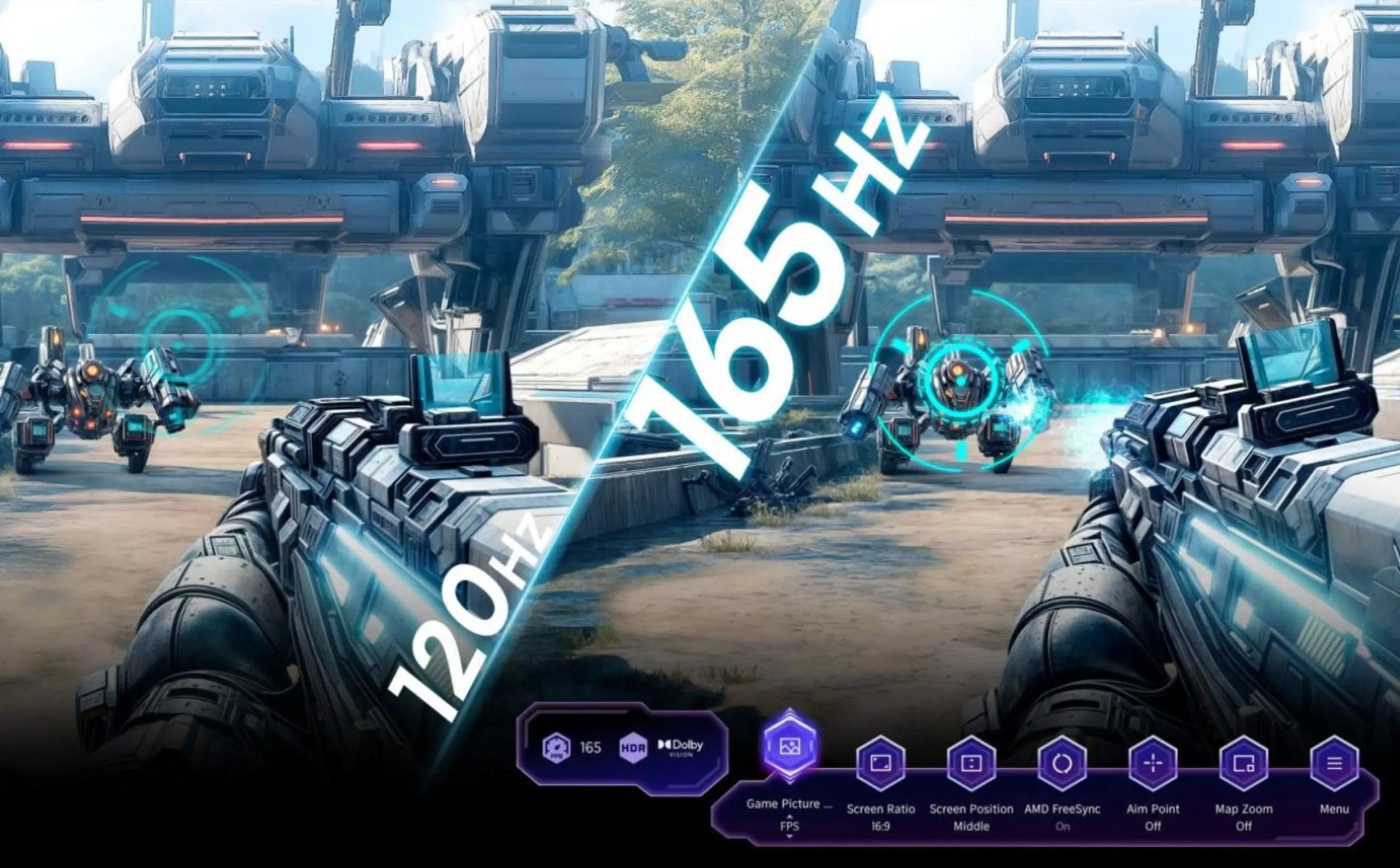
The panel refreshes natively at 165 Hz, rises to 330 Hz in HSR mode, and all four HDMI 2.1 inputs support VRR up to 180 Hz in 4K, with ALLM and FreeSync Premium Pro. Measured input lag in Game mode drops to 7 ms. Current consoles top out at 120 Hz in 4K: higher frequencies mainly benefit a gaming PC connected via HDMI. The fact that all four ports are on the same level avoids the usual trade-off between a console, an Ultra HD Blu-ray player, and a soundbar, with the latter finding its place on HDMI 3, which carries eARC.
2.1.2 sound tuned by Devialet
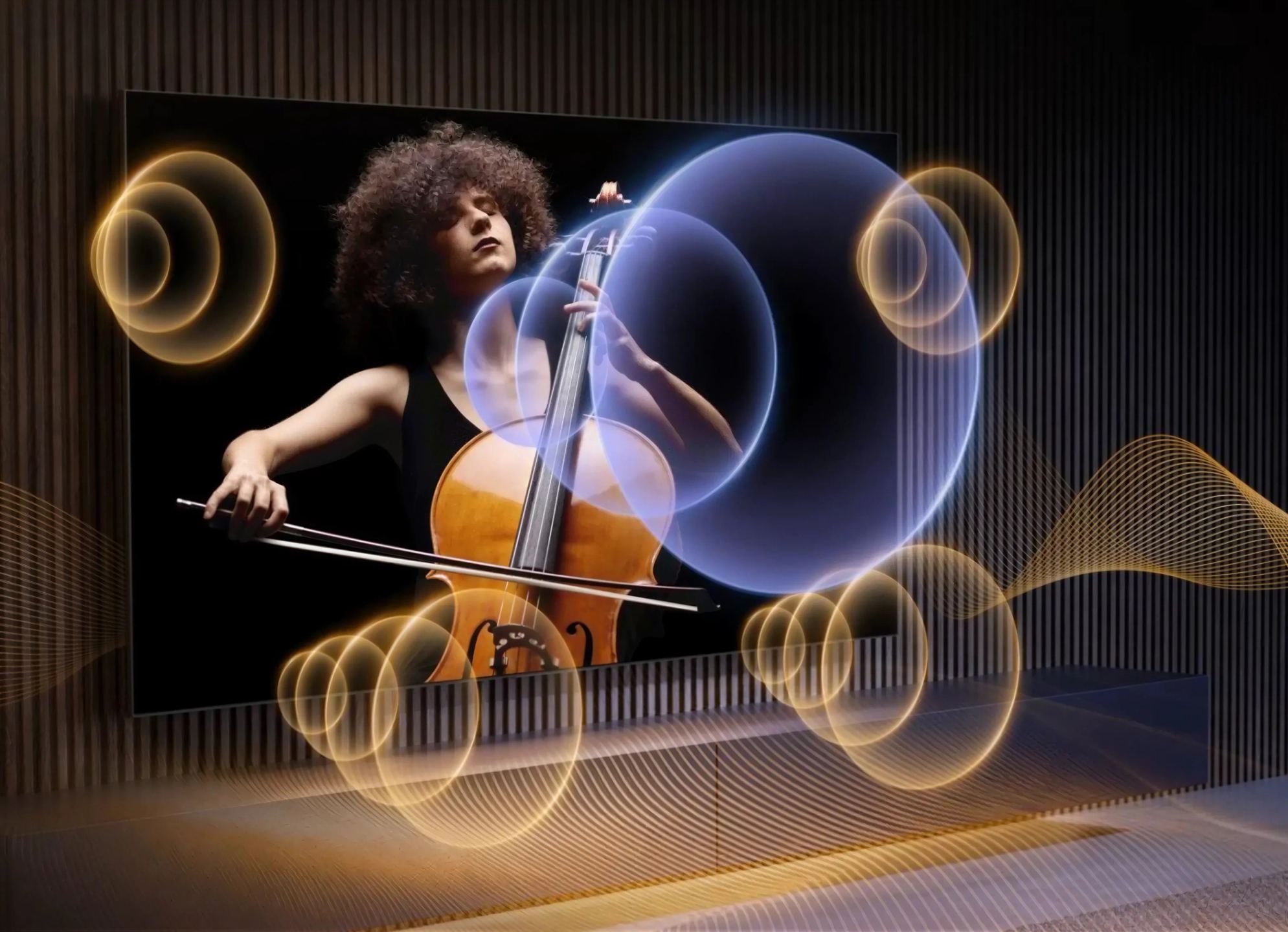
The configuration brings together two main 10 W channels, an integrated 20 W subwoofer, and two 5 W speakers aimed at the ceiling for Dolby Atmos vertical channels. Devialet handled the acoustic tuning of the whole system, and the Room Fitting Tuning function adjusts playback according to the television’s placement, against a wall or in an enclosed cabinet. With 5 W per height channel, the ceiling effect requires a low room and a reflective wall to make itself clearly heard; on the other hand, the integrated subwoofer keeps dialogue from relying on the midrange alone. The WiSA SoundSend protocol opens the way to wireless speakers, and Hi-Concerto pairs the television with a compatible Hisense soundbar.
The VIDAA U9.5 interface in everyday use
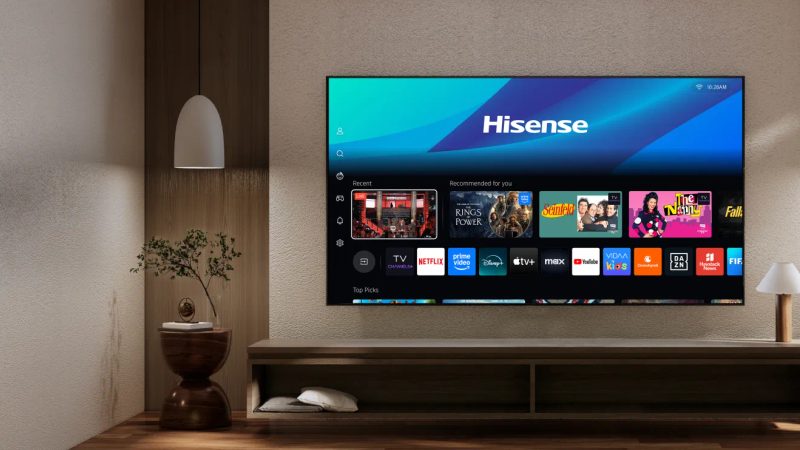
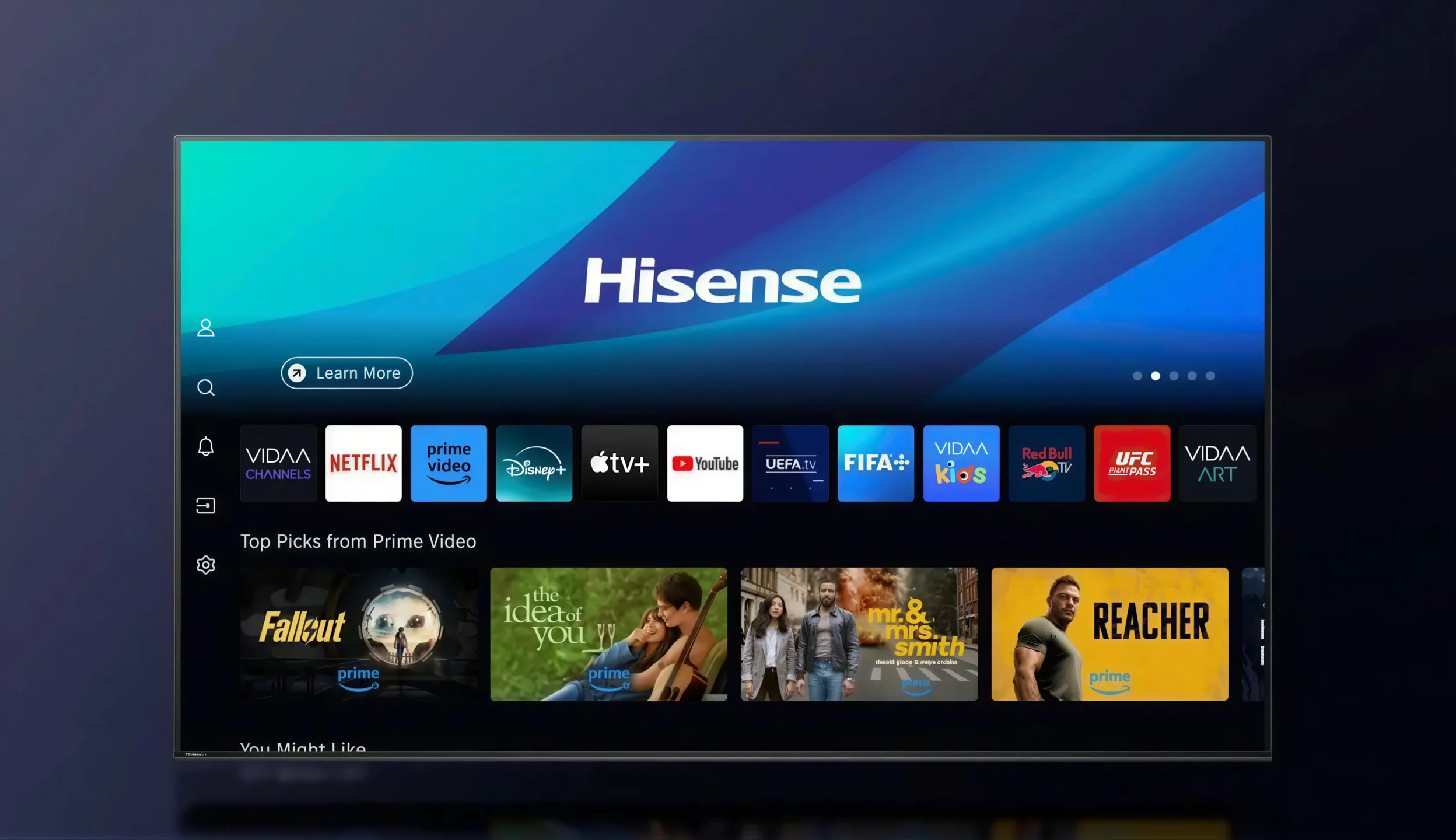
VIDAA U9.5 starts quickly and offers two voice assistants, Vidaa Voice and Alexa, controllable from the microphone on the ERF6P66H remote control. AirPlay 2 supports streaming from an iPhone or a Mac, and screen sharing covers Windows and Android sources. An automatic AI picture mode analyzes the displayed content to switch between settings, and Vidaa ART turns the screen into a display panel when no one is watching. One technical reservation: the Wi-Fi section stops at the 802.11ac standard on the 2.4 and 5 GHz bands, without Wi-Fi 6. Bluetooth, meanwhile, is version 5.4.
Four HDMI 2.1 ports and a two-height stand
Without its feet, the chassis measures 1668 x 963 mm, is 52 mm thick, and weighs 27.9 kg, which remains within the limits of a VESA 400 x 400 wall mount. Set on its stand, it rises to 32.1 kg and requires a surface at least 167 cm wide and 31 cm deep. The feet can be mounted in a high or low position, with a 32 mm difference: enough to slide a slim soundbar under the panel without cutting into the picture. In terms of power consumption, count 83 kWh per 1000 hours in SDR, class D, and 240 kWh in HDR, class G, with standby drawing just 0.5 W.
The tuner supports terrestrial TV in DVB-T2, cable and satellite in DVB-S2, with Fransat certification and a CI+ interface for subscription cards.
Documentation
FrenchDurability index
FrenchTechnical data sheet
FrenchEnergy label
FrenchEuropean product sheet
French
Technical specifications
Display
- Diagonal: 75 inches (189 cm)
- Panel: MiniLED QLED, matte anti-glare coating
- Resolution: Ultra HD 3840 x 2160
- Native refresh rate: 165 Hz, 330 Hz in HSR
- Local Dimming: 1100 zones
- Peak brightness: 3000 nits
- Wide color gamut: 90% DCI-P3
- Color depth: 8 bits + FRC
- Brightness sensor
HDR formats and image processing
- Supported HDR formats:
- Dolby Vision, Dolby Vision IQ
- HDR10, HDR10+, HDR10+ Adaptive
- HLG, 4K HDR Immersive
- Certifications: IMAX Enhanced, Calman Ready
- Quad Core MT9655 processor
- 4K upscaling
- MEMC motion compensation
- Picture modes: cinema, Filmmaker, sports
Gaming
- 165 Hz Game Mode
- Input lag: 7 ms
- AMD FreeSync Premium Pro
- HDMI 2.1 with ALLM and VRR up to 4K 180 Hz
Sound
- Power: 2 x 10 W + 20 W + 2 x 5 W
- 2.1.2 configuration with built-in subwoofer
- Surround effect
- Tuned by Devialet
- Dolby Atmos, Dolby Audio
- Equalizer with advanced settings
- Room Fitting Tuning
- WiSA SoundSend
- Audio modes: Hi-Concerto, TV Mode, EzPlay
System and interface
- Operating system: VIDAA U9.5
- Built-in voice assistants: Alexa, Vidaa Voice
- Voice control via remote
- Automatic AI picture mode
- Vidaa ART
- VIDAA App Store, apps with direct access on the remote
- Internet browser, media player
Wireless connectivity
- Wi-Fi IEEE 802.11 a / b / g / n / ac, 2.4 GHz and 5 GHz
- Bluetooth 5.4
- Content sharing and screen sharing from PC, tablet and mobile
- AirPlay 2
Connections
- HDMI 1: HDMI 2.1, ALLM, VRR 4K 180 Hz
- HDMI 2: HDMI 2.1, ALLM, VRR 4K 180 Hz
- HDMI 3: HDMI 2.1, eARC, ALLM, VRR 4K 180 Hz
- HDMI 4: HDMI 2.1, ALLM, VRR 4K 180 Hz
- 1 USB 3.0 port
- 1 USB 2.0 port
- 1 S / PDIF audio output
- 2 antenna inputs
- Ethernet RJ45
- Common Interface CI+
Reception
- DVB-T2 / T / C / S2 / S tuner
- Fransat certification
- HbbTV 2.0.4
- PVR and Timeshift
- Parental control
- Hotel mode
Supported formats
- Video: mp4, mov, mkv, ts, avi, wmv, webm
- Video codecs: MPEG1 / 2, MPEG4, AVC (H.264), HEVC (H.265), WMV3, VC1, VP8, VP9, AV1
- Audio: wav, mp3, wma, flac
- Audio codecs: LPCM, MPEG1 / 2 Layer1, MPEG1 / 2 Layer2, MPEG1 / 2 / 2.5 Layer3, WMA, AAC, MPEG-H, FLAC, Vorbis, Opus
- Photo: jpg, jpeg, png, bmp, gif, webp, tiff
Power
- Power supply: AC 100-240 V, 50 / 60 Hz
- SDR energy class: D
- HDR energy class: G
- SDR consumption: 83 kWh / 1000 h
- HDR consumption: 240 kWh / 1000 h
- Standby consumption: 0.5 W
- Programmable shutdown and automatic standby
Dimensions and weight
- TV without stand: 1668 x 963 x 52 mm
- TV with stand:
- High position: 1668 x 1029 x 310 mm
- Low position: 1668 x 997 x 310 mm
- Box: 1830 x 173 x 1125 mm
- Weight without stand: 27.9 kg
- Weight with stand: 32.1 kg
- Weight with box: 42 kg
- VESA compatibility: 400 x 400 mm
Included accessories
- ERF6P66H voice remote
- Power cable
Frequently Asked Questions
What does HSR mode at 330 Hz actually mean?
HSR refers to a mode in which the panel halves the vertical resolution to double the refresh rate. The TV then displays 1920 x 1080 pixels at 330 Hz instead of 3840 x 2160 at 165 Hz. This is an option reserved for competitive gaming where smoothness takes priority over definition, and it has no effect on movies or television.
Can television programs be recorded?
Yes. The PVR and Timeshift functions use an external hard drive or a USB flash drive connected to one of the TV’s two ports. The USB 3.0 port is preferable for recording a high-definition stream. Pausing live TV is possible as soon as the storage device is recognized and formatted by the TV.
Do you need a decoder to receive satellite?
No, provided you stick to free channels. Fransat certification means that the TV receives the French satellite package directly with a simple access card inserted into the integrated reader, without an external receiver. For paid terrestrial or cable channels, the Common Interface CI+ port accepts the operator’s module.
What does the Calman Ready designation mean?
The television can be controlled by the Calman calibration software, which writes the corrections directly to the device’s memory without going through the menus. This procedure requires a colorimeter and a pattern generator, equipment intended for installers rather than users. Without calibration, Filmmaker and Cinema modes remain the closest starting points to production references.
How does WiSA SoundSend compatibility work?
WiSA transmits sound wirelessly to compatible speakers, with controlled latency and no lossy compression. The TV manages the protocol, but the SoundSend transmitter module and WiSA-certified speakers must be purchased separately. The connection then replaces the cabling of a multichannel system.
What changes with an 8-bit panel with FRC compared to native 10-bit?
FRC, or Frame Rate Control, alternates very quickly between two neighboring shades to simulate an intermediate tone that the panel cannot produce. The result comes close to the 1.07 billion colors of 10-bit. On a slow gradient, a twilight sky for example, the eye can sometimes perceive fine bands where a native 10-bit panel remains smooth. The difference comes down to edge cases, rarely on everyday content.
- Eco-contribution of €12.65 included in the sale price.
- Spare parts available for 7 years
- GTIN / EAN: 6942351437446