

SPL Phonos Duo black


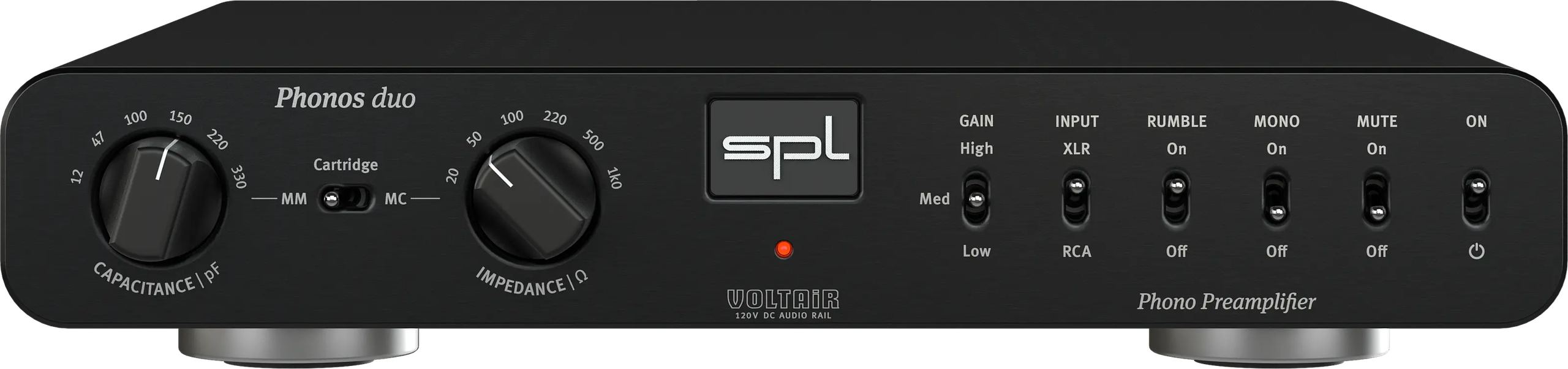

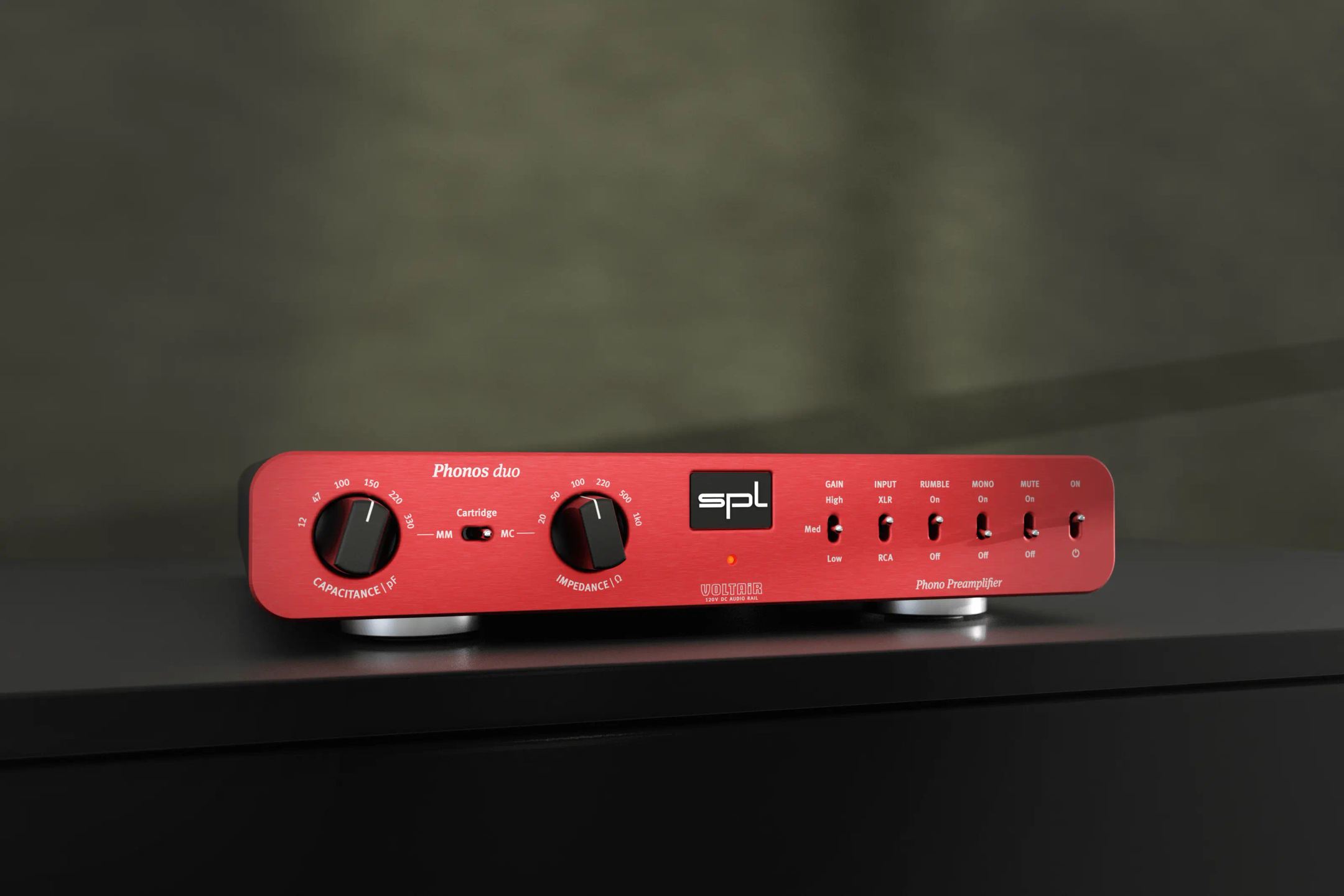
SPL Phonos Duo, the RIAA phono preamp
Connecting a turntable to a modern system relies on an often overlooked link: the phono preamp, which restores the RIAA curve cut into the groove and boosts a tiny electrical signal. SPL takes its Phonos and adds a second pair of balanced inputs and outputs. The Phonos Duo gains connection flexibility, communicates equally well via RCA and XLR, and retains the low noise and dynamics that have made the series renowned.
Connecting via RCA or XLR
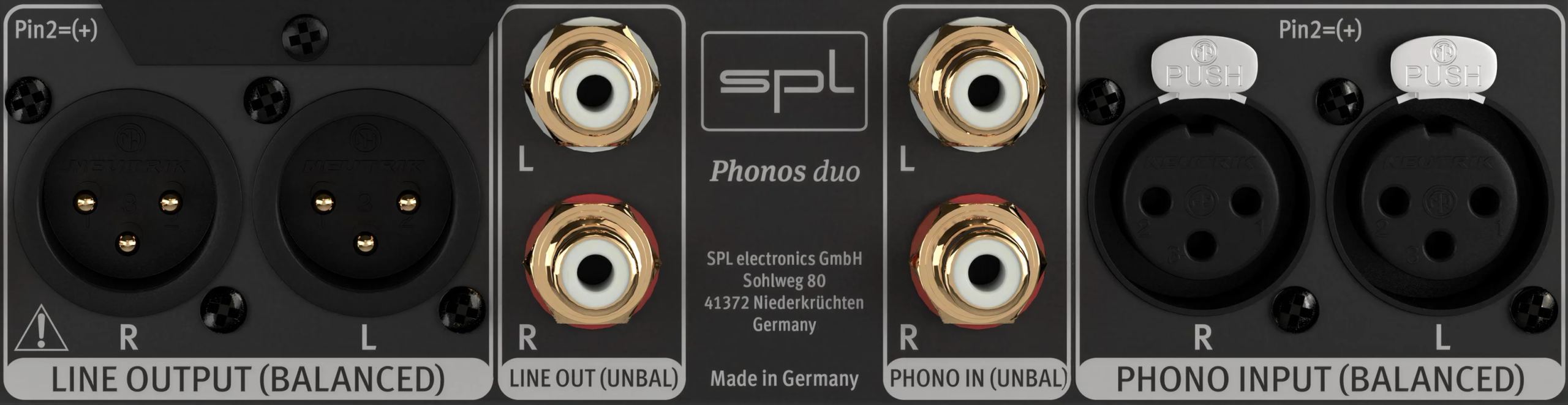
The original Phonos was limited to unbalanced RCA connections. The Duo version doubles the connectivity by adding a pair of balanced XLR inputs and outputs. Two turntables, or one turntable and one line-level source, can therefore remain permanently connected: an INPUT selector on the front panel chooses the active input. Both RCA and XLR outputs remain fed in parallel regardless of the selected input, allowing two amplifiers or an amplifier and a recorder to be connected simultaneously.
The RCA sockets are gold-plated, and turntable grounding is handled via a banana-plug terminal: the ground cable can be clamped or plugged in depending on the available connector. A balanced connection is only useful if the source supports it from end to end; with a conventional RCA-output turntable, the unbalanced input remains the logical path, while the XLR pair awaits long cable runs or an electrically noisy environment to demonstrate its usefulness.
A 120-volt internal supply
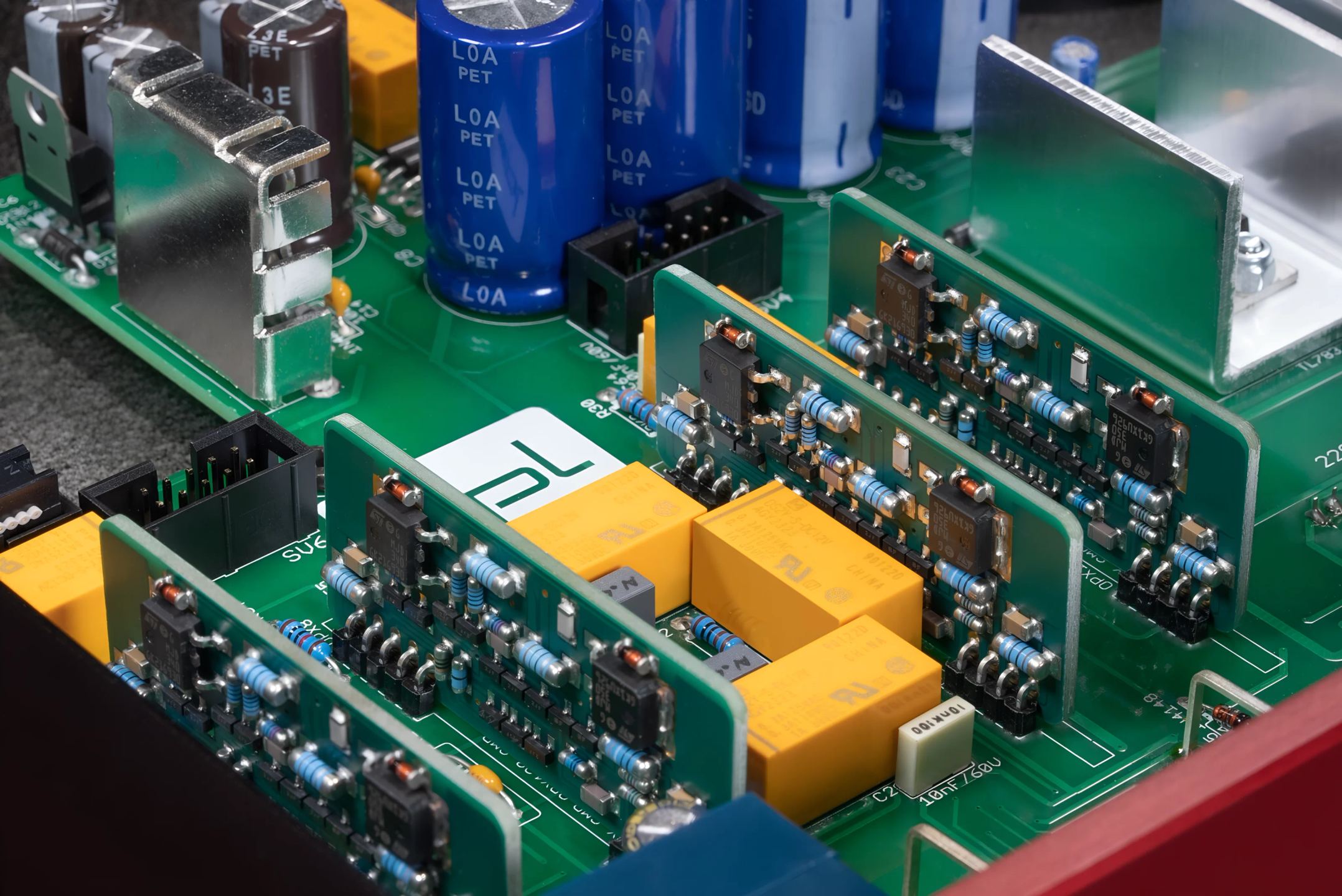
Most audio electronics operate with an internal power supply voltage of ±15 V and saturate their input stage at around +21.5 dBu. SPL raises this value to ±60 V thanks to its in-house op-amps, the SPL 120V SUPRA, which handle voltages that a standard component could not withstand. The VOLTAiR name encapsulates the idea: Volt for voltage, Air for the space left for music.
In practical terms, the Phonos Duo accepts input levels up to +32.5 dBu, providing 12 dB of additional headroom before clipping. A vinyl record produces abrupt transients, percussion or piano attacks that rise very high in an instant: this reserve prevents the input stage from cutting them off. The high gain available for moving-coil cartridges, whose output voltage is measured in hundreds of microvolts, also requires an extremely low noise floor, which is where the high internal voltage truly comes into its own.
Douglas Self-style RIAA equalization
During cutting, bass is attenuated and treble boosted according to the 1954 RIAA standard, a convention that saves space on the record and improves the signal-to-noise ratio. During playback, the preamp applies the inverse correction to restore a linear response. Everything depends on the precision of this filter.
SPL follows the design approach of British engineer Douglas Self: many low-value capacitors rather than a few large ones. These capacitors, audiophile Styroflex capacitors throughout the RIAA equalizer, charge and discharge faster, improving resolution and impulse response. Some components are through-hole mounted on the printed circuit boards, and SPL claims tuning by ear in addition to measurement.
Matching the preamp to the cartridge
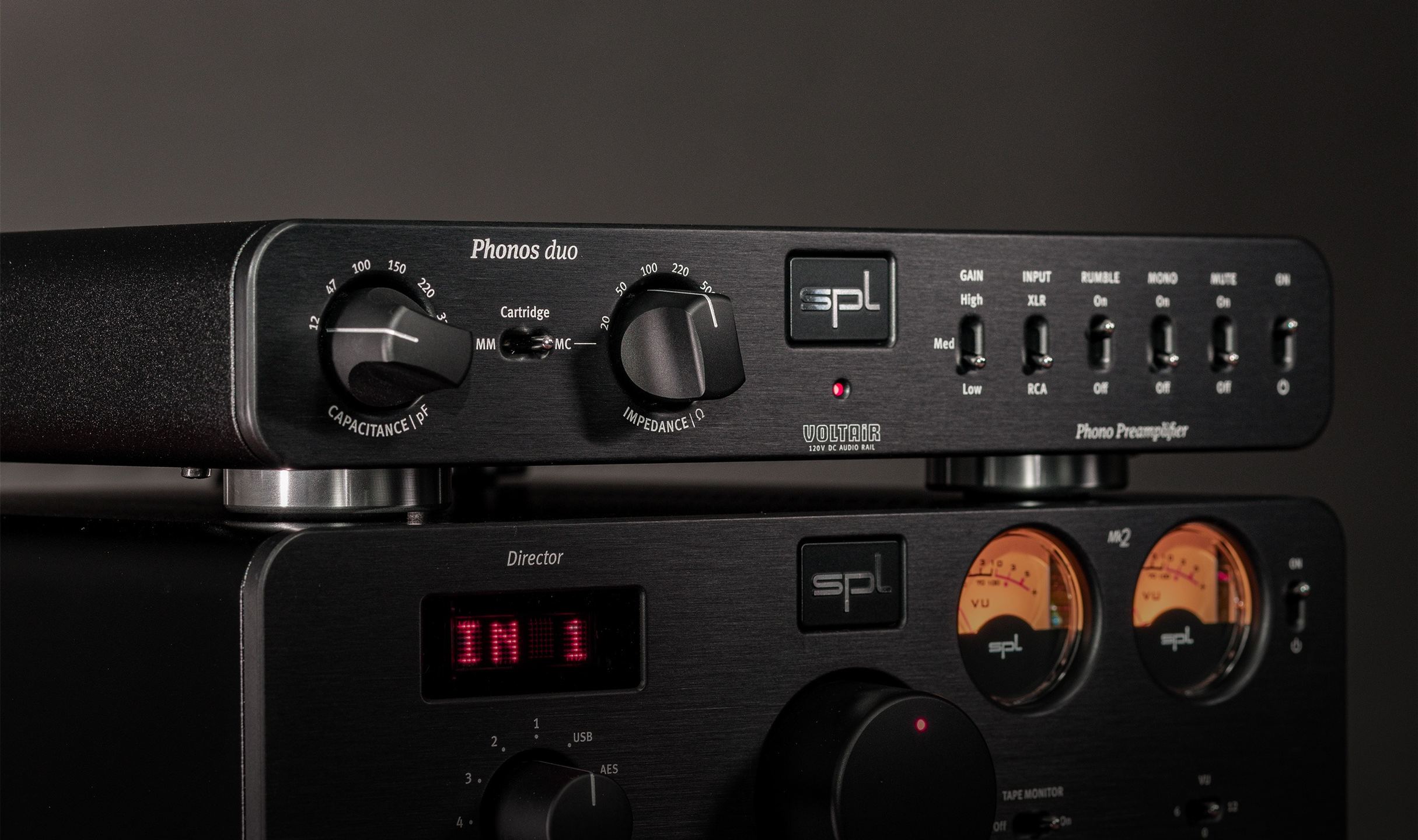
Gain is adjustable in three settings. In the low position, amplification reaches +30 dB for a moving-magnet (MM) cartridge and +50 dB for a moving-coil (MC) cartridge. The middle setting adds 10 dB to each, for +40 and +60 dB respectively, while the high position adds another 10 dB, bringing MM to +50 dB and MC to +70 dB. This maximum level matches the output of a modern digital converter, making it practical to balance the sources in a system.
An MM cartridge is sensitive to load capacitance: the cable between the turntable and preamp adds some, affecting the upper end of the spectrum. Six values are available, from 12 to 330 pF, with a fixed input impedance of 47 kΩ. An MC cartridge reacts more to load impedance, also adjustable in six positions between 20 Ω and 1 kΩ. Cartridge manufacturers specify the recommended value, which is best followed as closely as possible.
The MC cartridge is considered more refined, as its low moving mass follows groove nuances more accurately, but its tiny output voltage makes it more vulnerable to noise and hum. The MM cartridge is more robust and often more affordable, with slightly less precise playback; the neodymium magnets in recent models reduce this gap. If unsure which capacitance setting to use, a listening test is enough: cycle through the positions while monitoring the treble. As long as it rises, the value remains below that of the cartridge; as soon as it falls, it has gone above it.
Hum, ground loops and mono
The bass boost imposed by RIAA correction also amplifies low-frequency vibrations from the turntable drive mechanism. A switchable subsonic filter (Rumble) removes them when they become troublesome. To combat electrically induced hum, the GND LIFT switch isolates the internal ground from the chassis ground to break a ground loop, a useful complement to the existing grounding terminal.
Two other controls complete the front panel. Mono mode combines the two channels, which is useful with mono records as it narrows the image and reduces surface noise. The Mute function silences all outputs, for example while changing a record or handling the tonearm without sending a “pop” through the speakers.
A slim chassis made in Germany
The Phonos Duo measures 278 mm wide, 57 mm high and 300 mm deep, a low-profile format that fits beneath other components without taking up an entire shelf, and weighs 3.2 kg. Its internal linear power supply uses a shielded toroidal transformer, a consistent choice for a device whose weak point would be mains-induced noise. Standby consumption remains below 0.3 W, and the mains voltage is selectable (230 V for France).
Technical specifications
General
- Audiophile RIAA phono preamplifier
- Compatible with MM (Moving Magnet) and MC (Moving Coil) cartridges
- RIAA equalization based on the Douglas Self design
- Proprietary SPL VOLTAiR 120 V technology providing wide dynamic headroom and very low noise
- Manufactured in Germany
Features
- Gain adjustable in 3 levels
- MM capacitance adjustable in 6 positions
- MC impedance adjustable in 6 positions
- Switchable subsonic (Rumble) filter
- Mono mode
- Mute function
- Ground Lift switch
- Ground terminal compatible with banana plug or bare wire
Connectivity
- Stereo inputs (switchable)
- 1 pair of RCA
- 1 pair of balanced XLR
- Stereo outputs (simultaneously active)
- 1 pair of RCA
- 1 pair of balanced XLR
- Ground terminal (Ground)
Moving Magnet (MM) Preamplifier
- Gain
- Low: +30 dB
- Medium: +40 dB
- High: +50 dB
- Switchable capacitance: 12 pF, 47 pF, 100 pF, 150 pF, 220 pF, 330 pF
- Input impedance: 47 kΩ
- Noise (A-weighted, 50 dB gain): -82 dBu
- Dynamic range (50 dB gain): 132 dB
Moving Coil (MC) Preamplifier
- Gain
- Low: +50 dB
- Medium: +60 dB
- High: +70 dB
- Switchable impedance: 20 Ω, 50 Ω, 100 Ω, 220 Ω, 500 Ω, 1 kΩ
- Noise (A-weighted, 70 dB gain): -62 dBu
- Dynamic range (70 dB gain): 129 dB
Audio performance
- Frequency response: 10 Hz – 100 kHz
- Crosstalk (1 kHz): -80 dBu
- Output impedance: 75 Ω
Power supply
- Internal linear power supply with shielded toroidal transformer
- Operating voltage for analog audio: ±60 V
- Operating voltage for relays and LEDs: +12 V
- Selectable mains voltage (see fuse compartment)
- 230 V AC / 50 Hz
- 115 V AC / 60 Hz
- Fuse for 230 V: T 0.5 A
- Fuse for 115 V: T 1 A
- Maximum power consumption: 30 VA
- Standby power consumption: < 0.3 W
Dimensions and weight
- Dimensions (W × H including feet × D): 278 × 57 × 300 mm
- Net weight: 3.2 kg
- Shipping weight (including packaging): 4.3 kg
Frequently asked questions
Is the Phonos Duo sufficient on its own, or is an amplifier needed downstream?
It is a phono preamp, not an integrated amplifier. It prepares the turntable signal and then sends it to a line-level input: that of a preamplifier, an integrated amplifier, or a headphone amplifier with a line input. It therefore does not directly drive speakers.
Can I power two devices at the same time from the Phonos Duo?
Yes. The RCA and XLR outputs operate in parallel and remain active simultaneously. For example, you can connect an amplifier via RCA and a recorder or second system via XLR, without an additional distribution box.
Is an XLR input useful if my turntable outputs RCA?
In this case, the RCA input is the right choice. The XLR pair becomes relevant with an already balanced source or when the cable runs over a long distance in an electrically noisy environment, as a balanced connection better rejects interference picked up along the way.
How do I know which capacitance or impedance setting to choose for my cartridge?
The cartridge manufacturer specifies the recommended value, which should be set as closely as possible on the corresponding selector (capacitance for an MM, impedance for an MC). Without documentation, the listening method described above can help approximate the correct capacitance setting by monitoring changes in the treble.
What should I do if I hear a persistent low hum?
Two distinct issues. A rumble related to the turntable mechanism can be addressed with the subsonic filter. A continuous electrical hum is more likely due to a ground loop: first connect the turntable to the ground terminal, then test the GND LIFT switch, which isolates the internal ground from the chassis.
- Eco-contribution included in the sale price.
- Manufacturer reference: LPHNS2450
- GTIN / EAN: 4260149320322