Aurender A15 silver


Specifications and features


Overview
Replacing an aging CD player or laptop with a single source, without stacking a separate DAC and transport: that is where the A15 comes in. This network music server combines file playback, access to streaming platforms and digital-to-analog conversion in a single machined aluminum chassis. Its variable-level balanced and unbalanced outputs can feed either a preamplifier or a power amplifier directly.
A dual-mono DAC with AKM4490 chips
The A15 replaces the A10, Aurender’s first server to incorporate a digital-to-analog converter. The conversion stage is based on two AKM4490 chips in a dual-mono configuration, one per channel, each powered by a dedicated linear section that separates the left and right channels. Decoding supports PCM up to 32-bit/768 kHz and native DSD up to DSD512. A full MQA decoder is fitted on the board: it unfolds MQA files to their full resolution without any prior software step.
FPGA clocking against jitter
The conversion section is clocked by a precision timing system based on an FPGA, a reprogrammable logic circuit. The generator offers accuracy below 100 femtoseconds, complemented by a TCXO oscillator (temperature-compensated crystal oscillator). The goal is practical: to time each sample precisely in order to reduce jitter, the tiny timing shifts that degrade digital playback.
Linear power supply and built-in UPS
The power supply is entirely linear, with no switching circuitry. Four toroidal transformers share the workload: one 50 W unit for the processor, two 25 W units for the DAC’s left and right sections, and a final 25 W unit for the FPGA. This separation isolates sensitive circuits from the noise generated by the computing section, supported by internal shielding. A supercapacitor UPS takes over in the event of a mains power outage and stabilizes operation, without any chemical battery to replace. In use, the A15 consumes 29 W during playback, 42 W at maximum and 7 W in standby.
Variable-level outputs and preamp function
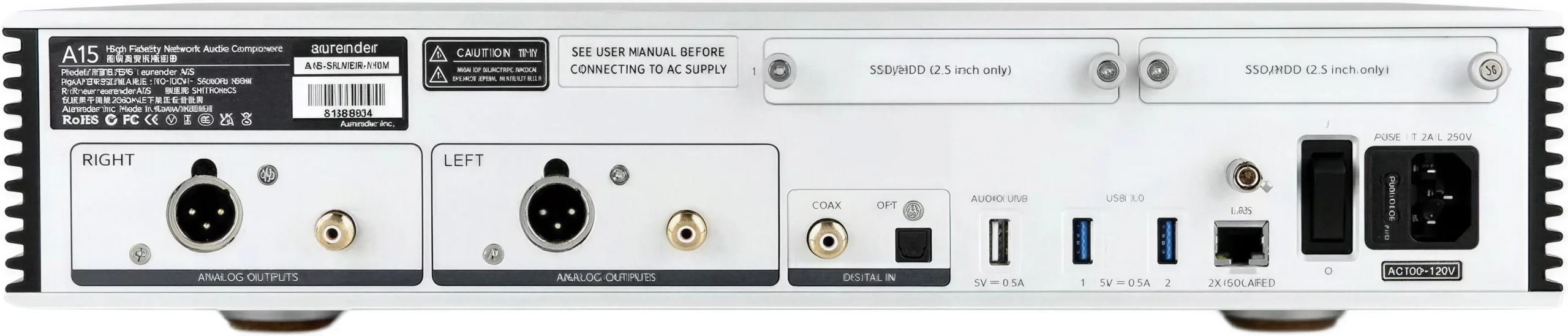
The A15 is fitted with two sets of analog outputs: one balanced pair on XLR and one unbalanced pair on RCA. Their level is variable, adjusted by a lossless digital volume control that operates directly at DAC level. This changes how it can be connected: the A15 can be connected to a preamplifier or integrated amplifier, but can also drive a power amplifier directly, eliminating the need for a preamp. Two coaxial digital inputs on RCA and one Toslink optical input accommodate other sources, such as a CD transport or television, which then benefit from the internal DAC. Conversely, a dedicated USB Audio output, physically and electrically isolated from the processor board, makes it possible to connect an external DAC.
Two storage bays and cache playback
At the rear, two 2.5-inch bays accommodate SSD or mechanical drives that the user installs themselves, up to 8 TB per bay. They can also be left empty for 100% streaming listening, without paying for unnecessary storage. Playback is never carried out directly from these drives: each track is first copied to a 240 GB NVMe SSD, which also hosts the system, then played from this cache. Library drives and the network remain outside the audio path, protecting playback from the fluctuations of a NAS or unstable connection. A critical listening mode turns off the screen, buttons and non-essential background tasks to further reduce electrical noise. Two USB 3.0 ports and NAS access are used for transfers and file imports.
Conductor control and network connection
Everything is controlled from the Aurender Conductor app, on iOS and Android, which brings together the local library and integrated services: Tidal, Qobuz, web radio, plus Spotify Connect and AirPlay. Network connection is via a Gigabit Ethernet port with dual transformer isolation, which filters link noise, with no Wi-Fi. A low-power quad-core Intel processor supported by 8 GB of RAM runs the system; using a low-consumption processor limits the current draw and, with it, the noise injected into the audio circuits. On the front panel, a 6.9-inch color IPS LCD screen (1280 × 480) displays album artwork, artist and track title. The machined aluminum chassis measures 430 × 356 × 97 mm and weighs 11.9 kg.
Technical specifications
General
- Type: network music server, streamer, high-end DAC
- Chassis: machined aluminum
- Display: 6.9” color IPS LCD, 1280 × 480 pixel resolution
- Processor: low-power Intel Quad-Core
- RAM: 8 GB
- System storage and cache: 240 GB NVMe SSD
- Control application: Aurender Conductor
Digital-to-analog converter
- Architecture: 2 × AKM4490 in Dual-Mono configuration
- PCM resolution: up to 32-bit / 768 kHz
- DSD resolution: up to native DSD512
- Integrated MQA Full Decoder decoding
- Compatible formats: DSD (DSF, DFF), WAV, FLAC, AIFF, ALAC, M4A, APE and other compatible audio formats
Clock and digital processing
- Clock system: FPGA-based precision architecture
- Clock generator accuracy: below 100 fs
- Audio clock: TCXO
- Purpose: jitter reduction for more accurate digital reproduction
Music storage
- Storage bays: 2 × 2.5” slots for HDD or SSD
- Installation: user-installable storage
- Maximum capacity: up to 2 × 8 TB
- USB connection: compatible with USB drives and NAS servers
Network and connectivity
- Ethernet connection: dual-isolated Gigabit LAN
- Streaming services: compatible with services integrated into the Aurender ecosystem
- Library access: local storage, USB and NAS
Analog outputs
- RCA outputs: 1 unbalanced stereo pair
- XLR outputs: 1 balanced stereo pair
- Output level: variable
- Volume control: lossless digital adjustment at DAC level
- Direct use: can be connected directly to a power amplifier
Digital inputs and outputs
- Digital audio output: dedicated USB Audio
- Coaxial digital inputs: 2 × RCA
- Optical digital input: 1 × Toslink
Formats supported via USB output
- PCM: up to 32-bit / 768 kHz
- Native DSD: up to DSD512
- DSD via DoP: up to DSD256
Power supply
- Type: fully linear power supply
- Transformers: 4 audiophile toroidal transformers
- 1 × 50 W for the processor
- 2 × 25 W for the left and right DAC sections
- 1 × 25 W for the FPGA
- Integrated UPS system via supercapacitors
- Role: protection against power outages and improved operating stability
Power consumption
- During playback: 29 W
- Maximum consumption: 42 W
- Standby: 7 W
Dimensions and weight
- Dimensions (W × D × H): approximately 430 × 356 × 97 mm
- Height without feet: approximately 84 mm
- Weight: 11.9 kg
Frequently asked questions
Can the A15 rip CDs to its library?
No, it does not have a CD drive or ripping function. To add CDs to your collection, they must be copied from another device to the internal drives. A CD player can also be connected to the coaxial or optical inputs to be played through the A15’s converter.
What file formats does the A15 support?
DSD (DSF, DFF), WAV, FLAC, AIFF, ALAC, M4A, APE, and other common audio formats.
Can you do without a NAS with the A15?
Yes. The two internal bays each support up to 8 TB of storage, accommodating a large permanent library. A NAS or USB drive can still be used to play or import files, but they are not necessary.
Does the A15 have a headphone output?
No, it does not include a headphone amplifier. It is a line-level source: for headphones, it must be connected to an amplifier with a headphone output or to a dedicated headphone amplifier.
Does it support an external clock (master clock)?
No, the A15 does not have a clock input. Its timing relies on the FPGA’s internal clock and the TCXO oscillator.
How does the A15 differ from Aurender's N150 transport?
The N150 is a pure network transport: it has no converter or analog output and is limited to a USB output for an external converter. The A15 adds the AKM4490 dual-mono converter and XLR and RCA outputs, allowing it to connect directly to an amplifier.
Does MQA decoding require a paid option?
No. The full MQA decoder is built into the A15’s board and unfolds MQA files at full resolution without any additional purchase.
- Eco-contribution included in the sale price.