Aurender A20 silver


Specifications and features


Overview
Combining the server, network player, converter, preamplifier and headphone amplifier in a single enclosure usually requires compromises in one of the links in the chain. The A20 borrows its conversion stage from the A30, the brand’s flagship model, and forgoes CD ripping in order to fit on a single equipment shelf. The result is a complete digital source, capable of driving a power amplifier directly.
The A30 model’s converter in a compact format
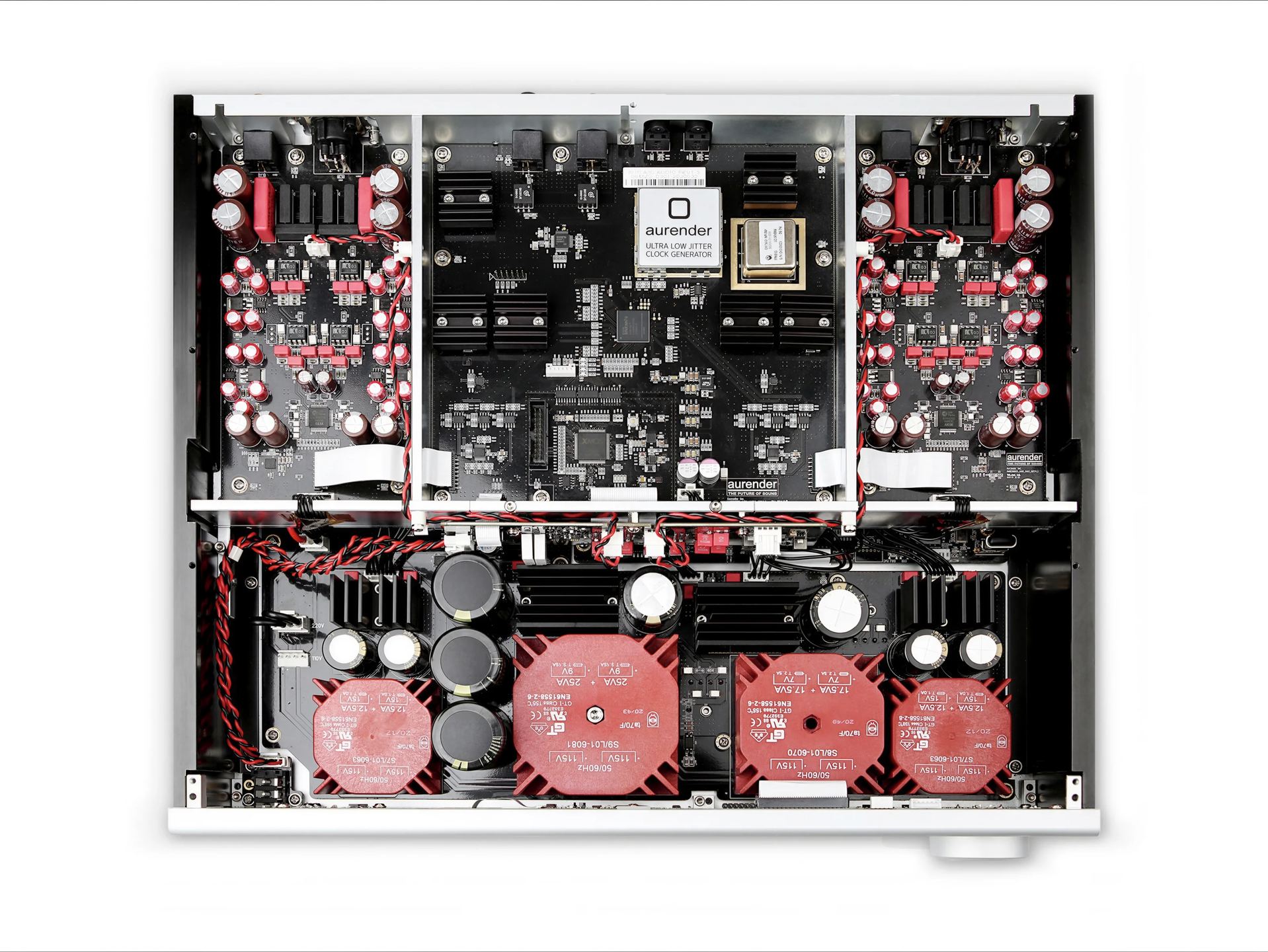
At the heart of the A20 is a dual-mono conversion module with AKM4497 chips, one per channel, each served by its own discrete linear power supply. It is the same stage as in the A30 model, the top of the range, whose chassis format the A20 also adopts. The difference from the lower-tier A15 lies in this chip: the A15 uses the AKM4490, while the A20 features the flagship’s 4497.
The clock, managed by an FPGA circuit, reduces playback jitter. PCM is supported up to 768 kHz and 32 bits, DSD up to native DSD512 for internal playback and DSD256 via DoP. Full MQA decoding is built into the board, with no paid option to activate. PCM upsampling to 705.6 or 768 kHz is available, and can be enabled or disabled depending on whether you prefer a rescaled signal or playback faithful to the original file.
What the A20 leaves to the A30: CD ripping via an integrated drive and associated library management, as well as the factory-installed drive. It delivers reference conversion in an enclosure designed for a library that has already been digitized or is entirely online.
Analog outputs and preamplifier function
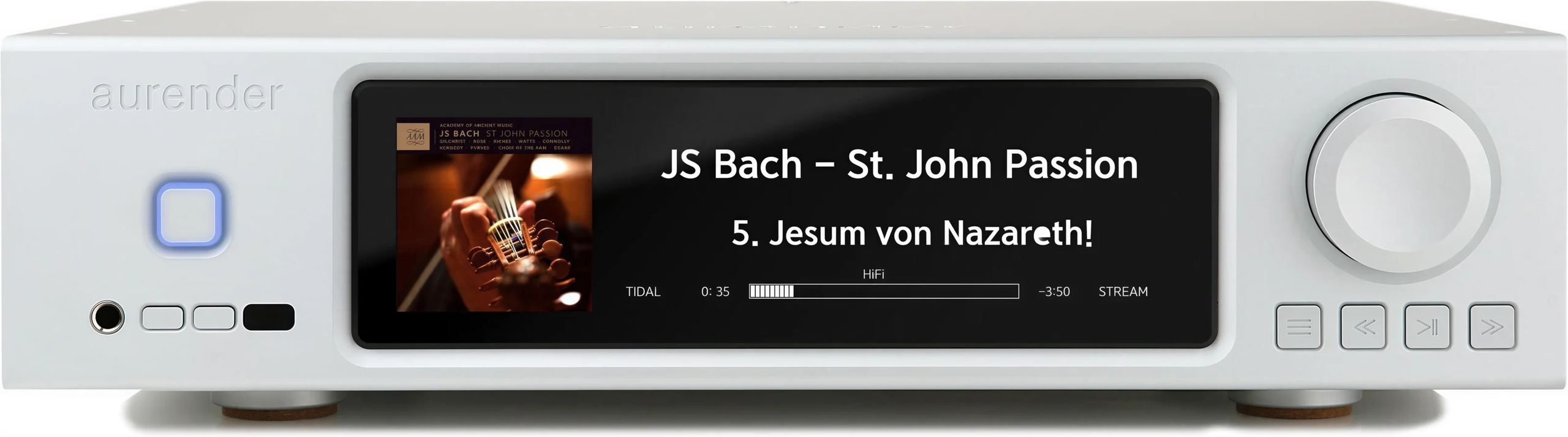
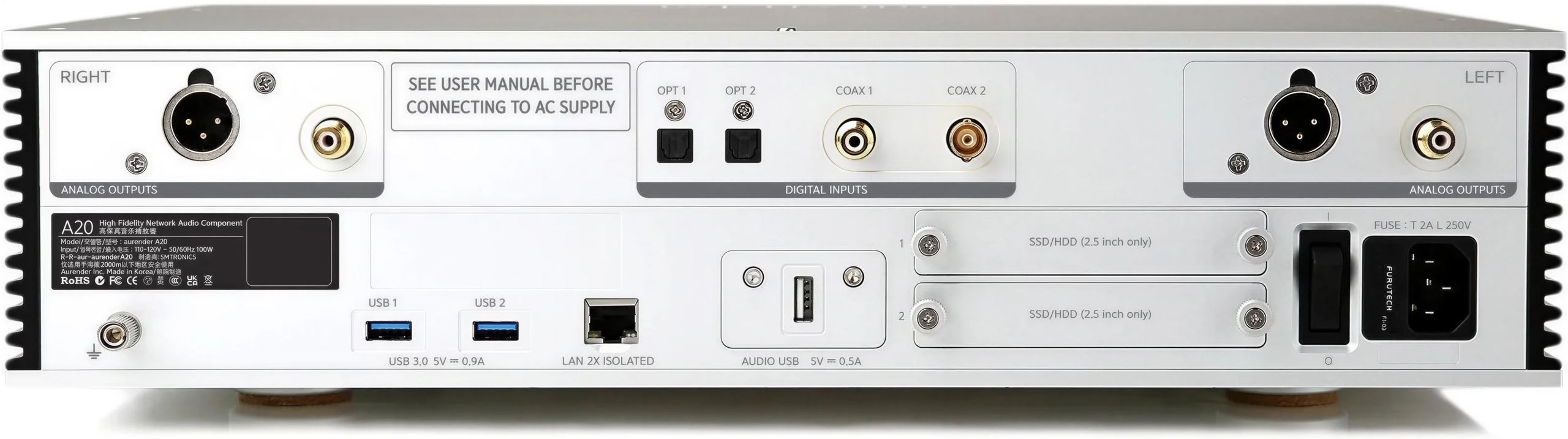
The A20 offers one pair of balanced XLR outputs and one pair of unbalanced RCA outputs. The output level is variable: volume is adjusted in the digital domain, at converter level, in 0.5 dB increments between -90 and 0 dB, with a knob sensitive to rotation speed. This setting can be controlled from the front panel, the Conductor app or the supplied infrared remote control.
In practical terms, the A20 connects directly to a power amplifier, without an intermediate preamplifier. Digital volume reduction avoids the electronics of an additional analog stage; in return, it operates on the converted signal, an approach that places control as close as possible to the converter.
A headphone output connected to the main converter
The front panel features a 6.35 mm jack headphone output, with an unbalanced connection. It relies on a dedicated section, powered by the same converter and output stage as the rest of the unit, placing headphone listening at the level of the main chain rather than as an auxiliary function.
In this respect, the A20 remains behind the A30, which adds balanced outputs (4-pin XLR and 4.4 mm) to its headphone section. Here, only one unbalanced output is available, suited to wired headphones connected via 6.35 mm.
Two drive bays to populate yourself
At the rear, two bays accommodate 2.5-inch hard drives or SSDs, to be installed by the user. Each slot accepts up to an 8 TB SSD, providing 16 TB of local music storage when both are populated. There is no obligation to fill them: for 100% online listening, the A20 operates with empty bays, with the option of adding a drive later.
A 480 GB internal NVMe SSD is reserved for the system and playback cache. Before being played, a track is copied to this cache and then played from it, isolating playback from network or NAS fluctuations. The A20 also reads files from a USB drive or a NAS server on the local network.
A linear power supply with four transformers
The power supply is entirely linear, a choice that limits electrical interference compared with a switching power supply. Four toroidal transformers share the task: one 50 W transformer for the processor, two 25 W transformers for the left and right converters, and one 35 W transformer for the FPGA circuit and headphone section. Powering these stages separately prevents them from interfering with one another.
An internal supercapacitor UPS takes over in the event of a sudden mains power cut and allows the unit to shut down properly, without corrupting files or the system. In operation, the A20 consumes 47 W during playback, 80 W maximum and 6 W in standby.
Digital inputs and dedicated USB output
The A20 does not merely play its own files. Three types of digital inputs are provided on the rear: one RCA coaxial input, one BNC coaxial input and two Toslink optical inputs. They accept signals up to 24 bits and 192 kHz, plus DSD64 via DoP, routing an external source, such as a CD player or television, through the internal converter.
In the other direction, a dedicated USB Audio Class 2.0 output, isolated to keep noise at bay, sends the stream to an external converter. It supports PCM up to 768 kHz/32 bits, native DSD512 and DSD256 via DoP, allowing the A20 to remain a network player ahead of another converter.
Wired network and control via the Conductor app
Network connection is handled through a dual-isolated Gigabit Ethernet port. The A20 connects by cable, without Wi-Fi, a constant across the range that keeps radio interference away from the audio electronics. The processor, a low-power Intel quad-core supported by 8 GB of memory, remains deliberately modest: it only has to manage playback, not heavy processing.
All control is handled by the Aurender Conductor app, on iOS and Android. It includes access to Tidal, Qobuz and web radio stations, and adds Spotify Connect as well as AirPlay; the A20 is also Roon Ready certified. If an issue arises, the Aurender team can connect remotely to the device via the Internet to diagnose a fault.
A critical listening mode disables the screen, buttons and background tasks not essential to playback, for quieter operation. The display is an 8.8-inch color IPS panel with a resolution of 1920 × 480. The chassis is made from machined aluminum: 429 mm wide, 356 mm deep, 112 mm high (99 mm without feet), weighing 14.2 kg.
Technical specifications
Supported audio formats
- PCM up to 768 kHz / 32 bits
- Native DSD up to DSD512
- Supported formats: WAV, FLAC, AIFF, ALAC, M4A, APE, DSF, DFF
- MQA with full built-in decoding
Digital-to-analog converter (DAC)
- Dual-mono architecture
- AKM4497 converter
- Full MQA decoding
- PCM upsampling up to 705.6 / 768 kHz
Analog outputs
- 1 balanced XLR pair
- 1 unbalanced RCA pair
- Variable output level
- Lossless digital volume control at the DAC level
- Can be used as a digital preamplifier
Headphone section
The A20 features a dedicated headphone section for direct listening without additional equipment.
- Headphone output: 6.35 mm jack
- Dedicated architecture
- Compatible with wired headphones via unbalanced connection
Digital connectivity
- Digital inputs
- 1 RCA coaxial input
- 1 BNC coaxial input
- 2 Toslink optical inputs
These inputs allow different digital sources, such as a CD player or television, to be connected in order to benefit from the A20’s built-in DAC.
- Digital output
- 1 dedicated USB Audio output
- PCM up to 768 kHz / 32 bits
- Native DSD512
- DSD256 via DoP
Storage and music library
- 2 bays for 2.5-inch HDD or SSD
- User-installable storage
- Up to 2 × 8 TB SSD depending on the selected configuration
- 480 GB internal NVMe SSD for the system and cache
- Compatible with local music libraries
- Can be connected to USB drives and NAS servers
Power supply and internal architecture
The Aurender A20 benefits from a fully linear power supply to limit electrical interference and ensure independent power for the various circuits.
- Fully linear power supply
- 4 dedicated toroidal transformers
- 1 × 50 W for the processor
- 2 × 25 W for the left and right DACs
- 1 × 35 W for the FPGA and headphone section
- Built-in supercapacitor UPS system
- Protection against sudden power outages
Network and control
- Double-isolated Gigabit Ethernet port
- Aurender Conductor control software
- Compatible with integrated streaming services
- Playback from local storage, USB and NAS
- Support for major digital audio formats
- Remote technical support via the Internet
Processor and memory
- Low-power Intel Quad-Core processor
- 8 GB RAM
- 480 GB NVMe SSD for the system and cache
Display
- Wide 8.8-inch (22.4 cm) color IPS display
- Resolution: 1920 × 480 pixels
Power consumption
- Playback: 47 W
- Maximum power consumption: 80 W
- Standby: 6 W
Dimensions and weight
- Width: 429 mm
- Depth: 356 mm
- Height: 112 mm
- Height without feet: approximately 99 mm
- Weight: 14.2 kg
Construction
- Machined aluminum chassis
- High-end audiophile design
- Integrated architecture combining music server, DAC, preamplifier and headphone amplifier
Frequently asked questions
Is MQA decoding necessary to enjoy the A20?
No. Full MQA decoding is used to play files encoded in this format. For everything else, PCM up to 768 kHz/32-bit and DSD up to DSD512, the A20 decodes natively without using MQA. Tidal and Qobuz streams integrated into the app are played in their respective formats, including FLAC and high-resolution audio.
Which drives can be installed in the two bays?
User-installed 2.5-inch hard drives or SSDs, with a maximum height of 15 mm. Each bay supports up to an 8 TB SSD. You can install just one, both, or neither, and add them later.
Is a separate preamplifier necessary?
Not necessarily. The A20’s variable output level allows it to drive a power amplifier directly. If you keep an existing preamplifier, set the A20’s output to a reference level and let the preamplifier control the volume.
Can a television or CD player be connected to the A20?
Yes, via the digital inputs: one RCA coaxial, one BNC coaxial and two Toslink optical inputs, whose signal passes through the internal converter. They accept up to 24-bit/192 kHz and DSD64 in DoP. For a television, set the audio output to stereo PCM: these inputs do not decode compressed multichannel streams such as Dolby or DTS.
Is the A20 Roon Ready certified?
Yes. It appears as a Roon playback endpoint connected to its internal DAC (analog output) by default, or as a USB output if you switch to USB output in Conductor. The Conductor app remains necessary to access the internally stored library and certain in-house features.
Can the A20 play music from a NAS or an external USB drive?
Yes. It can access shared folders on a NAS server on the network and drives connected to its rear USB 3.0 ports. Internal storage remains preferable to take advantage of the read cache, which protects the library from network fluctuations.
- Eco-contribution included in the sale price.