

Sonus Faber Gravis I walnut


Overview
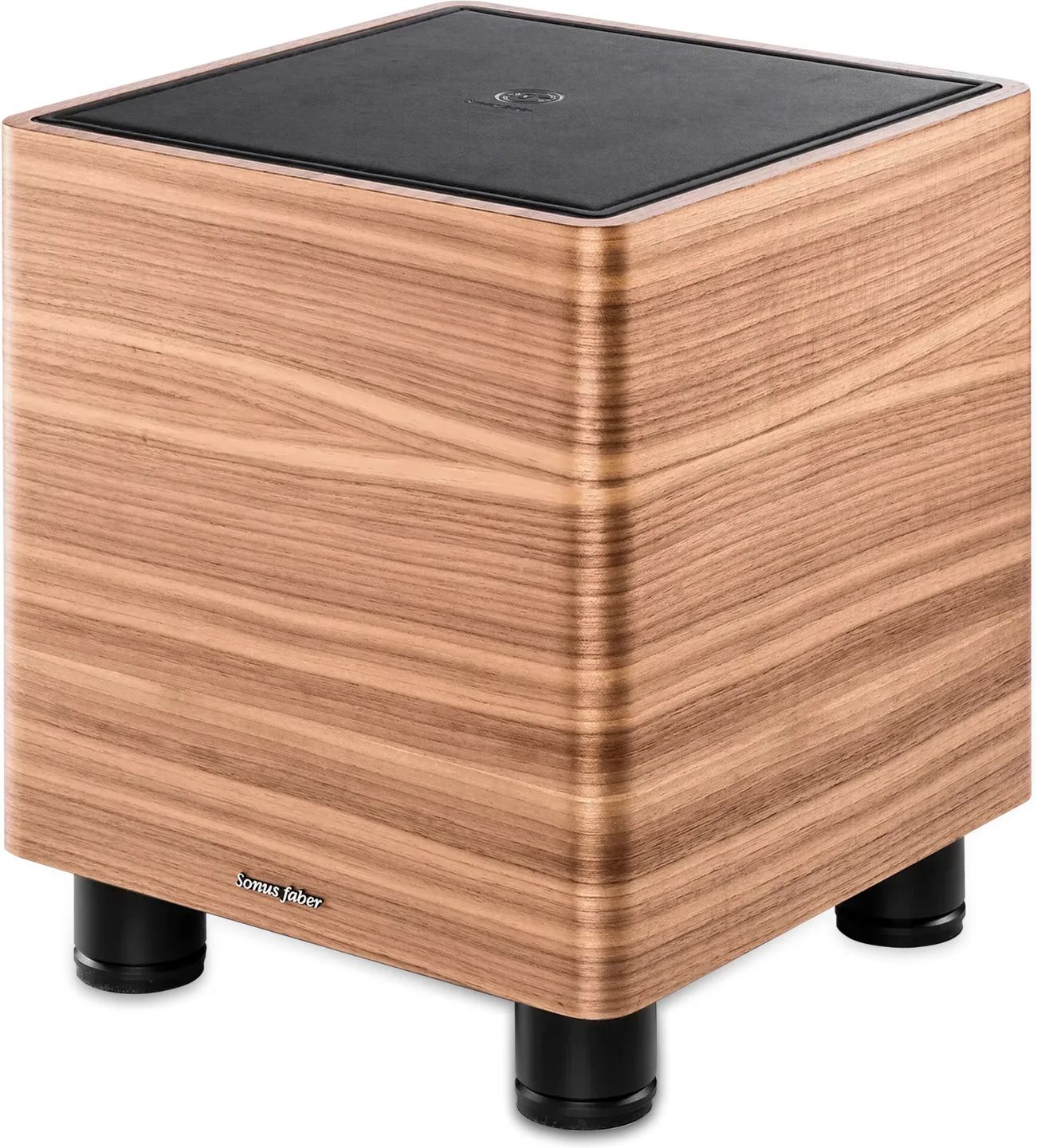
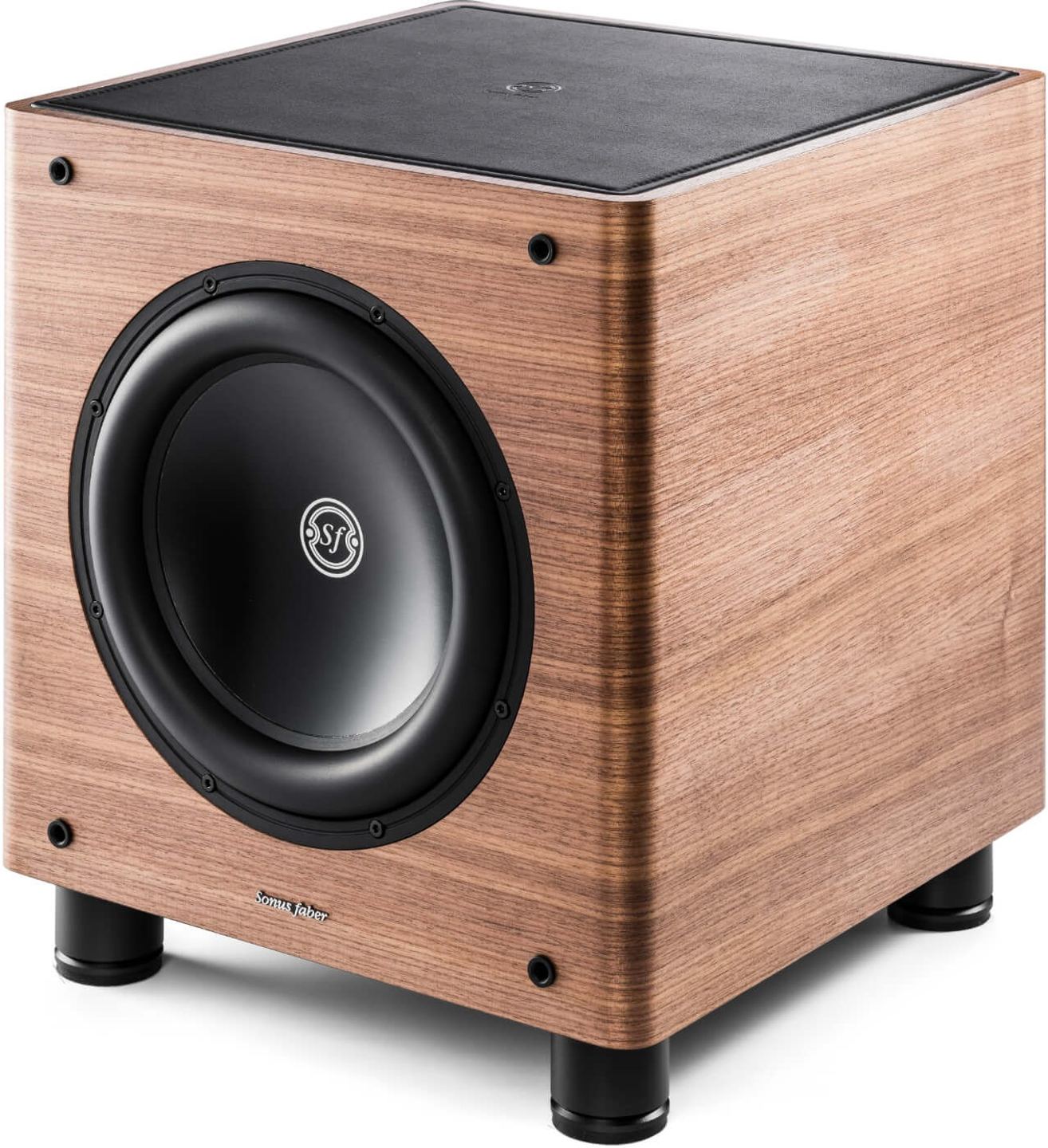
Adding depth to a pair of compact speakers without cluttering the living room calls for a discreet, precise, and easy-to-adjust subwoofer. This 21-centimeter active model uses a sealed enclosure, with the driver facing the floor, delivering tight bass that is more musical than showy, yet capable of supporting a movie soundtrack. Its Italian craftsmanship and leather top bring it closer to the brand’s speakers.
A floor-firing sealed enclosure
A sealed enclosure is an airtight cabinet in which the driver operates without a port. This choice has a direct effect on sound: bass starts and stops quickly, without overhang, helping the subwoofer keep pace with the rhythm of the music. In return, a sealed enclosure reaches slightly less deep and delivers slightly less output than a similarly sized ported cabinet. The Gravis I embraces this approach, with claimed extension down to 30 Hz (at -6 dB).
The 21-centimeter driver is mounted beneath the cabinet and radiates toward the floor. This orientation distributes bass through reflection off the floor, makes the subwoofer less easy to locate by ear, and allows placement near a wall or in a corner. Rubber feet decouple the subwoofer from the floor and limit vibration transmission.
A long-excursion 21 cm driver, 150 watts
The transducer uses a treated paper cone and a wide rubber surround. This surround allows for long travel: the cone moves a long way back and forth, compensating for the moderate diameter and moving enough air to produce deep bass.
The internal amplification is high-linearity Class AB, a topology that seeks a balance between signal cleanliness and efficiency. It delivers 150 watts RMS, with peaks of up to 250 watts for brief impacts, kick drum hits, or explosions. Power consumption remains at 200 watts during operation and drops to 0.5 watt in standby.
Connections and settings
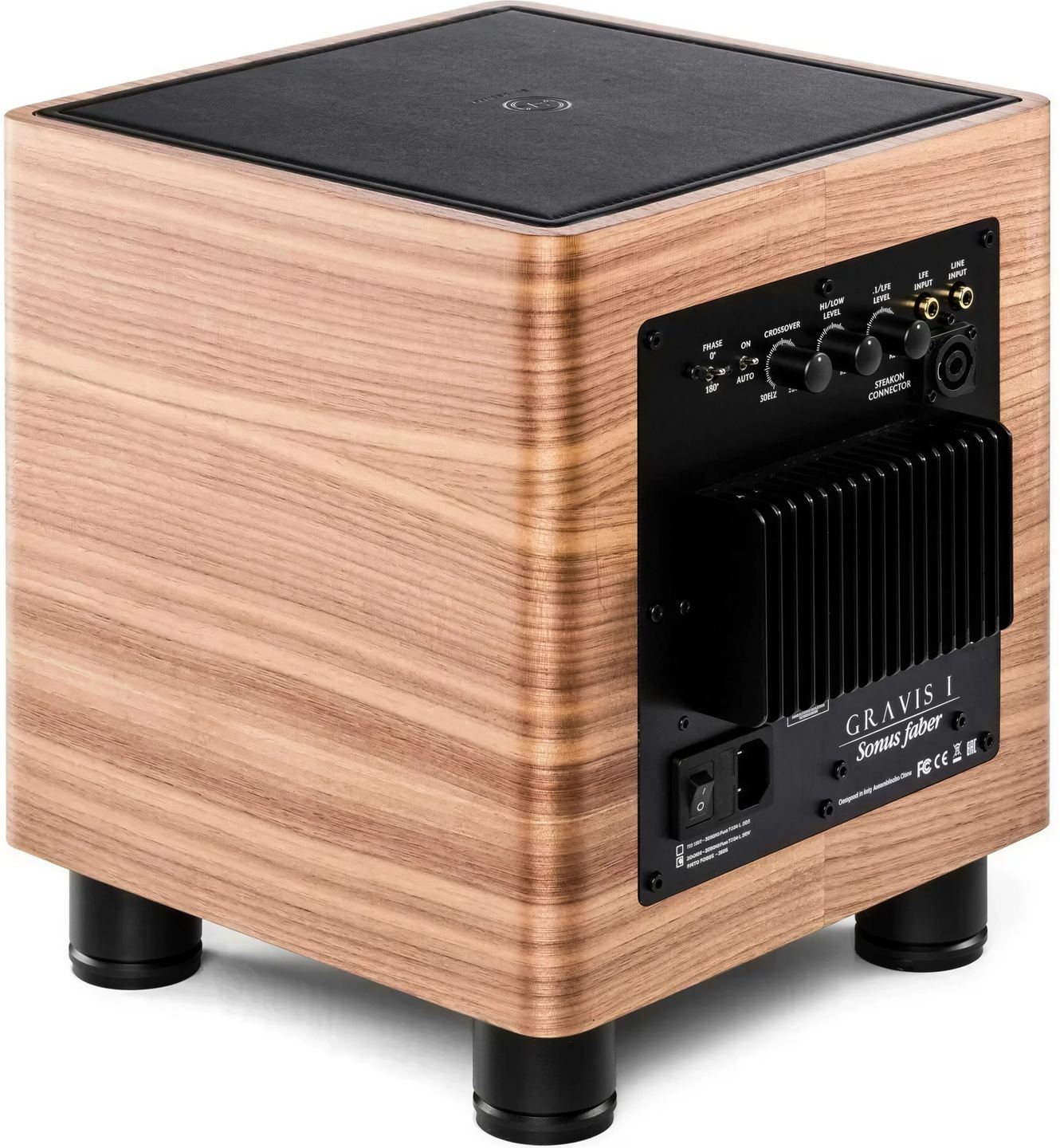
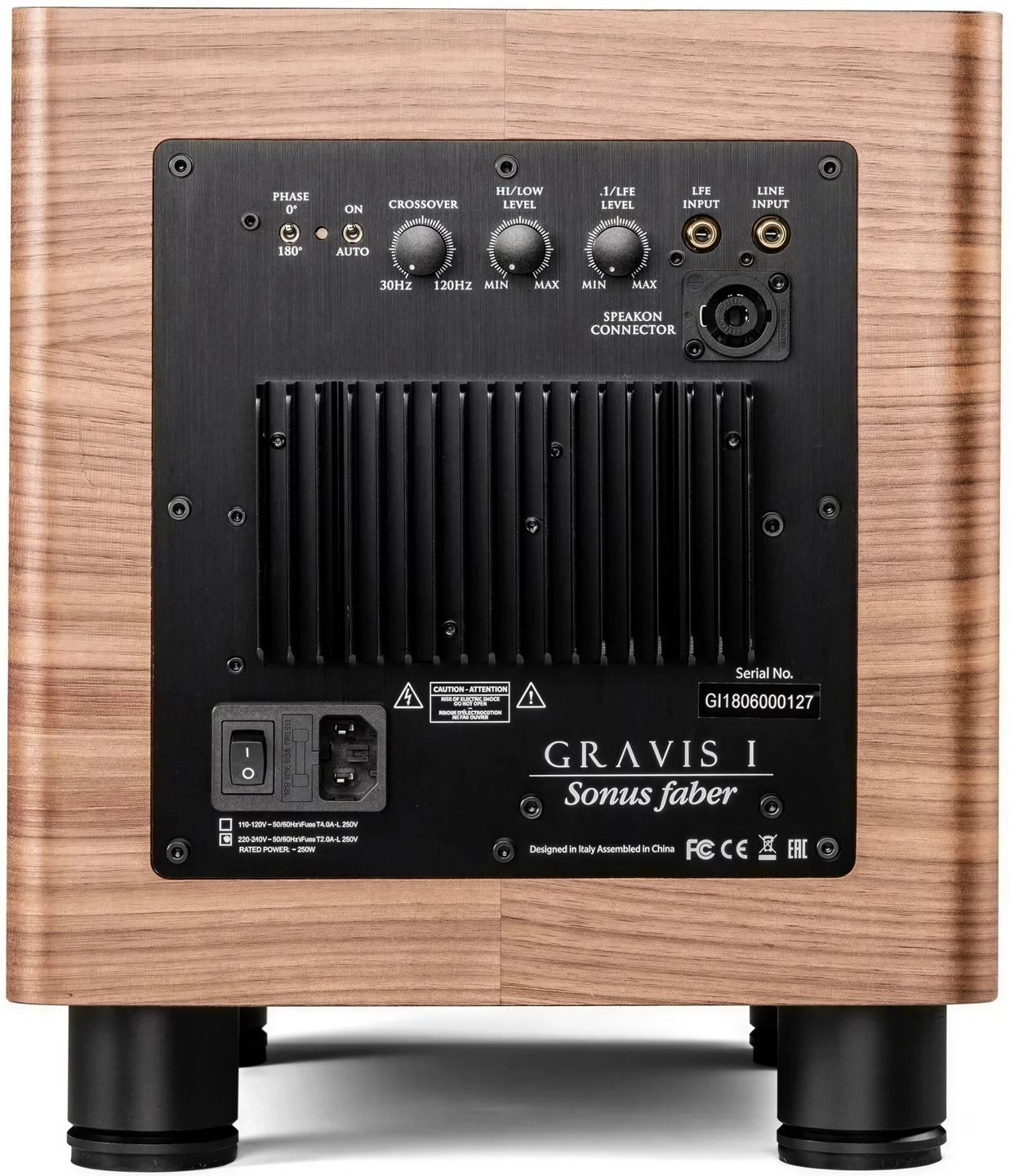
The rear panel brings together three inputs, one for each type of installation. The LFE input (mono RCA) receives the low-frequency effects channel from a home theater amplifier. The LINE input (mono RCA) connects to a preamplified output in a conventional stereo system. The HIGH LEVEL input, in Neutrik Speakon 4-pole format, connects to the amplifier’s speaker terminals: the subwoofer then takes the same signal as the main speakers and follows the amplifier’s sonic character.
For settings, the crossover frequency is continuously adjustable from 30 to 120 Hz, with a 24 dB per octave slope. Such a steep slope limits overlap between the subwoofer and speakers, for a cleaner blend in the low midrange. The phase switch (0° or 180°) aligns the subwoofer with the speakers according to its position in the room. Two independent volume controls, Master and LFE, separately adjust the level for music and home theater. Automatic power-on wakes the subwoofer when a signal is detected and puts it into standby after a period of silence; it can be disabled if you prefer to control it differently.
The cabinet, leather, and finishes
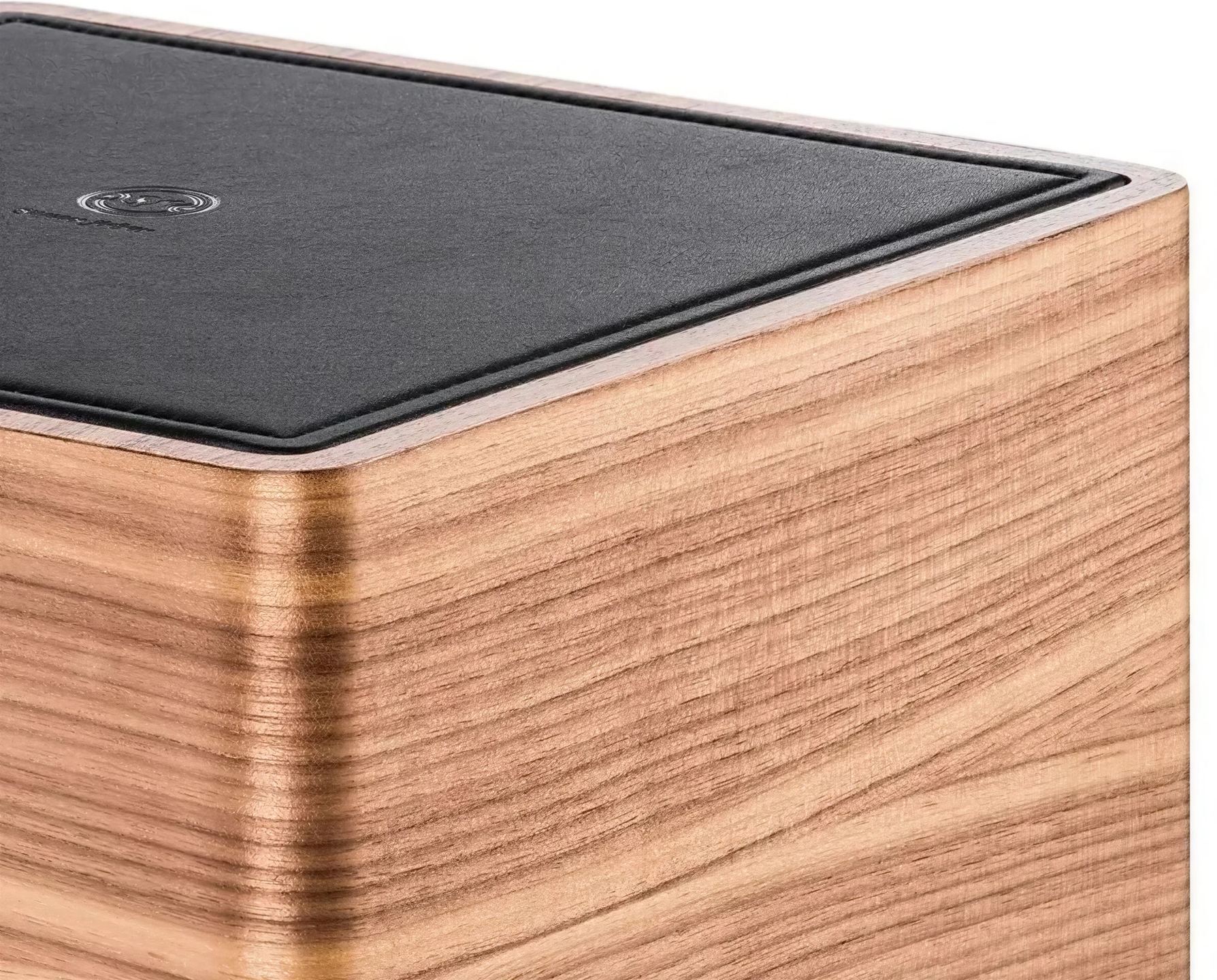
The square cabinet is available in four finishes: open-pore walnut and wenge, matte white, and glossy lacquered black. The top is covered in black leather embossed with the Sonus faber logo, a detail carried over from the brand’s speakers. The unit is assembled in Italy, in Arcugnano, near Vicenza.
Its dimensions remain compact: 334 mm high, 286 mm wide, and 316 mm deep, with a weight of 14 kg. Enough to slide the subwoofer next to a piece of furniture or a sofa without making its presence felt.

Speakers to pair it with
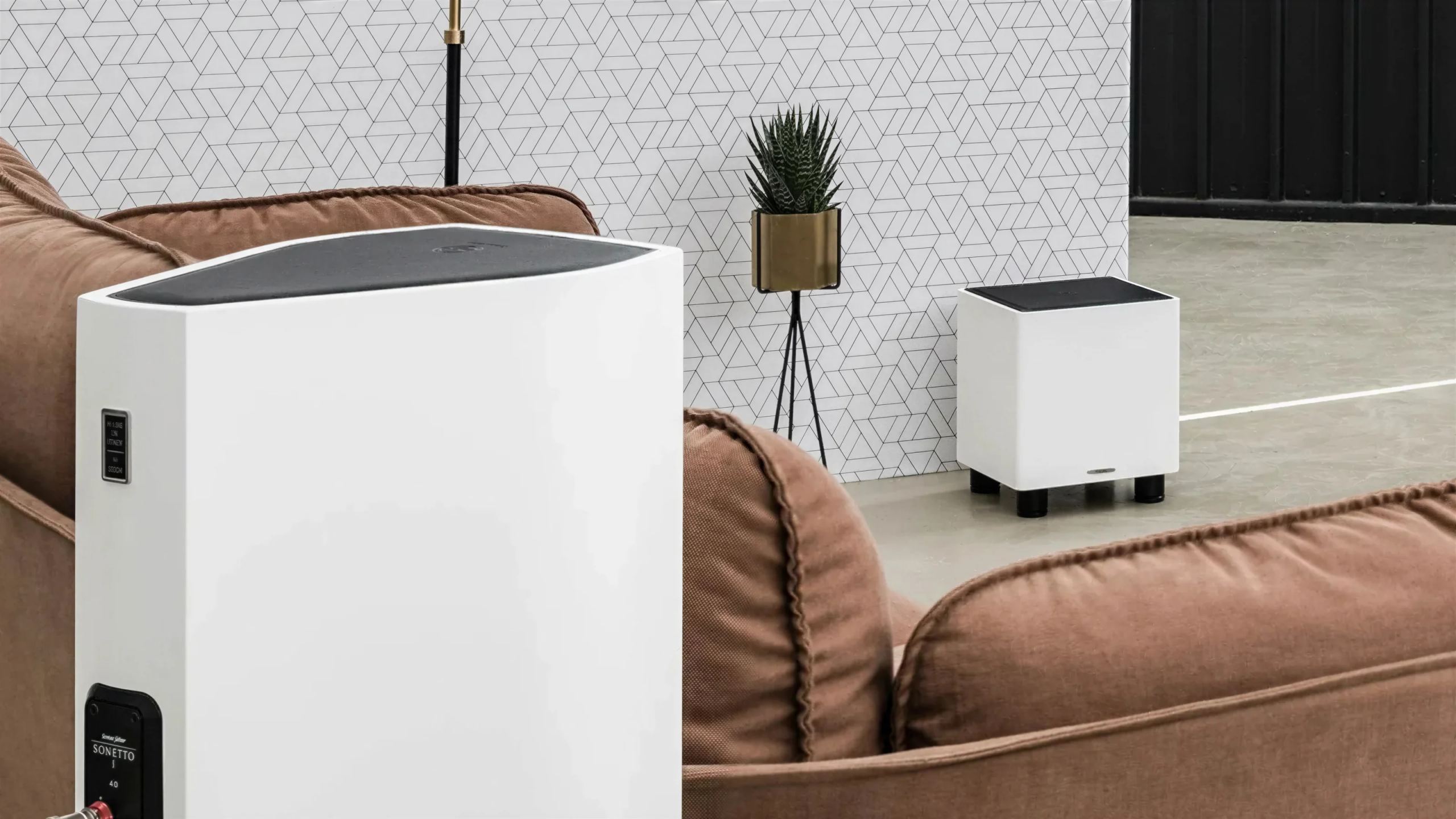
The Gravis I is the most compact subwoofer in the Gravis collection; it fits naturally into small and medium-sized rooms. It is a natural companion for the compact speakers in the catalog: the Lumina collection and the small Sonetto bookshelf speakers (Sonetto I and II). This pairing is far from incidental, as the subwoofer extends the low end that these speakers cannot reproduce on their own, below around fifty hertz.
Nothing requires you to stay within the same family, however. The three inputs cover both a stereo system and a home theater installation, and the subwoofer supports a pair of floorstanding speakers just as effectively as a multichannel setup. Above it, the Gravis collection includes more substantial models: the Gravis II, for example, moves up to a 25-centimeter driver supported by a passive radiator, for larger spaces.
Documentation
Technical specifications
Type and acoustic design
- Type: active subwoofer
- Acoustic loading: sealed enclosure, down-firing driver
- Cabinet: square format
Driver
- Configuration: 1 × 210 mm long-excursion driver
- Cone: treated paper
- Surround: wide rubber surround
Amplification
- Technology: high-linearity Class AB
- RMS power: 150 W
- Peak power: 250 W
Acoustic performance
- Frequency response: 30 Hz to Fc, at -6 dB
- Crossover frequency: continuously adjustable from 30 to 120 Hz
- Filter slope: 24 dB / octave
Adjustments and controls
- Phase: 0° / 180° phase inversion
- Volume controls: independent Master volume and LFE volume
- Automatic power-on: Auto On / Off, can be disabled
Connectivity
- Mono RCA LFE input
- Mono RCA LINE input
- HIGH LEVEL input via 4-pole Neutrik Speakon
Power supply
- Supply voltage: 120 V / 60 Hz or 230 V / 50 Hz, depending on version
- Rated power consumption: 200 W
- Standby power consumption: 0.5 W
- Fuse: T4.0A (110 V / 60 Hz) or T2.0A (230 V / 50 Hz)
Finishes and trim
- Available finishes: open-pore walnut wood, open-pore wenge, matte white, glossy lacquered black
- Top: black leather covering with embossed Sonus faber logo
- Decoupling system: rubber pads
Dimensions and weight
- Dimensions (H × W × D): 334 × 286 × 316 mm
- Weight: 14 kg
- Packaged dimensions (H × W × D): 447 × 437 × 418 mm
- Packaged weight: 17.6 kg
Frequently asked questions
What size room is the Gravis I suitable for?
It is the smallest subwoofer in the range, well suited to a small or medium-sized room. In a very large space, you will either need to push it harder, at the risk of hearing it strain, or choose a larger model from the collection.
Can two Gravis I units be installed?
Yes, and it can sometimes be useful. Two subwoofers distributed around the room smooth out bass dips and peaks caused by the room’s dimensions (room modes), for more consistent bass from one seat to another. Each subwoofer retains its own settings, allowing fine-tuning of the pair.
How do I connect it to an amplifier without a dedicated subwoofer output?
This is the purpose of the high-level speaker input (High Level, Speakon connector). It connects to the amplifier’s speaker terminals: the subwoofer receives the signal sent to the speakers, without using a subwoofer or pre-out output. Many integrated stereo amplifiers without a dedicated output are suitable for this type of connection.
How does it differ from the Gravis II?
The Gravis II is larger and reaches deeper into the low end: it combines a 25-centimeter driver and a passive radiator, whereas the Gravis I uses a 21-centimeter driver in a sealed enclosure. The former is aimed at large rooms, the latter at more modest spaces.
Does a 30 Hz cutoff correspond to real extension?
The response down to 30 Hz is rated at -6 dB, a point at which the level has already dropped by roughly half in voltage. This is a stricter reference than the -3 dB sometimes displayed elsewhere, and therefore representative: the Gravis I does indeed produce energy around 30 Hz, the range of organ infrabass or the deepest cinema effects, without claiming the 20 Hz performance of very large subwoofers.
Should the floor beneath the subwoofer be protected?
The speaker radiates downward, and the subwoofer rests on rubber feet that decouple it from the floor. On parquet or tile flooring, these feet are generally sufficient; on a delicate floor, a rug or isolation pad will further reduce the transmission of vibrations to other floors or adjacent rooms.
- Eco-contribution included in the sale price.








