

Sonus Faber Gravis V walnut


Sonus faber Gravis V, the subwoofer from the Homage collection
Going deep while remaining precise: this is the constant compromise of bass, in music as in cinema. Sonus faber addresses it with a sealed enclosure, renowned for its control and precision, in a cabinet finished like a living-room loudspeaker rather than a bass box. A 32-centimeter driver, generous amplification and fine adjustments complete the package, adjustments that can be tailored to a given room and system.
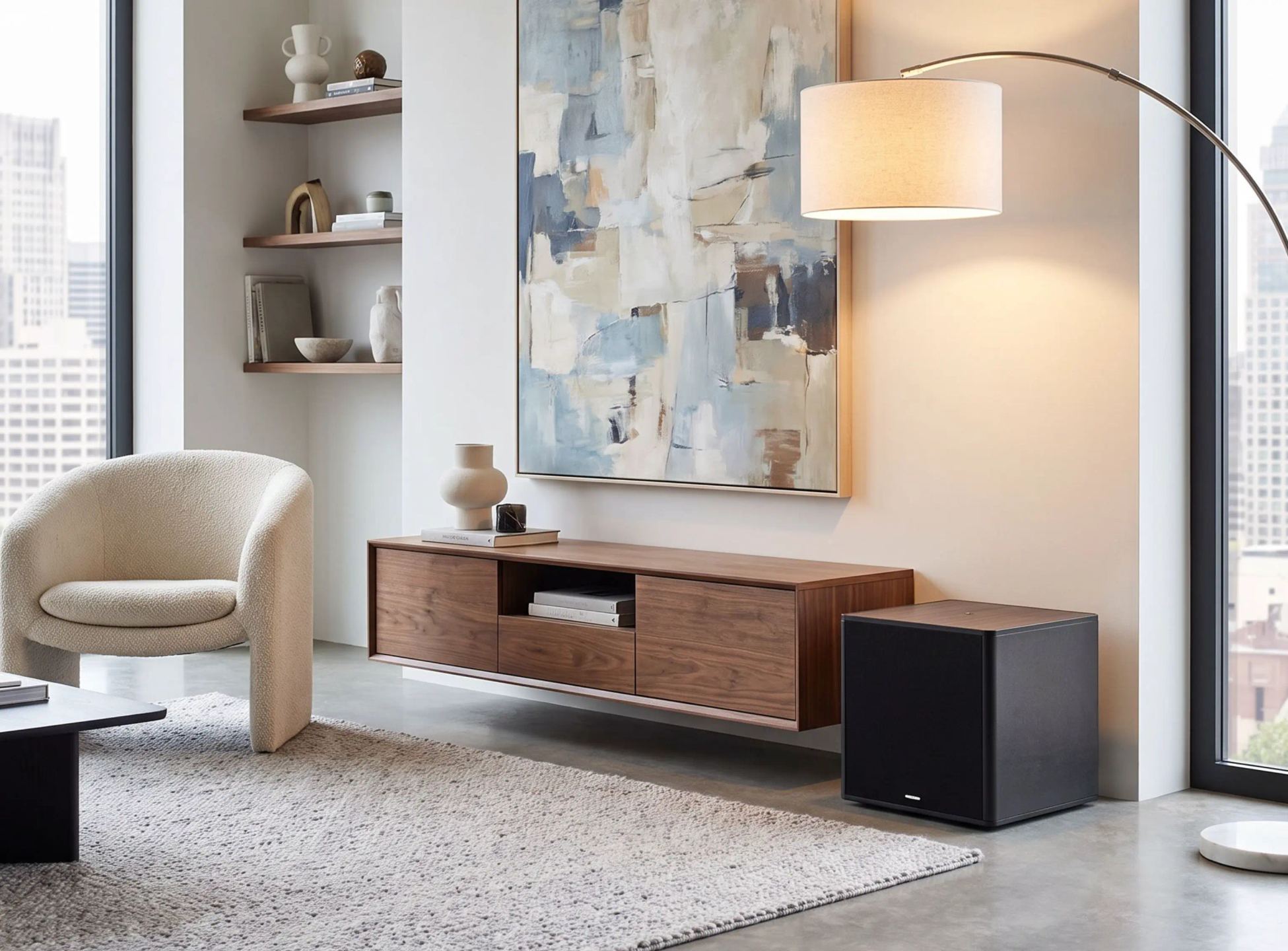
A cube of wood and leather
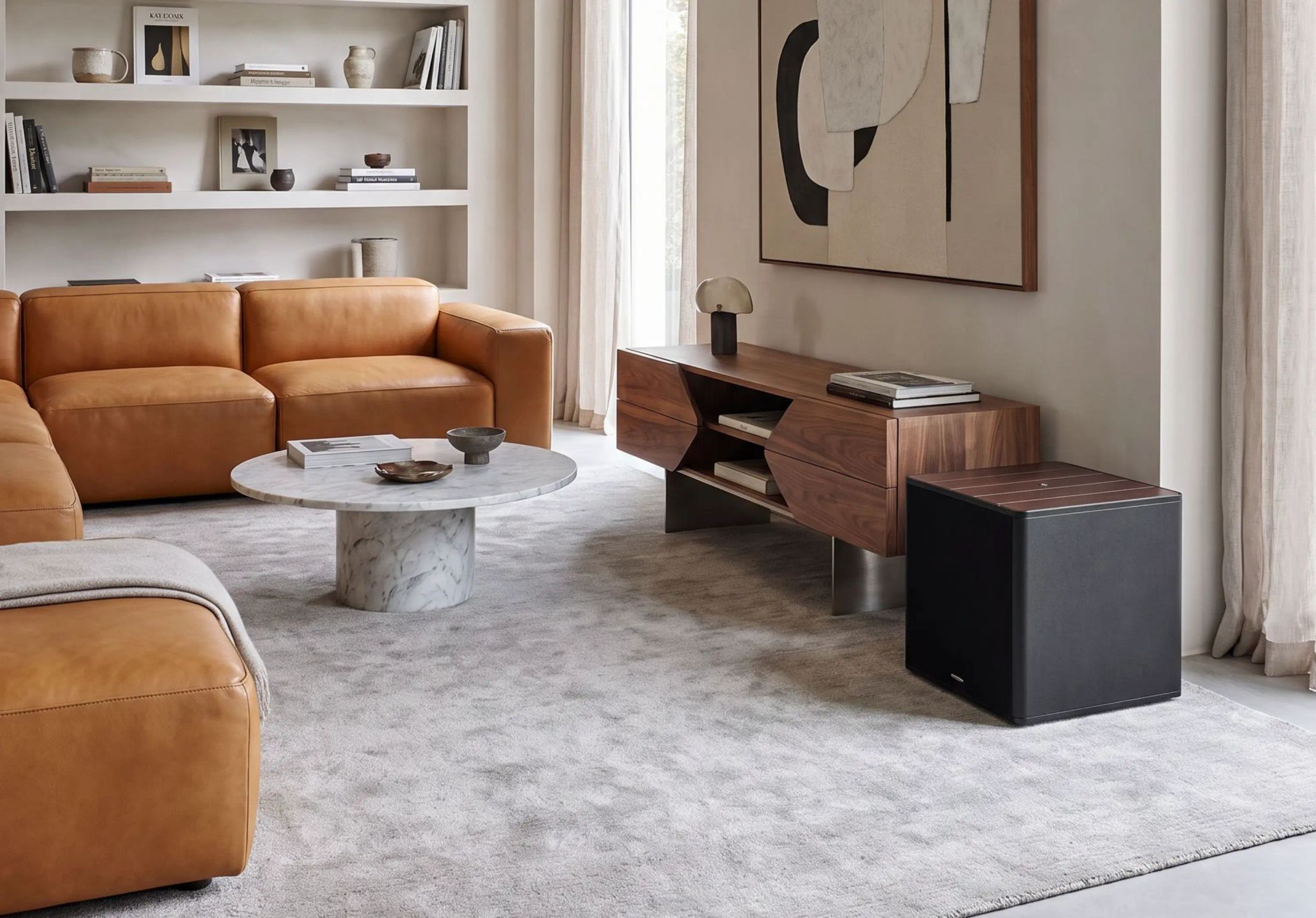
The Gravis V fits into a cube measuring around 45 centimeters on each side, with clean, squared lines. The top is handcrafted in high-gloss wood or lacquered finish, while the sides are clad in the brand’s signature black leather. A few aluminum elements punctuate the overall design. The object favors restraint and materials over technical showmanship, in keeping with the aesthetic of the brand’s loudspeakers.
At 32 kilos, the subwoofer rests on rubber pads that decouple the structure from the floor. This detail limits the transmission of vibrations to the floor, a frequent source of unwanted resonances that muddy the bass and cause it to spill into neighboring rooms. The finish and visual codes echo those of the Homage collection, which the Gravis V is designed to match.
The sealed enclosure in the service of bass
A sealed enclosure is a fully closed cabinet, with no tuning port (the tube or opening found on many subwoofers). The air trapped behind the cone acts like a spring, returning the driver to its resting position. The result is controlled, precise bass that starts and stops sharply, at the cost of slightly lower efficiency in the lowest frequencies compared with a ported enclosure. Sonus faber embraces this choice, which favors tonal accuracy and transient attack.
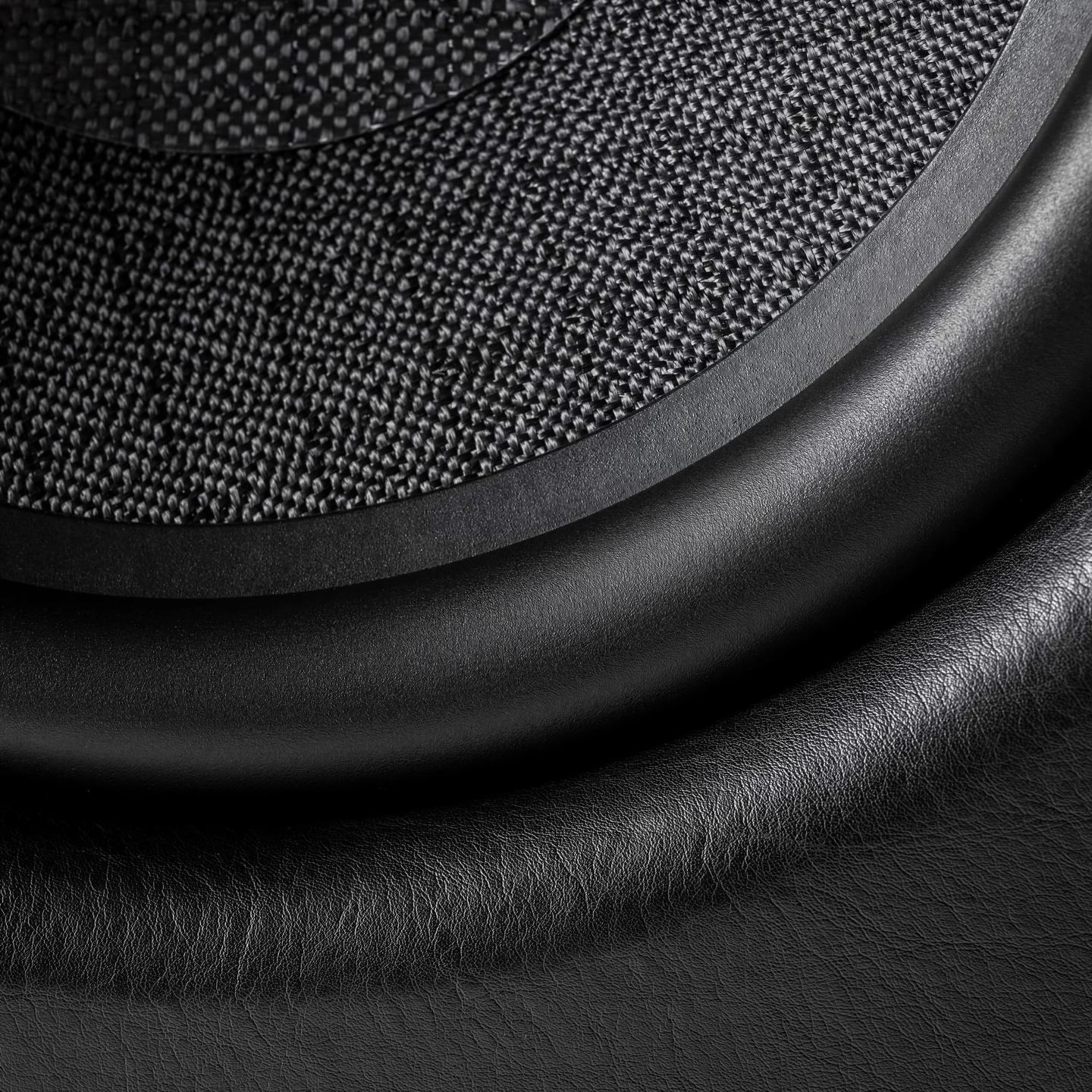
The work is handled by a single 320-millimeter dual voice-coil driver. Its honeycomb-structure sandwich cone combines rigidity and lightness, while its wide rubber surround allows long excursion, meaning significant movement of the cone forward and backward. This excursion is what makes it possible to move a large volume of air, and therefore produce deep bass without audible distortion. The built-in Class AB amplification delivers 850 watts RMS and 1200 watts peak, a comfortable reserve for controlling such a large diameter.
Response extends down to 20 hertz, measured at -6 decibels with the EQ1 preset. In practical terms, the level there is already reduced by half in sound pressure: these lowest frequencies are felt more than heard, in the infrasonic effects of an explosion or an organ. The upper cutoff, designated Fc, is continuously adjustable according to the main loudspeakers and the room.
Settings controlled from an app
Fine-tuning a subwoofer depends as much on the room as on the equipment, and this is often where everything is decided. The Gravis V can be controlled from an iOS and Android app that provides access to the essentials. The crossover frequency can be adjusted from 40 to 150 hertz with a 24-decibel-per-octave slope: this is the point at which the subwoofer takes over from the loudspeakers, and its steepness determines the cleanliness of the transition between the two.
Phase can be adjusted from 0 to 360 degrees, and an adjustable delay from 1 to 20 milliseconds aligns the moment the subwoofer’s bass reaches the ear with that of the loudspeakers, to prevent them from working against each other. Up to eight parametric equalization filters can correct peaks and dips specific to each living room, those frequencies that linger or boom depending on the room’s dimensions. Automatic calibration provides an initial adjustment, four presets store configurations, and an automatic power-on threshold switches the subwoofer to standby mode (less than 2 watts) as soon as the signal stops.
Line, balanced and high-level inputs
The Gravis V can be connected in several ways. Two unbalanced RCA line inputs accept left, right and LFE channels, the dedicated subwoofer output of home theater amplifiers. Two balanced XLR line inputs perform the same role with better resistance to interference over long cable runs, an advantage when the subwoofer is located far from the electronics.
A high-level input completes the picture, using a 4-pole Neutrik Speakon connector, a locking connection derived from professional sound reinforcement. It takes the signal directly from the amplifier’s speaker terminals. This input solves the issue for integrated stereo amplifiers without a dedicated subwoofer output, common in hi-fi: the Gravis V can then find its place in a two-channel system, not only in a home theater setup.
Its place in the Gravis range
Sonus faber has been making subwoofers since 1986 and the Gravis FB100. The current collection includes five models, differentiated by size and power. The compact Gravis I and II accompany Lumina and Sonetto loudspeakers. The Gravis III pairs with the Olympica Nova collection. Above them, the Gravis V and Gravis VI are among the brand’s most powerful models and share app control.
The Gravis V is the model whose finish, wooden top and black leather complement the loudspeakers of the Homage Tradition line, handcrafted in Veneto. The larger Gravis VI tops the range and is intended for the Reference collection. In every case, the logic remains the same: to add depth to the lower end of the spectrum without betraying the brand’s Natural Sound signature, this pursuit of bass that extends the loudspeakers rather than drawing attention to itself.
Technical Specifications
Type and design
- Type: active subwoofer
- Configuration: single driver
- Acoustic enclosure: sealed box (Sealed Box)
- Architecture: active
- Sound signature: Sonus faber Natural Sound
Driver
- Diameter: 320 mm / 12”
- Long Throw technology
- Honeycomb-structure sandwich diaphragm
- Wide rubber surround
- Design combining extensive excursion with precise bass control
Built-in amplification
- Amplifier class: high-performance Class AB
- RMS power: 850 W
- Peak power: 1200 W
- Built-in amplification dedicated to the bass driver
Frequency response
- Frequency response: 20 Hz → Fc (at -6 dB)
- Acoustic filtering: 4th-order Linkwitz
- Continuously adjustable Fc crossover frequency
Bass management and DSP
- 4 presets
- Volume adjustment
- Crossover frequency: adjustable from 40 to 150 Hz
- Filter slope: 24 dB / octave
- Phase: adjustable from 0° to 360°
- Parametric equalization: up to 8 filters
- Delay: adjustable from 1 to 20 ms
- Automatic room calibration
- Configurable threshold for automatic power on / off
- Control via dedicated iOS / Android app
Connectivity
- Unbalanced line inputs
- 2 × LINE (Left / Right / LFE)
- RCA connectors
- Balanced line inputs
- 2 × LINE
- XLR connectors
- High-level input
- HIGH LEVEL
- 4-pole Neutrik Speakon® connector
Design and construction
- Cubic format with clean lines
- Square-shaped cabinet
- Handcrafted or lacquered wood top
- Sides upholstered in Sonus faber signature leather
- Aluminum elements
- High-gloss wood
- Black leather
- Construction prioritizing a refined and luxurious aesthetic
- Design specifically matched to the Homage collection
- Incorporates Sonus faber’s iconic design codes
Isolation
- Isolation system: rubber feet
- Function: limits the transmission of vibrations to the floor
Power supply
- Power consumption
- Standby: < 2 W
- Rated power: 1000 W
- Mains voltage (factory selected)
- 100–120 V AC – 50 / 60 Hz
- 220–240 V AC – 50 / 60 Hz
- Fuses
- T12A H250V for 100–120 V
- T6.3A H250V for 220–240 V
Dimensions and weight
- Subwoofer
- Height: 455 mm
- Width: 448 mm
- Depth: 448 mm
- Weight: 32 kg
- Packaging
- Dimensions: 640 × 590 × 590 mm
- Packaged weight: 42 kg
Frequently asked questions
Can the Gravis V operate wirelessly?
A wired connection remains the reference, but Sonus faber offers a dedicated accessory, the Gravis Transmitter, which sends the signal to the subwoofer wirelessly. Useful when the subwoofer is placed far from the electronics and it is difficult to run a discreet cable connection to it.
Can it be used with a stereo amplifier without a dedicated subwoofer output?
Yes, that is precisely the purpose of the high-level input on the Speakon connector: it connects to the amplifier’s speaker terminals and takes the signal from there. The subwoofer therefore integrates into a conventional two-channel hi-fi system, without requiring a home theater amplifier or a subwoofer output.
Do you need two subwoofers for a large room?
A single Gravis V is sufficient in most living rooms. In a large room or dedicated listening room, adding a second subwoofer mainly helps distribute bass more evenly from one listening position to another, reducing areas where bass is too strong or too weak depending on where you are seated.
What does “20 Hz at -6 dB” mean in the technical specifications?
This is the point at which the subwoofer’s output level has already dropped by half in sound pressure compared with its useful range. The Gravis V does therefore produce sound at 20 hertz, but at a reduced level: these frequencies correspond to infrasound, which is felt more in the body than heard with the ears. Most music and movie content concentrates its bass slightly higher up.
Does automatic calibration eliminate the need for manual adjustments?
It provides a good starting point by analyzing the room, but manual phase, delay, and parametric equalization adjustments remain the best way to fine-tune the result, especially the integration with the main speakers. Listening and a few positioning tests often do the rest.
What is the difference between the Gravis V and the Gravis VI?
The Gravis VI is the range-topping, more substantial model, associated with the Reference collection. The Gravis V is designed to aesthetically and sonically match the Homage line. Both share the same sealed-enclosure philosophy and app control, with the VI simply raising the bar in terms of volume and power.
- Eco-contribution included in the sale price.








