

Audio Pro C10 MKII W white


Specifications and features


Overview
A power cord, home Wi-Fi and a cabinet 32 centimeters wide are all it takes to play music in stereo in a living room. Audio Pro’s C10 moves to the W generation and gets a new app, with AirPlay 2, Google Cast, Spotify Connect and TIDAL Connect. Bluetooth and an analog input remain available for sources that don’t use the network.
Two tweeters and a woofer in one cabinet
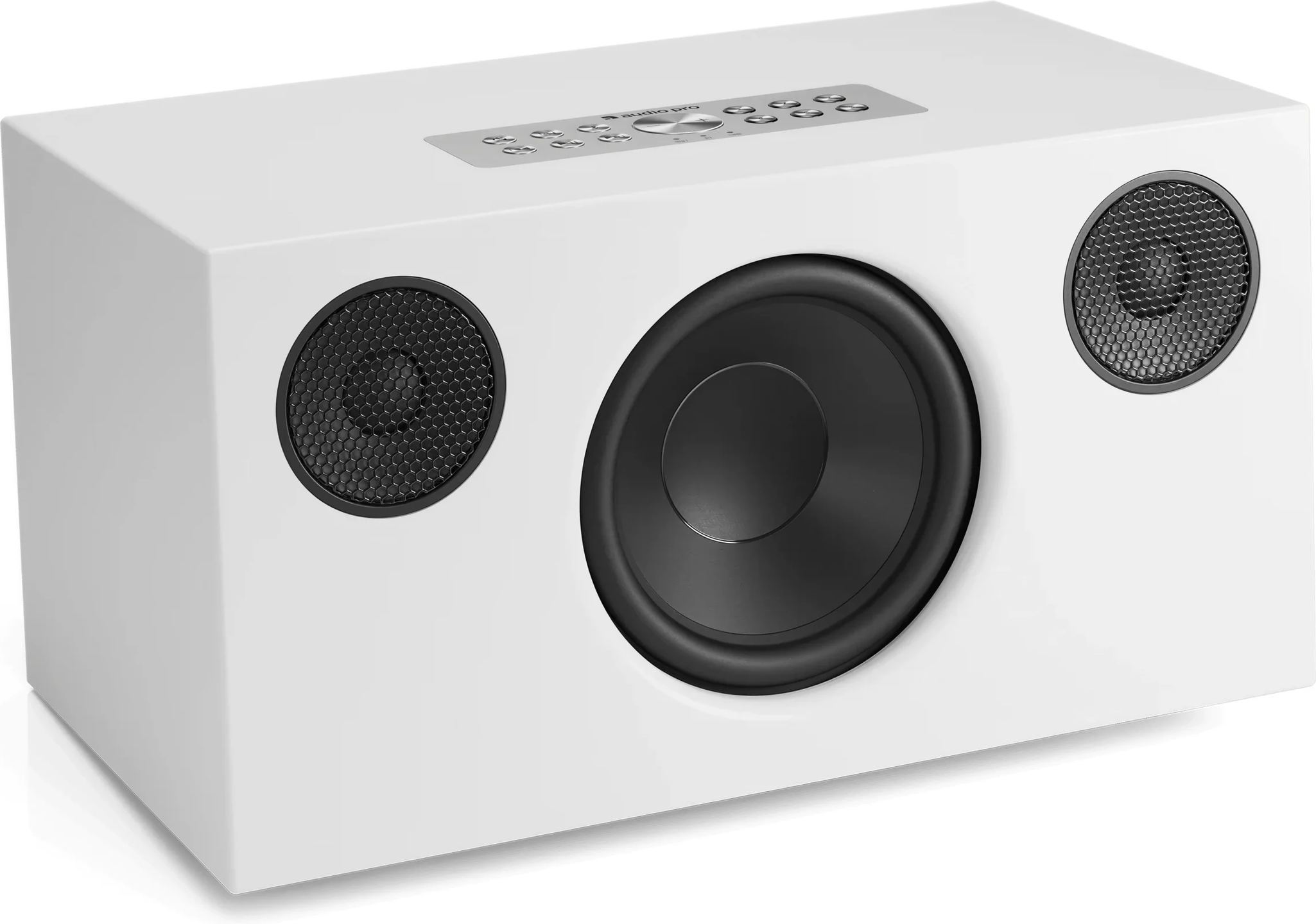
The speaker reproduces both stereo channels from a single cabinet. Each channel has its own 1.9 cm fabric-dome tweeter, positioned on either side of the front panel, while a centrally mounted 13 cm mid-woofer handles the lower frequencies for both left and right. The design is two-way: below 2.5 kHz, the signal goes to the mid-woofer; above that, it goes to the tweeters. This crossover point is set low enough for most of the vocals to come through the central driver, while the tweeters handle consonants, cymbals and the air around instruments.
The mid-woofer has a long throw: its cone can move farther than that of an ordinary driver, and that movement produces bass from a 4.2 kg cabinet. A rear port complements it using the bass-reflex principle: air set in motion inside the cabinet exits through the port and reinforces the low frequencies. The frequency response extends from 45 Hz to 22 kHz, and reaches down to 38 Hz (at -6 dB) once the speaker is placed in a room, because the walls and floor add bass. The port does need some clearance, however: without around ten centimeters of free space behind the speaker, the bass becomes duller and less defined.
Each driver has its own Class D digital amplifier: 20 W for each tweeter and 40 W for the mid-woofer, for 80 W in total. This power reserve is enough to fill a large living room with sound. The cabinet’s width does, however, limit the stereo image: with the tweeters only a few dozen centimeters apart, channel separation remains much narrower than with two speakers placed two meters apart.
An understated cabinet and touch controls
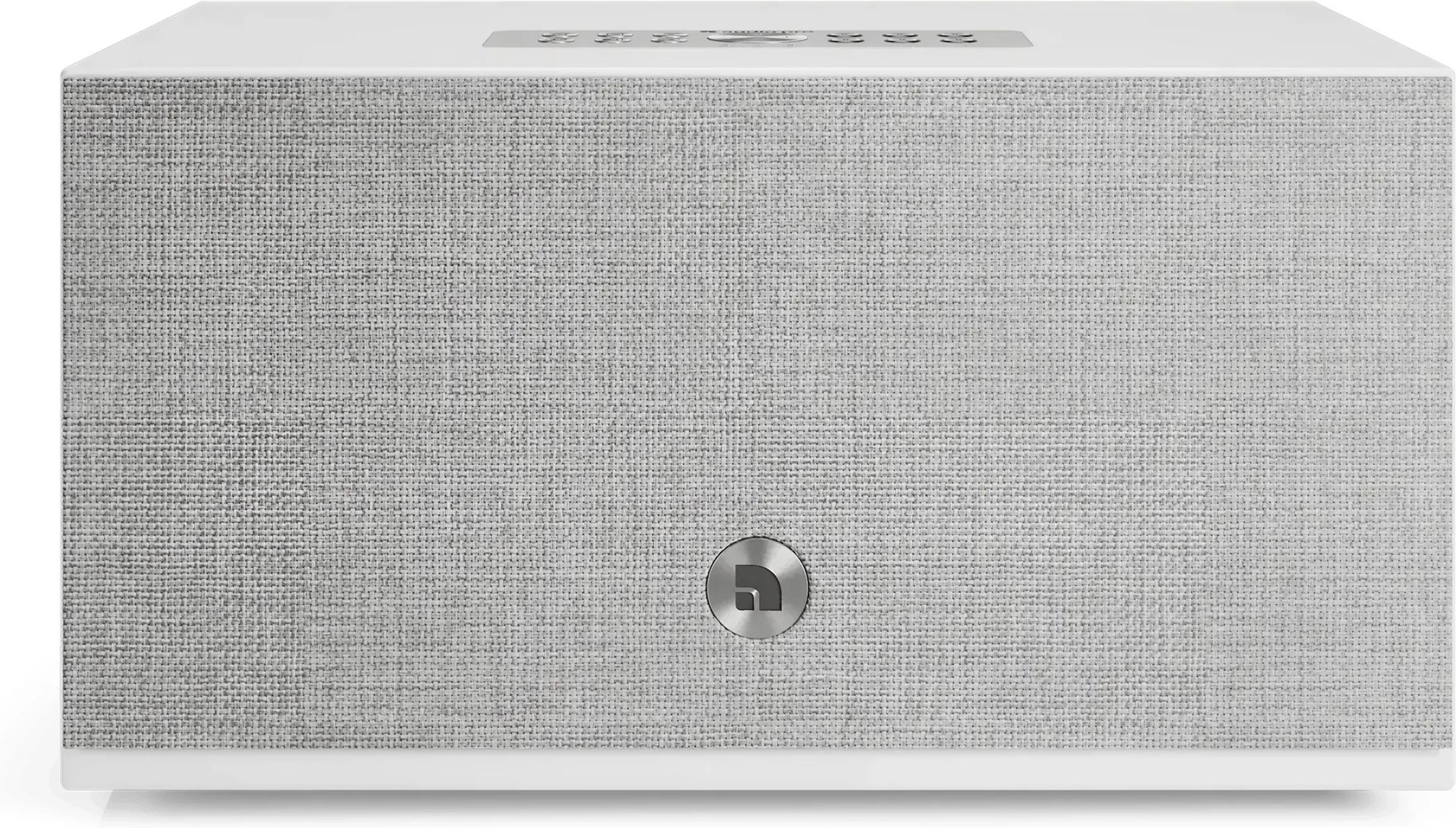
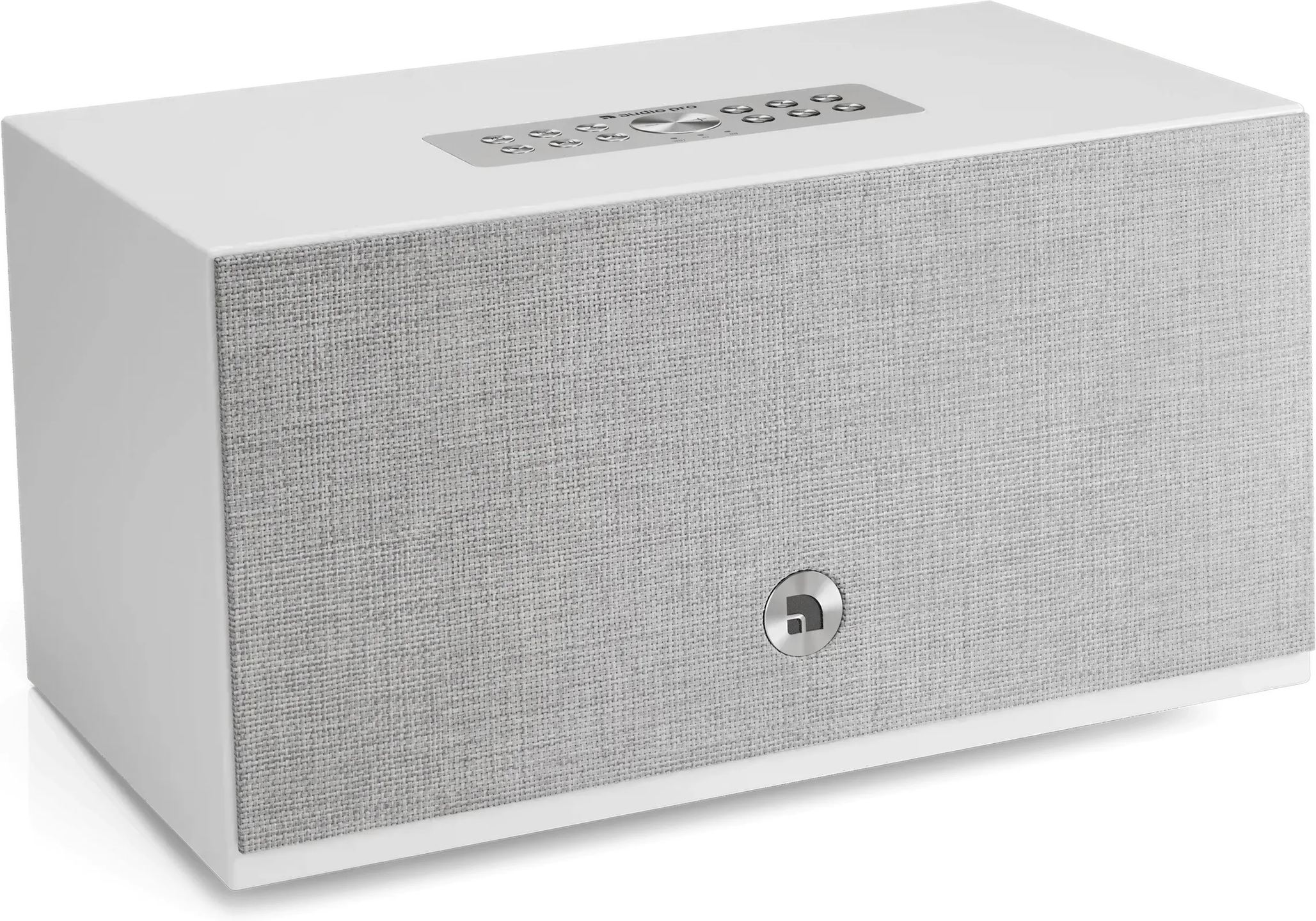
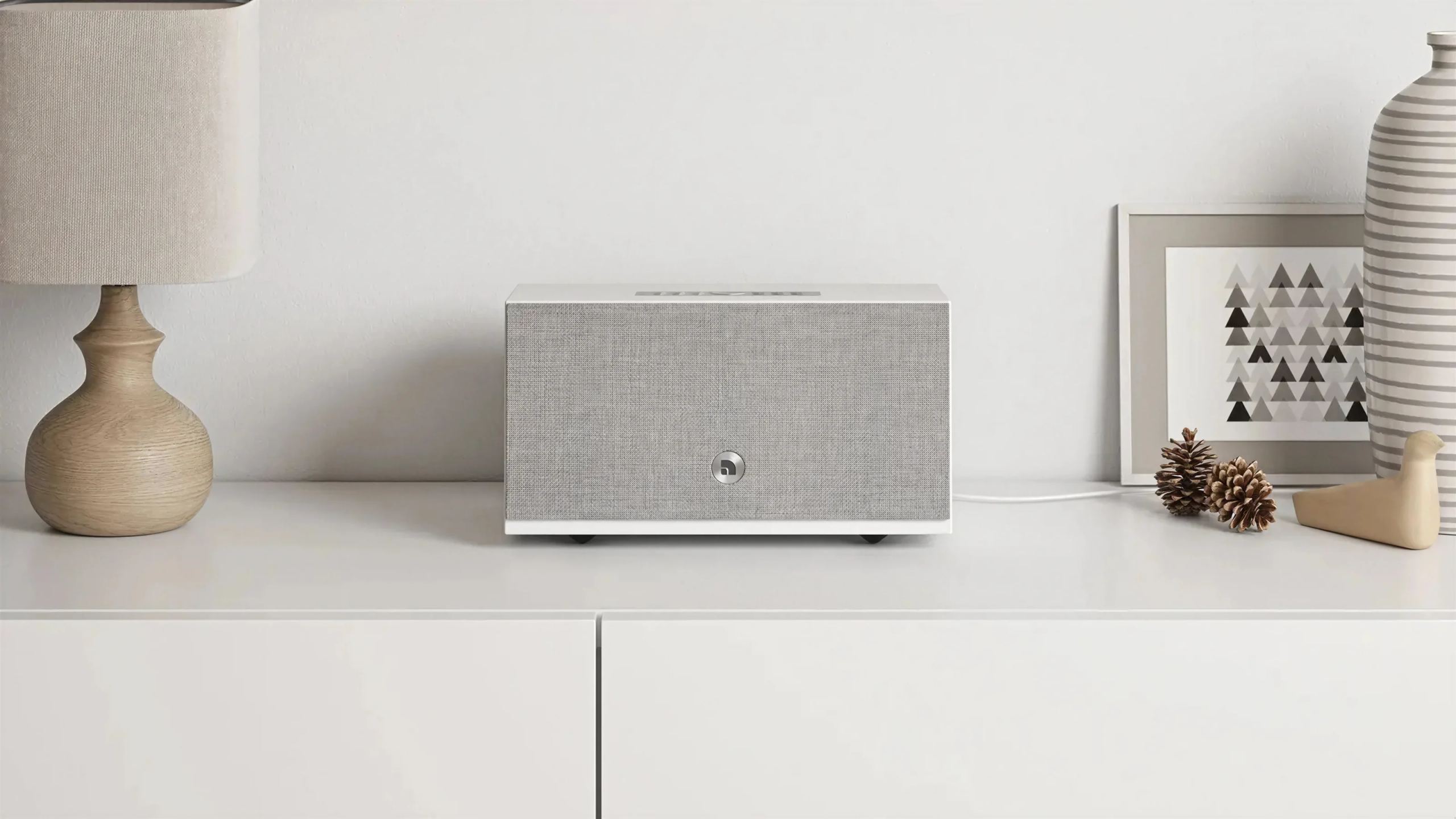
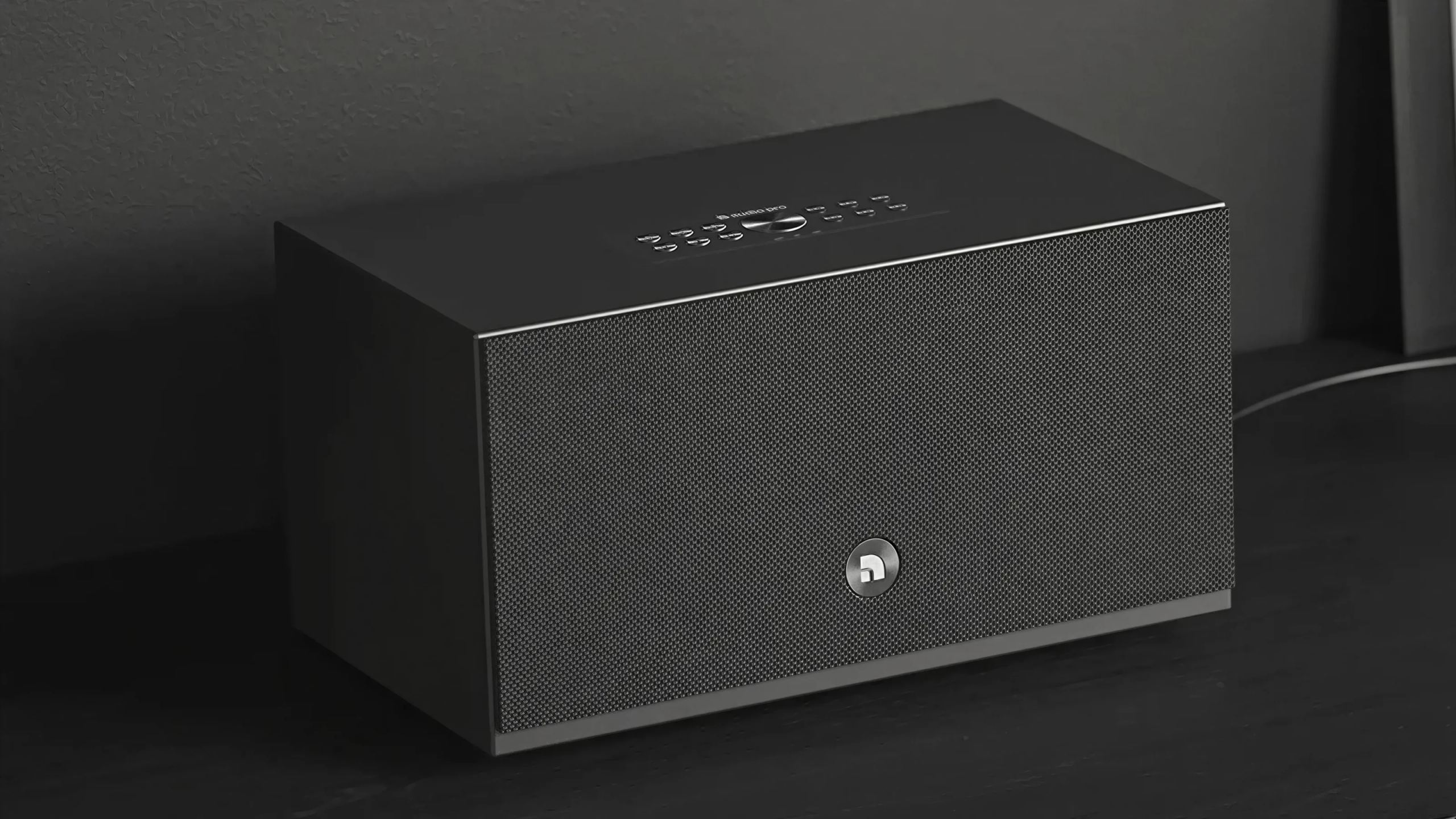
The rectangular cabinet measures 320 × 165 × 185 mm and comes in black, white or gray. An acoustic fabric grille covers the drivers. It can be removed to reveal the two tweeters and the mid-woofer, depending on the look you want in the room.
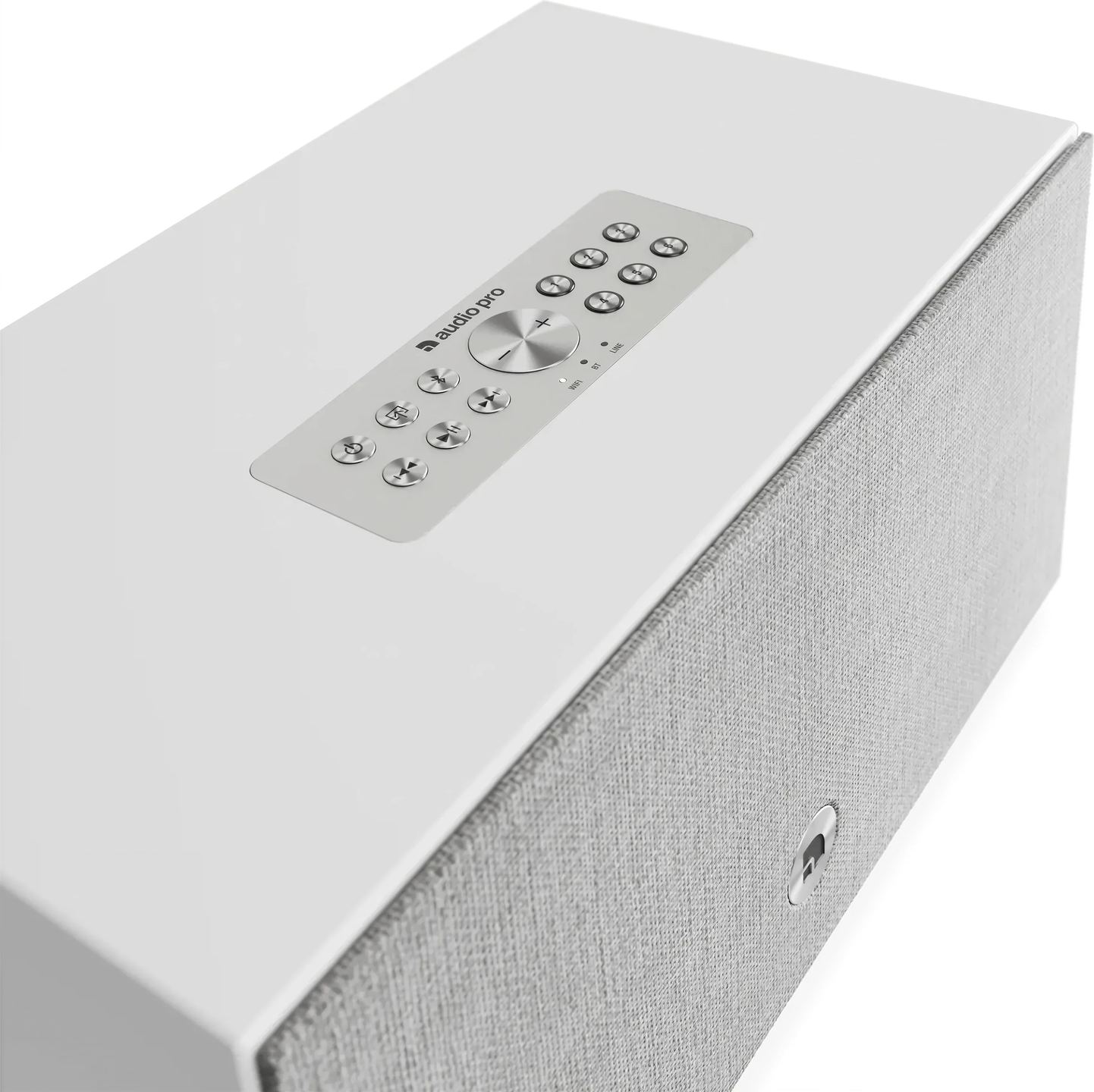
The top panel brings together all the controls as touch-sensitive areas: power and standby, source selection, play and pause, previous or next track, volume, Bluetooth pairing, and six presets. These presets store a playlist or radio station from the app, then start it again with a touch, without having to take out your phone. After twenty minutes with no signal, the speaker automatically goes into standby.
On a shelf or in a bookcase, the cabinet needs space around it: 20 cm above and at the sides, and 10 cm at the rear for the port and ventilation. The speaker is not designed to be built into a wall.
Wi-Fi streaming and multiroom playback
The C10 MkII W connects to Wi-Fi on the 2.4 and 5 GHz bands, the latter often being less congested in apartment buildings. There is no Ethernet port, so reception quality depends on the distance from the router or a repeater. Over Wi-Fi, playback supports up to 24-bit/96 kHz audio, a higher resolution than CD (16-bit/44.1 kHz), and the speaker plays FLAC, Apple Lossless, AAC, MP3 and WMA files.
To start the music, everyone can use what they already have. From an iPhone or Mac, AirPlay 2 works directly in the music player. An Android phone or Chrome browser sends audio via Google Cast. Spotify and TIDAL subscribers control playback from their service’s app: the speaker fetches the stream from the Internet itself, and the phone serves only as a remote control. The Audio Pro app provides access to other services, including Qobuz, Deezer and Amazon Music, numerous Internet radio stations such as TuneIn and Radio Paradise, and Plex for a library stored on a home server. It also includes an equalizer to adjust the balance between bass and treble.
The same app groups multiple W-generation Audio Pro speakers to play the same music in several rooms, or different programs from room to room. AirPlay and Google Cast groups remain available for connecting compatible devices from other brands.
A line input and subwoofer output on the rear
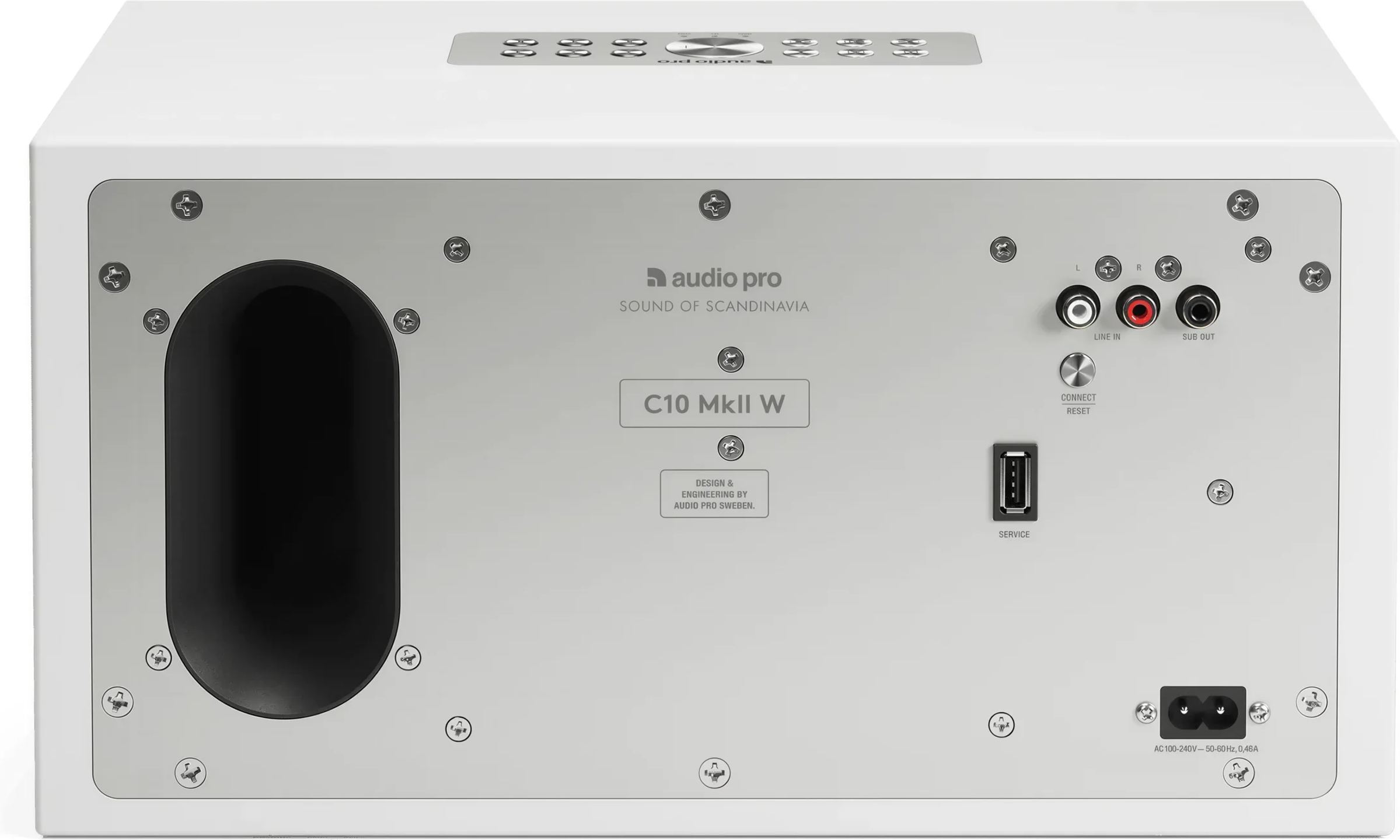
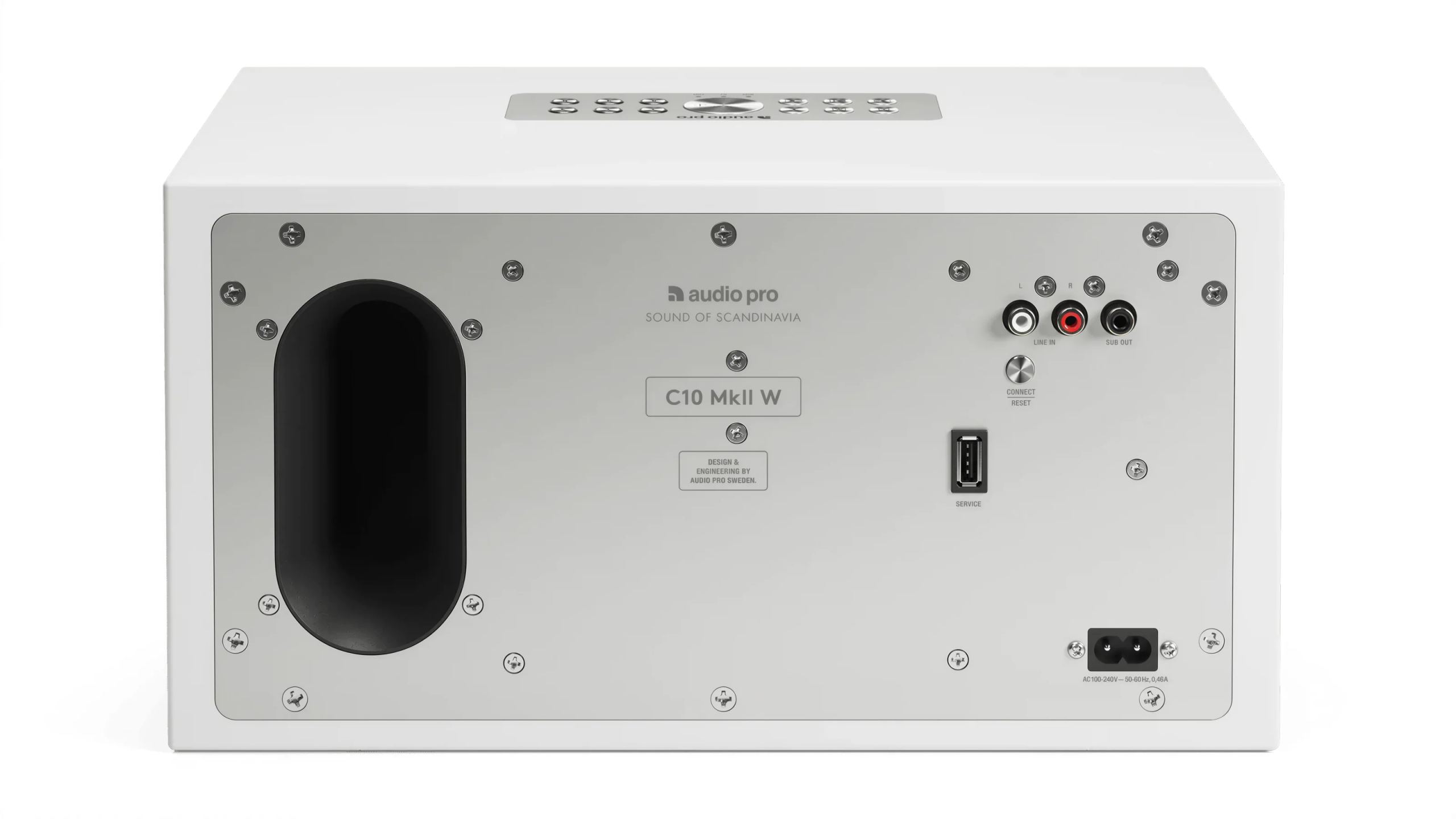
The rear connections are limited to the essentials: an RCA line input, an output for a subwoofer and a USB-A port reserved for maintenance. The line input accepts a CD player, a portable music player or a TV’s analog output. A turntable can also be connected, provided it has a phono preamplifier, either built into the turntable or placed between the two: the signal from a phono cartridge is too weak for a line input and must first be equalized and amplified.
A source connected via the analog input, or received via Bluetooth, is not limited to the room where the speaker sits. In a multiroom group created through the app, the C10 MkII W designated as the main speaker retransmits that input over Wi-Fi to the other speakers in the group. A record playing in the living room can then be heard in the kitchen too.
The subwoofer output lets you add a powered subwoofer to reach lower bass frequencies or play louder without pushing the 13 cm driver to its limit. Bluetooth 4.2 is useful for a device without network access, but its SBC codec compresses the signal more than Wi-Fi playback does.
Documentation
Technical specifications
Design and controls
- Stereo smart speaker
- Top-mounted control interface
- 6 presets
- Built-in equalizer, adjustable from the Audio Pro app
Acoustic design and drivers
- 2-way bass-reflex design with rear port
- Drivers:
- 2 × 1.9 cm fabric-dome tweeters
- 1 × 13 cm long-throw mid-bass driver
- Crossover frequency: 2.5 kHz
Amplification and audio performance
- Amplification:
- Tweeters: 2 × 20 W
- Mid-bass driver: 1 × 40 W
- Total power: 80 W
- Frequency response: 45 Hz to 22 kHz
- Bass response: 38 Hz (−6 dB)
- Audio streaming: up to 24-bit / 96 kHz
- Supported audio formats: MP3, WMA, AAC, FLAC, Apple Lossless
Wireless connectivity and multiroom streaming
- Bluetooth 4.2, SBC codec
- Wi-Fi: 2.4 GHz / 5 GHz
- AirPlay 2, Google Cast, Spotify Connect, TIDAL Connect
- Multiroom systems: Audio Pro, LinkPlay
- Streaming services: Amazon Music, BBC Radio, Calm Radio, Deezer, Hotmix, iHeart Radio, KKBOX, Napster, Open Network Stream, Pandora, Plex, Qobuz, Radio Paradise, SoundCloud, SoundMachine, Spotify, Soundtrack Your Brand, TIDAL, TuneIn, vTuner
Connections
- 1 RCA line input
- 1 subwoofer output
- 1 USB-A port for maintenance only
- Ethernet: no
- Optical input: no
- Coaxial input: no
- HDMI ARC: no
Power
- Mains power: 100 to 240 V AC, 50 / 60 Hz
- Standby power consumption: 0.5 W
- Operating power consumption: 2.6 W
- Built-in battery: no
Dimensions and weight
- Dimensions (W × H × D): 320 × 165 × 185 mm
- Weight: 4.2 kg
Included accessories
- Removable acoustic fabric grille
- Power cord
- User manual
Frequently asked questions
What does the W generation offer over the original C10 MkII?
The C10 MkII W retains the C10 MkII’s size and speaker configuration: two 1.9 cm tweeters, a 13 cm mid-woofer, and 80 W of amplification. The changes are to the streaming electronics and software: a new Audio Pro app, TIDAL Connect added alongside Spotify Connect, AirPlay 2 and Google Cast, and a wider range of services in the app. To play an older C10 MkII and a C10 MkII W together, AirPlay 2 and Google Cast are the options shared by both generations.
What’s the difference compared with the C10 MkII W Classic?
The Classic version has the same amplification, drivers, connections, dimensions and weight as the C10 MkII W, but with a different design inspired by Audio Pro speakers of the past. The choice between the two therefore comes down to aesthetics.
Can it be used as a soundbar with a TV?
Only if the TV has an analog audio output that can be connected to the RCA input. The speaker has neither HDMI ARC nor an optical input, the two most common connections on recent TVs. For primarily TV use, the C20 MkII W in the same range offers an HDMI ARC port and a built-in phono preamplifier.
Which subwoofer should I connect to the dedicated output?
Any powered subwoofer with an RCA line input will work. The RCA cable is not included: the box contains the speaker, its fabric grille, the power cable, and the manual. Adjust the crossover frequency and level on the subwoofer so its bass blends with the speaker’s without dips or peaks.
Does the speaker work without Wi-Fi?
Yes, via Bluetooth or the line input, without any network connection. Wi-Fi is still required for streaming services, Internet radio, multiroom audio, and free software updates delivered online by Audio Pro. During setup, the Wi-Fi password must not contain special characters or Nordic accented letters (å, ä, ö).
How do I save a preset?
Simply start playing the desired playlist or station, then press and hold your chosen preset on top of the speaker for about three seconds. You can also do this in the app. The six presets are then available at a touch, even when your phone is off or in another room.
Where should I place the speaker for the best bass?
Placed a few dozen centimeters from a wall, the speaker benefits from the wall’s natural reinforcement. Pressed against the wall or enclosed in a niche, its rear port is obstructed and the bass becomes muddy. A low cabinet or sturdy shelf, with the tweeters roughly at ear height when seated, provides the most natural balance.
- Eco-contribution included in the sale price.
- Manufacturer reference: 15301








