T+A Pulsar S130 black (pack of 2)


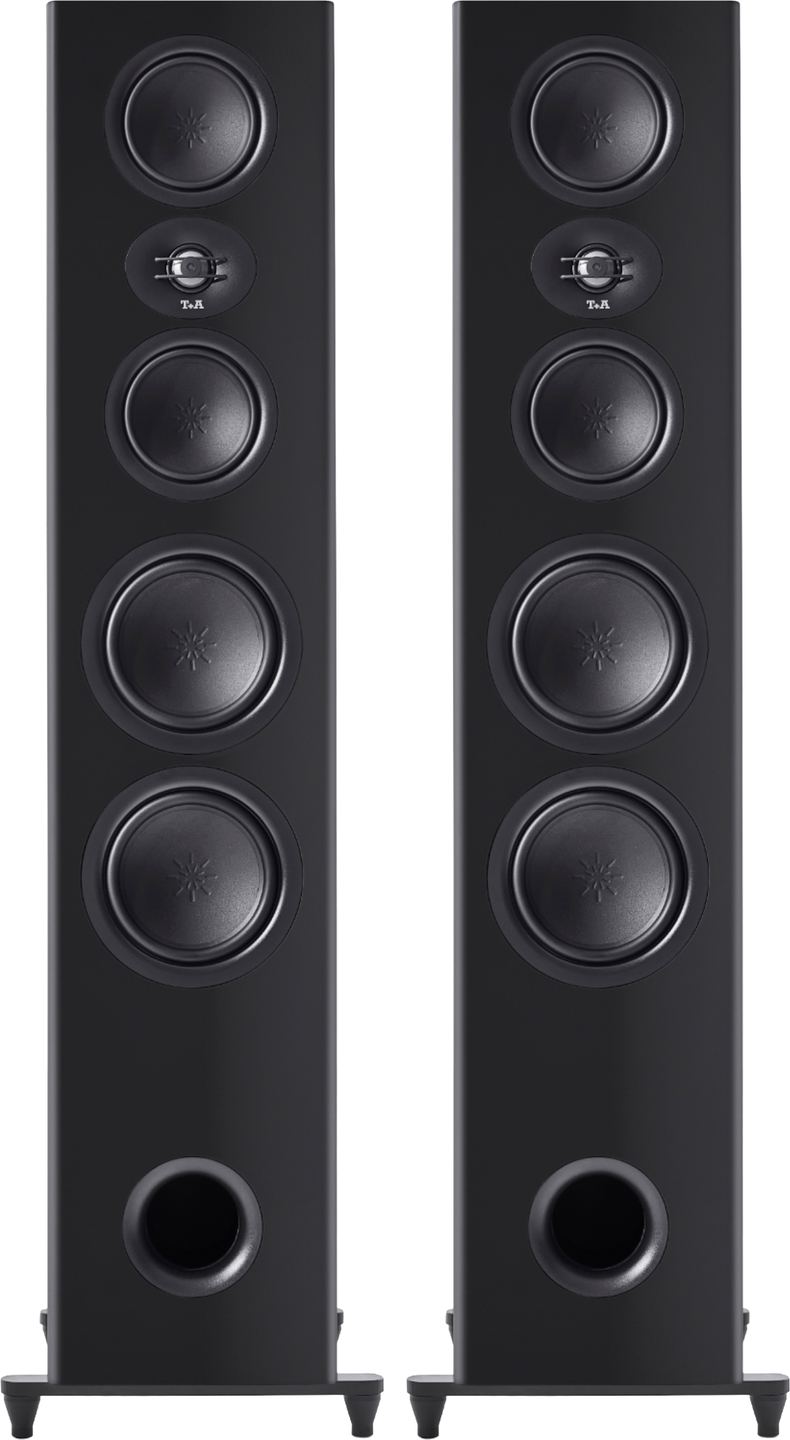
T+A Pulsar S 130, three-way floorstanding speaker with controlled directivity
One metre tall, a curved silhouette with Art Deco accents and, behind a front baffle without a single visible screw, a simple idea: direct the midrange and treble towards the listener rather than towards the floor and ceiling. The Pulsar series, the third speaker line from T+A, brings the symmetrical directivity principle of the Criterion and Solitaire to a new price bracket for the brand, in a five-driver floorstanding speaker with living-room proportions.
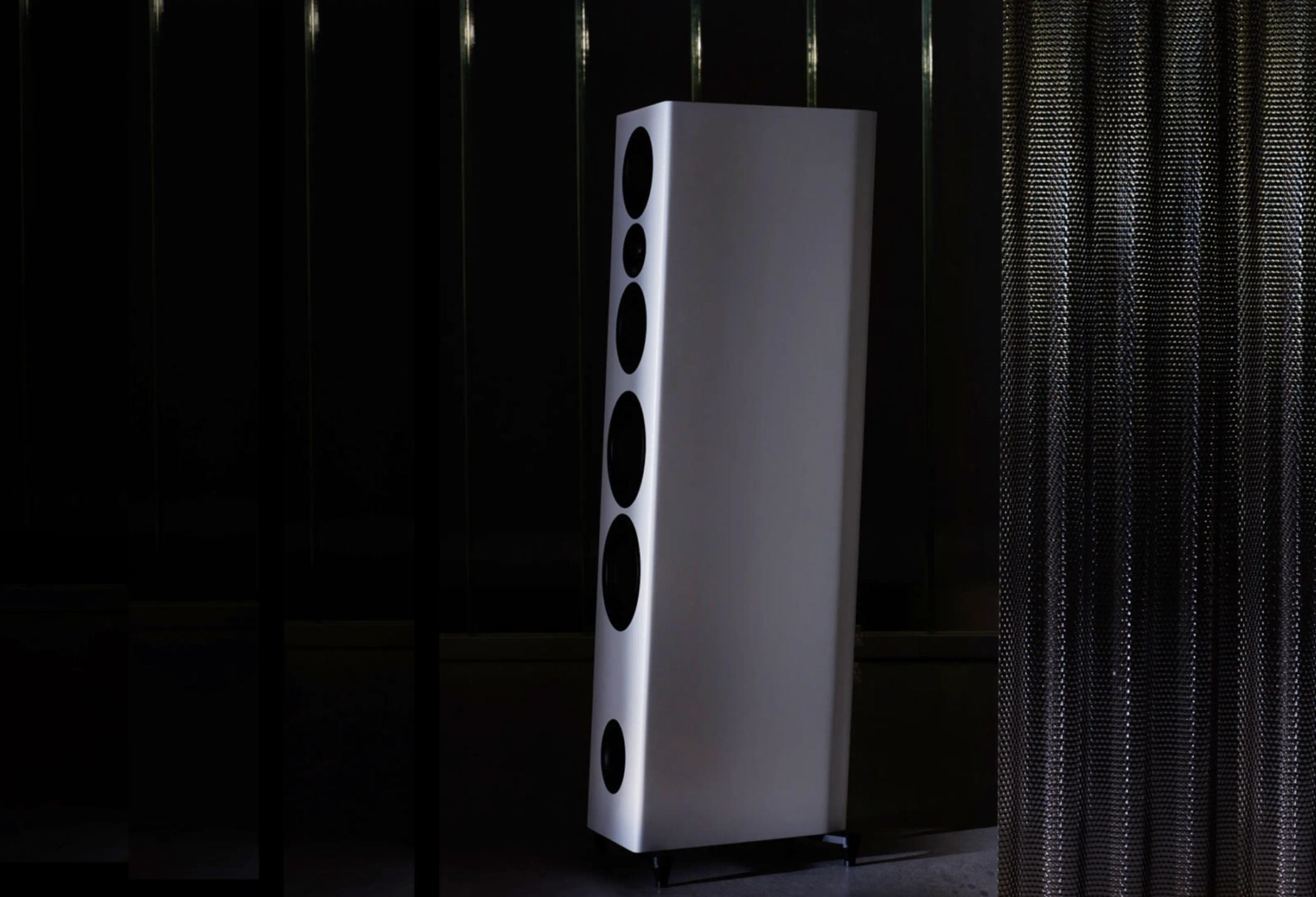
Five drivers and two well-placed crossover points
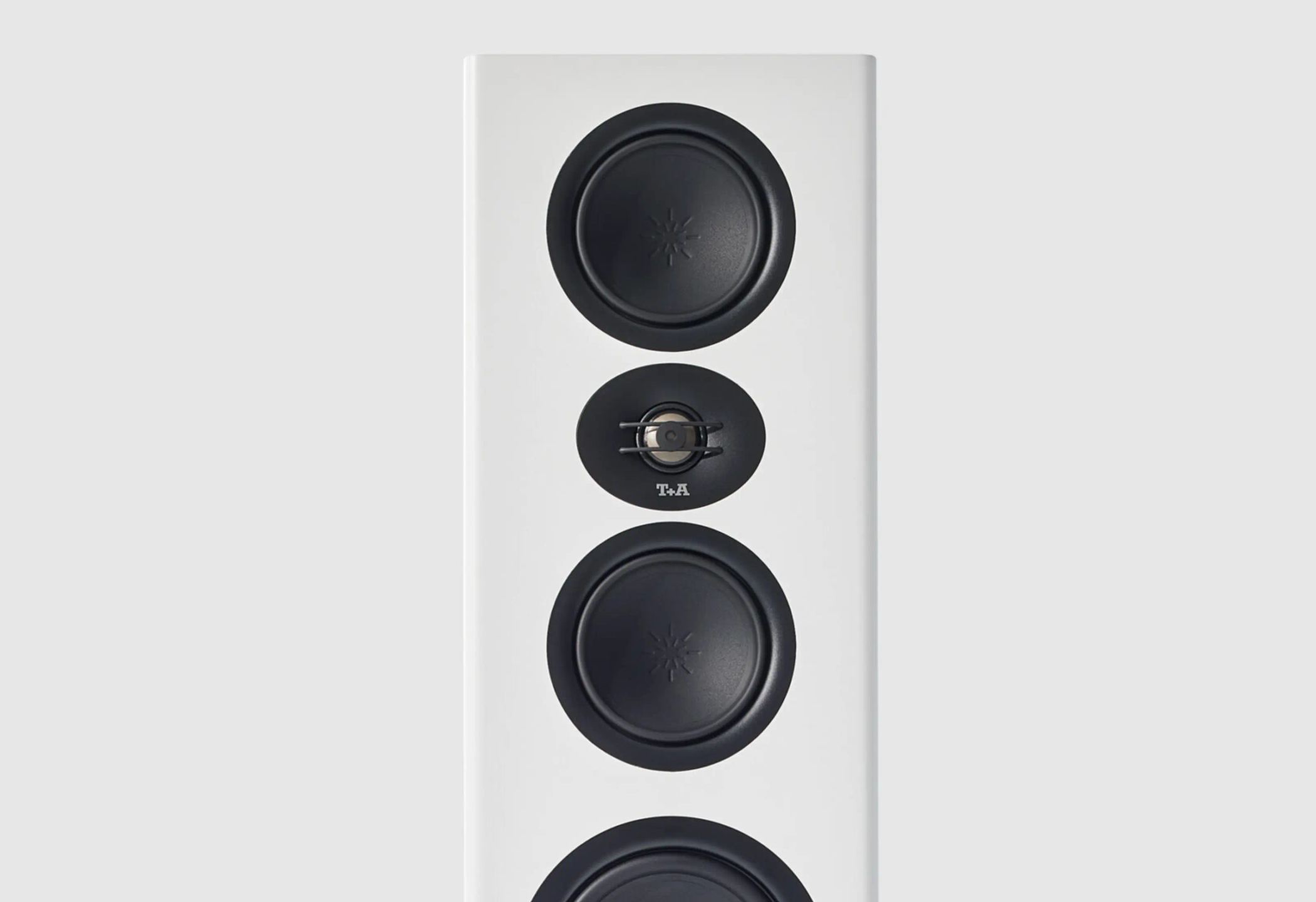
The Pulsar S 130 is a passive three-way floorstanding speaker with a bass-reflex enclosure. Its two 150 mm bass drivers operate only below 225 Hz; between 225 and 2,200 Hz, two 115 mm midrange drivers take over across the full range of the human voice, and a 25 mm tweeter handles frequencies above that. Together, they cover 32 Hz to 45 kHz. Setting the bass-to-midrange crossover this low spares the small cones the large excursions of the lower frequencies, and this is where much of the clarity of voices and solo instruments is achieved.
The four bass and midrange cones share the same StarStabilizer diaphragm, made from a material enriched with silicon powder and stiffened at its centre by a star-shaped rib. This structure prevents resonant modes from developing, where areas of the diaphragm start vibrating independently and colour the sound: the cone moves as a single unit, like a piston, even at high levels. The two 150 mm drivers have powerful motors, large voice coils and long-excursion suspensions, and the cabinet recovers the energy they radiate backwards rather than losing it, thanks to a carefully tuned bass-reflex enclosure. Reaching down to 32 Hz with a 100 × 27 × 37 cm cabinet comes down to this work on the bass.
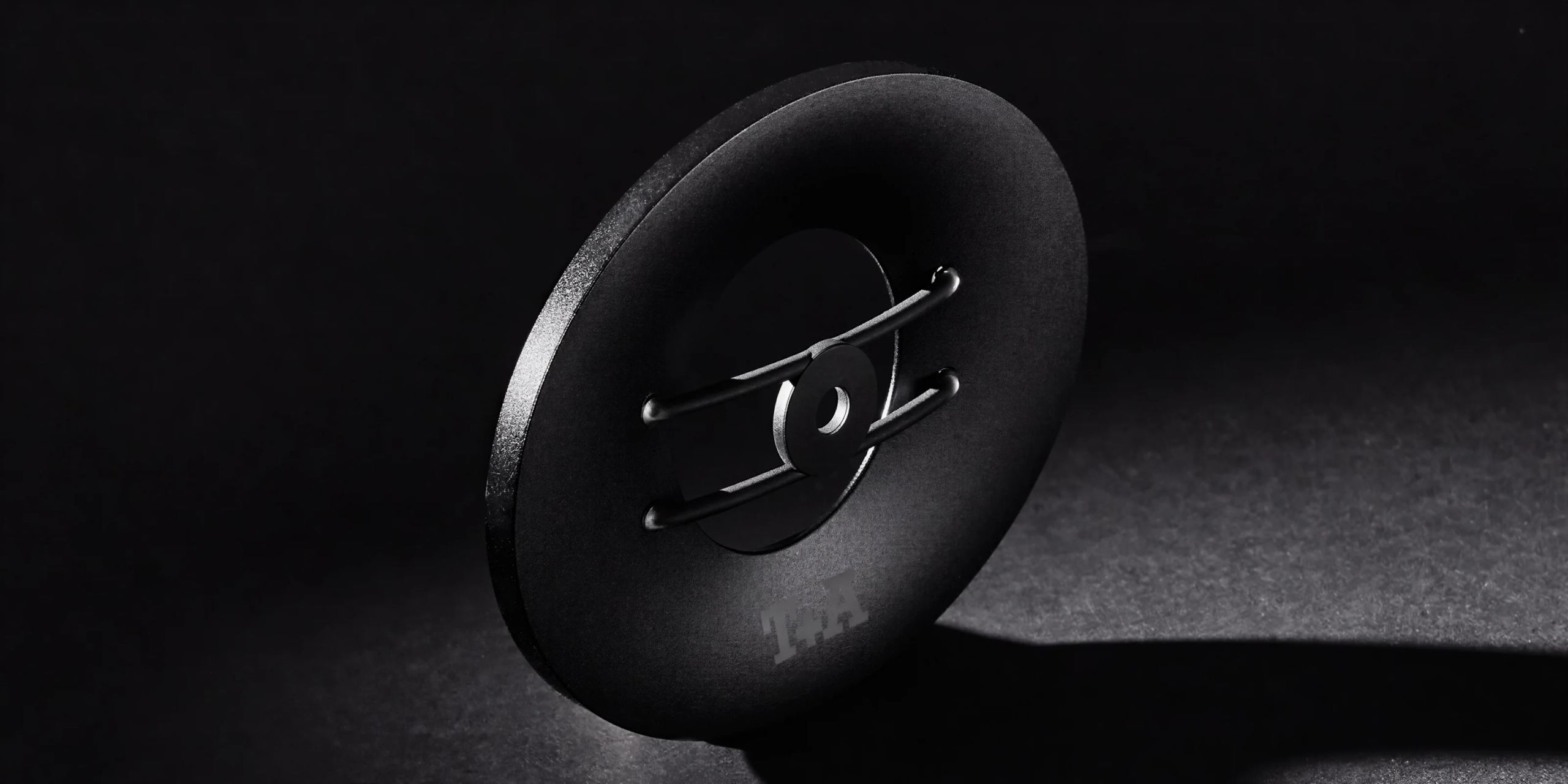
The tweeter introduces T+A’s AudiophileLinearity series. Its rigid, lightweight magnesium dome has a coating that damps the resonances that often affect metal domes at the top of the frequency spectrum, while a central diffuser evens out treble dispersion across its entire range.
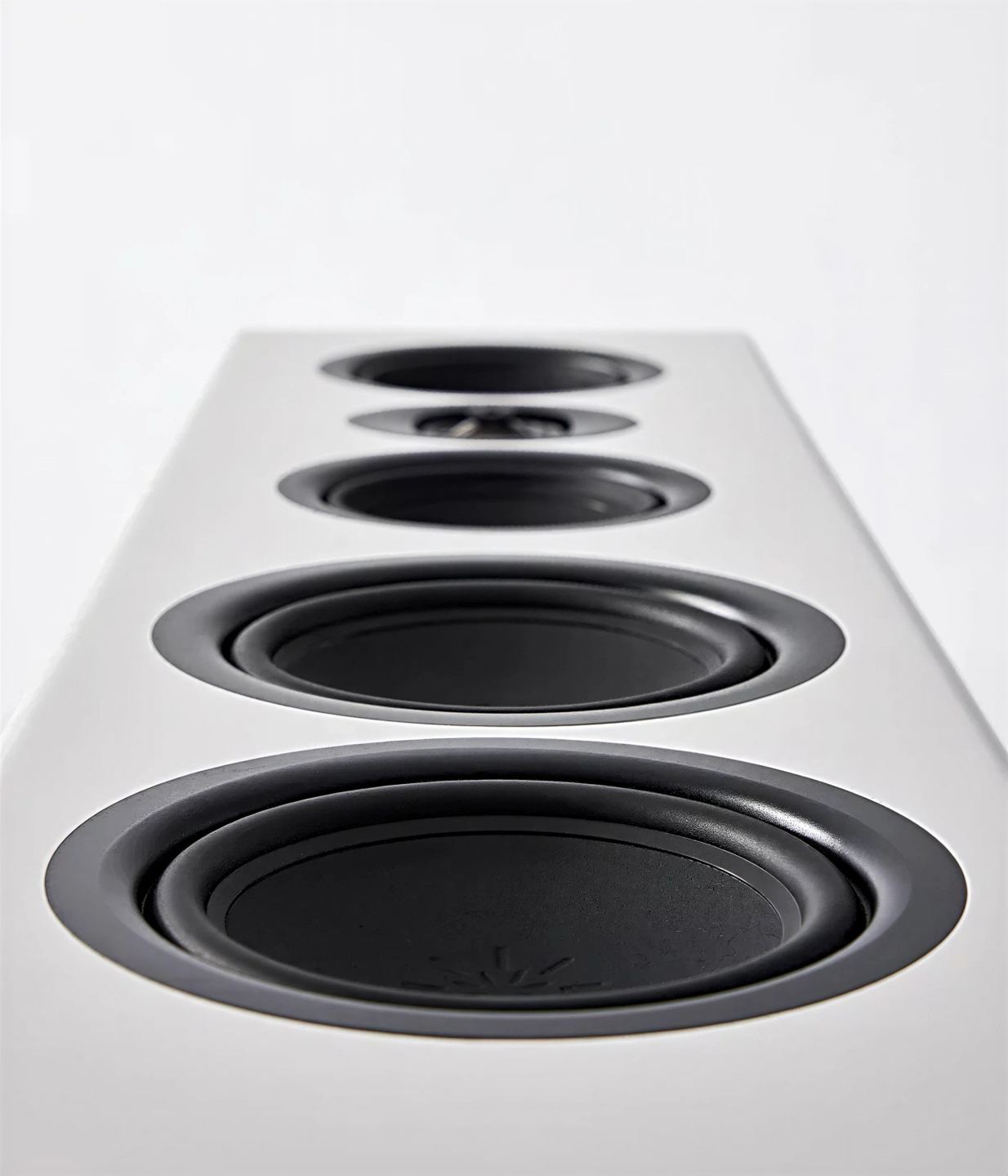
Dual midrange drivers that focus sound towards the listening area
Two midrange drivers positioned on either side of a tweeter recall the D’Appolito arrangement, but the principle is different. For such an arrangement to behave as a single source, the centres of the two midrange drivers would need to be spaced less than two-thirds of a wavelength apart at the crossover frequency: at 2,200 Hz, this would require drivers too small to reproduce a linear midrange response. Instead, T+A takes advantage of the spacing between its two 115 mm drivers and a crossover calculated accordingly. Above and below the speaker, the waves from the two midrange drivers interfere destructively, while they add together in the horizontal plane: the energy is focused vertically towards the listening area, and far less reaches the floor and ceiling.
These two surfaces are rarely treated in a living room. The sound they reflect reaches the ear with a slight delay and mixes with the direct sound, blurring timbre and instrument positioning, while a rug absorbs little more than treble. Reducing these reflections at the source makes the floorstanding speaker far less dependent on the room. The 25 mm tweeter, meanwhile, maintains broad horizontal dispersion that matches that of the midrange drivers around the crossover point, so the stereo soundstage retains its width when the listener moves along the sofa. This symmetrical directivity system, recognised for its innovation by the German federal government in 2024, is used in all T+A speaker series; the Pulsar S 130 receives a version adapted to its size.
A screw-free front baffle and Art Deco curves
The Pulsar series introduces T+A’s “Classical Modernity” design language. The curved sides visually soften the speaker’s actual bulk, and the front baffle has no visible screws or trim rings. This OrganicBaffle principle addresses a specific acoustic constraint: midrange and treble frequencies, whose wavelengths measure just a few millimetres to a few centimetres, react to the slightest edge or screw head, sources of diffraction and subtle but audible colouration. The drivers are therefore secured from inside, and the front baffle’s profile was calculated in advance to avoid obstructing dispersion.
Two finishes are available, black or white sanded lacquer, applied in several coats to combine a deep appearance with lasting durability. Each speaker weighs 22.5 kg, including the plinth and spikes.
A stable amplifier and a room with space to sit back
With a nominal impedance of 4 Ω and a sensitivity of 86 dB, the Pulsar S 130 requires electronics that are up to the task. Sensitivity expresses the sound level achieved at one metre with one watt: 86 dB remains a moderate value, and every 3 dB increase requires twice the power. An amplifier that is stable into 4 Ω, capable of delivering more than 10 A of current and with power in reserve, brings out its bass and dynamics; a model constantly pushed to its limit clips signal peaks and hardens the sound. The speaker handles 150 W of nominal power and 180 W of music power.
The listening room matters as much as the amplifier, because the listening distance must not fall below 3 m. The equilateral triangle rule between the two speakers and the listener then requires at least 3 m between the speakers, placing the Pulsar S 130 in a medium-to-large living room or listening room rather than an office. Its one-metre height places the tweeter and midrange drivers at ear level when seated in a standard chair, and angling the speakers slightly towards the listening position tightens the stereo image.
Technical specifications
Acoustic design
- Generation: 3rd generation of T+A speakers
- Acoustic principle: 3-way, Symmetric Directivity System
- Acoustic loading: bass-reflex, tuned to harness the rear energy of the woofers
- Crossover frequencies: 225 Hz, 2200 Hz
- Directivity: optimized to limit floor and ceiling reflections
- Sound philosophy: natural, neutral and uncolored reproduction
- Acoustic objective: wide soundstage, realistic depth, precise localization of instruments and voices
Drivers and technologies
- Woofers:
- Configuration: 2 × 150 mm
- Design: long excursion, powerful magnets, large voice coils
- Midrange drivers:
- Configuration: 2 × 115 mm
- Configuration: 2 × 110 mm
- Design: two drivers with reinforced magnets, covering the entire vocal range
- Tweeter:
- Configuration: 1 × 25 mm
- Design: rigid and lightweight magnesium dome, AudiophileLinearity technology
- Frequency response: up to 40 kHz
- Dispersion: Audiophile Diffuser device for uniform dispersion
- Diaphragms: StarStabilizer technology, star-shaped central reinforcement with silicon powder
Power and performance
- Power handling:
- Nominal: 150 W
- Music: 180 W
- Impedance: 4 Ω
- Frequency range: 32 – 45000 Hz
- Sensitivity: 86 dB
Design and finish
- Front baffle: OrganicBaffle technology, with no visible screw-mounted driver frames
- Finish: black or white, multilayer finish
- Design: “Classical Modernity”, Art Deco inspiration
Dimensions and weight
- Dimensions (H × W × D): 100 × 27 × 37 cm, base and spikes included
- Weight: 22.5 kg
Frequently Asked Questions
Can the Pulsar S 130 be installed near a wall?
A nearby wall reinforces the bass through reflection, eventually making it boomy and overpowering. Keeping a distance of 0.5 to 1 m from the rear wall avoids this excess. The simplest approach is to start within this range, then adjust in small increments while listening.
Are bi-wiring and bi-amping possible?
Yes, each floorstanding speaker has two sets of terminals (bass on one side, midrange/treble on the other), linked by factory-fitted jumpers. For a standard connection, a single cable per speaker is sufficient and the jumpers remain in place. For bi-wiring, two cables are run to each speaker, connected to the amplifier’s A and B outputs or in parallel to a single output. For bi-amping, one stereo amplifier powers the bass drivers of both floorstanding speakers and a second powers the midrange/treble drivers, with the signal split upstream. In these last two cases, the jumpers must be removed.
Spikes or pads: which should you choose for parquet or tile flooring?
The spikes are very sharp and can mark delicate floors: on parquet or tiles, the supplied pads are the right solution. The spikes are suited to carpet, with a protective cup if the floor requires it, and should be kept out of reach of children.
Should the grilles be removed when listening?
The grilles attach using built-in magnets, and their effect on the sound has been kept to a minimum, but the best sound reproduction is achieved without them. They mainly serve to protect the cones when the system is not playing. To remove dust, simply vacuum them gently without applying pressure, as the drivers are directly behind them.
How long does it take to break in speakers?
Allow up to around a hundred hours of operation. During this period, the diaphragms, surrounds and spiders (the parts that center the voice coil) become more flexible and reach their final performance characteristics. Listening at a moderate volume to a variety of material is sufficient.
Is a subwoofer useful with the Pulsar S 130?
In stereo, a response that extends down to 32 Hz covers almost the entire musical bass range: the lowest string of a four-string double bass is around 41 Hz. A subwoofer remains useful in home theater, where the low-frequency effects channel in films extends lower and demands high sound pressure levels.
- Eco-contribution included in the sale price.