T+A PA 2000R silver



Overview
A chassis just 8.2 cm tall, 200 watts per channel into 4 ohms and fully analogue electronics: the R series integrated amplifier brings the solutions T+A developed for its high-end HV line into a compact format. Built in a dual-mono configuration in Herford, Germany, it doesn’t try to do everything. It amplifies the sources you give it, with fine adjustments and carefully chosen connections.
Two independent amplifiers in a single chassis
The PA 2000 R follows the dual-mono principle: the left and right channels are kept separate right down to their mechanical construction and sit on identical boards, so that both channels sound exactly the same. These two boards carry the input stage, the volume control, the voltage amplifier and the current stage. They occupy the right half of the chassis, where the massive heatsink isolates them from the mains power supply and the output stage.
The input stage comes straight from the HV series. It is a cascode differential amplifier, a circuit in which stacked transistors stabilise operation, built around hand-selected J-FET transistors. Everything is made from discrete components, with no integrated operational amplifiers. This linearity reduces the need for global negative feedback almost to zero; this technique feeds part of the output signal back to the input to correct circuit errors. The preamplifier accepts signals of up to 60 V peak-to-peak without distortion, and its bandwidth extends from 0.5 Hz to 300 kHz. The voltage amplifier and the current stage that follows it are galvanically isolated from each other: the currents flowing through the speakers cannot travel back to the sensitive stages.
A power supply that holds up under demanding speakers
Power increases as impedance drops: 2 × 100 W into 8 ohms, 2 × 200 W into 4 ohms and 2 × 300 W into 2 ohms. This doubling between 8 and 4 ohms is the sign of a power supply that doesn’t falter when the speaker demands current. For the R series, T+A developed a new mains power supply that remains stable under heavy load, even during very high peaks. It is backed by 60,000 µF of filter capacitors, energy reservoirs that deliver the current for brief transients, such as a kick drum hit. The output stages, also new, operate with very little negative feedback.
The damping factor, greater than 65, measures the amplifier’s ability to stop the bass driver’s cone once the signal has passed, which prevents bass from dragging. The slew rate of 60 V/µs indicates its ability to follow rapid changes in the signal. With a response of 1 Hz to 150 kHz for the power stage, the headroom far exceeds what music requires. A protection circuit monitors for short circuits, overheating and clipping. When clipping occurs, the amplifier lowers the volume on its own, a safety feature that can be disabled in the menu.
Relay-based volume control and reversible tone controls
Volume and input selection are handled by sealed relays with gold-plated contacts. Being gas-tight, they are immune to dust, corrosion and ageing. The volume control combines these bistable relays with discrete precision resistors. It moves in 1 dB steps, with exact matching between the two channels and none of the slight imbalance that conventional potentiometers often show at low levels. The relays are integrated directly into the circuit, which shortens the signal path between the input sockets and the preamplifier boards.
Bass and treble can be adjusted from −6 to +8 dB, together or separately for each channel. This flexibility comes in handy when the two speakers are not placed in the same conditions, one near a corner and the other in open space. The FLAT button uses a relay to bypass the entire tone section and delivers a perfectly linear response. Physiological correction, or loudness, boosts bass and treble at low volume to compensate for the ear’s reduced sensitivity. It can be set to three levels, chosen according to the speakers’ efficiency and the size of the room. A table in the manual indicates the right setting, and listening lets you fine-tune it until you get the same balance at low and high levels.
Six analogue inputs and a phono option
The rear panel features three balanced XLR inputs and three unbalanced RCA inputs. A balanced connection carries the signal over two conductors in opposite phase, which cancels out interference picked up along the way. It makes sense with a source equipped with true XLR outputs or over long cable runs. All sockets are made from non-magnetic materials, with hard gold contacts. They are screwed onto a solid aluminium rear panel.
The fourth input, in RCA format, can accommodate an optional phono preamplifier module. It is available in moving magnet (MM) or moving coil (MC) versions, with two distinct circuits optimised for each type of cartridge. The MM module offers 16 capacitance values for cartridges from 1 to 5 mV. The MC module offers 16 impedance values for cartridges from 60 to 1,000 µV. This lets you precisely match the load to the cartridge fitted to your turntable. A grounding terminal accepts the turntable’s ground wire.
On the output side, a pair of terminal blocks accepts one set of speakers. The RCA preamp output (1 V nominal, 9.5 V maximum) feeds a power amplifier or active speakers. The front-panel headphone jack accepts headphones of at least 50 ohms. Plugging in headphones automatically mutes the speakers and the preamp output, unless you switch to manual mode.
The PA 2000 R remains a fully analogue amplifier: it has no digital input, no HDMI, no Bluetooth and no network playback. A TV, computer or streaming services connect via a DAC or a network player with analogue outputs.
A place in a home cinema or smart home
Input 3 (XLR) or input 5 (RCA) can be switched to Surround Pass Through mode. The amplifier then handles the front left and right channels of a multichannel system controlled by a processor or AV receiver. The level of this input is stored separately, as are the balance, loudness and FLAT settings. The volume only changes after a press of the button, which prevents upsetting the balance between the front channels and the rest of the system. The display then shows “SR” instead of the level.
One of the two R2-Link sockets serves as a trigger input via an adapter cable. A voltage of 5 to 20 V sent by the processor switches the amplifier on to the correct input, and its removal switches it off after 30 seconds. The R2-Link sockets also connect compatible T+A sources, which can then be controlled with the SRC 1 remote. A LAN network port is used for diagnostics and for control by home automation systems such as Crestron or AMX.
A slim anodised aluminium chassis
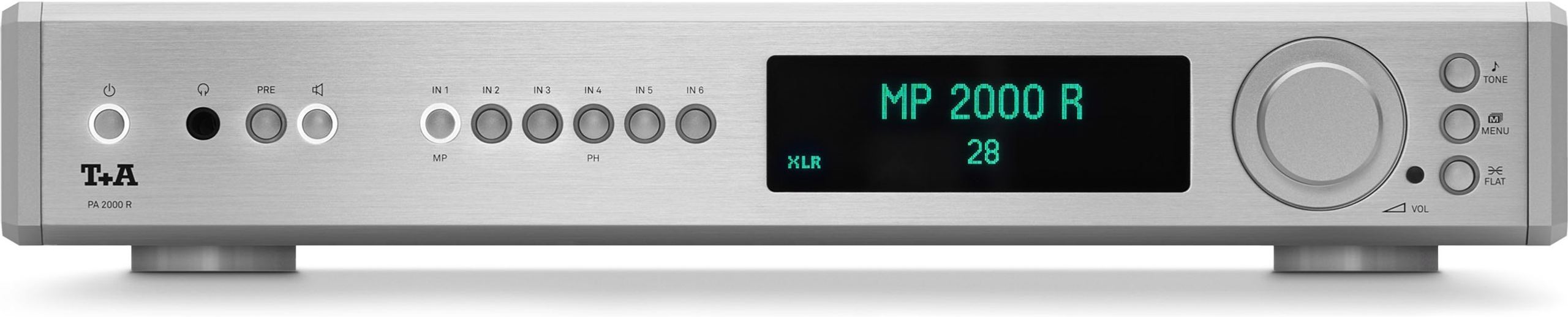
At 8.2 cm high, 46 cm wide and 40 cm deep, the PA 2000 R fits into a standard hi-fi cabinet, provided you leave 10 cm of free space all around for ventilation. When stacked with other components, it goes on top. The chassis, made entirely from high-purity non-magnetic metals, is available in brushed silver or black anodised aluminium and weighs 10.5 kg.
The graphic display shows the source and volume in large characters, or adds a VU meter. Its brightness is adjustable, and it can switch off between operations. The front-panel buttons light up in white or in colour depending on their status. Each input can be given a custom name, entered using the remote control’s keypad.
Documentation
Technical specifications
Type and power
- Type: stereo integrated amplifier
- Output power:
- 2 × 100 W into 8 Ω
- 2 × 200 W into 4 Ω
- 2 × 300 W into 2 Ω
Audio performance
- Frequency response:
- Preamplification: 0.5 Hz – 300 kHz (+0 / −3 dB)
- Amplification: 1 Hz – 150 kHz (+0 / −3 dB)
- Signal-to-noise ratio: 105 dB unweighted, 109 dB A-weighted
- Channel separation: > 90 dB
- Total harmonic distortion:
- Preamplification: < 0.001%
- Power stage: < 0.02%
- Preamplification intermodulation distortion: < 0.001%
- Slew rate: 60 V/µs
- Damping factor: > 65
- Filter capacitance: 60000 µF
Audio inputs and outputs
- High-level RCA inputs: 3 × 250 mV to 4 V RMS / 20 kΩ
- Balanced XLR inputs: 3 × 500 mV to 8 V RMS / 5 kΩ
- Optional phono inputs:
- Moving magnet (MM): 1 to 5 mV, 16 capacitances
- Moving coil (MC): 60 to 1000 µV, 16 impedances
- RCA preamplifier output: 1 V RMS nominal / 9.5 V RMS maximum, 75 Ω
- Headphone output: 50 Ω
Audio settings and modes
- Tone controls: bass and treble, separate for each channel
- Bass adjustment range: −6 to +8 dB
- Treble adjustment range: −6 to +8 dB
- Loudness compensation: switchable, adjustable according to speaker efficiency
- Tone control / loudness compensation bypass: yes
- Multichannel pass-through mode: yes
Control and accessories
- Trigger input: +5 to +20 V via adapter
- Control interface: R2-Link
- Remote control: SRC 1
Power supply and consumption
- Power supply: 100–120 V or 200–240 V, 50/60 Hz
- Maximum power consumption: 1000 W
- Standby power consumption: < 0.5 W
Dimensions and weight
- Dimensions (height × width × depth): 8.2 × 46 × 40 cm
- Weight: 10.5 kg
Frequently Asked Questions
What is the difference compared to the PA 2500 R?
The two integrated amplifiers in the R series share the same construction, circuit design, components and subassemblies. The PA 2500 R stands out with higher power output, different connectivity and a larger chassis. The PA 2000 R is the slimline version of the series.
Can you connect 2-ohm speakers to it?
Not speakers with a nominal impedance of 2 ohms. Each speaker must have an impedance of at least 4 ohms according to the DIN standard, meaning an actual minimum above 3.2 ohms. The power rating into 2 ohms indicates the current reserve available when the impedance of a 4-ohm speaker briefly dips, which often happens in the bass range.
Can the phono module be added after purchase?
Yes. The PHE-P/PA R module plugs into the unit and replaces input 4. Installing it requires opening the casing, a task reserved for a qualified technician: the easiest option is to have the dealer handle it. Choose the MM or MC version according to the cartridge used.
How do I connect a TV?
If the TV has an analog audio output, it connects directly to an RCA input. Otherwise, its optical or HDMI eARC output goes through an external converter, which is connected to the PA 2000 R via RCA or XLR.
Why are faint clicks heard when adjusting the volume?
The gold-contact relays switch the resistors at each 1 dB step. This mechanical noise comes from inside the casing and accompanies the normal operation of the volume and balance controls.
How is the software updated?
The update is performed through a T+A MP 2000 R multi-source player connected to the PA 2000 R. This player retrieves the file from the Internet or a USB flash drive.
Does the amplifier go into standby automatically?
Yes. In Europe, it switches to standby after 90 minutes without a music signal or user input. A message appears two minutes beforehand: simply confirm it to keep the amplifier on. In standby, it consumes less than 0.5 W and can be switched back on using the remote control or a trigger signal.
Which remote control is included?
The amplifier comes with the SRC 1, an infrared remote control with a range of around 4 to 5 m that runs on three LR03 batteries. Its alphanumeric keypad is used to name the inputs. It also controls T+A sources connected via R2-Link. The brand’s metal FM 2000 remote control is also supported, with direct source selection buttons.
- Eco-contribution included in the sale price.