T+A Criterion S240 lacquered black (pack of 2)


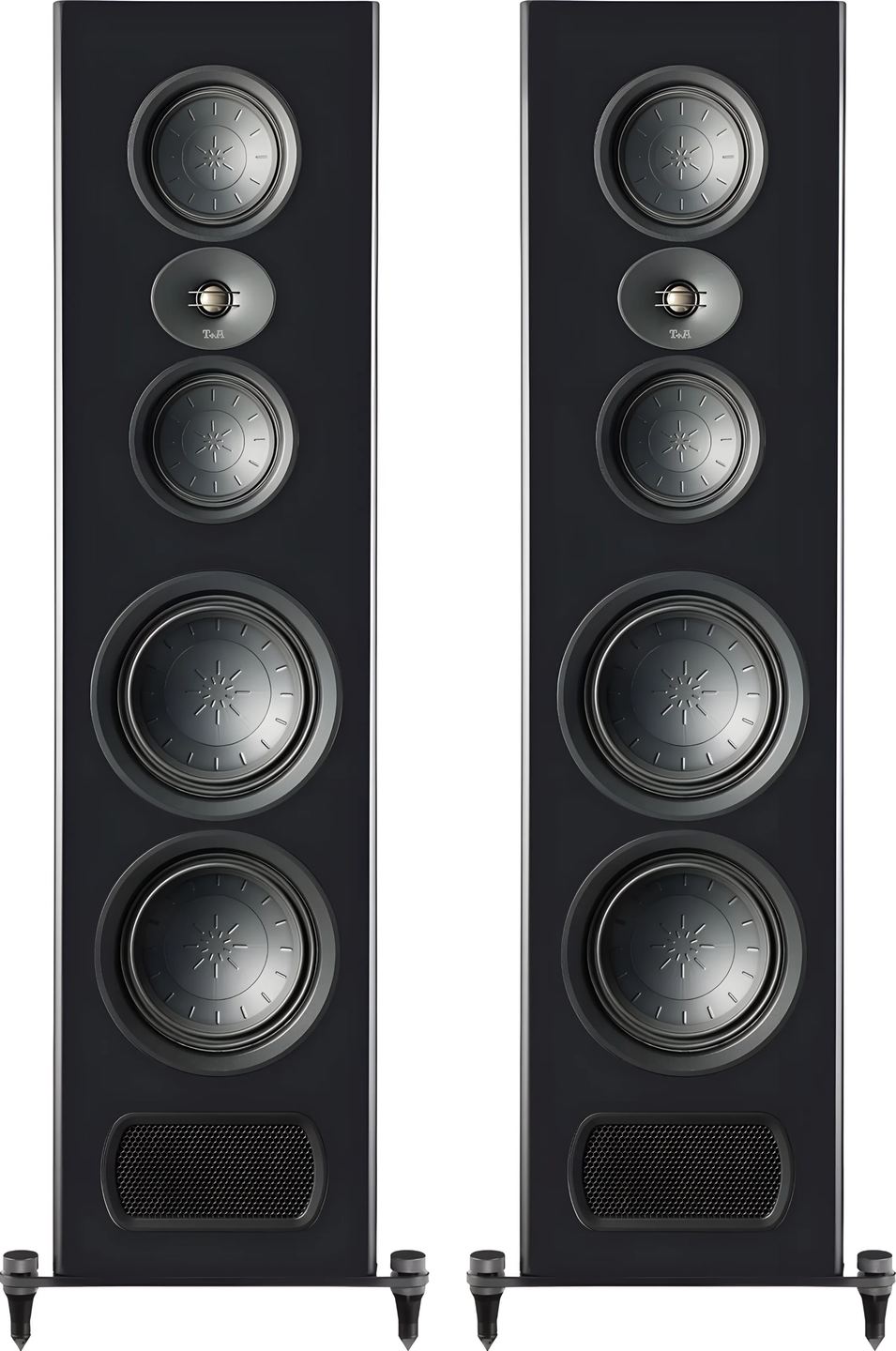
T+A Criterion S240: the large transmission-line floorstanding speaker
Achieving very deep bass without placing a bulky cabinet in the middle of the living room: the transmission line has long been T+A’s answer to this problem, and this three-way floorstanding speaker made in Herford uses its latest version. It adopts the midrange and treble system from the Solitaire reference series, in a cabinet with curved sides that make its 123-centimetre height less imposing. It is the larger of the two floorstanding speakers in the Criterion S series.
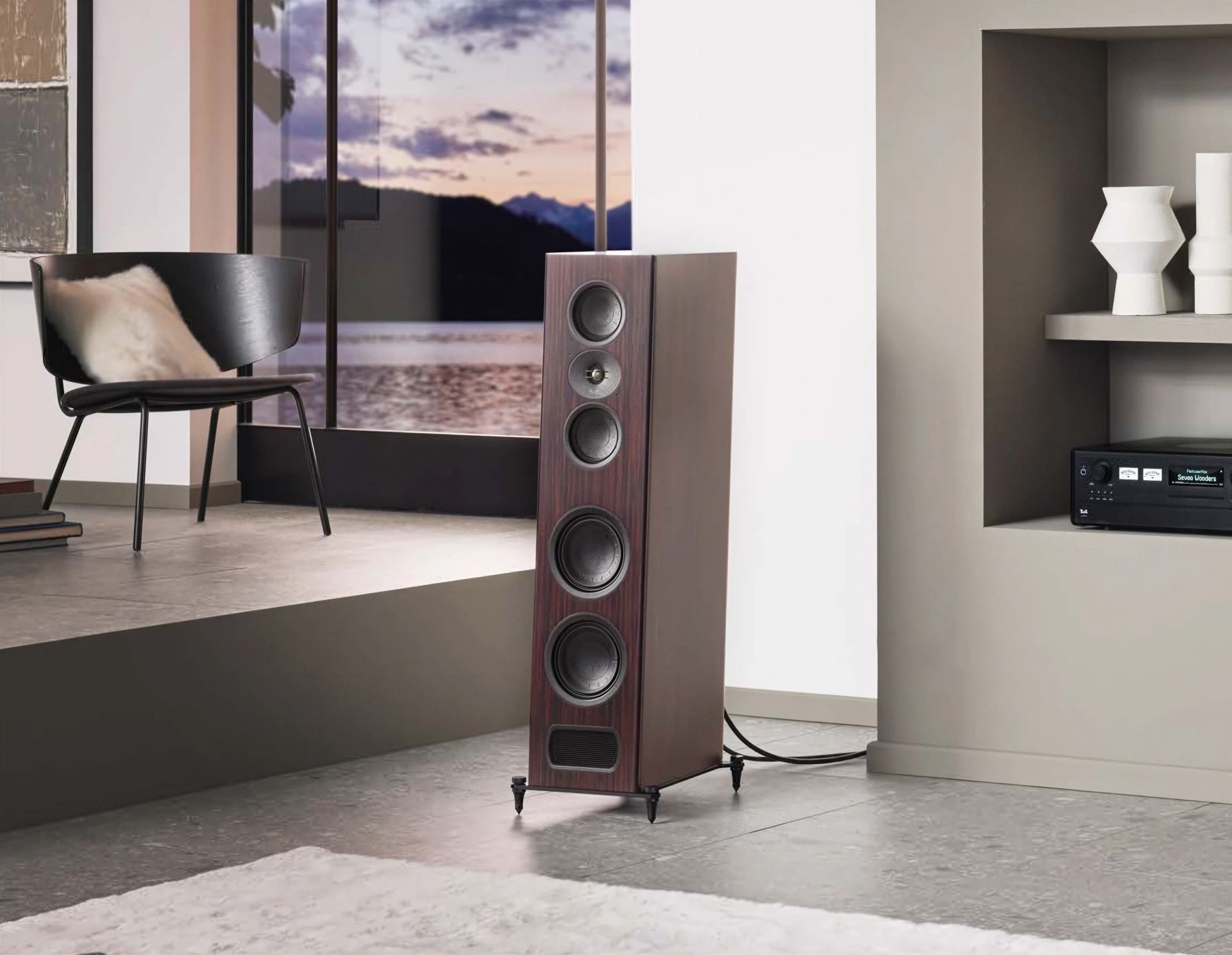
Bass loaded by a folded transmission line
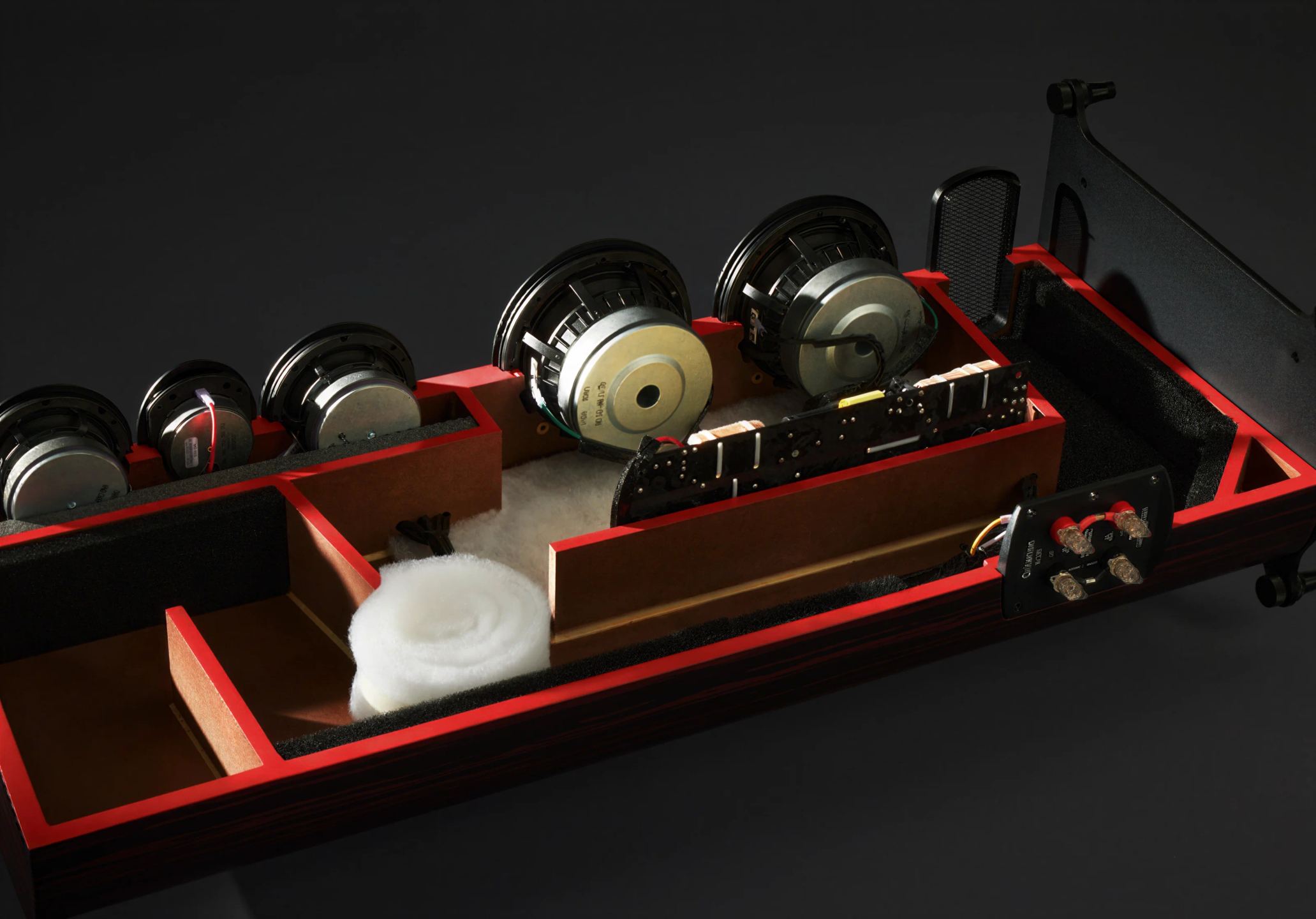
In a conventional speaker, the sound wave emitted from the rear of the bass drivers is either damped inside a sealed cabinet or redirected through a bass-reflex port. A transmission line guides it through a long, precisely calculated duct, tuning it to the front wave before releasing it. On the Criterion S240, this duct takes the form of a multi-resonator structure folded against the internal rear wall. Its dimensions are calculated so that the standing waves formed inside reinforce acoustic pressure at the bottom of the frequency range rather than dissipating within it. The line exits at the front, beneath the bass drivers, and the stated frequency response extends down to 26 Hz.
Two 220 mm bass drivers feed this line. Their baskets are made from die-cast aluminium, and their resonant frequency is tuned to that of the duct. Powerful motors, large voice coils and long-excursion surrounds enable them to deliver high output levels in the deepest bass. The internal walls also stiffen the cabinet and limit the spread of vibrations through the structure. This abundant bass has a downside in small or highly reverberant rooms: it can become overpowering. The supplied absorbers help moderate it, while distance from the rear wall remains another means of adjustment.
Two symmetrical midrange drivers around a magnesium tweeter
Everything above 170 Hz is handled by a group of three drivers: two 150 mm midrange drivers positioned symmetrically above and below a 25 mm tweeter. T+A calls this arrangement Symmetric Directivity and first introduced it on the Solitaire S 430. The two midrange drivers share the work, so each diaphragm moves half as far as a single diaphragm would, resulting in lower distortion. Their control by the crossover also narrows vertical dispersion. Direct sound converges on the listening area, with less energy directed towards the ceiling and floor. These surfaces usually reflect sound in ways that blur the positioning of voices and instruments. With a low crossover point of 170 Hz, the midrange drivers handle the entire vocal range without sharing it with the bass drivers. This focus imposes a placement requirement: there must be at least 3 m between the speakers and the listening position for the five drivers to blend into a single source.
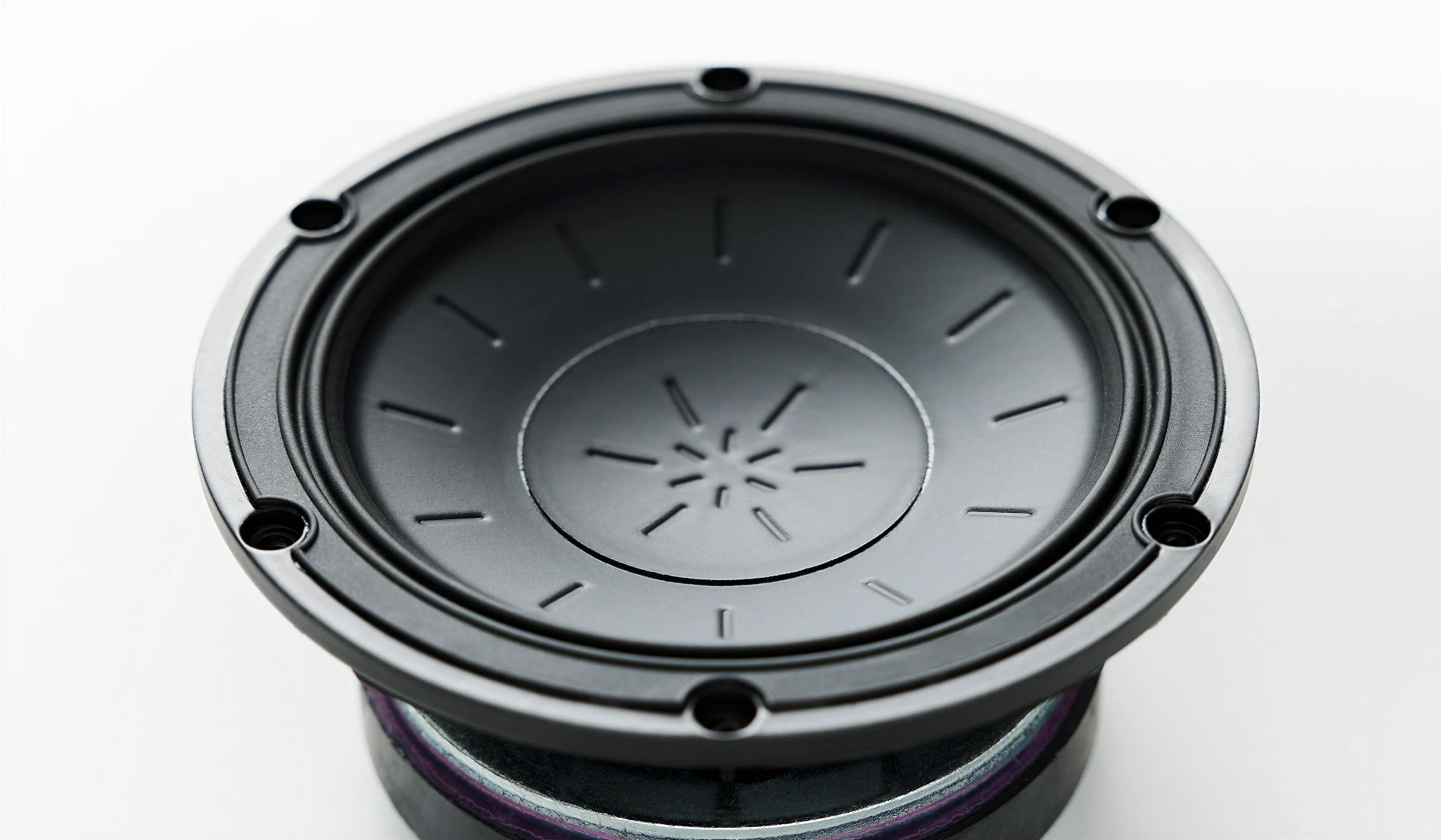
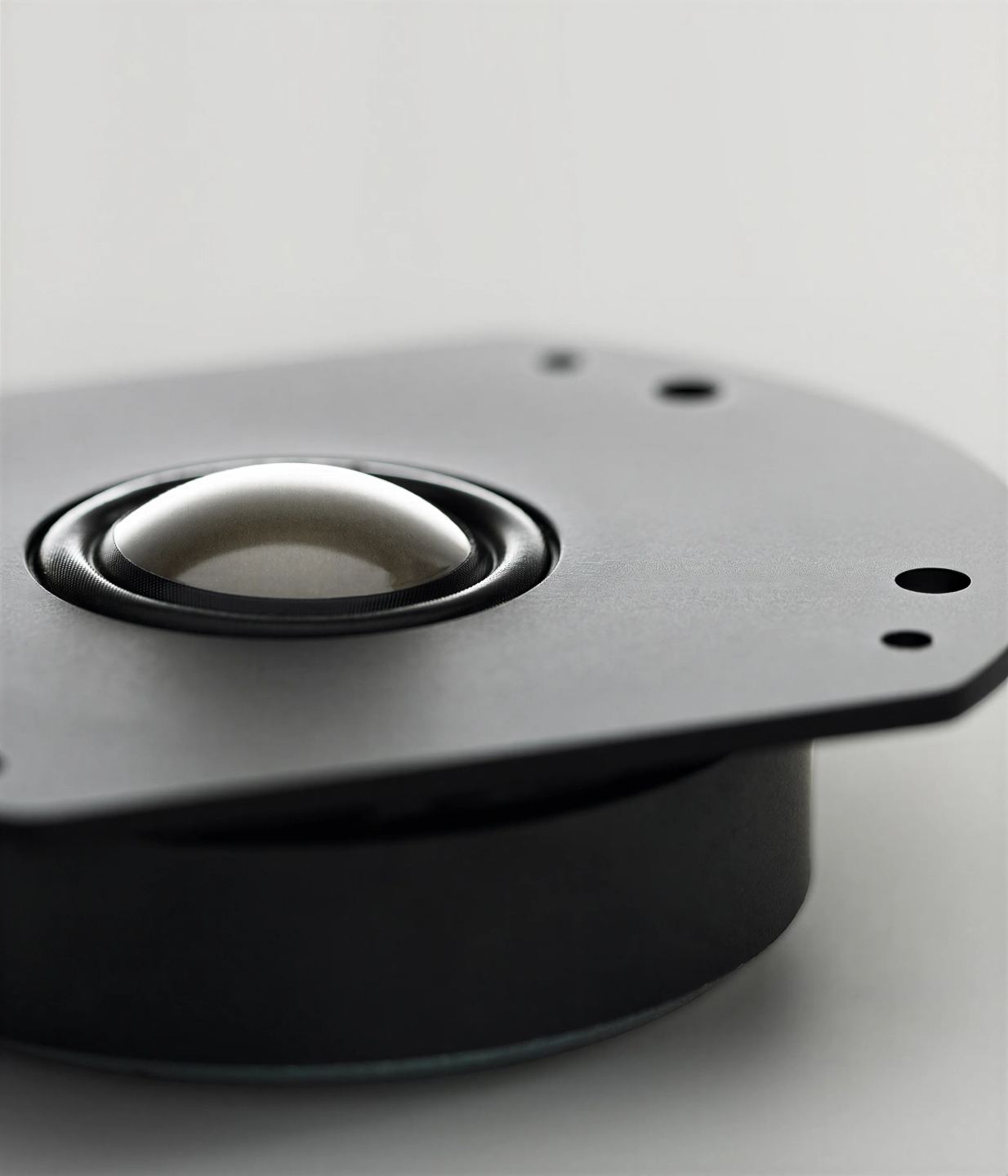
The tweeter diaphragm is made of magnesium, a metal that is both very rigid and very light. Metal tweeters tend to resonate in the highest treble frequencies, and T+A treats this diaphragm with a special coating to eliminate these resonances. The tweeter and midrange drivers occupy sealed chambers isolated from the transmission line: the air pressure inside the duct does not disturb their diaphragms. All cones receive the StarStabilizer treatment, which combines a calculated cone profile with a star-shaped stiffener stamped into the centre. The aim is to prevent the diaphragm from deforming into sections that each vibrate independently (“breakup modes”). It therefore continues to move as a single unit, like a piston, even at high output levels.
A screw-free front baffle in a curved cabinet
At the highest frequencies, wavelengths measure just a few millimetres or centimetres. A screw head, the edge of a driver basket or a sharp baffle edge is then enough to diffract sound and slightly colour the treble. The Criterion S240’s OrganicBaffle is secured from the inside, with no visible screws, and its profile has no sharp edges. The cabinet follows T+A’s “Classic Modernity” design language, with distinctly curved sides inspired by Art Deco. These curves visually slim the floorstanding speaker and soften the bulk of its 38 cm width and 50 cm depth. The finishes are applied in several successive coats. Removable magnetic grilles cover the front when concealing the drivers is preferred.
Separate crossover boards for bass and midrange/treble
The three-way FSR (Fast Signal Response) crossover is built on double-sided printed circuit boards. A dedicated ground layer handles high currents and brief pulses without distortion. The stages have been tuned to control phase and group delay, meaning the time offset between different frequencies. The bass and midrange/treble sections have entirely separate boards. The dual binding posts, made from nickel-free brass with hard gold plating, can therefore accept two pairs of cables (bi-wiring) or connect to two separate amplifiers (bi-amping).
With a nominal impedance of 4 Ω and a sensitivity of 88 dB, the Criterion S240 is not particularly demanding in terms of power, but it does require current. An amplifier that is stable into 4 Ω and capable of supplying more than 10 A is suitable. The 250 W nominal and 380 W music power ratings indicate the power it can handle, not what it needs. An integrated amplifier with moderate power and a robust power supply will drive it better than a very powerful unit that struggles as soon as the impedance drops.
Installing and adjusting the floorstanding speaker in the room
Each speaker rests on four reversible feet: one side forms an isolation spike for carpet or hard flooring, while the other is a pad that protects parquet or delicate tiles. An assembly tool is supplied for the spikes. At 55 kg per speaker, installation is a two-person job. It is best to find the final position before screwing in the spikes. The speakers achieve their balance between 0.5 and 1 m from the rear wall, and the minimum listening distance of 3 m points towards a good-sized room.
Technical specifications
Model and design
- Type: passive floorstanding speaker
- Acoustic principle: 3-way transmission line
- Manufacturer: T+A elektroakustik, Herford (Germany)
Acoustic loading and directivity
- Bass loading: MultiResonator Transmissionline transmission line
- Folded structure along the internal rear panel
- Front bass outlet, below the woofers
- Bass adjustment: absorbers to be placed in the transmission line outlet
- Attenuation: 2 to 3 dB
- Intensity adjustable according to the absorber position
- Midrange-treble system: Symmetric Directivity, derived from the Solitaire series
- Two midrange drivers positioned symmetrically above and below the tweeter
- Focuses direct sound toward the listener and limits reflections from the ceiling, floor and walls
- Internal isolation: tweeter and midrange drivers housed in sealed chambers separate from the transmission line
- Front baffle: OrganicBaffle, mounting with no visible screws and an edgeless profile
Drivers
- Bass: 2 × 220 mm
- Midrange: 2 × 150 mm
- Treble: 1 × 25 mm, magnesium dome
- Driver technology: Star Stabilizer
Acoustic and electrical performance
- Power handling:
- Nominal: 250 W
- Music: 380 W
- Impedance: 4 Ω
- Frequency response: 26 to 45000 Hz
- Sensitivity: 88 dB
- Crossover frequencies: 170 Hz, 1800 Hz
- Recommended amplification: amplifier stable into 4 Ω, current capability greater than 10 A
Connections
- Dual binding posts:
- Hard gold-plated brass, nickel-free
- Compatible with bi-wiring and bi-amping
Installation and placement
- Combination feet: 4 per speaker, usable as isolation spikes or pads for delicate floors
- Recommended listening distance: 3 m minimum
- Recommended distance from the wall: 0.5 to 1 m
Box contents and included accessories
- Speakers: 2
- Grilles: 2, magnetic and removable
- Spike / pad feet: 8
- Spike installation tool: 1
- Transmission line port removal tools: 2
- Bass absorbers: 2
- Jumpers for single wiring
- Documentation: warranty card, manual
Dimensions and weight
- Dimensions (H × W × D): 123 × 38 × 50 cm, including base and feet, with isolation spikes
- Weight: 55 kg per speaker
Frequently Asked Questions
What are the differences compared to the Criterion S230?
Both floorstanding speakers share the multi-resonator transmission line, Symmetric Directivity system, magnesium tweeter and OrganicBaffle front baffle. The S240 uses larger drivers: 220 mm instead of 170 mm for the bass, 150 mm instead of 120 mm for the midrange. It extends down to 26 Hz versus 29 Hz, gains 1 dB in sensitivity (88 dB versus 87 dB) and has lower crossover frequencies (170 and 1800 Hz versus 200 and 2000 Hz). It stands 123 cm tall and weighs 55 kg, compared with 105 cm and 37.5 kg for the S230. The additional volume and larger cones give it more headroom in the bass and at high levels, which is useful in a spacious living room.
What are the supplied bass absorbers for?
They fit into the transmission line outlet on the front panel and reduce the bass by 2 to 3 dB. The effect varies depending on their position in the opening, allowing the bass level to be fine-tuned to the room. Two tools are supplied to remove the piece that closes off the port and access the outlet. They are used when the bass becomes boomy, for example if the speakers need to stay close to a wall or if the room is small.
Is bi-wiring mandatory?
No. Jumpers are supplied to connect the two pairs of terminals and connect the speaker using a single cable. Bi-wiring and bi-amping remain possible, since the bass and midrange/treble crossovers are physically separate. In this case, the jumpers must be removed before connecting the two cables or the two amplifiers.
Should I leave space behind the speakers?
The transmission line opens at the front: no rear port blows against the wall. A distance of 0.5 to 1 m is still recommended, because proximity to a wall always reinforces the bass. The closer the speaker is to the wall, the more likely absorbers are to be useful.
Can these floorstanding speakers be used with a home theater amplifier?
Yes, as front left and right speakers, provided the amplifier supports 4 Ω speakers and has current in reserve for these two channels. Many home theater amplifiers are set to 6 or 8 Ω by default and offer an impedance setting in their menu, which should be checked before connecting. The S240’s extended bass response also allows the front channels to be set to “large speaker” mode rather than sending the entire low end to the subwoofer.
What finishes are available?
Four finishes are available: black lacquer, white lacquer, arctic silver and Macassar wood veneer. The veneer highlights the wood grain, while the lacquer finishes give the curved cabinet a more sculptural appearance.
What's in the box?
Each box contains a pair of speakers with their two magnetic grilles and eight reversible feet (spikes or pads). Also included are the spike installation tool, two port removal tools, two bass absorbers, single-wiring jumpers, the manual and the warranty card.
- Eco-contribution included in the sale price.